
Acids and bases: pH scale, alkalis and indicators
What this lesson covers
- How acids and bases differ, and why both can be dangerous
- Common acids and the main types of base
- What makes a base an alkali
- The pH scale from 0 to 14
- How litmus and universal indicator show acidity
- Matching pH to everyday uses
Two groups with opposite properties
- Acids and bases are two families of substances that behave in opposite ways.
- When an acid and a base are mixed in the right amounts they cancel each other out, a reaction called neutralisation.
- Acids often taste sour, like lemon juice and vinegar.
- Bases often taste bitter, like baking soda, and solutions of them feel slippery or soapy on skin.
- Strong acids and strong bases are both corrosive, meaning they damage skin, eyes and other materials. In the lab you never taste or touch a chemical to identify it.
Common acids
- Three acids turn up again and again in labs and industry.
- Weaker acids are found in food: citric acid in citrus fruit, ethanoic acid in vinegar, and carbonic acid in fizzy drinks.
| Acid | Formula | Where you meet it |
|---|---|---|
| Hydrochloric acid | HCl | Your stomach makes it to help digest food; cleaning concrete and bricks |
| Sulfuric acid | H₂SO₄ | Car batteries; making fertilisers |
| Nitric acid | HNO₃ | Making fertilisers and explosives |
Types of base, and which ones are alkalis
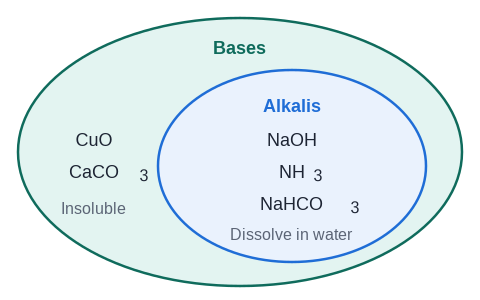
- Most bases belong to a few types: metal oxides, metal hydroxides, metal carbonates, metal hydrogencarbonates (bicarbonates) and ammonia.
- A base that dissolves in water is called an alkali, and its solution has a pH above 7.
- So every alkali is a base, but not every base is an alkali: copper oxide and calcium carbonate are bases that barely dissolve.
- Insoluble bases still neutralise acids, which is why farmers spread ground limestone on acidic paddocks.
| Type of base | Example | Dissolves in water? | Use |
|---|---|---|---|
| Metal oxide | Copper(II) oxide, CuO | No, so not an alkali | Making copper salts in the lab |
| Metal hydroxide | Sodium hydroxide, NaOH | Yes, an alkali | Drain and oven cleaners |
| Metal carbonate | Calcium carbonate, CaCO₃ | No, so not an alkali | Agricultural lime, antacid tablets |
| Bicarbonate | Sodium hydrogencarbonate, NaHCO₃ | Yes, a weak alkali | Baking soda |
| Ammonia | NH₃ | Yes, an alkali | Household glass cleaners |
The pH scale
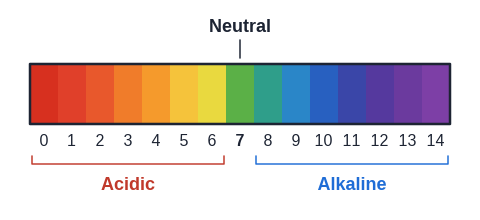
- PH is a number, usually from 0 to 14, that says how acidic or alkaline a solution is.
- A solution under 7 is acidic, one at exactly 7 is neutral, and one over 7 is alkaline.
- The lower the pH, the more acidic the solution; the higher it is above 7, the more alkaline.
- Each step of 1 on the scale is a tenfold change, so pH 3 is ten times more acidic than pH 4.
| pH (about) | Substance | Type |
|---|---|---|
| 1 | Stomach acid | Strongly acidic |
| 2 | Lemon juice | Acidic |
| 3 | Vinegar | Acidic |
| 5 | Black coffee | Weakly acidic |
| 7 | Pure water | Neutral |
| 8 | Sea water around NZ | Weakly alkaline |
| 9 | Baking soda solution | Alkaline |
| 11 | Ammonia cleaner | Alkaline |
| 13 to 14 | Drain cleaner | Strongly alkaline |
How much more acidic?
- Some geothermal lakes near Rotorua, such as Inferno Crater at Waimangu, are about pH 2. Black coffee is about pH 5. How many times more acidic is the lake?
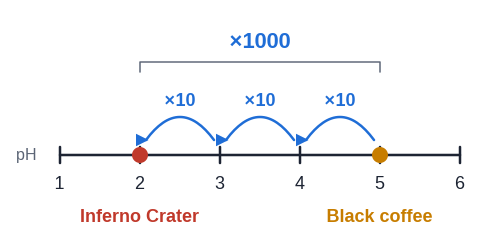
- 5 − 2 = 3 steps on the pH scalefind the gap
- 10 × 10 × 10 = 1000each step is a factor of 10
- The lake is about 1000 times more acidic than black coffee
Indicators: colour tells you pH
- An indicator is a dye that changes colour depending on whether it is in an acid or an alkali.
- Litmus comes as paper strips. Blue litmus turns red in an acid; red litmus turns blue in an alkali; in a neutral solution neither changes.
- Litmus only says acid or alkali, not how strong.
- Universal indicator is a mixture of dyes that shows a different colour at each part of the scale, so you match the colour against a chart to read an approximate pH.
- The exact shades differ a little between brands, so always use the chart that comes with the bottle.
| pH | Universal indicator colour | Meaning |
|---|---|---|
| 0 to 2 | Red | Strong acid |
| 3 to 4 | Orange | Acid |
| 5 to 6 | Yellow | Weak acid |
| 7 | Green | Neutral |
| 8 to 9 | Blue-green to blue | Weak alkali |
| 10 to 11 | Blue to indigo | Alkali |
| 12 to 14 | Violet | Strong alkali |
Try it: indicators and the pH scale
Choosing the right way to measure pH
- Pick the method by the question you need to answer.
- If you only need to know acid or alkali, litmus is quick and cheap.
- If you need a rough pH number, use universal indicator, but it is hard to read in a solution that already has a strong colour, such as blackcurrant juice.
- If you need an exact value, for example checking a swimming pool or soil for a crop, use a calibrated pH meter.
| Method | Tells you | Good for | Weakness |
|---|---|---|---|
| Litmus paper | Acid, neutral or alkali | Quick sorting | No number |
| Universal indicator | pH to about 1 unit | Comparing strengths | Hard to read in coloured liquids |
| pH meter | pH to 0.1 or better | Accurate measurement | Costs more, needs calibrating |
Linking pH to uses
- Antacid tablets contain weak bases such as calcium carbonate, which neutralise extra stomach acid without harming the stomach lining.
- Drain cleaners are strongly alkaline (pH 13 or more) so they can break down the fats and hair that block pipes, which is also why they burn skin.
- Hydrangeas are a living indicator: in acidic soil their flowers turn blue, while in alkaline soil they turn pink.
Identifying unknown solutions from evidence
- Three unlabelled colourless solutions, A, B and C, are tested. Use the results to decide what each could be.
| Solution | Blue litmus | Red litmus | Universal indicator |
|---|---|---|---|
| A | Turns red | Stays red | Red |
| B | Stays blue | Stays red | Green |
| C | Stays blue | Turns blue | Blue |
- A: blue litmus to red, indicator red, so pH about 1 or 2a strong acid
- B: no litmus change, indicator green, so pH 7neutral
- C: red litmus to blue, indicator blue, so pH about 8 or 9a weak alkali
- A could be dilute hydrochloric acid, B pure water or salt water, C baking soda solution
Try it: acid, base or alkali?
Common mistakes
- pH 2 is only a little more acidic than pH 3, because the numbers are just 1 apart.Each step on the pH scale is a tenfold change, so pH 2 is ten times more acidic than pH 3.
- The higher the pH number, the stronger the acid.Acids are below 7 and get stronger as the number goes down; a high pH means a strong alkali.
- Alkali and base mean the same thing.An alkali is a base that dissolves in water, so every alkali is a base, but insoluble bases such as copper oxide are not alkalis.
- Litmus paper tells you the pH of a solution.Litmus only shows acid or alkali; you need universal indicator for a rough pH number or a pH meter for an exact one.
Make a red cabbage indicator
You need: 2 red cabbage leaves, hot tap water, a jug, 4 clear glasses or cups, vinegar, lemon juice, baking soda, a teaspoon
- Tear the cabbage leaves into small pieces in the jug, cover them with hot tap water and leave it for 10 minutes until the water is dark purple.
- Let it cool, then pour the purple water into the four glasses, leaving the cabbage behind, so each is about a quarter full.
- Leave the first glass as it is. Add a teaspoon of vinegar to the second and a teaspoon of lemon juice to the third.
- Stir half a teaspoon of baking soda into the fourth glass.
- Look for the colours: the vinegar and lemon glasses turn pink or red because they are acids, the baking soda glass turns blue or green because it is alkaline, and the plain glass stays purple, close to neutral.
Safety: Hot tap water can scald and the purple dye stains clothes and benches, so pour slowly over the sink, and do not drink any of the mixtures.
Your turn
A solution has pH 4. Is it acidic, neutral or alkaline, and what colour would universal indicator turn?
Magnesium oxide hardly dissolves in water. Is it a base, an alkali, or both?
You need to check whether a farmer's paddock soil is pH 5.8 or 6.2. Which method should you use, and why?
Why is it a bad idea to identify a liquid in the lab by tasting it, even though acids taste sour?
Oven cleaner has pH 13 and lemon juice has pH 2. Which is further from neutral, and what does that tell you about handling it?
A gardener in Whanganui sees her hydrangeas flowering blue. What does that tell her about her soil?
A colourless liquid turns red litmus blue and turns universal indicator violet. What is it most likely to be?
Stomach acid is about pH 1 and vinegar is about pH 3. How many times more acidic is stomach acid?
Show answer
1. Acidic, because it is below 7; universal indicator turns orange. 2. A base only. It neutralises acids, but an alkali must dissolve in water. 3. A pH meter, because universal indicator cannot tell apart values only 0.4 apart. 4. The liquid could be corrosive or poisonous, and tasting is never a safe lab test. 5. Oven cleaner: it is 6 units above 7, while lemon juice is 5 units below. It is a strong alkali and corrosive, so wear gloves and eye protection and rinse any splash with plenty of water. 6. Her soil is acidic, below pH 7, because hydrangeas act as a living indicator: blue in acidic soil, pink in alkaline soil. 7. A strong alkali such as drain cleaner: red litmus turning blue means an alkali, and violet universal indicator means pH 12 to 14. 8. About 100 times: 3 − 1 = 2 steps on the pH scale, and each step is a factor of 10, so 10 × 10 = 100.
pH Scale: Basics
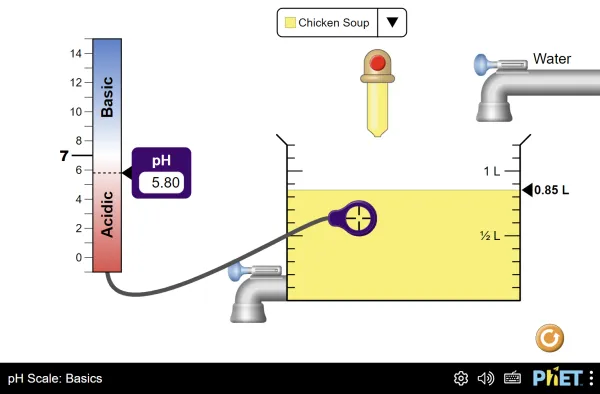
Full screen · PhET Interactive Simulations, University of Colorado Boulder, CC BY 4.0
Recap
- Acids and bases have opposite properties and neutralise each other; strong ones of either kind are corrosive.
- Hydrochloric, sulfuric and nitric acids are common acids; oxides, hydroxides, carbonates, bicarbonates and ammonia are bases.
- An alkali is a base that dissolves in water.
- PH under 7 means acidic, exactly 7 means neutral and over 7 means alkaline; each unit is a tenfold change.
- Litmus shows acid or alkali, universal indicator gives an approximate pH by colour, and a pH meter gives an exact value.
- A substance's pH explains its uses, from antacids to drain cleaners.
Challenge
Five unlabelled liquids are tested. P: blue litmus turns red, universal indicator turns red. Q: blue litmus turns red, universal indicator turns orange. R: red litmus turns blue, universal indicator turns violet. S: neither litmus paper changes, universal indicator turns green. T is a dark blackcurrant juice, and the indicator colour cannot be seen in it. The labels that fell off say: dilute hydrochloric acid, vinegar, salt water, sodium hydroxide solution, blackcurrant juice. (a) Match each liquid to its label and give a likely pH for P to S. (b) Why could litmus alone not tell P and Q apart? (c) How should the class measure the pH of T?
Hint
Litmus sorts each liquid into acid, neutral or alkali. Universal indicator then tells you how strong. Match the strongest acid and the strongest alkali first.
Answer
(a) P is dilute hydrochloric acid (about pH 1 to 2), Q is vinegar (about pH 3), R is sodium hydroxide solution (about pH 13 to 14), S is salt water (pH 7), T is blackcurrant juice. (b) Litmus only shows acid or alkali, and both P and Q are acids. (c) Use a pH meter, because it does not depend on seeing a colour.
Step by step
- P and Q turn blue litmus red, so both are acids, and R turns red litmus blue, so it is an alkali.
- S changes neither litmus paper and turns universal indicator green, so it is neutral: salt water.
- Universal indicator is red for P (pH 0 to 2) but orange for Q (pH 3 to 4), so P is the stronger acid: hydrochloric acid. Q is the weaker acid in vinegar.
- Violet means pH 12 to 14, a strong alkali: sodium hydroxide.
- Litmus turns red in any acid, strong or weak, so it gives no number to compare P and Q.
- T is strongly coloured, so indicator colours are hidden; a calibrated pH meter reads the pH directly.
Full working
- P, Q: blue litmus to redacids
- R: red litmus to bluealkali
- S: no litmus change, indicator green, pH 7neutral, salt water
- P: indicator red, pH about 1 to 2strong acid, hydrochloric acid
- Q: indicator orange, pH about 3weaker acid, vinegar
- R: indicator violet, pH about 13 to 14strong alkali, sodium hydroxide
- T: coloured, so use a pH meterindicator colour cannot be seen
- P hydrochloric acid, Q vinegar, R sodium hydroxide, S salt water, T blackcurrant juice
A Waikato farmer tests two paddocks. Paddock 1 has soil at pH 5. Paddock 2 has soil at pH 4. The grass she wants grows best at about pH 6. (a) How many times more acidic is paddock 2 than paddock 1, and than the pH she wants? (b) She spreads ground limestone (calcium carbonate) rather than sodium hydroxide. Give two reasons, using what you know about bases and alkalis. (c) Her son says limestone cannot work because it does not dissolve in water, so it is not an alkali. Explain what is wrong with his reasoning. (d) Hydrangeas of a kind whose flower colour depends on the soil grow by the house in soil like paddock 2. If she limes that bed until it is alkaline, what colour change could she expect in the flowers?
Hint
Each step of 1 on the pH scale is a tenfold change. For (c), think about the difference between a base and an alkali.
Answer
(a) 10 times more acidic than paddock 1 and 100 times more acidic than pH 6. (b) Sodium hydroxide is a strong, corrosive alkali: dangerous to handle, and too much would make the soil strongly alkaline and harm the grass. Limestone is a weak, insoluble base that is safe to spread and barely dissolves, so extra limestone cannot push the soil to a high pH. (c) Limestone is a base, not an alkali, but insoluble bases still neutralise acids where they touch them. (d) From blue to pink, for a hydrangea variety whose colour depends on the soil.
Step by step
- Paddock 2 is 1 pH step below paddock 1, so it is 10 times more acidic.
- It is 2 steps below pH 6, so it is 10 × 10 = 100 times more acidic than she wants.
- Sodium hydroxide is a strong alkali: it burns skin, and overdosing could take the soil far above pH 7.
- Calcium carbonate is a base that barely dissolves, so it is safe to handle and only reacts with the acid it meets; extra limestone mostly just sits there.
- An alkali is only a base that dissolves. Every base, soluble or not, can neutralise an acid.
- In some hydrangea varieties the flower colour depends on the soil: blue in acidic soil and pink in alkaline soil. Other varieties stay the same colour.
Full working
- paddock 2 v paddock 1: 5 − 4 = 1 step, so 10 timeseach step is × 10
- paddock 2 v target: 6 − 4 = 2 steps, so 10 × 10 = 100 timestwo tenfold changes
- sodium hydroxide: strong alkali, corrosiveunsafe, risks overshooting past pH 7
- calcium carbonate: weak, insoluble basesafe, cannot make soil strongly alkaline
- base that dissolves = alkali; insoluble base still neutralises acidhis mistake
- acidic soil: blue flowers; alkaline soil: pinkonly in varieties whose colour depends on the soil
- (a) 10 and 100 times, (b) safer and cannot overshoot, (c) a base need not dissolve to neutralise, (d) blue to pink
A student has 10 mL of a strong acid at pH 2. For this acid, every time the solution is diluted to 10 times its volume by adding water, the pH goes up by 1. (a) How much water must be added to the 10 mL to make it pH 4? (b) How much water would it take to reach pH 6? (c) Explain why no amount of water could ever make it pH 8. (d) A small amount of this acid is spilt on a lab bench. Use your answers to explain why a weak base such as baking soda is used on the spill rather than just water.
Hint
Going from pH 2 to pH 4 is two tenfold dilutions, so the final volume is 10 × 10 times the start. Remember the water is added to the 10 mL already there.
Answer
(a) 990 mL of water (to a total of 1000 mL). (b) 99,990 mL, about 100 litres. (c) Water is neutral: adding more only brings the solution closer to pH 7, it can never make it alkaline. (d) Diluting needs huge volumes and still leaves an acid, while a base neutralises the acid quickly; a weak base is used so that any excess is not itself corrosive.
Step by step
- pH 2 to pH 4 is 2 steps, so the volume must become 10 × 10 = 100 times bigger: 1000 mL.
- 10 mL is already there, so add 990 mL of water.
- pH 2 to pH 6 is 4 steps: 10 × 10 × 10 × 10 = 10,000 times bigger, which is 100,000 mL. Subtract the 10 mL: 99,990 mL.
- Water is pH 7. Mixing an acid with more and more water brings the pH closer to 7 but never past it, because water adds nothing alkaline.
- So water is a poor way to deal with acid: a little spill would need buckets of water and would still be acidic.
- A base neutralises the acid. Baking soda is a weak base, so using a little too much is not dangerous, unlike a strong alkali.
Full working
- pH 2 to pH 4: 2 steps, volume × 10 × 10 = × 100each step is a tenfold dilution
- 10 mL × 100 = 1000 mL; 1000 − 10 = 990 mLwater to add
- pH 2 to pH 6: 4 steps, volume × 10,000four tenfold dilutions
- 10 mL × 10,000 = 100,000 mL; 100,000 − 10 = 99,990 mLabout 100 L of water
- water is pH 7, so dilution only approaches 7it cannot make the solution alkaline
- base + acid → neutralisationfast; weak base is safe in excess
- (a) 990 mL, (b) 99,990 mL, (c) water cannot go past neutral, (d) neutralise with a weak base