Sample spaces, experiments, and the Law of Large Numbers
What this lesson covers
- Some chance-based situations, such as tossing a non-regular 3D shape, can only be explored through probability experiments.
- Results from sets of repeated trials for the same experiment may vary.
- The Law of Large Numbers states that as the number of trials in a chance experiment increases, the experimental probability will approach the experiment’s theoretical probability.
- Lists, tables, two-way tables, and tree diagrams are useful systematic methods for generating all possible outcomes.
Two ways to find a probability
- You can work it out on paper, or you can go and measure it.
- Which one is available depends on the situation.
- And it is not the one you would guess from school examples.
Theory needs something to be symmetrical
- A die has six identical faces, so each is equally likely.
- A drawing pin has nothing like that. No equal faces at all.
- So for the pin there is nothing to calculate. You have to throw it.
| Route | Method | When it works |
|---|---|---|
| Theory | list the outcomes and reason | needs equally likely outcomes |
| Experiment | do it many times and count | works on anything |
| A die | six equal faces | theory works |
| A drawing pin | no symmetry at all | only experiment works |
Which makes school examples misleading
- Dice, coins and cards are almost all you ever meet.
- All three are symmetrical, so theory always works.
- In the real world it usually does not. Experiment is the normal case.
The sample space is every possible outcome
- One die: six outcomes. Two coins: four.
- Theoretical probability is the ways it can happen, over the total.
- So listing the outcomes correctly is the whole job.
| Situation | Outcomes | Count |
|---|---|---|
| One die | 1, 2, 3, 4, 5, 6 | 6 outcomes |
| Two coins | HH, HT, TH, TT | 4 outcomes |
| Theoretical probability | the ways it can happen | over the total |
Two coins, and a question people get wrong
- Toss two coins. What is the chance of one head and one tail?
- Most people say a third: two heads, two tails, or one of each.
- But one of each happens two ways. HT and TH. So it is a half.
| Step | Detail | Value |
|---|---|---|
| Outcomes | HH, HT, TH, TT | |
| One of each | HT and TH | 2 of the 4 |
| So the chance | 2/4 | 1/2 |
| Not 1/3 | HT and TH are different outcomes |
Try it: two coins in a tree
Two dice: use a grid
- Six by six, first die down the side, second along the top.
- Thirty-six cells, and you cannot accidentally miss one.
- Count the cells totalling seven: six of them. So one sixth.
| Step | Working | Result |
|---|---|---|
| Six by six grid | first die down, second across | 36 outcomes |
| Total of 7 | 1+6, 2+5, 3+4, 4+3, 5+2, 6+1 | 6 ways |
| So P(7) | 6/36 | 1/6 |
| Total of 2 | only 1+1 | 1/36 |
Try it: two dice in a grid
Systematic beats careful
- Writing outcomes as they occur to you loses some. Always.
- A grid, a table or a tree has a slot for every single one.
- Then you count the slots rather than your own memory.
| Method | What happens | |
|---|---|---|
| Writing them as they occur | you will lose some | |
| A grid, a table, a tree | has a slot for every one | |
| Count the slots | not the ones you thought of |
Experimental probability is just counting
- How many times it happened, divided by how many trials.
- Eighteen heads in thirty tosses is 0.6.
- That is not 0.5, and nothing has gone wrong.
| Idea | Working | Value |
|---|---|---|
| Definition | times it happened | ÷ number of trials |
| 18 heads in 30 tosses | 18/30 | 0.6 |
| That is not 0.5 | and nothing is wrong |
The pin, where there is no theory to check against
- Throw a drawing pin. Does it land point up or point down?
- There is no symmetry argument. Nothing to calculate.
- Sixty-two point-up in two hundred throws. So about 0.31.
| Step | Detail | Value |
|---|---|---|
| Throw a drawing pin | point up, or point down? | |
| Theory | no equal faces to appeal to | nothing to calculate |
| 62 point-up in 200 | 62/200 | 0.31 |
| That estimate | is the only answer there is |
And that estimate is the answer
- Not an approximation to some true value we could look up.
- There is no formula for a drawing pin.
- Experiment is not second best here. It is the only method.
More trials, closer to the theory
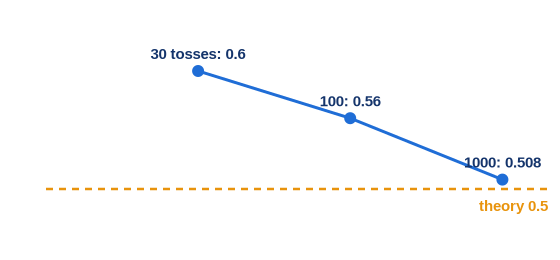
- Thirty tosses gave 0.6, which is off by a tenth.
- A hundred gave 0.56. A thousand gave 0.508.
- The gap keeps shrinking. That is the Law of Large Numbers.
| Trials | Heads | Proportion |
|---|---|---|
| 30 tosses | 18 heads | 0.6, off by 0.1 |
| 100 tosses | 56 heads | 0.56, off by 0.06 |
| 1000 tosses | 508 heads | 0.508, off by 0.008 |
| The gap | shrinks as trials rise | that is the Law |
But it does not mean anything is ever due
- Five heads in a row. Is a tail more likely now? No.
- The coin has no memory. The next toss is still a half.
- What settles down is the proportion, not the counts.
| Claim | Detail | Verdict |
|---|---|---|
| Five heads in a row | is a tail now due? | no |
| The coin | has no memory of the five | |
| Next toss | still 1/2 | exactly as before |
| What converges | the proportion, not the counts |
So how does it settle down, then?
- Those five extra heads never get cancelled out by anything.
- They just stop mattering, once there are a thousand tosses.
- Five out of a thousand is nothing. That is dilution, not correction.
Which is why simulations are worth using
- Nobody is tossing a coin ten thousand times by hand.
- A spreadsheet will do it instantly, as many times as you like.
- And that is when the convergence becomes obvious.
What to take away
- Six things, and the last one wins arguments.
| Theoretical probability | needs outcomes you can list and call equal |
| Experimental probability | is successes divided by trials |
| Some situations | have no theory available at all |
| List outcomes systematically | a grid or a tree, never from memory |
| More trials | brings the experimental value closer |
| Nothing is ever due | the proportion settles, the counts do not |
Common mistakes
- Two coins give HH, TT or one of each, so P(one head and one tail) = 1/3.HT and TH are different outcomes; of the 4 equally likely outcomes 2 count, so P = 2/4 = 1/2.
- Two dice have 11 totals from 2 to 12, so P(7) = 1/11.The totals are not equally likely; 6 of the 36 grid cells total 7, so P(7) = 6/36 = 1/6.
- Five heads in a row, so a tail is due.A coin has no memory; P(tail) is still 1/2 on every toss.
- The pin landed point up 18 times in 30, so P(point up) is exactly 0.6.18/30 = 0.6 is only an estimate; more trials bring it closer to the true probability.
Your turn
- Try all eight.
How many outcomes when you roll two dice?
What is the probability the two dice total 5?
24 sixes in 120 rolls. What is P(six)?
After five heads, what is P(head) next?
Which of these can only be explored by experiment, because its outcomes are not equally likely?
A spinner landed on red 45 times, giving an experimental probability of 0.3. How many spins were there?
A die is rolled and a coin is tossed. Use a grid to find P(a head and an even number).
Aroha gets 13 heads in 20 coin tosses, a proportion of 0.65. If she keeps going to 2,000 tosses, what will most likely happen?
Show answer
1. 36. Six faces on the first die times six on the second. 2. 4 out of 36, which is 1/9. The four ways are 1 and 4, 2 and 3, 3 and 2, and 4 and 1. 3. 24 divided by 120, which is 0.2. The theoretical value is one sixth, about 0.167, so this run came out a bit high. More rolls would close the gap. 4. One half. The coin does not know what it did before, and nothing is ever due. 5. Dropping a plastic cup. It has no equal faces to reason from, so you can only drop it many times and count; the die, coin and equal spinner are symmetrical. 6. 150. Experimental probability is times it happened ÷ number of trials, so 45 ÷ trials = 0.3 and trials = 45 ÷ 0.3 = 150. 7. 1/4. The grid has 6 × 2 = 12 outcomes, and a head with 2, 4 or 6 is 3 of them, so 3/12 = 1/4. 8. It moves closer to 0.5. More trials bring the experimental value nearer the theory; the early extra heads are diluted, not cancelled by extra tails.
The answers
- Six faces times six faces.
- A total of five happens four ways.
- Nothing is ever due.
| Answer | |
|---|---|
| 1 | 36 |
| 2 | 4/36, or 1/9 |
| 3 | 0.2 |
| 4 | One half |
Plinko Probability
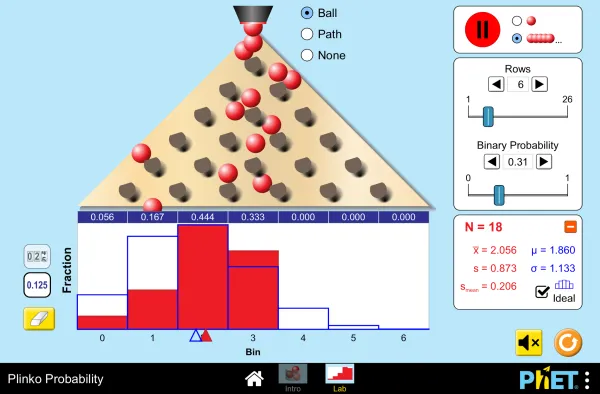
Full screen · PhET Interactive Simulations, University of Colorado Boulder, CC BY 4.0
Challenge
Two fair dice are rolled, and you write down the difference between the two numbers (the bigger one take away the smaller one, or 0 if they match). There are six possible differences, from 0 to 5. Which difference is most likely, and what is its probability? Which is least likely?
Hint
Six possible differences does not mean six equally likely ones. Draw the 6 by 6 grid and write the difference in every cell.
Answer
A difference of 1 is most likely, with probability 1036 = 518. A difference of 5 is least likely, with probability 236 = 118.
Step by step
- Use the 6 by 6 grid: 36 equally likely cells.
- Write the difference in each cell and count each value.
- 0 appears 6 times, 1 appears 10 times, 2 appears 8 times, 3 appears 6 times, 4 appears 4 times and 5 appears 2 times.
- The counts add to 36, so none were missed.
- A difference of 1 is the most common, 10 out of 36. A difference of 5 only comes from 1 and 6 or 6 and 1.
Full working
- sample space: 6 × 6 = 36 cellsfirst die down, second across
- difference 0: 6 cells, on the diagonal1 and 1 up to 6 and 6
- difference 1: 5 + 5 = 10 cellsjust above and just below the diagonal
- difference 2: 4 + 4 = 8, difference 3: 3 + 3 = 6the next lines out
- difference 4: 2 + 2 = 4, difference 5: 1 + 1 = 2the corners
- 6 + 10 + 8 + 6 + 4 + 2 = 36every cell counted once
- P(1) = 1036 = 518 and P(5) = 236 = 118ways over total
- most likely 1, with probability 518; least likely 5, with probability 118
A fair four-sided die (faces 1, 2, 3, 4) and a fair six-sided die are rolled together, and the two numbers are multiplied. (a) Use a grid to find the probability that the product is odd. Which products are most likely, and with what probability? (b) Mere does this 240 times and gets an odd product 80 times. Sam does it 24 times and gets an odd product 8 times. How many odd products did theory predict for each of them? (c) Both got an experimental probability of 13. Whose result is stronger evidence that the dice are not fair? Explain using the Law of Large Numbers.
Hint
A 4 by 6 grid has 24 equally likely cells. A product is odd only when both numbers are odd. For (c), think about how far each result is from what you expect, compared with how many trials there were.
Answer
(a) P(odd) = 624 = 14. The most likely products are 4, 6 and 12, each with probability 324 = 18. (b) Mere: 60 odd products. Sam: 6. (c) Mere's. With 240 trials the experimental probability should be close to 14, so 80 instead of 60 is a big gap. With only 24 trials, 8 instead of 6 is the kind of difference that happens by chance.
Step by step
- Make a 4 by 6 grid: 24 equally likely cells, each holding a product.
- A product is odd only when both numbers are odd: 1 or 3 on the small die and 1, 3 or 5 on the big one. That is 2 × 3 = 6 cells, so P(odd) = 624 = 14.
- Counting the products: 4 comes from 1 × 4, 2 × 2 and 4 × 1; 6 from 1 × 6, 2 × 3 and 3 × 2; 12 from 2 × 6, 3 × 4 and 4 × 3. No product appears more than 3 times.
- Theory predicts 14 of 240 = 60 for Mere and 14 of 24 = 6 for Sam.
- The Law of Large Numbers says the experimental probability gets closer to the theoretical one as the number of trials grows. Small runs bounce around a lot, big runs should not.
- So Sam's 8 is only 2 more than expected, which is normal for 24 trials, but Mere's 80 is 20 more over 240 trials. A computer simulation of fair dice gets 80 or more odd products in 240 rolls only about 2 times in 1000, but 8 or more in 24 rolls about 1 time in 4.
Full working
- grid: 4 × 6 = 24 cellssmall die down, big die across
- odd product: both odd, 2 × 3 = 6 cellsodd × odd is the only odd product
- P(odd) = 624 = 14ways over total
- 4: (1,4), (2,2), (4,1); 6: (1,6), (2,3), (3,2); 12: (2,6), (3,4), (4,3)3 cells each, the most of any product
- P(4) = P(6) = P(12) = 324 = 18the most likely products
- Mere expects 240 × 14 = 60, Sam expects 24 × 14 = 6expected = trials × probability
- Mere: 80 − 60 = 20 too many in 240; Sam: 8 − 6 = 2 too many in 24same 13, very different evidence
- big runs settle near the true value, small runs varythe Law of Large Numbers
- (a) 14; 4, 6 and 12, each 18, (b) 60 and 6, (c) Mere's result
Three fair six-sided dice have unusual faces. Die A: 2, 2, 4, 4, 9, 9. Die B: 1, 1, 6, 6, 8, 8. Die C: 3, 3, 5, 5, 7, 7. In a game, your friend chooses a die first, then you choose one of the other two. You both roll once and the higher number wins (a draw is impossible). Show that whichever die your friend chooses, you can choose one that wins with probability 59. Which die should you choose in each case?
Hint
Each die has only three different numbers, each on two faces, so a 3 by 3 grid of equally likely pairs is enough for each match. Find who wins A against B, B against C and C against A.
Answer
A beats B, B beats C and C beats A, each with probability 59. So if your friend picks A, choose C; if they pick B, choose A; if they pick C, choose B.
Step by step
- Each die has three values, each equally likely, so each match has a 3 by 3 grid of 9 equally likely pairs.
- A against B: A wins with 2 against 1, 4 against 1, 9 against 1, 9 against 6 and 9 against 8. That is 5 of the 9 pairs.
- B against C: B wins with 6 against 3, 6 against 5, 8 against 3, 8 against 5 and 8 against 7. Again 5 of 9.
- C against A: C wins with 3 against 2, 5 against 2, 5 against 4, 7 against 2 and 7 against 4. Again 5 of 9.
- So no die is best: each one is beaten by another, and you just choose the die that beats your friend's.
Full working
- each die: 3 values, each with probability 13two faces each
- each match: 3 × 3 = 9 equally likely pairsa small grid
- A v B: A wins (2,1), (4,1), (9,1), (9,6), (9,8)5 of 9
- B v C: B wins (6,3), (6,5), (8,3), (8,5), (8,7)5 of 9
- C v A: C wins (3,2), (5,2), (5,4), (7,2), (7,4)5 of 9
- A beats B, B beats C, C beats Ait goes round in a circle
- friend picks A, you pick C; B, you pick A; C, you pick B; you win with probability 59