Expressions, equations, and the inequality that flips
What this lesson covers
- The properties of operations (commutative, distributive, associative, inverse, and identity) and the order of operations apply to numbers and variables.
- When operating on or writing equations with fractions, fractions of magnitude greater than 1 are usually written as improper fractions.
A letter is a number you have not been told yet
- Algebra looks like a new subject. It is not one.
- It is arithmetic done on a number whose value is blank.
- Everything you know about numbers still holds.
The same five rules, with and without numbers
- Read the middle column. You agree with all of it.
- The right column is the same thing with the numbers removed.
- That is the whole of what algebra asks you to accept.
| Property | With numbers | With letters |
|---|---|---|
| Commutative | 7 + 3 = 3 + 7 | a + b = b + a |
| Associative | (2 + 3) + 4 = 2 + (3 + 4) | (a + b) + c = a + (b + c) |
| Distributive | 3 × (10 − 4) = 30 − 12 | a(b − c) = ab − ac |
| Identity | 9 + 0 = 9 | a + 0 = a, and a × 1 = a |
| Inverse | 5 + (−5) = 0 | a + (−a) = 0, and a × 1/a = 1 |
Collecting: add up what is the same
- Three a plus five b minus a plus two b.
- Gather the a terms, gather the b terms.
- Two a and seven b, and they will not combine further.
| Expression | Step | Gives |
|---|---|---|
| 3a + 5b − a + 2b | the starting expression | |
| 3a − a | the a terms | 2a |
| 5b + 2b | the b terms | 7b |
| 2a + 7b | and it stops there | a and b will not combine |
Why 2a + 7b cannot be tidied further
- Two apples and seven bananas is not nine of anything.
- A and b stand for different unknown numbers.
- Unlike terms stay separate. That is not an unfinished answer.
Expanding: the distributive rule, forwards
- Three times a bracket means three times everything inside it.
- 2x times, bracket, x minus 5, gives 2x squared minus 10x.
- The minus sign comes through. That is the slip to watch for.
| Expression | What to do | Result |
|---|---|---|
| 3(x + 4) | 3 times each thing inside | 3x + 12 |
| 2x(x − 5) | 2x times each thing inside | 2x² − 10x |
| Note | the minus comes through too | not 2x² + 10x |
Try it: expand it as an area
Factorising: the same rule, backwards
- Ask what goes into every term, and take it outside.
- 6x plus 9: three goes into both, giving 3, bracket, 2x plus 3.
- And you can always check by expanding it again.
| Expression | Common factor | Factorised |
|---|---|---|
| 6x + 9 | what goes into both? 3 | 3(2x + 3) |
| 4x² − 6x | what goes into both? 2x | 2x(2x − 3) |
| Check | expand it again | you should get back |
Substitution: filling the blank in
- Once you know what the letters are, put them in.
- v = u + at with u five, a two, t three, gives eleven.
- And the order of operations still runs. Multiply before adding.
| Formula | Values | Result |
|---|---|---|
| Area = lw, l = 7, w = 3 | 7 × 3 | 21 |
| v = u + at | u = 5, a = 2, t = 3 | 5 + 6 = 11 |
| Order of operations | still applies, always | multiply before adding |
Solving: ask what was done to x
- In 3x + 7, x was multiplied by three, then seven was added.
- To get x back, undo those. In reverse order.
- Subtract the seven first, then divide by the three.
Three x plus seven equals twenty-two
- Undo the add: 3x equals 15.
- Undo the times: x equals 5.
- Check it: three fives plus seven is twenty-two.
| Line | Reasoning | |
|---|---|---|
| 3x + 7 = 22 | what was done to x? | times 3, then add 7 |
| 3x = 15 | undo the add 7 first | |
| x = 5 | then undo the times 3 | |
| Check | 3 × 5 + 7 | 22, correct |
The same when there is a fraction in it
- x over four, plus two, equals five. Subtract the two.
- x over four is three, so x is twelve.
- Nothing about the method changed.
| Line | Step | Gives |
|---|---|---|
| x/4 + 2 = 5 | subtract 2 | x/4 = 3 |
| x = 12 | multiply by 4 | |
| 2x/3 = 8 | multiply by 3 | 2x = 24 |
| x = 12 | divide by 2 |
Inequalities work the same way
- Two x plus one is less than nine. Subtract one.
- Two x is less than eight, so x is less than four.
- And notice the sign did not move. We divided by a positive.
| Line | Step | Note |
|---|---|---|
| 2x + 1 < 9 | subtract 1 | 2x < 8 |
| x < 4 | divide by 2 | the sign did not move |
| Why not? | we divided by a positive |
But watch what a negative does
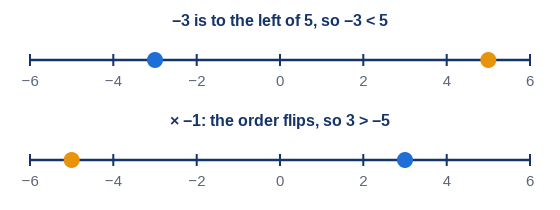
- Minus three is less than five. That is true.
- Multiply both sides by minus one: three, and minus five.
- Three is not less than minus five. The sign has to turn round.
| Statement | True? | |
|---|---|---|
| −3 < 5 | true | |
| × both sides by −1 | 3 and −5 | |
| Is 3 < −5? | no, that is false | |
| 3 > −5 | so the sign had to turn round |
Try it: divide by a negative
So there is exactly one extra rule
- Multiply or divide an inequality by a negative, and the sign flips.
- Minus two x is greater than six gives x is less than minus three.
- Adding and subtracting never flip it. Only negative times or divide.
Rearranging is solving with letters in the answer
- P equals two l plus two w. Get w on its own.
- Same moves: subtract two l, then divide by two.
- w is P minus two l, all over two. And then check it.
| Line | Step | |
|---|---|---|
| P = 2l + 2w | get w on its own | |
| P − 2l = 2w | subtract 2l from both sides | |
| (P − 2l)/2 = w | divide both sides by 2 | |
| Check: P = 20, l = 6 | (20 − 12)/2 | w = 4 |
Try it: undo it in reverse
What to take away
- Six things, and the last one is the only genuinely new rule.
| A letter | is a number you have not been told yet |
| Every arithmetic rule | works the same on letters |
| Expanding and factorising | are one property, both directions |
| Solving | is undoing, in reverse order |
| Rearranging | is solving with letters in the answer |
| Times or divide by a negative | and the inequality sign turns round |
Common mistakes
- 2x(x − 5) = 2x² + 10xThe minus comes through the bracket: 2x × −5 = −10x, so 2x(x − 5) = 2x² − 10x.
- 3a + 5b − a + 2b = 9abOnly like terms combine: 3a − a = 2a and 5b + 2b = 7b, so the answer is 2a + 7b.
- −2x < 6, so x < −3Dividing both sides by a negative number turns the sign round: −2x < 6 gives x > −3.
- P = 2l + 2w, so w = P/2 − 2lSubtract 2l from both sides, then halve everything: w = (P − 2l)/2, which is P/2 − l.
Your turn
- Try all eight.
Simplify 5x + 3y − 2x + y.
Expand 4(2x − 3).
Solve 5x − 4 = 21.
Solve −2x > 6.
Factorise 10x² + 15x fully.
Find the value of 3a² − 2b when a = −2 and b = 5.
Solve 3x/5 − 2 = 7.
Make t the subject of v = u + at.
Show answer
1. 3x + 4y. The x terms and the y terms do not combine with each other. 2. 8x − 12. The 4 multiplies both terms, and the minus comes through. 3. x = 5. Add 4 to both sides to get 5x = 25, then divide by 5. 4. x < −3. Dividing by −2 turns the sign round. Check with x = −4: −2 × −4 is 8, and 8 is greater than 6, so it works. 5. 5x(2x + 3). Both 5 and x go into every term, so take out 5x. Check: 5x × 2x + 5x × 3 = 10x² + 15x. 6. 2. The square comes first: (−2)² = 4, so 3 × 4 − 2 × 5 = 12 − 10 = 2. 7. x = 15. Add 2 to get 3x/5 = 9, multiply by 5 to get 3x = 45, then divide by 3. 8. t = (v − u)/a. Subtract u from both sides to get v − u = at, then divide both sides by a.
The answers
- x terms and y terms do not combine.
- The minus comes through the bracket.
- Dividing by −2 turns the sign round.
| Answer | |
|---|---|
| 1 | 3x + 4y |
| 2 | 8x − 12 |
| 3 | x = 5 |
| 4 | x < −3 |
Equality Explorer
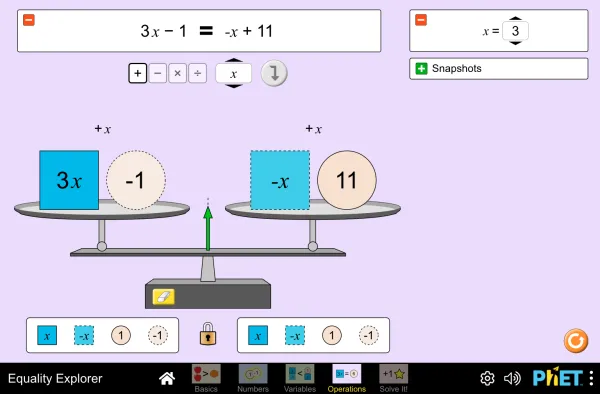
Full screen · PhET Interactive Simulations, University of Colorado Boulder, CC BY 4.0
Challenge
(a) Make x the subject of a(x − b) = c(x + b). (b) Use your answer to solve 7(x − 3) = 4(x + 3) and 3(x − 2) = 7(x + 2), and check both by substituting. (c) Your formula breaks down when a = c. Explain what goes wrong, and what the equation 5(x − 2) = 5(x + 2) tells you.
Hint
Expand both brackets, then gather every term with an x on one side and everything else on the other. The x terms can then be factorised: x is a common factor.
Answer
(a) x = b(a + c)a − c. (b) x = 11 (both sides 56) and x = −5 (both sides −21). (c) When a = c the bottom of the fraction is 0, and you cannot divide by 0. 5(x − 2) = 5(x + 2) becomes −10 = 10 after taking 5x off both sides, which is never true, so it has no solution.
Step by step
- Expand: ax − ab = cx + cb.
- Move the x terms to the left and the rest to the right: ax − cx = ab + cb.
- Factorise both sides: x(a − c) = b(a + c), then divide by (a − c).
- For 7(x − 3) = 4(x + 3), a = 7, b = 3, c = 4, so x = 3 × 11 ÷ 3 = 11. For 3(x − 2) = 7(x + 2), a = 3, b = 2, c = 7, so x = 2 × 10 ÷ (−4) = −5.
- If a = c, the x terms cancel completely and you are left comparing −ab with ab, which only match if b = 0.
Full working
- ax − ab = cx + cbexpand both brackets
- ax − cx = ab + cbadd ab and subtract cx on both sides
- x(a − c) = b(a + c)factorise each side
- x = b(a + c)a − c(a) divide by a − c
- a = 7, b = 3, c = 4: x = 3 × 11 ÷ 3 = 11(b) first equation
- check: 7 × 8 = 56 and 4 × 14 = 56it works
- a = 3, b = 2, c = 7: x = 2 × 10 ÷ (−4) = −5(b) second equation
- check: 3 × (−7) = −21 and 7 × (−3) = −21it works
- 5x − 10 = 5x + 10, so −10 = 10(c) false for every x, no solution
- x = b(a + c)a − c; x = 11; x = −5; no solution when a = c (unless b = 0)
A new operation ★ is defined by a ★ b = 2a − b. For example 5 ★ 3 = 10 − 3 = 7. (a) Show that ★ is not commutative, and find exactly which pairs a, b give a ★ b = b ★ a. (b) Is ★ associative? Find (a ★ b) ★ c and a ★ (b ★ c) in terms of a, b and c, and say when they are equal. (c) Solve (x ★ 4) ★ 5 = x ★ (x ★ 1).
Hint
Always work out the inside bracket first, then use the rule again with that answer as the new first (or second) number. Write everything with letters and simplify, just as you would with numbers.
Answer
(a) 5 ★ 3 = 7 but 3 ★ 5 = 1. a ★ b = b ★ a only when a = b. (b) (a ★ b) ★ c = 4a − 2b − c and a ★ (b ★ c) = 2a − 2b + c. They are equal only when a = c, so ★ is not associative. (c) x = 72.
Step by step
- a ★ b = 2a − b and b ★ a = 2b − a. Setting them equal gives 3a = 3b, so a = b.
- (a ★ b) ★ c means (2a − b) ★ c = 2(2a − b) − c = 4a − 2b − c.
- a ★ (b ★ c) means a ★ (2b − c) = 2a − (2b − c) = 2a − 2b + c.
- Setting these equal: 4a − c = 2a + c, so 2a = 2c and a = c.
- For (c): x ★ 4 = 2x − 4, then (2x − 4) ★ 5 = 4x − 13. And x ★ 1 = 2x − 1, then x ★ (2x − 1) = 2x − (2x − 1) = 1.
- So 4x − 13 = 1, giving 4x = 14 and x = 72.
Full working
- 5 ★ 3 = 7, 3 ★ 5 = 6 − 5 = 1(a) not commutative
- 2a − b = 2b − a, so 3a = 3b, a = b(a) when the order does not matter
- (a ★ b) ★ c = 2(2a − b) − c = 4a − 2b − c(b) left grouping
- a ★ (b ★ c) = 2a − (2b − c) = 2a − 2b + c(b) right grouping, the minus comes through the bracket
- 4a − 2b − c = 2a − 2b + c gives a = c(b) equal only when a = c
- (x ★ 4) ★ 5 = 2(2x − 4) − 5 = 4x − 13(c) left side
- x ★ (x ★ 1) = 2x − (2x − 1) = 1(c) right side
- 4x − 13 = 1, so 4x = 14(c) solve
- x = 72
For how many integers x is 3x + 14x + 2 also an integer? List them all.
Hint
Try to write 3x + 14 as 3 lots of (x + 2) plus something left over. The distributive law run backwards does this. Then ask what (x + 2) has to be for the left-over part to divide exactly.
Answer
8 integers: x = −10, −6, −4, −3, −1, 0, 2, 6.
Step by step
- 3(x + 2) = 3x + 6, so 3x + 14 = 3(x + 2) + 8.
- Dividing by (x + 2): 3x + 14x + 2 = 3 + 8x + 2.
- 3 is already an integer, so the whole thing is an integer exactly when 8x + 2 is.
- So x + 2 must divide 8 exactly. It can be 1, 2, 4, 8 or −1, −2, −4, −8 (negatives are allowed because x is any integer).
- Subtract 2 each time to get x. Note x = −2 is not allowed, because the bottom would be 0.
Full working
- 3x + 14 = 3x + 6 + 8 = 3(x + 2) + 8split off 3 lots of the bottom
- 3x + 14x + 2 = 3 + 8x + 2divide each part by x + 2
- x + 2 = 1, 2, 4, 8, −1, −2, −4 or −8x + 2 must divide 8
- x = −1, 0, 2, 6, −3, −4, −6 or −10subtract 2
- check x = 6: 32 ÷ 8 = 4; x = −10: −16 ÷ −8 = 2two checks
- 8 integers: −10, −6, −4, −3, −1, 0, 2, 6