
Hormones, the menstrual cycle, flowers and fungi
What this lesson covers
- What a hormone is and how it reaches its target
- How hormones control ovulation and the uterus lining
- Hormones and sperm production
- The stages of reproduction in flowering plants
- How most fungi reproduce with spores
- Organising information to compare processes
Hormones: messages in the blood
- A hormone is a chemical messenger. It is made in one part of the body, released into the blood, and carried all round the body.
- It only affects certain target cells or tissues, which have the right receptors to respond to it, and it changes what those cells do.
- For example, insulin from the pancreas tells liver and muscle cells to take up sugar, and adrenaline gets the body ready for action when you are scared.
- Reproduction is controlled by hormones too, mainly from the pituitary gland at the base of the brain and from the ovaries or testes.
The menstrual cycle
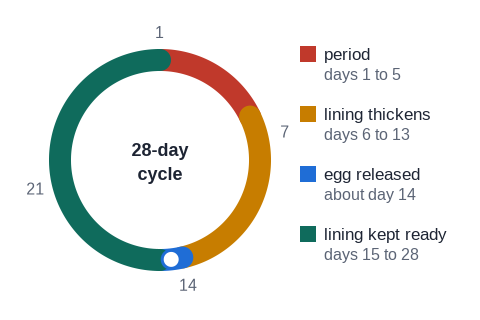
- From puberty, a female's body goes through a repeating cycle, often about 28 days long, though it varies from person to person and month to month.
- Hormones make an egg mature in an ovary and the lining of the uterus grow thick and full of blood vessels, ready to receive a fertilised egg.
- About halfway through the cycle, an egg is released from the ovary. This is ovulation.
- If the egg is not fertilised, hormone levels fall and the thick lining breaks down and leaves the body through the vagina over a few days. This bleeding is menstruation, or a period.
- Then the cycle starts again. If the egg is fertilised, hormones keep the lining in place and periods stop during pregnancy.
Hormones and sperm production
- From puberty, the testes make sperm all the time, millions every day, rather than in a monthly cycle.
- This is controlled by hormones from the pituitary gland, which signal the testes.
- The testes make the hormone testosterone, which keeps sperm production going and also causes changes at puberty, such as a deeper voice and more body hair.
Organising: female and male gametes
- Organise the facts about gamete production into a table, then state one similarity and one difference.
| Female | Male | |
|---|---|---|
| Gamete | Egg (ovum) | Sperm |
| Where made | Ovaries | Testes |
| How often released | About once a month | Made continuously |
| Controlled by | Hormones from the pituitary and ovaries | Hormones from the pituitary and testes |
- Similarity: both are controlled by hormones, including ones from the pituitarythe last row matches
- Difference: eggs are released in a monthly cycle, sperm are made all the timethe third row differs
- One similarity and one difference, each taken from a row of the table
Try it: egg or sperm?
How flowering plants reproduce
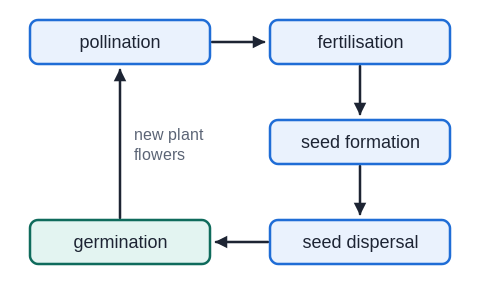
- Pollination: pollen, carrying the male gamete, moves from an anther to the stigma of a flower, carried by wind, insects or birds. Tūī and korimako (bellbirds) pollinate kōwhai and harakeke as they feed on nectar.
- Fertilisation: a tube grows from the pollen grain down to the ovary, and the male gamete joins an egg cell inside an ovule.
- Seed formation: the fertilised ovule becomes a seed holding a tiny plant and a food store, and the ovary around it often becomes a fruit.
- Seed dispersal: seeds are spread away from the parent by wind, water or animals. Kererū swallow large berries such as those of taraire and tawa and drop the seeds far away.
- Germination: with water, warmth and oxygen, the seed swells, a root grows down and a shoot grows up, starting a new plant.
Try it: put the steps in order
Why a forest needs kererū
- Some native trees have berries so large that only the kererū can swallow them. Explain what could happen to these trees if kererū disappeared from a forest.
- Kererū swallow the berries and drop the seeds elsewherethis is seed dispersal
- Without kererū, the berries fall under the parent treeno other animal carries them
- Seedlings there compete with the parent for light and watermost fail
- Fewer new trees grow in new places, so these trees slowly become rarer
Fungi reproduce with spores
- Most fungi reproduce by making spores: tiny cells, far too small to see one by one, that can grow into a new fungus.
- Moulds, such as the fuzz on old bread, make spores directly on short stalks that grow up from their threads. The dark dots you see are clusters of spores.
- Mushrooms make spores on thin gills or in tiny tubes under the cap. A single mushroom can release millions.
- Spores are so light that air currents carry them a long way. If one lands somewhere damp with food, it germinates and grows threads, starting a new fungus.
Common mistakes
- A hormone works on every cell it reaches in the blood.A hormone travels everywhere in the blood but only changes the target cells that can respond to it.
- A period is when the egg is released.The egg is released at ovulation, about halfway through the cycle; a period is the lining being shed when no fertilisation happened.
- Pollination and fertilisation are the same thing.Pollination moves pollen to the stigma; fertilisation happens later, when the male gamete joins the egg inside the ovule.
- Mushrooms grow from seeds.Fungi have no seeds; they grow from spores, which are single tiny cells.
Make a mushroom spore print
You need: a fresh flat (open) mushroom from the supermarket, a sheet of white paper, a sheet of dark paper, a bowl or glass to cover it
- Gently pull the stalk off the mushroom so the gills underneath are showing.
- Put the cap gills-down so it sits half on the white paper and half on the dark paper.
- Cover it with the upturned bowl so no draught moves the air, and leave it overnight.
- Lift the bowl and the cap off very carefully.
- Look for a print of fine lines matching the gills: it is made of millions of spores that fell from the gills, too small to see one at a time.
Safety: Use only mushrooms bought from a shop and never pick wild ones, because some New Zealand wild mushrooms are deadly; wash your hands after handling it, and throw it away afterwards rather than eating it.
Your turn
Give the three parts of the definition of a hormone.
What happens to the lining of the uterus if an egg is not fertilised?
Which hormone made by the testes keeps sperm production going?
Put these in order: germination, pollination, seed dispersal, fertilisation, seed formation.
Why can a mould appear on bread in a closed bag, even though nobody put it there?
Show answer
1. A chemical messenger, carried in the blood, that changes how its target cells work. 2. It breaks down and leaves the body as menstruation, a period. 3. Testosterone. 4. Pollination, fertilisation, seed formation, seed dispersal, germination. 5. Mould spores are tiny and floating in the air everywhere, so some were already on the bread or in the bag and germinated.
Recap
- A hormone is a chemical messenger carried in the blood that changes how its target cells work.
- In the menstrual cycle, hormones control ovulation and the thickening of the uterus lining, which is shed as a period if no fertilisation happens.
- Hormones from the pituitary and the testes keep sperm production going.
- Flowering plants go through pollination and fertilisation, then form seeds, which are dispersed and germinate.
- Most fungi reproduce by spores that drift in the air and germinate where it is damp and there is food.
Challenge
Ana cut four slices from the same fresh loaf and sealed each one in its own clean, airtight container. Slice A: dry, kept in a warm cupboard at 22 °C. Slice B: sprinkled with water, warm cupboard. Slice C: sprinkled with water, kept in the fridge at 4 °C. Slice D: sprinkled with water, then heated in a hot oven for 10 minutes and sealed in a jar that had been boiled, then kept in the warm cupboard. These are her made-up results, in days until mould first appeared: A, none after 14 days; B, 4 days; C, 11 days; D, none after 14 days. (a) Slice B was sealed straight away, so where did its mould come from? (b) What do A, B and C together show about what a spore needs to grow? (c) Explain the result for D. (d) Her brother says the mould on B must have grown out of the bread itself. Use D to argue against him.
Hint
Remember how tiny and light spores are, and where they travel. Compare the slices in pairs that differ in only one thing: A with B, then B with C, then B with D.
Answer
(a) Mould spores are in the air everywhere and settle on bread before it is sealed, so they were already on the slice. (b) A and B differ only in water: spores need moisture to germinate. B and C differ only in temperature: warmth makes the mould grow faster, and cold slows it down but does not stop it. (c) The heat killed the spores already on the bread, and the boiled jar kept new spores out, so there was nothing to grow even though the bread was damp and warm. (d) D was the same bread, damp and warm, yet nothing grew once the spores were killed and kept out. So mould grows from spores that land on bread, not from the bread itself.
Step by step
- Spores are so small and light that air carries them everywhere, so most food already has some on it.
- A versus B: only the water changed, and only the damp slice went mouldy.
- B versus C: only the temperature changed, and the cold slice took nearly three times as long.
- D had food, water and warmth but no living spores, so no mould grew.
- That shows mould needs spores to start; it does not appear from nothing.
Full working
- B moulded while sealedspores were already on the bread from the air
- A (dry) none, B (damp) 4 daysspores need moisture
- B (22 °C) 4 days, C (4 °C) 11 dayswarmth speeds growth; cold slows it
- D: spores killed by heat and kept outno spores, no mould
- Damp, warm bread with no spores stays cleanmould comes from spores, not the bread
- Spores need moisture and grow faster when warm; no spores, no mould
Kiwifruit vines are either male or female. Male vines make pollen but no fruit; female flowers have an ovary full of ovules, but their own pollen does not work. In a Te Puke orchard a grower tested 50 female flowers in each of four groups. These are made-up results. Group 1: covered with a paper bag before opening, 0 fruit. Group 2: left open to bees, 44 fruit. Group 3: bagged, then brushed by hand with pollen from male flowers and bagged again, 47 fruit. Group 4: bagged, then brushed with pollen from other female flowers, 0 fruit. (a) Give the percentage of flowers that set fruit in groups 2 and 3. (b) What does each group show? (c) A kiwifruit is cut open and has hundreds of tiny black seeds. Explain what each seed is and why a good fruit needs a great many pollen grains to reach its flower. (d) Why do growers bring beehives into the orchard only while the vines are flowering, and plant male vines among the female ones?
Hint
Use the order: pollination, fertilisation, seed formation. Which group is missing which step? For (c), each pollen grain grows one tube to one ovule.
Answer
(a) Group 2: 88%; group 3: 94%. (b) Group 1: without pollen reaching the stigma, no fruit forms. Group 2: bees carry enough male pollen to pollinate most flowers. Group 3: male pollen alone, placed by hand, is enough, so bees are only the carriers. Group 4: female pollen does not work, so male vines are essential. (c) Each seed is an ovule fertilised by the male gamete from one pollen grain, and the ovary grows into the fruit around them. A fruit with hundreds of seeds needs hundreds of pollen grains to reach its stigma, and a poorly pollinated flower gives a small fruit with few seeds. (d) The bees are needed to carry pollen from male to female vines while the flowers are open, and the male vines must be close enough for the bees to carry pollen between them.
Step by step
- Divide the fruit by 50 and multiply by 100.
- Only flowers that received working male pollen made fruit.
- The hand-pollinated group shows bees are just the carriers, not something the flower needs for itself.
- Each seed needs its own fertilisation, so many seeds need many pollen grains.
- Pollination happens only while flowers are open, so that is when bees are needed, and male vines must be near.
Full working
- Group 2: 44 ÷ 50 × 100 = 88%open to bees
- Group 3: 47 ÷ 50 × 100 = 94%male pollen by hand
- Groups 1 and 4: 0%no working pollen, so no fertilisation
- One seed = one ovule fertilised by one pollen grainhundreds of seeds need hundreds of grains
- Bees carry pollen from male to female vines while flowers are openhives at flowering time
- 88% and 94%; fruit forms only with male pollen, and each seed needs its own pollen grain
Old man's beard is a climbing flowering plant brought to New Zealand that smothers native trees. Each seed has a long feathery tail. In a made-up test, seeds with their tails fall through still air at 0.5 m per second, but seeds with the tails cut off fall at 2.5 m per second. A vine has climbed to the top of a tree 15 m high, and a steady wind blows sideways at 6 m per second. (a) How long does a tailed seed take to fall 15 m, and how far does the wind carry it in that time? (b) Do the same for a seed with no tail. How many times further does the tailed seed travel? (c) Explain why some seeds are found a kilometre or more away. (d) Weed teams cut the vines at the base before the plant flowers, rather than after the seeds have formed. Use the stages of reproduction in flowering plants to explain why.
Hint
Time to fall = height ÷ falling speed. While it falls, the seed moves sideways at the wind speed, so distance = wind speed × time. For (c), think about air that moves upwards, not only sideways.
Answer
(a) 30 seconds, carried 180 m. (b) 6 seconds, carried 36 m, so the tailed seed goes 5 times as far. (c) Gusts and rising air can lift seeds higher or hold them up for longer, so they stay in the air much longer than 30 seconds and travel much further. (d) Cutting before flowering stops pollination, so there is no fertilisation and no seeds form. Once seeds have formed, cutting the vine is too late: the seeds are already there to be dispersed by the wind, and they will germinate wherever they land with water, warmth and oxygen.
Step by step
- Find the falling time from the height and the falling speed.
- Multiply that time by the wind speed to find the sideways distance.
- The tail slows the fall, so the wind has longer to carry the seed.
- Rising air and gusts keep seeds up even longer, so real distances can be much greater.
- No flowers means no pollination, no fertilisation and no seeds, so cutting early stops the spread at the start.
Full working
- Tailed: 15 ÷ 0.5 = 30 stime to fall
- Tailed: 6 × 30 = 180 mwind speed × time
- No tail: 15 ÷ 2.5 = 6 s; 6 × 6 = 36 msame method
- 180 ÷ 36 = 5how many times further
- Cut before flowering → no pollination → no fertilisation → no seedsthe stages in order
- 180 m versus 36 m, 5 times further; cutting before flowering stops seeds forming at all