
Producers, consumers, decomposers and how organisms interact
What this lesson covers
- Producers, consumers and decomposers, and how they depend on each other
- How energy flows and matter cycles through an ecosystem
- Predators and prey, mutualism and parasitism
- What soil is made of and its part in recycling nutrients
- Measuring abiotic conditions with quadrats and transects
- Finding patterns in data about organisms and their surroundings
Three roles in an ecosystem
- An ecosystem is all the living things in an area together with their non-living surroundings, such as light, water, soil and temperature.
- Producers make their own food. Plants, algae and some bacteria use light energy to turn carbon dioxide and water into glucose, a carbohydrate, by photosynthesis.
- Consumers cannot make food, so they get energy and nutrients by eating producers or other consumers. Herbivores eat plants, carnivores eat animals, and omnivores eat both.
- Decomposers, mainly fungi and bacteria, break down dead plants, dead animals and waste, releasing nutrients back into the soil and water.
- Each group depends on the others, so the organisms are interdependent: remove one group and the rest suffer.
Energy flows, matter cycles
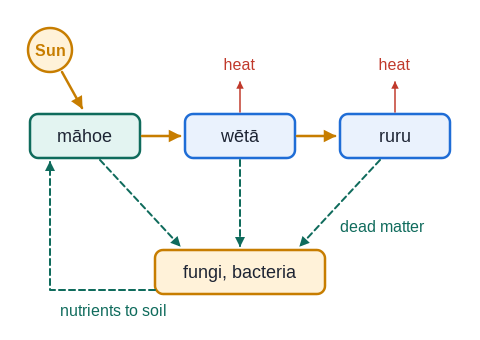
- A food chain shows what eats what, with arrows pointing the way energy goes: māhoe leaves → tree wētā → ruru (morepork).
- Energy enters as sunlight and passes along the chain, but at every step much of it is used for living and lost as heat. So energy flows through an ecosystem in one direction and must keep coming from the Sun.
- Matter is different. The carbon, nitrogen and other nutrients in living things are used again and again.
- When the leaf, the wētā and the ruru die, decomposers break them down and return their nutrients to the soil, where plant roots take them up. This is nutrient cycling.
Ways organisms interact
- Organisms in an ecosystem affect each other in several ways, as the table shows.
- A predator hunts and eats other animals, its prey. Numbers of predators and prey affect each other: more prey can feed more predators, and more predators mean fewer prey.
- In mutualism both partners benefit. In parasitism one organism, the parasite, lives on or in another, its host, and benefits while harming it.
| Relationship | Who gains, who loses | New Zealand example |
|---|---|---|
| Predator and prey | Predator gains, prey loses | Stoats hunt kiwi chicks; ruru hunt wētā |
| Mutualism | Both gain | Tūī get nectar from harakeke flowers and carry their pollen |
| Mutualism | Both gain | Bees get nectar and pollen from flowers and pollinate them |
| Parasitism | Parasite gains, host loses | Fleas feed on a dog's blood and make it itch |
Try it: name the relationship
Removing a predator
- A reserve traps out stoats. Predict and explain what happens to the kiwi population over the next few years.
- Stoats are predators of kiwi chicksthe relationship
- Fewer stoats, so more chicks survive to adulthoodless predation
- More adults, so more eggs and chicks in later yearsthe effect builds
- The kiwi population increases, as long as there is enough food and space
Soil: where nutrients are recycled
- Soil is made of rock particles, decaying organic matter (humus), living organisms, air and water.
- The living part is huge: plant roots, fungi, bacteria, earthworms, mites, slaters and insect larvae.
- Earthworms and slaters break dead leaves into small pieces, then fungi and bacteria decompose them, releasing nutrients such as nitrogen that plants need.
- Without soil organisms, dead leaves would pile up and plants would run short of nutrients.
Measuring an ecosystem
- Abiotic factors are the non-living conditions: light, temperature, water, wind and soil type. Biotic factors are the living things.
- Light intensity can be measured with a light meter (many phones have one in an app), temperature with a thermometer, and soil moisture with a probe or by weighing soil before and after drying.
- A quadrat is a square frame, often 1 m by 1 m, placed on the ground so you can count or estimate what is inside it.
- A transect is a straight line, such as a measuring tape, laid across an area where conditions change. Placing quadrats at regular distances along it shows how organisms change as the conditions change.
- Repeat counts and readings at each point, and record them in a table planned beforehand.
Try it: estimate with quadrats
A sand dune transect
- Room 15 laid a tape from the high-tide line up a dune and put a quadrat every 10 m. In each one they counted sandhoppers under seaweed and debris, and estimated the percentage of ground covered by marram grass.
| Distance from high tide | Sandhoppers | Marram grass cover |
|---|---|---|
| 0 m | 34 | 0% |
| 10 m | 12 | 10% |
| 20 m | 3 | 55% |
| 30 m | 0 | 80% |
| 40 m | 0 | 60% |
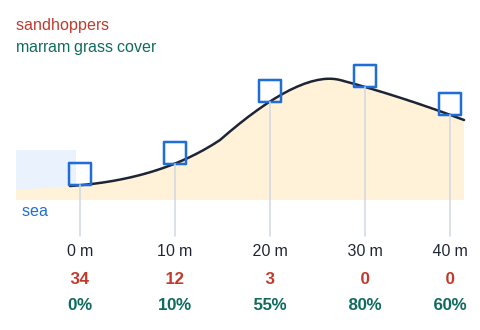
- Sandhoppers fall from 34 to 0 moving inlandthey shelter in damp seaweed washed up near the tide line
- Marram rises to a peak of 80% at 30 mit grows best on the dune itself, away from the waves
- Each organism lives where conditions suit itthe abiotic factors change along the transect
- Sandhoppers near the tide line, marram higher on the dune
Try it: sandhoppers along the dune
Leaf litter or bare ground?
- Room 15 also counted invertebrates (animals without backbones) in five small quadrats under leaf litter and five on bare ground nearby, and took the soil temperature.
| Site | Invertebrates in each quadrat | Mean | Soil temperature |
|---|---|---|---|
| Leaf litter | 23, 18, 27, 20, 22 | 22 | 14 °C |
| Bare ground | 3, 1, 4, 2, 0 | 2 | 21 °C |
- Litter: (23 + 18 + 27 + 20 + 22) ÷ 5 = 110 ÷ 5 = 22mean count
- Bare: (3 + 1 + 4 + 2 + 0) ÷ 5 = 10 ÷ 5 = 2mean count
- Litter is cooler and gives food and shelter from drying outlink to abiotic factors
- About 11 times as many invertebrates live under leaf litter as on bare ground
Common mistakes
- In a food chain the arrow means 'eats', so it points from the ruru to the wētā.The arrow shows where energy goes, so it points from the food to the eater: wētā → ruru.
- Decomposers are not important because they only deal with dead things.Decomposers return nutrients to the soil, and without them plants would run out of nutrients.
- Energy is recycled round an ecosystem like nutrients are.Matter cycles, but energy flows one way and is lost as heat, so it must keep coming from the Sun.
- Any relationship where two animals live together is mutualism.It is only mutualism if both benefit; if one is harmed, as with fleas on a dog, it is parasitism.
Leaf litter hunt
You need: 4 sticks and a 4 m piece of string, a white tray or old pillowcase, garden gloves, a spoon, a notebook and pencil
- Push the sticks into the ground to make a 1 m square quadrat under a tree or hedge, with string round the edge.
- Wearing gloves, scoop the leaf litter from inside the square onto the white tray with the spoon.
- Count each kind of invertebrate you find (slaters, worms, beetles, spiders, millipedes) and tally them in your notebook.
- Put everything back, then repeat with a 1 m square on a bare or mown patch of the same garden.
- Look for the difference: the leaf litter usually holds far more animals, because it is cooler, damper and full of food.
Safety: Wear gloves because some spiders bite and soil can carry tetanus germs, move slowly so you do not crush anything, and return every animal and the litter to where you found it.
Your turn
In the chain kawakawa → looper caterpillar → tauhou (silvereye), which organism is the producer?
Name the role of the fungi growing on a fallen log.
A tapeworm lives in a dog's gut and takes its food. What type of relationship is this?
In Room 15's transect, at what distance was marram grass cover highest?
Why does an ecosystem need a constant supply of energy from the Sun but not a constant supply of new nutrients?
Show answer
1. Kawakawa, because it makes its own food by photosynthesis. 2. Decomposers, breaking the log down and returning nutrients to the soil. 3. Parasitism: the tapeworm gains and the dog is harmed. 4. At 30 m, with 80% cover. 5. Energy is lost as heat at every step, but nutrients are recycled by decomposers and used again.
Recap
- Producers make glucose by photosynthesis, consumers eat other organisms, and decomposers break down dead matter and waste.
- Energy flows one way from the Sun along food chains, while matter is cycled back to the soil by decomposers.
- Predators eat prey, both partners gain in mutualism, and a parasite gains while harming its host.
- Soil is rock particles, humus, living organisms, air and water, and its organisms keep nutrients cycling.
- Quadrats and transects, with readings of light, temperature and soil, reveal patterns in where organisms live.
Challenge
Red mistletoe (pikirangi) grows on the branches of beech trees. It grows a special root into the beech branch and takes water and minerals from it, but the mistletoe has its own green leaves. Its flower buds mostly stay shut until a tūī or korimako (bellbird) twists them open to drink nectar, and the bird carries pollen to the next flower. Possums love to eat mistletoe leaves. In one valley, rangers have trapped out the possums, but stoats and rats still raid bellbird nests. A ranger says: 'The possums are gone, so the mistletoe will recover.' (a) Name the relationship between the mistletoe and the beech, and between the mistletoe and the bellbird. (b) Why is the mistletoe-beech relationship not exactly like a flea on a dog? (c) Explain why the mistletoe may still not recover well, and say what else the rangers should do.
Hint
Ask who gains and who loses in each pair. Then follow the chain from the stoats, through the bellbird, to the mistletoe flowers and seeds.
Answer
(a) Mistletoe and beech: parasitism (the mistletoe gains water and minerals, the beech loses them). Mistletoe and bellbird: mutualism (the bird gets nectar, the mistletoe gets pollinated). (b) The mistletoe makes its own food by photosynthesis in its green leaves, so it takes only water and minerals, while a flea takes all its food from the dog. (c) Removing possums stops the leaves being eaten, but stoats and rats keep bellbird numbers low, so few buds are opened, few flowers are pollinated and few seeds form, so few new mistletoe plants grow. The rangers should also control stoats and rats so bellbird and tūī numbers rise.
Step by step
- The mistletoe takes water and minerals from the beech and gives nothing back, so it is a parasite and the beech is its host.
- It still makes its own glucose in its green leaves, so it is only partly a parasite, unlike a flea.
- The bellbird gets nectar and the mistletoe gets its pollen carried, so both gain: mutualism.
- Stoats and rats eat bellbird eggs and chicks, so there are fewer birds to open the flowers.
- Without pollination there are few seeds, so even safe adult plants are not replaced by new ones.
- Recovery needs both pests dealt with: possums for the leaves, stoats and rats for the pollinators.
Full working
- Mistletoe gains, beech losesparasitism
- Mistletoe has green leavesit makes its own food, so it is only a partial parasite
- Bellbird gains nectar, mistletoe gains pollinationmutualism
- Stoats and rats → fewer bellbirdsnest predation
- Fewer bellbirds → fewer flowers opened → fewer seedsthe mutualism breaks down
- Mistletoe recovers only if stoats and rats are also controlled so pollinating birds increase
In a South Island beech forest, the beech trees make a huge crop of seed only every few years (a 'mast' year). Each summer rangers count mice and stoats as the number caught per 100 traps, and check mohua (yellowhead) nests. These are made-up results. Year 1, normal seed: mice 4, stoats 2, mohua nests destroyed 10%. Year 2, the summer after a mast year: mice 60, stoats 3, nests destroyed 10%. Year 3: mice 5, stoats 12, nests destroyed 60%. Year 4: mice 3, stoats 4, nests destroyed 15%. (a) How many times bigger was the mouse count in year 2 than in year 1, and the stoat count in year 3 than in year 2? (b) Explain why the changes come in the order seed, then mice, then stoats. (c) Stoats eat mice and also birds, their eggs and chicks. Explain why the mohua suffer most in year 3, not year 2. (d) The rangers can afford one big round of stoat trapping. Should they do it in year 1, year 2 or year 3? Explain.
Hint
Follow the food: seed feeds mice, and mice feed stoats. Mice can breed many times a year, but a stoat has only one litter a year. Then ask what all those stoats eat once the mice are gone.
Answer
(a) Mice: 15 times bigger (60 ÷ 4). Stoats: 4 times bigger (12 ÷ 3). (b) The seed is food for mice, so with plenty of seed more mice survive and breed, and mice breed fast. Mice are prey for stoats, so with plenty of mice more stoat young survive, but stoats breed only once a year, so their numbers rise a year later. (c) In year 3 the seed is gone and the mice have crashed (60 to 5), but there are now many stoats. Hungry stoats switch to birds, so 60% of mohua nests are destroyed. In year 2 there were few stoats and plenty of mice to eat. (d) Year 2: trapping while the mice are booming stops the extra stoats being raised and removes them before the mice crash, so there are few stoats left to turn on the mohua in year 3. Year 1 is too early (nothing has happened yet), and year 3 is too late, because the stoats are already raiding nests.
Step by step
- Divide the bigger count by the smaller one to find how many times bigger it is.
- Each organism is food for the next, so each population can only grow after its food has increased.
- Mice breed fast, so they boom quickly; stoats breed once a year, so they boom a year later.
- When the prey crashes, a large number of predators must find other food, and the mohua become that food.
- Controlling the predator before its numbers peak protects the birds; afterwards the damage is already done.
Full working
- Mice: 60 ÷ 4 = 15 timesyear 2 versus year 1
- Stoats: 12 ÷ 3 = 4 timesyear 3 versus year 2
- Seed → mice → stoatseach is food for the next, so each peak comes later
- Year 3: mice 60 → 5 while stoats 3 → 12stoats switch to birds, 60% of nests destroyed
- Trap in year 2remove stoats before the mice crash
- Mice 15 times, stoats 4 times; trap stoats in year 2, before the mice crash and the stoats turn to the mohua
In a made-up experiment, mānuka seedlings were grown for 6 months in three kinds of pot, 10 seedlings in each. Pot A: forest soil heated to kill every living thing in it. Pot B: the same heated soil with plant fertiliser added. Pot C: forest soil straight from the bush, still full of living fungi and bacteria. The mean dry mass of a seedling was A 2.0 g, B 4.5 g, C 5.0 g. Under a microscope, the roots in pot C were wrapped in fine fungus threads that spread far out into the soil, and tests showed that each seedling in C passed about one fifth of the sugar it made to the fungus. (a) By what percentage was the mean mass in B and in C bigger than in A? (b) What does comparing A with B tell you about what held back the seedlings in A? (c) Rua says: 'Giving away a fifth of its sugar should make the C seedlings smaller than the A seedlings.' Use the results to explain why he is wrong, and name the kind of relationship between the mānuka and the fungus. (d) Why were there 10 seedlings in each pot instead of one?
Hint
Plants make their own sugar, but they also need minerals such as nitrogen and phosphorus from the soil to grow. What could fine threads spreading through the soil do for the roots?
Answer
(a) B 125% bigger, C 150% bigger. (b) The seedlings in A were short of minerals (nutrients), not sugar, because adding fertiliser more than doubled their growth. (c) The fungus threads reach far more soil than the roots can, and pass minerals to the mānuka in return for sugar; the seedlings were limited by minerals, so the trade pays off and they grew even more than with fertiliser. Both partners benefit, so it is mutualism. (d) Seedlings vary, so one plant could be unusually big or small by chance; a mean of 10 is more reliable.
Step by step
- Percentage increase = increase ÷ starting value × 100, using A as the starting value.
- B only differs from A by fertiliser, so the extra growth shows minerals were the limiting factor.
- C has the living fungus: the plant gives sugar and gets minerals, so both gain.
- Using many seedlings and a mean makes the result less likely to be due to chance.
Full working
- 4.5 − 2.0 = 2.5 g, and 2.5 ÷ 2.0 × 100 = 125%B compared with A
- 5.0 − 2.0 = 3.0 g, and 3.0 ÷ 2.0 × 100 = 150%C compared with A
- A short of minerals, since fertiliser in B more than doubles growthA and B differ only in fertiliser
- plant gives sugar, fungus gives minerals, both gainmutualism
- B 125% bigger, C 150% bigger; minerals limited A; the mānuka and fungus are mutualists