Experimental probability and the Law of Large Numbers
What this lesson covers
- Some chance-based situations, such as rolling a weighted die, can only be explored through probability experiments.
- Results from sets of repeated trials for the same experiment may vary.
- The Law of Large Numbers states that as the number of trials in a chance experiment increases, the experimental probability will approach the experiment's theoretical probability.
- The estimated probability of an event from an experiment is the number of times the event happens divided by the total number of trials in the experiment (i.e. the relative frequency for that event).
Some things you cannot work out in advance
- A fair coin has two identical sides, so heads is a half.
- You did not have to flip anything to know that.
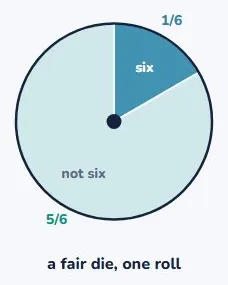
- Now weight one side of a die. What is the chance of a six?
| Situation | Why | How to find out |
|---|---|---|
| A fair coin | two identical sides | reason it out |
| A fair die | six identical faces | reason it out |
You genuinely cannot calculate that
- The argument for a fair die is that the faces are identical.
- Weight it, and that argument is gone. There is nothing left.
- The only way to find out is to roll it and count.
| Situation | Why | How to find out |
|---|---|---|
| A fair coin | two identical sides | reason it out |
| A fair die | six identical faces | reason it out |
| A weighted die | the symmetry is broken | you must experiment |
| A drawing pin | no symmetry at all | you must experiment |
So: count, and divide
- Count how many times the thing happened.
- Divide by how many trials you did altogether.
- 13 heads in 20 flips gives 13 ÷ 20, which is 0.65.
| Step | Working | Gives |
|---|---|---|
| Count the event | heads came up | 13 times |
| Count the trials | we flipped | 20 times |
| Divide | 13 ÷ 20 | 0.65 |
That fraction has a name
- It is the relative frequency of the event.
- Relative, because it is measured against the total.
- And it is an estimate of the probability, not the probability.
| Term | Means | |
|---|---|---|
| Frequency | how many times it happened | 13 |
| Relative frequency | out of how many trials | 13/20 |
| As a probability | an estimate | 0.65 |
Two people, same experiment, different answers
- Both roll the same die 30 times and count sixes.
- One gets 11, so 0.367. The other gets 4, so 0.133.
- Nobody made a mistake. This is normal.
| Run | Result | Estimate |
|---|---|---|
| Run 1 | 11 sixes in 30 rolls | 0.367 |
| Run 2 | 4 sixes in 30 rolls | 0.133 |
| Same die, same method | different answers |
Because each trial is its own event
- The die has no memory and no quota to fill.
- Any 30 rolls could come out almost any way.
- So an estimate from 30 trials is a rough one.
So do more of them
- Take a fair coin, where we know the answer is 0.5.
- Flip it 20 times, then 100, then 1000.
- Watch what the estimate does.
| Trials | Heads | Estimate |
|---|---|---|
| 20 flips | 13 heads | 0.65 |
Try it: more trials
It closes in on the truth
- 20 flips: 13 heads, so 0.65. A long way out.
- 100 flips: 54 heads, so 0.54. Closer.
- 1000 flips: 508 heads, so 0.508. Very close indeed.
| Trials | Heads | Estimate |
|---|---|---|
| 20 flips | 13 heads | 0.65 |
| 100 flips | 54 heads | 0.54 |
| 1000 flips | 508 heads | 0.508 |
| Theoretical | 0.5 |
Probability simulator
The errors make it obvious
- Out by 0.15. Then by 0.04. Then by 0.008.
- Each time you do a lot more trials, the error shrinks.
- That is the Law of Large Numbers, and that is all it is.
| Trials | Compared | Error |
|---|---|---|
| 20 flips | 0.65 vs 0.5 | out by 0.15 |
| 100 flips | 0.54 vs 0.5 | out by 0.04 |
| 1000 flips | 0.508 vs 0.5 | out by 0.008 |
But not what most people think it says
- It does not say the counts even out. Look at them.
- 13 against 7 is a gap of 6. 508 against 492 is a gap of 16.
- The counts drifted further apart. The proportion closed in.
| Trials | Split | Raw gap |
|---|---|---|
| 20 flips | 13 heads, 7 tails | gap of 6 |
| 100 flips | 54 and 46 | gap of 8 |
| 1000 flips | 508 and 492 | gap of 16 |
| So the counts | drift further apart |
Which is why "it is due" is wrong
- Five heads in a row does not make tails more likely next.
- The coin cannot remember, and it has nothing to make up.
- The proportion settles by adding trials, not by correcting.
| Belief | Verdict | |
|---|---|---|
| Tails is due after five heads | wrong | the coin has no memory |
| The next flip is still 0.5 | right |
Try it: estimate, gap, due?
How many trials is enough?
- Thirty is a sensible minimum for a rough estimate.
- A hundred or more before you trust a second decimal place.
- And there is no number that makes it exact.
| Trials | Good for | |
|---|---|---|
| Under 30 | almost nothing | |
| 30 or so | a rough estimate | |
| 100 or more | seeing the law work | |
| Any number | never exact |
Back to the weighted die
- Roll it 60 times. Six comes up 15 times.
- Experimental probability: 15 ÷ 60, which is 0.25.
- A fair die would give about 0.167. This one favours six.
| Step | Working | Gives |
|---|---|---|
| Rolled 60 times | six came up | 15 times |
| Experimental | 15 ÷ 60 | 0.25 |
| A fair die would be | 1 ÷ 6 | 0.167 |
| So this die | favours six |
And what that does and does not tell us
- It tells us this die is probably not fair.
- It does not tell us 0.25 is the exact chance.
- For that, roll it a thousand times instead of sixty.
| Claim | Supported? | |
|---|---|---|
| This die is not fair | yes, well supported | |
| P(six) is exactly 0.25 | no, 60 trials is too few | |
| P(six) is well above 1/6 | yes |
Common mistakes
- 13 heads and 7 tails, so P(heads) = 13/7.Divide by the total number of trials, not the other results: 13 ÷ 20 = 0.65.
- I got 11 sixes in 30 rolls, so the probability of a six is exactly 0.367.Relative frequency is only an estimate; another 30 rolls could give a different value.
- After five heads in a row, tails is more likely next time.The coin has no memory; each flip is independent, so P(tails) is still 1/2.
- With 1000 flips I will get exactly 500 heads.The Law of Large Numbers says the proportion of heads gets close to 0.5, not that the count lands exactly on 500.
Your turn: eight questions
- Try all eight.
- Question 2 wants a reason, not a calculation.
- Question 3 asks why, so say what more trials actually do.
A coin is flipped 40 times and lands heads 18. Find the experimental probability.
Why can you not calculate the probability a drawing pin lands point up?
Which estimates better, 30 trials or 200? Why?
A bag is drawn from 20 times, red 7 times. Find P(red) from the experiment.
A fair coin lands heads five times in a row. What is the probability of tails on the next flip?
Hemi rolls a die 30 times and gets 9 sixes. Aroha rolls the same die 30 times and gets 4. What explains it?
Which statement is what the Law of Large Numbers says about flipping a fair coin many times?
A spinner has 4 equal sections, one blue. It lands on blue 45 times in 100 spins. Compare with theory.
Show answer
1. 0.45, from 18 ÷ 40. 2. It has no symmetry to reason from. Nothing about its shape tells you how often it lands point up, so the only way to find out is to drop it a few hundred times and count. 3. 200. More trials brings the proportion closer to the true value. Note it does not guarantee it, it just makes a large error much less likely. 4. 0.35, from 7 ÷ 20. And with only 20 trials that is a rough estimate. 5. 0.5: the coin has no memory. Each flip is its own event, so tails is not due. 6. Normal variation: results from 30 trials vary. Nobody made a mistake; the die has no quota to fill. 7. The proportion of heads gets closer to 0.5. The raw counts can drift further apart, and no number of flips makes it exact. 8. 0.45 against 0.25: it probably favours blue. 45 ÷ 100 = 0.45, a fair spinner gives 1 ÷ 4 = 0.25, and 100 trials is enough to doubt it.
The answers
- 18 ÷ 40 is 0.45.
- A drawing pin has no symmetry to reason from, so you must drop it.
- 200 trials, because the proportion settles. And 7 ÷ 20 is 0.35.
| Answer | |
|---|---|
| 1 | 0.45 |
| 2 | no symmetry to reason from |
| 3 | 200 trials |
| 4 | 0.35 |
Plinko Probability
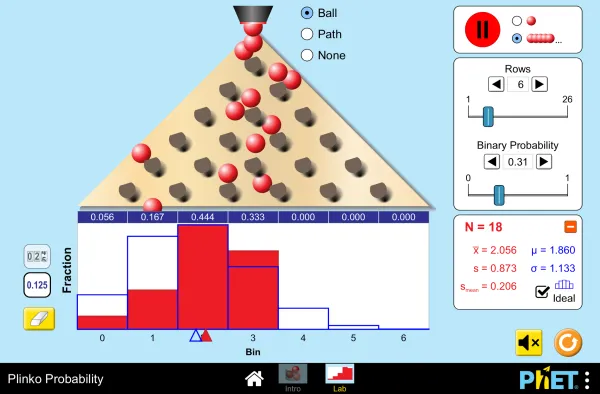
Full screen · PhET Interactive Simulations, University of Colorado Boulder, CC BY 4.0
What to take away
- Experimental probability is a count divided by the trials.
- More trials brings the proportion in, not the counts.
- And some situations can only ever be explored by experiment.
| Remember | |
|---|---|
| Experimental probability | times it happened, over trials |
| Two runs | of the same experiment will disagree |
| More trials | brings the proportion closer |
| The counts | drift further apart, and that is fine |
| A weighted die | can only be explored by rolling it |
Challenge
Three groups drop the same drawing pin and count how often it lands point up. Group A dropped it 50 times and got an experimental probability of 0.62. Group B dropped it 150 times and got 0.54. When the class put all three groups' results together, there were 300 drops altogether and the experimental probability of point up was 0.55. How many drops did Group C do, how many landed point up, and what was Group C's own experimental probability? Also explain why the estimate from Groups A and B together is not the average of 0.62 and 0.54.
Hint
Turn every probability back into a count of point-up landings before you combine anything.
Answer
Group C: 100 drops, 53 point up, experimental probability 0.53. A and B together give 112 ÷ 200 = 0.56, not 0.58, because Group B did three times as many drops, so its result counts for more.
Step by step
- Group A: 0.62 × 50 = 31 point up. Group B: 0.54 × 150 = 81 point up.
- Altogether: 0.55 × 300 = 165 point up in 300 drops.
- Group C did 300 − 50 − 150 = 100 drops, with 165 − 31 − 81 = 53 point up.
- So Group C's experimental probability is 53 ÷ 100 = 0.53.
- A and B together: 112 ÷ 200 = 0.56. Averaging 0.62 and 0.54 gives 0.58, which treats 50 drops as if they were worth as much as 150.
Full working
- 0.62 × 50 = 31Group A point up
- 0.54 × 150 = 81Group B point up
- 0.55 × 300 = 165all groups point up
- 300 − 50 − 150 = 100, 165 − 31 − 81 = 53Group C
- 53 ÷ 100 = 0.53Group C's estimate
- (31 + 81) ÷ 200 = 0.56, (0.62 + 0.54) ÷ 2 = 0.58combining counts, not probabilities
- Group C: 100 drops, 53 point up, 0.53; A and B together 0.56
A class wants to know how many kōura (freshwater crayfish) live in a pond. They catch 60 kōura, put a harmless mark on each, and let them go. A week later they catch 75 kōura and 9 of them are marked. The next week they catch 125 kōura and 11 are marked. Using the first week's catch, estimate the number of kōura in the pond. Then make a new estimate using both catches together. Which estimate should they trust more, and why?
Hint
The fraction of marked kōura in a catch is an estimate of the fraction of marked kōura in the whole pond. You know exactly how many marked ones are in the pond.
Answer
First catch: about 500 kōura. Both catches together: about 600 kōura. Trust 600 more, because it is based on 200 kōura instead of 75, and more trials give a better estimate.
Step by step
- In the first catch, 9 out of 75 are marked: 9 ÷ 75 = 0.12.
- So about 0.12 of the pond is marked. The marked ones number 60, so 12% of the pond is 60.
- 1% is 5, so the pond holds about 500.
- Both catches: 9 + 11 = 20 marked out of 75 + 125 = 200, which is 0.1. So 10% of the pond is 60, giving about 600.
- The combined estimate uses 200 kōura, so it is more trustworthy, but it is still only an estimate (it also assumes the marked kōura mix in well and none leave or die).
Full working
- 9 ÷ 75 = 0.12marked fraction in the first catch
- 12% of pond = 60, 1% = 5, 100% = 500first estimate
- (9 + 11) ÷ (75 + 125) = 20 ÷ 200 = 0.1both catches together
- 10% of pond = 60, 100% = 600second estimate
- 200 kōura beats 75 kōuramore trials, better estimate
- About 500 from the first catch; about 600 from both, and 600 is the better estimate
Wiremu flips a fair coin 100 times and gets 58 heads. His friend says tails is now due, so the coin will even things out. Suppose the next 900 flips give exactly half heads and half tails. What is the experimental probability of heads after all 1000 flips, and what is the gap between the number of heads and tails? If every flip after the first 100 keeps coming out exactly half heads, how many more flips (after the first 100) are needed before the experimental probability of heads is 0.501 or less?
Hint
After the first 100 flips, heads are 8 ahead of an exact half. If later flips split evenly, that extra 8 never goes away. What happens to 8 out of a bigger and bigger total?
Answer
After 1000 flips: 508 heads, experimental probability 0.508, and the gap is still 16. It takes 7900 more flips (8000 in total) to bring it down to 0.501.
Step by step
- After 1000 flips there are 58 + 450 = 508 heads and 42 + 450 = 492 tails.
- So P(heads) is 508 ÷ 1000 = 0.508, and the gap is 508 − 492 = 16, the same as after 100 flips.
- Nothing evened out: the proportion closed in because the total grew, not because tails caught up.
- Heads are always exactly half the flips plus 8 extra. For 0.501, those 8 extra must be 0.001 of all the flips.
- 0.001 of the total is 8 when the total is 8000, so 8000 − 100 = 7900 more flips are needed.
Full working
- 58 + 450 = 508, 42 + 450 = 492heads and tails after 1000
- 508 ÷ 1000 = 0.508experimental probability
- 508 − 492 = 16 = 58 − 42gap unchanged
- heads = half of total + 858 is 8 more than half of 100
- 8 ÷ total = 0.001, total = 8000the extra 8 must be 0.001 of all flips
- 4008 ÷ 8000 = 0.501check
- 0.508 with a gap of 16; 7900 more flips are needed