Equations, and what the letter is doing
What this lesson covers
- A variable can be used to represent: an unknown number, often in formulae; a quantity that can vary or change; a specific unknown value to be solved.
- The solution to an equation satisfies that equation.
- Equations can be rearranged using inverse operations (e.g. addition and subtraction, multiplication and division).
- Solutions to equations can be checked using substitution.
- Equations can be solved through trial and error, but this can be an inefficient method.
A letter does three different jobs
- In 3a = 18, the a is one unknown number. Find it.
- In A = bh, the letters are a formula. Put numbers in.
- In y = 3x + 4, they are a relationship. Neither is fixed.
| Looks like | The letter is | So you |
|---|---|---|
| 3a = 18 | one unknown value | solve for it |
| A = bh | a formula | substitute into it |
| y = 3x + 4 | a relationship | explore it |
Why that distinction matters
- Asked to "solve" A = bh, students go looking for b.
- There is nothing to find. It is a formula, not a puzzle.
- Read which job the letter is doing before you start.
| Looks like | The letter is | So you |
|---|---|---|
| 3a = 18 | one unknown value | solve for it |
| A = bh | a formula | substitute into it |
| y = 3x + 4 | a relationship | explore it |
What solving actually means
- 3a = 18. The solution is the value that makes it true.
- a = 6, because 3 × 6 really is 18.
- Any other number makes the statement false.
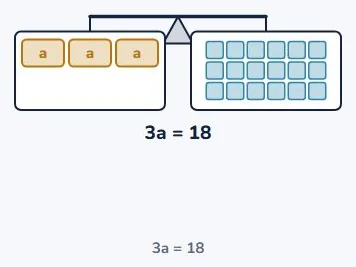
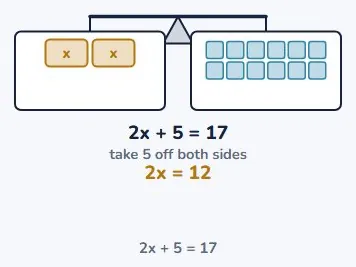
Think of it as a balance
- The two sides weigh the same. That is what = means.
- Take 5 off one pan and it tips, unless you take 5 off both.
- Every legal move is one you do to both sides.
Undo with the opposite operation
- Something added is undone by subtracting.
- Something multiplied is undone by dividing.
- These pairs are called inverse operations.
| If it was | Do this | |
|---|---|---|
| Added 7 | undo by | subtracting 7 |
| Subtracted 3 | undo by | adding 3 |
| Multiplied by 5 | undo by | dividing by 5 |
| Divided by 2 | undo by | multiplying by 2 |
Solving 2x + 5 = 17
- The 5 was added last, so take it off both sides first.
- That leaves 2x = 12.
- The x was doubled, so halve both sides. x = 6.
| Line | Move | Gives |
|---|---|---|
| 2x + 5 = 17 | take 5 off both pans | 2x = 12 |
| 2x = 12 | halve both pans | x = 6 |
| Check | 2 × 6 + 5 | 17 |
Try it: undo it on both sides
Could you just guess instead?
- Try 5s + 9 = −18 by trial. s = −5 gives −16. Close.
- s = −6 gives −21. Too far. s = −5.5 gives −18.5.
- Three goes, still not there. And the answer is not tidy.
| Guess | Working | Gives |
|---|---|---|
| s = −5 | 5(−5) + 9 | −16 |
| s = −6 | 5(−6) + 9 | −21 |
| s = −5.5 | 5(−5.5) + 9 | −18.5 |
| Target | −18 |
In fairness, guessing is sometimes fine
- For 3a = 18 you saw the answer instantly. No method needed.
- Guessing is quick when the answer is small and whole.
- It collapses when it is negative, or a decimal, or both.
| Equation | Guessing | Verdict |
|---|---|---|
| 3a = 18 | instant | fine |
| 5s + 9 = −18 | no | undo it instead |
So undo it instead
- 5s + 9 = −18. Subtract 9 from both sides: 5s = −27.
- Divide both sides by 5: s = −5.4.
- One pass, no guessing, and it works for any numbers.
| Line | Move | Gives |
|---|---|---|
| 5s + 9 = −18 | subtract 9 from both | 5s = −27 |
| 5s = −27 | divide both by 5 | s = −5.4 |
Notice the scales have gone
- A pan cannot hold −27 kilograms. The picture has run out.
- The algebra has not. It handles negatives without blinking.
- The balance explained why the method is allowed. It is done now.
| Balance | Algebra | |
|---|---|---|
| 2x + 5 = 17 | yes | yes |
| 5s + 9 = −18 | no | yes |
| t + 7 = 6.5 | no | yes |
One more the scales cannot hold
- t + 7 = 6.5. Something plus 7 gives less than 7.
- So t must be negative. Subtract 7 from both sides.
- t = −0.5. Predicted before we calculated it.
| Line | Move | Gives |
|---|---|---|
| t + 7 = 6.5 | subtract 7 from both | t = −0.5 |
| Check | −0.5 + 7 | 6.5 |
| Note | the answer was smaller than 7 |
You can always check your own answer
- Put your answer back into the original equation.
- 5 × −5.4 is −27, and −27 + 9 is −18. It works.
- No answer key needed. Algebra marks itself.
| Line | Move | Gives |
|---|---|---|
| 5s + 9 = −18 | subtract 9 from both | 5s = −27 |
| 5s = −27 | divide both by 5 | s = −5.4 |
| Check | 5(−5.4) + 9 | −18 |
Substituting, which is not solving
- Find w + 12 when w = 4. Nothing to solve. Put 4 in.
- 16. Same for y = 3x + 4 at x = 2, which gives 10.
- And A = bh with b = 5 and h = 4 gives 20.
| Given | Working | Answer |
|---|---|---|
| w + 12, w = 4 | 4 + 12 | 16 |
| y = 3x + 4, x = 2 | 3(2) + 4 | 10 |
| A = bh, b = 5, h = 4 | 5 × 4 | 20 |
Now: when it is not equal, but at least
- Some questions ask for a range, not a single value.
- "At least 5" is not one number, it is all of them from 5 up.
- We write that with an inequality sign.
| Sign | Means | End point |
|---|---|---|
| > | greater than | not including it |
| ≥ | greater than or equal to | including it |
| < | less than | not including it |
| ≤ | less than or equal to | including it |
Solving one works the same way
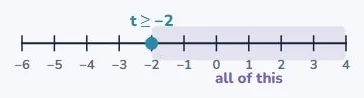
- t − 3 ≥ −5. Add 3 to both sides, exactly as before.
- t ≥ −2.
- So t can be −2, or anything above it.
| Line | Move | Gives |
|---|---|---|
| t − 3 ≥ −5 | add 3 to both sides | t ≥ −2 |
| So t can be | −2, −1, 0, 1, ... | |
| And −2 is | included |
Try it: solve it and draw it
And the circle tells you about the end
- t ≥ −2 includes −2, so the circle is filled in.
- If it were t > −2, the circle would be hollow.
- One stroke in the notation. Very visible on a line.
Common mistakes
- 2x + 5 = 17, so 2x = 22 and x = 11.Undo +5 by subtracting 5 from both sides: 2x = 12, so x = 6.
- 5s + 9 = −18, so 5s = −9 and s = −1.8.Subtract 9 from both sides: −18 − 9 = −27, so 5s = −27 and s = −5.4.
- t + 7 = 6.5 has no answer, because a number plus 7 can't be less than 7.t can be negative: subtract 7 from both sides to get t = −0.5.
- t ≥ −2, so I drew a hollow circle at −2.≥ includes −2, so the circle is filled in; a hollow circle is for > or <.
Your turn: eight questions
- Try all eight.
- Question 3 is a substitution, not an equation. Do not solve it.
- Check every answer by putting it back in.
Solve x + 8 = 3.
Solve 4m − 3 = 9.
Find 2p + 7 when p = 5.
Solve y − 4 ≤ 1, and say whether 5 is included.
To solve n ÷ 4 = 6, what do you do to both sides?
Solve 3r + 10 = 4.
Tia buys 3 books at the same price and a $5 bookmark. She pays $41 in total. How much is each book?
Solve x + 6 > 4. On a number line, is the circle at the end point filled or hollow?
Show answer
1. x = −5. Subtract 8 from both sides. The answer is negative, which is fine. 2. m = 3. Add 3 to both sides to get 4m = 12, then divide by 4. 3. 17. Substitute, do not solve: 2(5) + 7. 4. y ≤ 5, and yes, 5 is included, because the symbol has the line under it. On a number line that is a filled circle. 5. Multiply both sides by 4. The n was divided by 4, and multiplying is the inverse, giving n = 24. 6. r = −2. Subtract 10 from both sides to get 3r = −6, then divide both sides by 3. 7. $12. The equation is 3b + 5 = 41. Subtract 5 to get 3b = 36, then divide by 3. Check: 3 × 12 + 5 = 41. 8. x > −2, hollow circle. Subtract 6 from both sides. The > sign does not include −2, so the circle is hollow.
The answers
- x = −5, from subtracting 8. A negative answer is fine.
- m = 3, and 2p + 7 at p = 5 is 17.
- y ≤ 5, and 5 is included, so the circle is filled.
| Answer | |
|---|---|
| 1 | x = −5 |
| 2 | m = 3 |
| 3 | 17 |
| 4 | y ≤ 5, and 5 counts |
Equality Explorer
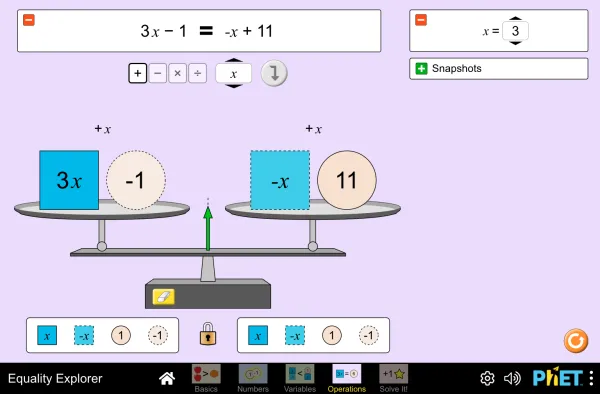
Full screen · PhET Interactive Simulations, University of Colorado Boulder, CC BY 4.0
What to take away
- Read what the letter is doing before you do anything to it.
- Undo the operations in reverse, doing the same to both sides.
- Then substitute your answer back, every single time.
| Remember | |
|---|---|
| A letter | does three jobs; read which one |
| Solving | undo the operations, in reverse |
| Both sides | always do the same to each |
| Checking | substitute your answer back in |
| ≥ and > | differ over whether the end point counts |
Challenge
The formula F = 1.8C + 32 turns a temperature in degrees Celsius (C) into degrees Fahrenheit (F). (a) A Wellington day is 15 °C. What is that in °F? (b) At one temperature the two scales show exactly the same number. Find it. (c) At what Celsius temperature is the Fahrenheit number exactly twice the Celsius number?
Hint
In (a) the letters are a formula: substitute. In (b) and (c) the two letters are no longer free: replace F with C, or with 2C, and you have an equation with one unknown. Collect the C terms on one side, as on a balance.
Answer
(a) 59 °F. (b) −40 (−40 °C is −40 °F). (c) 160 °C, which is 320 °F.
Step by step
- For (a), put C = 15 into the formula: 1.8 × 15 + 32 = 27 + 32 = 59.
- For (b), the same number means F = C, so C = 1.8C + 32.
- Take 1.8C off both sides: −0.8C = 32, so C = 32 ÷ −0.8 = −40.
- For (c), twice means F = 2C, so 2C = 1.8C + 32.
- Take 1.8C off both sides: 0.2C = 32, so C = 160, and F = 320.
- Check each answer by substituting it back into the formula.
Full working
- 1.8 × 15 + 32 = 27 + 32 = 59(a) substitute C = 15
- C = 1.8C + 32(b) F and C are the same number
- −0.8C = 32take 1.8C off both sides
- C = 32 ÷ −0.8 = −40divide both sides by −0.8
- Check: 1.8 × −40 + 32 = −72 + 32 = −40it works
- 2C = 1.8C + 32(c) F is twice C
- 0.2C = 32, so C = 160take 1.8C off both sides, then divide by 0.2
- Check: 1.8 × 160 + 32 = 288 + 32 = 320 = 2 × 160it works
- (a) 59 °F, (b) −40, (c) 160 °C (320 °F)
Hemi is 3 times as old as his sister Kiri. In 6 years' time he will be only twice as old as her. (a) Let Kiri's age now be k. Write an equation and solve it to find both ages now. (b) How many years ago was Hemi exactly 5 times as old as Kiri? Write and solve an equation for this too.
Hint
Write Hemi's age now, and both ages in 6 years, using k. "Twice as old" means Hemi's future age equals 2 times Kiri's future age. The unknown ends up on both sides: take the smaller number of k off both sides.
Answer
(a) Kiri is 6 and Hemi is 18. (b) 3 years ago, when Hemi was 15 and Kiri was 3.
Step by step
- Now: Kiri is k and Hemi is 3k. In 6 years: Kiri is k + 6 and Hemi is 3k + 6.
- Twice as old gives 3k + 6 = 2(k + 6) = 2k + 12.
- Take 2k off both sides: k + 6 = 12, so k = 6. Hemi is 3 × 6 = 18.
- For (b), y years ago Hemi was 18 − y and Kiri was 6 − y, so 18 − y = 5(6 − y).
- That is 18 − y = 30 − 5y. Add 5y to both sides: 18 + 4y = 30, so 4y = 12 and y = 3.
Full working
- 3k + 6 = 2(k + 6)ages in 6 years, Hemi twice Kiri
- 3k + 6 = 2k + 12multiply out the bracket
- k + 6 = 12, so k = 6take 2k off both sides, then 6
- Hemi is 3 × 6 = 18three times Kiri
- Check: in 6 years 24 and 12, and 24 = 2 × 12it works
- 18 − y = 5(6 − y) = 30 − 5y(b) y years ago
- 18 + 4y = 30, so 4y = 12 and y = 3add 5y to both sides, then take 18 off
- Check: 3 years ago 15 and 3, and 15 = 5 × 3it works
- (a) Kiri 6, Hemi 18; (b) 3 years ago
A Christchurch taxi works out its fare with the formula C = f + rd, where C is the cost in dollars, d is the distance in km, f is a fixed starting charge and r is the charge per km. A 4 km trip costs $17.80 and a 10 km trip costs $34.60. (a) Find f and r. (b) Find the cost of a 7 km trip. (c) Mere has $50. Fares are charged for whole kilometres only. What is the longest trip she can afford?
Hint
Both trips pay the same starting charge, so the difference in cost comes only from the extra kilometres.
Answer
(a) f = 6.60 and r = 2.80, so C = 6.60 + 2.80d. (b) $26.20. (c) 15 km (it costs $48.60; 16 km would cost $51.40).
Step by step
- The 10 km trip is 6 km longer and costs $16.80 more.
- So each km costs 16.80 ÷ 6 = $2.80.
- Substitute into the 4 km trip: 17.80 = f + 2.80 × 4, so f = 6.60.
- Now the formula gives any fare: 7 km costs 6.60 + 19.60 = 26.20.
- For part (c) solve 6.60 + 2.80d ≤ 50: d ≤ 15.5, so the longest whole-km trip is 15 km.
Full working
- 34.60 − 17.80 = 16.80extra cost for 6 more km
- r = 16.80 ÷ 6 = 2.80dollars per km
- 17.80 = f + 2.80 × 4 = f + 11.20substitute the 4 km trip
- f = 6.60subtract 11.20 from both sides
- Check: 6.60 + 2.80 × 10 = 34.60matches the 10 km trip
- 6.60 + 2.80 × 7 = 26.20cost of 7 km
- 6.60 + 2.80d ≤ 50, so 2.80d ≤ 43.40, d ≤ 15.5at most $50
- 15 km costs 48.60; 16 km costs 51.4016 is too far
- f = 6.60, r = 2.80; 7 km costs $26.20; longest trip 15 km