
Multiplying and dividing fractions and decimals
What this lesson covers
- In the simplest form of a fraction, the numerator and denominator do not share a common factor.
- Scaling by powers of 10 and using number facts supports multiplication with decimals.
12 ÷ 1/4 = 48
- Dividing just made the number bigger.
- That is not a typo and it is not a mistake.
- By the end of this it will be obvious.
| Calculation | Answer |
|---|---|
| 12 ÷ 4 | 3 |
| 12 ÷ 1/4 | 48 |
Multiplying by ten shifts the digits
- Every digit moves one column to the left.
- Dividing by ten moves them one to the right.
- The decimal point never actually moves.
| Calculation | What happens | Result |
|---|---|---|
| 3.5 × 10 | each digit moves one column left | 35 |
| 3.5 × 100 | two columns left | 350 |
| 3.5 ÷ 10 | one column right | 0.35 |
| 3.5 ÷ 100 | two columns right | 0.035 |
Watch it in the columns
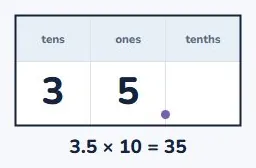
- 3.5 has a 3 in ones and a 5 in tenths.
- × 10 and the 3 becomes tens, the 5 becomes ones.
- Same digits, one column left. 35.
One fact, four answers
- If you know 7 × 5 = 35, you know all of these.
- Work out the easy one, then fix the size.
- 0.7 × 50 is 35; the shifts cancel out.
| Calculation | Reasoning | Answer |
|---|---|---|
| 7 × 5 | the fact you know | 35 |
| 0.7 × 5 | 7 is ten times too big | 3.5 |
| 0.7 × 50 | 7 down ten, 5 up ten | 35 |
| 0.07 × 5 | 7 is a hundred times too big | 0.35 |
0.35 × 6
- Ignore the point: 35 × 6 = 210.
- 0.35 has two decimal places.
- Put two back: 2.10, which is 2.1.
| Step | Working | Result |
|---|---|---|
| Ignore the point | 35 × 6 | 210 |
| Count the places | 0.35 has two | |
| Put them back | 210 with two places | 2.10 |
| Tidy up | drop the trailing zero | 2.1 |
Check the size is right
- 0.35 is about a third. Six thirds is about two.
- The answer was 2.1. That fits.
- 21 or 0.21 would not have.
| Answer | Against "about 2" |
|---|---|
| 2.1 | right size |
| 21 | ten times too big |
| 0.21 | ten times too small |
A fraction of an amount
- Three quarters of 20.
- Divide by the bottom to get one quarter: 5.
- Multiply by the top to get three of them: 15.
| Step | Working | Result |
|---|---|---|
| 3/4 of 20 | divide by the bottom | 20 ÷ 4 = 5 |
| multiply by the top | 5 × 3 = 15 | |
| Answer | 15 |
The same thing as a picture
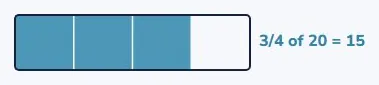
- Twenty, cut into four equal parts of 5.
- Take three of those parts.
- 15 out of 20.
Times a fraction is the same thing
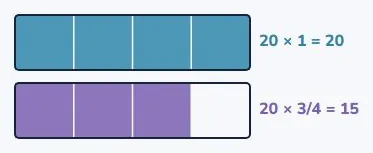
- 3/4 of 20 and 20 × 3/4 are the same question.
- Both give 15.
- And 15 is smaller than 20: multiplying shrank it.
| Written | Answer |
|---|---|
| 3/4 of 20 | 15 |
| 20 × 3/4 | 15 |
Try it: a fraction of a fraction
Why it shrank
- × 2 means take two of them.
- × 3/4 means take three quarters of one.
- Less than a whole one, so less than you started with.
Always leave it in simplest form
- An answer of 6/21 is correct but not finished.
- 6 and 21 both divide by 3.
- So write 2/7.
| Answer | Shared factor | Simplest |
|---|---|---|
| 6/21 | 3 | 2/7 |
| 2/12 | 2 | 1/6 |
| 15/20 | 5 | 3/4 |
3/4 ÷ 3
- Three quarters, shared between three people.
- One quarter each.
- Dividing made it smaller, as usual.
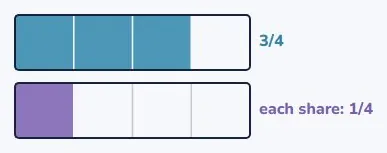
2/3 ÷ 4
- Two thirds shared four ways.
- Cut each third into four: twelfths. 2/12.
- Simplify: 1/6.
| Calculation | Working | Answer |
|---|---|---|
| 3/4 ÷ 3 | three quarters, shared three ways | |
| Each share | one quarter | 1/4 |
| 2/3 ÷ 4 | 2/12, then simplify | 1/6 |
Now the other kind
- 12 ÷ 1/4 is a different question entirely.
- Not "share 12 between a quarter of a person".
- It asks: how many quarters fit into 12?

How many quarters in 12?
- Each whole one holds four quarters.
- There are twelve wholes.
- 12 × 4 = 48.
| Step | Working | Answer |
|---|---|---|
| 12 ÷ 1/4 | how many quarters in 12? | |
| Each whole | holds 4 quarters | |
| 12 wholes | 12 × 4 | 48 |
Try it: how many fit?
The pattern behind both
- Multiplying by less than 1 shrinks.
- Dividing by less than 1 grows.
- The old rules were only true for numbers above 1.
| Operation | Effect |
|---|---|
| × a number above 1 | grows |
| × a number below 1 | shrinks |
| ÷ a number above 1 | shrinks |
| ÷ a number below 1 | grows |
Common mistakes
- 12 ÷ 1/4 = 3, because dividing always makes it smaller.It asks how many quarters fit into 12; each whole holds four, so 12 × 4 = 48.
- 0.35 × 6 = 21.35 × 6 = 210, then put back the two decimal places from 0.35 to get 2.10, which is 2.1.
- 2/5 of 35: 35 × 5 ÷ 2 = 87.5.Divide by the bottom, then multiply by the top: 35 ÷ 5 = 7, and 7 × 2 = 14.
- 6/7 ÷ 3 = 6/21, finished.6/21 is correct but not finished; 6 and 21 both divide by 3, so write it in simplest form as 2/7.
Your turn: eight questions
- Try all eight.
- On question 1, start from 6 × 4.
- On question 4, ask how many thirds fit.
Work out 0.6 × 40.
Find 2/5 of 35.
Work out 6/7 ÷ 3 in simplest form.
Work out 5 ÷ 1/3.
Work out 4.7 ÷ 100.
Mere says 0.08 × 30 = 24. What is the correct answer?
Hemi shares 3/4 of a pizza equally between 6 friends. What fraction of the pizza does each get, in simplest form?
Which of these gives an answer bigger than 12?
Show answer
1. 24. Use 6 × 4 = 24: the 6 went down ten and the 4 went up ten, so they cancel. 2. 14. 35 ÷ 5 = 7, then 7 × 2 = 14. 3. 2/7. Six sevenths shared three ways is 6/21, and 6 and 21 share a 3. 4. 15. There are three thirds in every whole, and five wholes, so 5 × 3. 5. 0.047. Dividing by 100 moves every digit two columns right, so the 4 moves from ones to hundredths. 6. 2.4. Start from 8 × 3 = 24; the 8 went down a hundred and the 3 up ten, so 24 is ten times too big. 7. 1/8. Three quarters shared six ways is 3/24, and 3 and 24 share a 3, so it simplifies to 1/8. 8. 12 ÷ 1/4, because dividing by a number below 1 makes it grow: it is 48. The others shrink to 9, 3 and 6.
The answers
- 0.6 × 40 is 24; the shifts cancel.
- 2/5 of 35 is 14. And 6/7 ÷ 3 is 2/7.
- 5 ÷ 1/3 is 15: three thirds in each of five wholes.
| Answer | |
|---|---|
| 1 | 24 |
| 2 | 14 |
| 3 | 2/7 |
| 4 | 15 |
What to take away
- Do the easy whole-number fact, then fix the size.
- A fraction of an amount: divide by the bottom, times the top.
- Dividing by a fraction asks how many fit, so it grows.
| Remember | |
|---|---|
| × 10, ÷ 10 | the digits shift columns |
| Decimal × whole | do the easy fact, then place the point |
| Fraction of an amount | divide by the bottom, times the top |
| Fraction ÷ whole | the pieces get smaller |
| Whole ÷ unit fraction | how many fit; the answer grows |
Challenge
You are told that 37 × 43 = 1591. Without multiplying again, work out A = 3.7 × 0.43, B = 0.037 × 43 and C = 370 × 0.0043. Then find the missing number in 0.43 × □ = 159.1. Finally, explain why A is smaller than 3.7.
Hint
Start from 37 × 43 and count how many times each number has been made ten times smaller or ten times bigger. For the missing number, how many places has 1591 moved, and how many has 43 moved?
Answer
A, B and C are all 1.591. The missing number is 370. A is smaller than 3.7 because 3.7 is multiplied by 0.43, which is less than 1.
Step by step
- A: 37 went down ten and 43 went down a hundred, so 1591 goes down a thousand: 1.591.
- B: 37 went down a thousand and 43 stayed, so again 1.591.
- C: 37 went up ten and 43 went down ten thousand, so overall down a thousand: 1.591.
- For the missing number: 159.1 is 1591 ten times smaller, and 0.43 is 43 a hundred times smaller, so □ must be 37 ten times bigger: 370.
- Multiplying by a number below 1 takes only part of it, so 3.7 × 0.43 is less than 3.7.
Full working
- 3.7 × 0.43: ÷ 10 and ÷ 1001591 ÷ 1000 = 1.591
- 0.037 × 43: ÷ 10001591 ÷ 1000 = 1.591
- 370 × 0.0043: × 10 and ÷ 10,0001591 ÷ 1000 = 1.591
- 0.43 × 370 = 43 × 37 ÷ 100 × 10 = 1591 ÷ 10the shifts must give 159.1
- 0.43 < 1, so 3.7 × 0.43 < 3.7× a number below 1 shrinks
- A = B = C = 1.591; □ = 370
A baker in Ōamaru has 9 kg of flour. She uses 34 of it to make loaves, and each loaf needs exactly 14 kg of flour. How many loaves does she make? The flour that is left is shared equally between 6 trays of scones. What fraction of a kilogram goes on each tray, in simplest form, and how many grams is that?
Hint
First find 34 of 9 kg. Then ask how many quarter kilograms fit into that amount. The flour left over is a fraction of a kilogram, shared between 6.
Answer
27 loaves, and 38 kg (375 g) of flour on each tray
Step by step
- 34 of 9 kg: divide by 4 and multiply by 3, which gives 274 kg, or 6 34 kg.
- Each whole kilogram holds 4 quarter kilograms, so 6 kg makes 24 loaves.
- The extra 34 kg holds 3 more quarters, so 27 loaves in all.
- The flour left is 9 − 6 34 = 2 14 kg, which is 94 kg.
- Shared between 6 trays: 94 ÷ 6 = 924, which simplifies to 38 kg.
- 38 of 1000 g is 1000 ÷ 8 × 3 = 375 g.
Full working
- 34 of 9 = 9 ÷ 4 × 3 = 274 = 6 34 kgdivide by the bottom, times the top
- 274 ÷ 14 = 2727 quarters fit into 27 quarters
- 9 − 6 34 = 2 14 = 94 kgflour left over
- 94 ÷ 6 = 924 = 38 kgcut each quarter into 6 pieces, then HCF 3
- 1000 ÷ 8 × 3 = 375 g38 of a kilogram
- 27 loaves; 38 kg = 375 g per tray
Start with the number 1. Multiply by 12, then divide by 13, then multiply by 14, then divide by 15, and keep going the same way: multiply by 16, divide by 17, multiply by 18, divide by 19, and finally multiply by 110. What number do you end with, in simplest form? Is it more or less than 14, and by how much?
Hint
Dividing by 13 asks how many thirds fit, which is the same as multiplying by 3. Rewrite every step as multiplying by a whole number or by a unit fraction.
Answer
63256, which is 1256 less than 14
Step by step
- Dividing by a unit fraction is the same as multiplying by its bottom number, so ÷ 13 is × 3, ÷ 15 is × 5, and so on.
- So the answer is 3 × 5 × 7 × 9 on top and 2 × 4 × 6 × 8 × 10 on the bottom.
- Top: 3 × 5 × 7 × 9 = 945. Bottom: 2 × 4 × 6 × 8 × 10 = 3840.
- 945 and 3840 share a factor of 15: 945 ÷ 15 = 63 and 3840 ÷ 15 = 256.
- 14 = 64256, so 63256 is just 1256 below it.
Full working
- 1 × 12 × 3 × 14 × 5 × 16 × 7 × 18 × 9 × 110÷ 1n is × n
- 3 × 5 × 7 × 92 × 4 × 6 × 8 × 10 = 9453840multiply tops, multiply bottoms
- 945 ÷ 15 = 63, 3840 ÷ 15 = 256HCF of 945 and 3840 is 15
- 14 = 64256equivalent fraction
- 64256 − 63256 = 1256compare
- 63256, which is 1256 less than 14
Practise this
Report a mistake
More in Number
 Powers of 10 and expanded form6 min
 Primes, factors, HCF and LCM7 min
 Integers, and adding below zero6 min
 Order of operations, rounding and remainders7 min
 Fractions, decimals and percentages7 minMultiplying and dividing fractions and decimals6 min
 Percentages, fractions of amounts, and proportion6 min
 Money, cash rounding and discounts6 min