Chance, sample space and the 0-to-1 scale
What this lesson covers
- Situations that involve chance, uncertainty, and randomness are called chance-based situations. Probability can be used to describe such situations.
- A trial is a single run of a chance-based situation that results in one of a set of possible outcomes.
- The possible outcomes for a chance-based situation can be arranged into events.
- The probability of an outcome is the chance of it occurring.
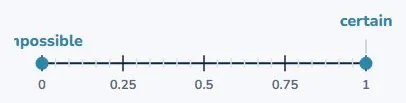
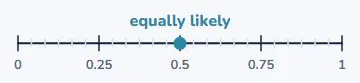
- Probabilities are associated with values between 0 and 1, where: 0 is impossible between 0 and 0.5 or 1/2 ranges from very unlikely to unlikely 0.5 or 1/2 is equally likely between 0.5 or 1/2 and 1 range from likely to very likely 1 is certain.
Two true things about one die
- Nobody can tell you what this roll will show.
- Everybody can tell you the chance of a six.
- Both true at once. That is what probability is for.
Chance-based situations
- Chance, uncertainty, randomness: all the same family.
- You cannot know the result before it happens.
- 7 × 8 is not one of these. It is 56, always.
| Situation | Chance-based? | Why |
|---|---|---|
| Rolling a die | yes | you cannot know which face |
| Tomorrow’s weather | yes | uncertain until it happens |
| 7 × 8 | no | it is 56, always |
| Your age next birthday | no | already decided |
Four words that get muddled
- Trial, outcome, sample space, event.
- They mean four different things.
- Worth ten seconds now to save an hour later.
| Word | Means | For a die |
|---|---|---|
| Trial | one single run | rolling the die once |
| Outcome | what that run gave | a 4 |
| Sample space | every outcome possible | 1, 2, 3, 4, 5, 6 |
| Event | outcomes grouped together | "even" means 2, 4 or 6 |
A trial is one single run
- Roll the die once: that is one trial.
- It gives exactly one outcome.
- Roll it thirty times and you have thirty trials.
| You do | That is |
|---|---|
| Roll once | 1 trial, 1 outcome |
| Roll 30 times | 30 trials |
| Flip a coin twice | 2 trials |
The sample space
- Every outcome that is possible. Each one listed once.
- For a die: 1, 2, 3, 4, 5, 6.
- Not 7. Not 0. Those are not possible.
| Situation | How many | Sample space |
|---|---|---|
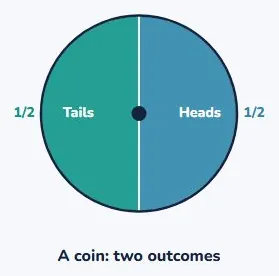
| A coin | 2 | heads, tails |
| A die | 6 | 1, 2, 3, 4, 5, 6 |
| A four-colour spinner | 4 | red, blue, green, yellow |
| Days of the week | 7 | Monday … Sunday |
Probability simulator
Listing one properly
- Be systematic: go in order, do not skip.
- A coin: heads, tails. Two outcomes.
- A die: 1 to 6. Six outcomes.
- Miss one and every probability after it is wrong.
Try it: every outcome for two dice
Outcomes group into events
- "An even number" is not one outcome.
- It is three of them: 2, 4 and 6.
- A group of outcomes like that is called an event.
| Event | Which outcomes | How many |
|---|---|---|
| Even | 2, 4, 6 | 3 |
| More than 4 | 5, 6 | 2 |
| A six | 6 | 1 |
| A seven | none | 0 |
A chance is a number
- "Probably" cannot be compared with "probably".
- The probability of an outcome is the chance of it happening.
- Written as a number between 0 and 1.

The two ends
- 0 means impossible. It cannot happen.
- 1 means certain. It must happen.
- Nothing sits outside those. There is no 1.5.
And the middle
- One half (0.5) means equally likely.
- As likely to happen as not.
- A fair coin landing heads sits exactly there.
The words for the in-between
- Below a half: unlikely, and below that very unlikely.
- Above a half: likely, and further up very likely.
- The words describe the number. The number comes first.
| Value | What we call it |
|---|---|
| 0 | impossible |
| between 0 and 1/2 | very unlikely, then unlikely |
| 1/2 | equally likely |
| between 1/2 and 1 | likely, then very likely |
| 1 | certain |
Real events on the line
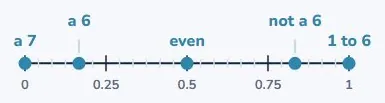
- A 7: impossible, so 0.
- A 6: 1/6, which is about 0.17 (unlikely).
- Not a 6: 5/6, about 0.83 (likely).
- Any of 1 to 6: certain, so 1.
When outcomes are equally likely
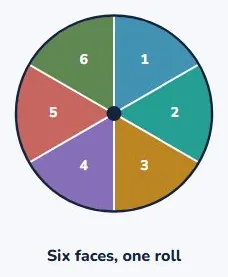
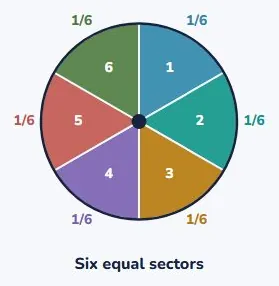
- A fair die: no face is favoured.
- Six outcomes, all with the same chance.
- Which is what lets you just count them.
The probability of one outcome
- Six equally likely outcomes.
- A six is one of them.
- So the probability is 1 out of 6: the fraction 1/6.
| Event | Count | Probability | As a decimal |
|---|---|---|---|
| Rolling a 6 | 1 of 6 | 1/6 | about 0.17 |
| Rolling an even number | 3 of 6 | 1/2 | 0.5 exactly |
| Rolling less than 6 | 5 of 6 | 5/6 | about 0.83 |
| Rolling a 7 | 0 of 6 | 0 | impossible |
Keep it as a fraction
- 1/6 is exact. 0.17 is rounded.
- Give the fraction unless you are asked otherwise.
- The decimal is for putting it on the line.
| Fraction | Decimal | Exact? |
|---|---|---|
| 1/2 | 0.5 | yes |
| 1/4 | 0.25 | yes |
| 1/6 | 0.1666… | no, rounds to 0.17 |
| 5/6 | 0.8333… | no, rounds to 0.83 |
When they are not equally likely
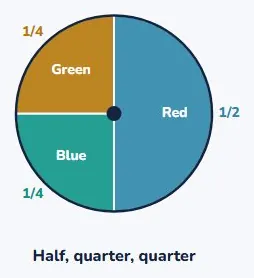
- Red takes half the spinner.
- Blue and green take a quarter each.
- So counting the colours would give the wrong answer.
- It is the size of each sector that decides.
Three colours, not one in three
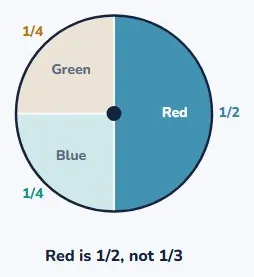
- Three colours might suggest 1/3 each.
- It is 1/2, 1/4 and 1/4.
- "How many kinds" is not "how likely".
Try it: three colours, unequal chances
Try it: events, the line and a spinner
One thing to notice
- On the die: six lots of 1/6.
- On the spinner: 1/2 + 1/4 + 1/4.
- Both come to exactly 1.
- That is not a coincidence (next lesson).
| Situation | All the probabilities | Total |
|---|---|---|
| A coin | 1/2 + 1/2 | 1 |
| A die | six lots of 1/6 | 1 |
| The spinner | 1/2 + 1/4 + 1/4 | 1 |
Common mistakes
- The spinner has three colours, so red has a probability of 1/3.Red takes half the spinner, so its probability is 1/2. Counting only works when the outcomes are equally likely.
- The probability of rolling a 6 is 1/6, which is 0.6.1/6 is 1 ÷ 6, which is about 0.17. 0.6 would be 6/10.
- The event "more than 4" is 4, 5 and 6.More than 4 does not include 4. It is only 5 and 6, so 2 of the 6 outcomes.
- Rolling less than 6 is unlikely.Five of the six faces are less than 6, so the probability is 5/6, about 0.83. That is above 1/2, so it is likely.
Your turn
List the sample space for spinning a three-colour spinner.
What is the probability of rolling a 3 on a fair die?
Which outcomes make up the event "more than 4"?
Where on the 0-to-1 line does "impossible" sit?
Hemi flips a coin 20 times. How many trials is that?
Which word best describes a probability of 0.3?
What is the probability of rolling a number less than 5 on a fair die?
A spinner is half red, a quarter blue and a quarter green. What is the probability of blue?
Show answer
1. The three colours, each listed once: that is the sample space; how likely each is depends on the sector sizes. 2. 1/6, because a fair die has six equally likely outcomes and a 3 is one of them. 3. 5 and 6, two outcomes, so 2/6, which is 1/3. 4. At 0, the very left-hand end. 5. 20 trials: each flip is one single run, so one trial. The 2 outcomes are the sample space, not the trials. 6. Unlikely: 0.3 is between 0 and 0.5, so below a half but above impossible. 7. 2/3: less than 5 means 1, 2, 3 or 4, so 4 of the 6 equally likely outcomes, and 4/6 is 2/3. 8. 1/4: blue takes a quarter of the spinner. Three colours does not mean 1/3 each; the sector size decides.
Plinko Probability
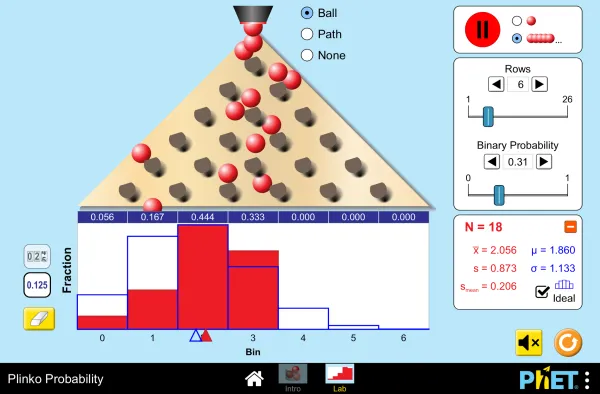
Full screen · PhET Interactive Simulations, University of Colorado Boulder, CC BY 4.0
What to take away
- A trial is one run; the sample space is every possible outcome.
- An event is a group of outcomes.
- A probability is a number from 0 to 1. 0.5 is equally likely.
- Equally likely outcomes let you count. Otherwise, measure.
Challenge
Tama rolls a fair red die and a fair blue die and adds the two numbers. He says: "The total can be anything from 2 to 12. That is 11 outcomes, so the chance of a total of 7 is 111." Explain what is wrong. Then find the real probability of a total of 7, and the probability of a total of 10 or more. What do you notice?
Hint
Treat the two dice as different. Red 1 with blue 6 is not the same result as red 6 with blue 1. How many (red, blue) results are there, and are they equally likely?
Answer
The 11 totals are not equally likely. P(total of 7) = 636 = 16, and P(total of 10 or more) = 636 = 16, the same
Step by step
- Counting only works when the outcomes are equally likely, and the totals 2 to 12 are not: a total of 2 can only happen one way, a 7 can happen many ways.
- The equally likely outcomes are the (red, blue) pairs: 6 choices for red times 6 for blue gives 36.
- A total of 7 comes from (1, 6), (2, 5), (3, 4), (4, 3), (5, 2) and (6, 1): 6 ways, so 636 = 16.
- A total of 10 or more comes from (4, 6), (5, 5), (6, 4), (5, 6), (6, 5) and (6, 6): also 6 ways, so 16.
- So a single total of 7 is exactly as likely as getting any of 10, 11 or 12, and both are unlikely.
Full working
- sample space: 6 × 6 = 36 equally likely (red, blue) pairseach die is fair
- total 7: (1,6) (2,5) (3,4) (4,3) (5,2) (6,1)6 ways
- P(7) = 636 = 16, not 111ways over total
- total 10: 3 ways, total 11: 2 ways, total 12: 1 way3 + 2 + 1 = 6
- P(10 or more) = 636 = 16the same as a 7
- P(7) = 16 and P(10 or more) = 16; Tama's 11 totals are not equally likely
The 8 letters of TAURANGA are written on 8 identical cards, one letter per card, and shuffled face down. Ana picks one card. Rua says: "There are 6 different letters, so the chance of an A is 16." (a) What is the real probability of an A? (b) What is the probability of a vowel, and where does it sit on the 0-to-1 scale? (c) Before Ana picks, you may take out exactly one card. Which cards could you take out so that a vowel becomes likely, but an A is still unlikely?
Hint
The equally likely outcomes are the 8 cards, not the 6 kinds of letter. For (c), try each kind of card in turn and count again out of 7.
Answer
(a) 38 (b) 48 = 12, equally likely (c) take out any one of T, R, N or G: then a vowel is 47 and an A is 37
Step by step
- The cards are what is equally likely, and there are 8 of them. Three of them are A, so P(A) = 38, not 16.
- The vowels are A, U, A, A: 4 cards out of 8, so the probability is 12, right in the middle of the scale (equally likely).
- Taking out one card leaves 7. To make vowels likely we need more than half of the 7 to be vowels, so all 4 vowels must stay.
- So the card taken out must be a consonant: T, R, N or G. Then a vowel is 47, more than 12, so likely.
- An A is then 37, which is less than 12, so still unlikely. Taking out the U or an A would leave only 3 vowels out of 7.
Full working
- T A U R A N G A: 8 cards, 3 are Acount cards, not kinds of letter
- P(A) = 38ways over total
- vowels A, U, A, A: P(vowel) = 48 = 12equally likely
- take out a consonant: P(vowel) = 47 > 12likely
- then P(A) = 37 < 12still unlikely
- take out U or an A: P(vowel) = 37not likely, so those fail
- (a) 38 (b) 12 (c) take out T, R, N or G
Four cards numbered 1, 2, 3 and 4 are shuffled face down. Aroha turns over one card for the tens digit, then, without putting it back, a second card for the ones digit, making a two-digit number. (a) List the sample space. How many outcomes are there? (b) Find the probability that the number is even, that it is more than 40, and that it is a multiple of 3, and give each one a word from the 0-to-1 scale. (c) Ana says: "If Aroha put the first card back and shuffled before picking again, a number with both digits the same would go from impossible to likely." Is she right? Would a number more than 40 become more likely?
Hint
Be systematic: list every number with a 1 in the tens place, then a 2, and so on. A card that is not put back cannot be picked again. For (c), list the new sample space the same way.
Answer
(a) 12 outcomes: 12, 13, 14, 21, 23, 24, 31, 32, 34, 41, 42, 43 (b) even 612 = 12, equally likely; more than 40 312 = 14, unlikely; multiple of 3 412 = 13, unlikely (c) Ana is only half right: both digits the same goes from 0 (impossible) to 416 = 14, which is unlikely, not likely; more than 40 stays at 14
Step by step
- Each tens digit (4 choices) can be followed by any of the 3 cards left, so there are 4 × 3 = 12 numbers, all equally likely: 12, 13, 14, 21, 23, 24, 31, 32, 34, 41, 42, 43.
- Even means the ones digit is 2 or 4: 12, 14, 24, 32, 34, 42. That is 6 out of 12, so 12: equally likely.
- More than 40 means a 4 first: 41, 42, 43, so 312 = 14: unlikely. Multiples of 3 are 12, 21, 24, 42, so 412 = 13: also unlikely.
- Without putting the card back, both digits the same cannot happen: probability 0, impossible. With the card put back there are 4 × 4 = 16 numbers, and 11, 22, 33, 44 are 4 of them: 416 = 14.
- 14 is less than 12, so it is unlikely, not likely: Ana is wrong about that. More than 40 is now 41, 42, 43, 44, which is 416 = 14, exactly the same as before.
Full working
- 4 tens digits × 3 cards left = 12 outcomesthe first card is not put back
- 12, 13, 14, 21, 23, 24, 31, 32, 34, 41, 42, 43sample space, in order
- even: 12, 14, 24, 32, 34, 42, so 612 = 12equally likely
- more than 40: 41, 42, 43, so 312 = 14; multiple of 3: 12, 21, 24, 42, so 412 = 13both unlikely
- put back: 4 × 4 = 16 outcomes; 11, 22, 33, 44 gives 416 = 14was 0, impossible
- more than 40 with the card put back: 41, 42, 43, 44 gives 416 = 14no change
- (a) 12 outcomes (b) 12, 14, 13 (c) same digits becomes 14, unlikely, not likely; more than 40 stays 14