Collecting data: rounding rules and paired variables
What this lesson covers
- Measurements for continuous numerical data need to have the place value for rounding specified (e.g. to the nearest centimetre).
- Bivariate data is data in a set that has two variables for each subject (e.g. dislikes and gender for each student).
Data does not arrive. Somebody collects it.
- And the choices made while collecting decide what you can find out.
- There are two of them, and neither can be fixed later.
- How precisely you measure, and whether you record the pairing.
| decision | if you get it wrong |
|---|---|
| how precisely to measure | the set does not agree with itself |
| what to pair together | a question becomes unanswerable |
Continuous data comes from measuring
- Counting gives whole numbers: 12 children, 3 dogs.
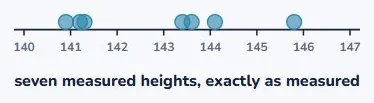
- Measuring does not. A height can be any value in a range.
- Here are seven real heights, in centimetres.
Try it: count or measure?
The rounding is agreed first
- The curriculum says the place value must be specified.
- Specified, not just done. That is a claim about the order.
- You agree the rule before anybody picks up a tape measure.
| who measures | their rule | what they write down |
|---|---|---|
| first | nearest cm | 144 cm |
| second | nearest mm | 143.6 cm |
| third | nearest 10 cm | 140 cm |
Why afterwards is too late
- You can always round a fine measurement more coarsely.
- You can never get back millimetres you did not write down.
- So the rule goes in the plan, and next to the data.
| you recorded | can you get | to the nearest cm? |
|---|---|---|
| 143.6 cm | yes | 144 cm |
| 140 cm | no | it could be anything from 135 up to 145 |
Applying the rule
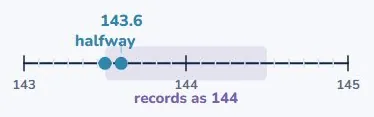
- To the nearest centimetre: look at the millimetres.
- 143.6 is past halfway between 143 and 144.
- So it is recorded as 144 cm.
Try it: round to the agreed place
What the rule does to the whole set
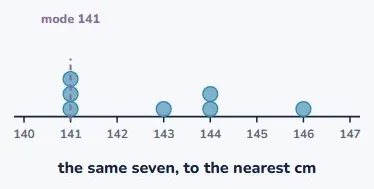
- Apply it to all seven, and the dots land on whole numbers.
- Three of them are now the same value: 141.
- You lost detail. You gained a set you can work with.
Too precise is also wrong
- Measuring a field to the nearest millimetre is not careful.
- It is a lie about how well you measured. The tape sags.
- Match the precision to what you can actually do.
| measuring | round to | why |
|---|---|---|
| a pencil | nearest mm | a ruler can do it |
| your height | nearest cm | you move more than a mm |
| a sports field | nearest m | the tape sags anyway |
Two things about each person
- Bivariate data has two variables for every subject.
- Here: what each student does at lunchtime, and their gender.
- One row per student, with both values on that row.
| student | at lunchtime | gender |
|---|---|---|
| Aroha | sport | girl |
| Ben | library | boy |
| Mele | sport | girl |
| Tane | sport | boy |
The mistake that cannot be undone
- Tally lunchtime activities. Then tally boys and girls.
- You have collected both variables, and lost the link.
- "Do more boys than girls play sport?" is now unanswerable.
| what you have | what you can ask |
|---|---|
| 12 play sport | how many play sport |
| 12 boys, 15 girls | how many boys there are |
| both, separately | nothing about the two together |
Recorded properly, you can ask
- With the pairing kept, the tally has rows and columns.
- Now: 7 boys play sport and 5 girls do.
- And the library is the other way round: 2 boys, 6 girls.
| at lunchtime | boys | girls | total |
|---|---|---|---|
| sport | 7 | 5 | 12 |
| library | 2 | 6 | 8 |
| talking | 3 | 4 | 7 |
Both variables here are categories
- Lunchtime activity is a category, not a number.
- So is gender. Neither can be averaged or measured.
- Paired categories are what you count into a two-way table.
| variable | kind | you can |
|---|---|---|
| height | continuous number | measure and round it |
| lunchtime activity | category | count how many |
| gender | category | count how many |
Check it adds up
- Every subject appears exactly once, in exactly one cell.
- So the cells must total the number of people you asked.
- 12 + 8 + 7 is 27. If your class is 27, the table is complete.
| check | value |
|---|---|
| sport + library + talking | 12 + 8 + 7 = 27 |
| boys + girls | 12 + 15 = 27 |
| people in the class | 27 |
Try it: keep the pair
Common mistakes
- 143.6 cm to the nearest centimetre is 143 cm.The .6 is past halfway between 143 and 144, so it rounds up to 144 cm.
- 156.5 cm to the nearest centimetre is 156 cm.Exactly halfway rounds up, so 156.5 cm becomes 157 cm.
- I tallied what everyone did at lunch, then tallied boys and girls on a separate list.Keep both answers for each student on one row, or you can no longer tell how many boys play sport.
- We will decide how to round after everyone is measured.Agree the rounding rule first. Millimetres you never wrote down can never be got back.
Your turn
Round 156.4 cm and 156.5 cm to the nearest centimetre.
What precision would you use for the length of a room?
Name the two variables in "pets owned, and year level".
A two-way table totals 24 across and 26 down. What is wrong?
Which of these is continuous numerical data?
Which of these is bivariate data?
Mia's height was recorded as 140 cm, to the nearest 10 cm. Can you now give her height to the nearest cm?
In Room 9, 6 boys and 9 girls walk to school; 8 boys and 4 girls come by car. Do more boys or girls walk, and by how many?
Show answer
1. 156 cm and 157 cm: exactly halfway rounds up. 2. Nearest centimetre, or nearest 10 cm. Millimetres would be pretending. 3. Number of pets (a count) and year level (a category). 4. Someone has been counted twice, or missed. Both totals must match. 5. Arm span in centimetres. It comes from measuring, so it can be any value in a range; the others are counts or categories. 6. Each student's lunchtime activity and gender, on one row. Two variables per subject, with the pairing kept. 7. No: the centimetres were never written down. You can round a fine measurement more coarsely, but never get detail back. 8. Girls, by 3. Read the walk row: 9 girls against 6 boys, and 9 − 6 = 3.
What to take away
- Agree the rounding before you measure, and record the rule.
- Bivariate means both values on one row, per subject.
- A pairing you did not write down cannot be recovered.
| job | the move |
|---|---|
| continuous data | specify the place value first |
| choosing precision | match what you can actually measure |
| two variables | one row per subject, both values |
| checking a table | totals must agree both ways |
Challenge
Room 12 has 27 students: 15 girls and 12 boys. Their teacher kept two separate tallies and lost the pairing: 20 students play sport at lunchtime and 7 do not. What is the smallest number of girls who could play sport, and what is the largest?
Hint
To make the number of girls as small as possible, give as many of the sport places as you can to the boys. Then do the opposite.
Answer
At least 8 girls play sport, and at most 15.
Step by step
- There are 20 sport players, and at most 12 of them can be boys, because there are only 12 boys.
- If all 12 boys play sport, the other 20 − 12 = 8 players must be girls. That is the fewest girls possible.
- For the most girls, all 15 girls play sport, and the other 5 players are boys.
- So the answer could be anything from 8 to 15. The separate tallies cannot say which; only a record with both values for each student could.
Full working
- boys who play sport ≤ 12there are only 12 boys
- 20 − 12 = 8fewest girls: all 12 boys play
- girls who play sport ≤ 15there are only 15 girls
- 20 − 15 = 5 boysmost girls: all 15 play, 5 boys fill the rest
- Smallest 8 girls, largest 15 girls
A class of 30 Year 5 and Year 6 students recorded how each one gets to school: walk, bus or car. The two-way table was lost, but these facts are known. 16 students are in Year 6. 12 students walk, and twice as many Year 6s walk as Year 5s. 8 students come by bus. The same number of Year 5s as Year 6s come by car. Rebuild the whole table. Do more Year 5s or Year 6s come by bus?
Hint
Start with the walkers: split 12 into two parts where one is double the other. Then see how many in each year group are left after walking, and try equal car numbers until the bus total is 8.
Answer
Walk: 4 Year 5s, 8 Year 6s. Bus: 5 Year 5s, 3 Year 6s. Car: 5 Year 5s, 5 Year 6s. More Year 5s come by bus (5 against 3).
Step by step
- 30 − 16 = 14 students are in Year 5.
- The 12 walkers split so Year 6 has twice Year 5: 4 and 8.
- After walking, 14 − 4 = 10 Year 5s and 16 − 8 = 8 Year 6s are left for bus and car.
- Equal car numbers are taken from both, so the bus numbers always differ by 2. Two numbers that differ by 2 and make 8 are 5 and 3, so 5 of each come by car.
- Check: every row and column adds up, and the total is 30.
Full working
- 30 − 16 = 14Year 5 students
- 4 + 8 = 12, and 8 = 2 × 4walkers
- 14 − 4 = 10, 16 − 8 = 8left for bus and car
- car 5 each: bus 10 − 5 = 5 and 8 − 5 = 35 + 3 = 8 bus riders
- Year 5: 4 + 5 + 5 = 14, Year 6: 8 + 3 + 5 = 16totals check
- 12 + 8 + 10 = 30walk + bus + car
- Walk 4 and 8, bus 5 and 3, car 5 and 5; more Year 5s take the bus
Three friends were measured to the nearest centimetre: 138 cm, 141 cm and 146 cm. A week later a nurse measures them again (they have not grown), this time to the nearest millimetre, and each new reading rounds back to the same centimetre value. What is the smallest the three new readings could add up to, and what is the largest? Why are these two answers not the same distance from 425 cm?
Hint
Which millimetre readings round to 138 cm? Remember that exactly halfway rounds up. Find the lowest and highest for one person, then do the same for all three.
Answer
Smallest total 423.5 cm, largest total 426.2 cm. Halfway values like 137.5 cm round up, so each reading can be up to 0.5 cm below the recorded value but only 0.4 cm above it.
Step by step
- A reading to the nearest millimetre has one decimal place in centimetres.
- 137.5 rounds up to 138, but 138.5 would round up to 139. So the readings that give 138 run from 137.5 to 138.4.
- The same holds for each friend: from 0.5 cm below to 0.4 cm above the recorded height.
- The recorded heights add to 425 cm. Smallest: 425 − 3 × 0.5 = 423.5 cm. Largest: 425 + 3 × 0.4 = 426.2 cm.
- Halfway always rounds up, which is why the range is lopsided.
Full working
- 138 + 141 + 146 = 425 cmthe recorded total
- 137.5 to 138.4 cm round to 138 cmhalfway rounds up
- each reading: 0.5 below to 0.4 abovesame for all three
- 137.5 + 140.5 + 145.5 = 423.5 cmall as low as possible
- 138.4 + 141.4 + 146.4 = 426.2 cmall as high as possible
- Smallest 423.5 cm, largest 426.2 cm