Parallel and perpendicular lines, and prisms
What this lesson covers
- Parallel lines are always the same distance apart and never meet.
- Perpendicular lines intersect at right angles (90°).
- A prism is a 3D shape with two identical, parallel ends and flat faces.
Neither word describes one line
- A single line is not parallel. Parallel to what?
- Both words say how two lines sit next to each other.
- So you always mark them in pairs.
| word | what it says about a pair |
|---|---|
| parallel | always the same distance apart |
| perpendicular | they cross at a right angle |
Parallel: the same distance apart
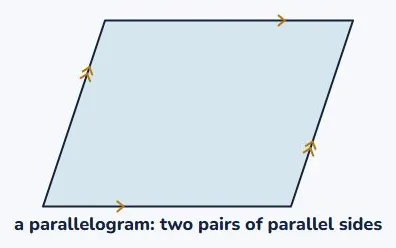
- Measure the gap anywhere along them. It never changes.
- Because of that, they never meet, however far you extend them.
- The arrows mark which sides are parallel to which.
"Never meet" is not enough
- Two lines drifting slowly together also never meet on the page.
- They are not parallel. The page just ran out.
- The test is the gap, not whether you can see them touch.
| gap along the lines | parallel? |
|---|---|
| 3 cm, 3 cm, 3 cm | yes |
| 3 cm, 2 cm, 1 cm | no, they are closing |
Perpendicular: crossing at 90°
- Perpendicular lines meet at a right angle. Exactly 90°.
- The little square at the corner is how you show it.
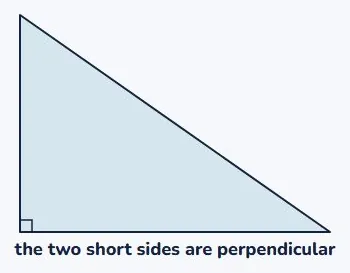
- These two sides are perpendicular to each other.
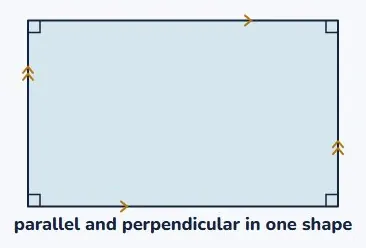
A rectangle has both
- Two pairs of parallel sides: top with bottom, left with right.
- And every corner is a right angle.
- So each side is parallel to one side and perpendicular to two.
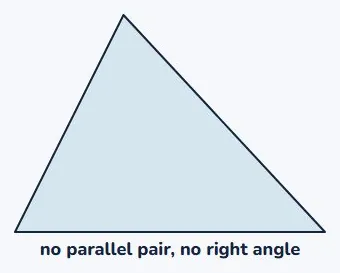
And a shape with neither
- This triangle has three different side lengths.
- No two sides are parallel, and no corner is a right angle.
- Plenty of shapes have neither. That is a real answer.
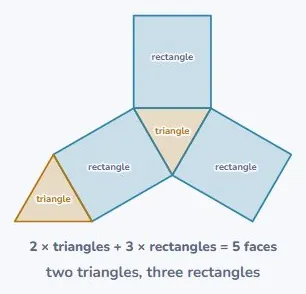
What makes a prism a prism
- Two ends that are identical to each other and parallel.
- And every other face flat: rectangles joining the ends.
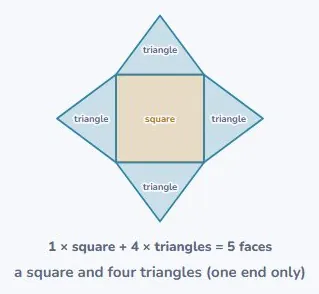
- Unfold one and you can see both conditions at once.
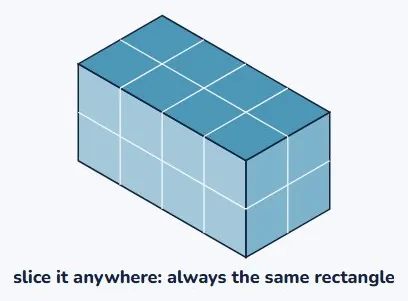
The cross section never changes
- Slice a prism anywhere between its two ends.
- You always get the same shape as the ends.
- That constant shape is called the cross section.
The cross section gives the name
- A triangle cross section makes a triangular prism.
- A hexagon makes a hexagonal prism. No exceptions.
- A cube is a prism too; its cross section is a square.
| cross section | the solid is called |
|---|---|
| triangle | triangular prism |
| square | cube, or square prism |
| rectangle | rectangular prism (a cuboid) |
| pentagon | pentagonal prism |
| hexagon | hexagonal prism |
Two ways to fail the test
- A pyramid fails: one end is a point, not a copy of the other.
- A cylinder has a constant cross section, but no flat sides.
- Both conditions have to hold, not just one.
Try it: prism or not?
Faces, edges and vertices
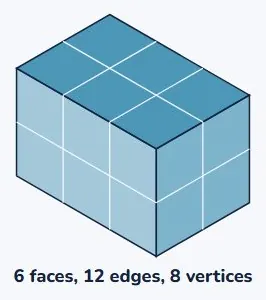
- A face is a flat surface. An edge is where two faces meet.
- A vertex is a corner, where edges meet.
- This cuboid has 6 faces, 12 edges and 8 vertices.
Count them from the cross section
- Do not memorise three numbers per solid. Count from n.
- n sides plus 2 ends. n edges round each end plus n joining.
- And n corners at each end. So n + 2, 3n and 2n.
| part | how many | why |
|---|---|---|
| faces | n + 2 | n sides, plus the two ends |
| edges | 3n | n round each end, n joining them |
| vertices | 2n | n corners at each end |
Try it: count faces, edges and vertices
It works on every prism
- A hexagonal prism: n is 6, so 8 faces and 18 edges.
- And 12 vertices. You never had to look at one.
- Notice each column grows by a constant: a pattern, as last lesson.
| n | prism | faces | edges | vertices |
|---|---|---|---|---|
| 3 | triangular | 5 | 9 | 6 |
| 4 | rectangular | 6 | 12 | 8 |
| 5 | pentagonal | 7 | 15 | 10 |
| 6 | hexagonal | 8 | 18 | 12 |
Common mistakes
- These lines never meet on the page, so they are parallel.Check the gap: parallel lines stay the same distance apart everywhere, and lines that are closing in are not parallel.
- A square pyramid is a prism because its sides are flat.A prism needs two identical, parallel ends; a pyramid's top is a point, so it is not a prism.
- A hexagonal prism has 6 + 2 = 8 edges.n + 2 counts faces; edges are 3n, so a hexagonal prism has 3 × 6 = 18 edges (and 8 faces).
- A cylinder is a prism because every slice is the same circle.A cylinder has a constant cross section but no flat sides, so it fails the prism test.
Your turn
How many pairs of parallel sides has a square? Right angles?
Two lines are 4 cm apart, then 4 cm, then 3 cm. Parallel?
An octagonal prism: faces, edges and vertices?
Why is a cone not a prism? Give both reasons.
In a rectangle, how many other sides is the top side perpendicular to?
A prism has 7 faces. What shape is its cross section, and what is the prism called?
Ana says a triangular prism has 6 faces, 9 edges and 6 vertices. Which count is wrong, and what should it be?
A prism has 30 edges. How many vertices does it have?
Show answer
1. Two pairs, and four right angles. 2. No, the gap changes, so they are closing. 3. n = 8, so 10 faces, 24 edges, 16 vertices. 4. Its two ends are not identical (one is a point) and its side is curved, not flat. 5. Two: the left and right sides. They meet the top at right angles; the bottom side is parallel to it instead. 6. Pentagon; a pentagonal prism. Faces are n + 2, so n + 2 = 7 gives n = 5 sides. 7. Faces: it should be 5. With n = 3 there are 3 + 2 = 5 faces; 9 edges and 6 vertices are right. 8. 20 vertices. Edges are 3n, so n = 10, and vertices are 2n = 20.
What to take away
- Parallel means the same distance apart, always, both ways.
- Perpendicular means crossing at exactly 90°.
- A prism is named by its cross section, and counted from it.
| job | the move |
|---|---|
| parallel? | measure the gap in two places |
| perpendicular? | look for exactly 90° |
| is it a prism? | identical parallel ends, all faces flat |
| count the parts | n + 2 faces, 3n edges, 2n vertices |
Challenge
Mia counts the faces, the edges and the vertices of a prism and adds the three numbers together. Her total is 62. What shape is the cross section of her prism? Explain why no prism could ever give a total of 100.
Hint
Use the rules from the lesson for a prism whose cross section has n sides, and add them up.
Answer
A 10-sided cross section (a decagonal prism). No prism gives 100, because the total is always 2 more than a multiple of 6, and 100 is not.
Step by step
- For a cross section with n sides there are n + 2 faces, 3n edges and 2n vertices.
- Added together that is 6n + 2.
- 6n + 2 = 62 means 6n = 60, so n = 10: a decagon.
- For a total of 100 we would need 6n = 98, and 98 is not in the 6 times table.
- So no prism can give 100.
Full working
- (n + 2) + 3n + 2n = 6n + 2faces + edges + vertices
- 6n + 2 = 62Mia's total
- 6n = 60, n = 10decagonal prism
- 12 + 30 + 20 = 62check
- 6n + 2 = 100 gives 6n = 98, and 98 is not in the 6 times tableso 100 is impossible
- Decagonal prism; 100 can never happen
A regular octagon (like a stop sign) has eight equal sides and eight equal angles. How many pairs of its sides are parallel? If each side is stretched out into a full straight line, how many pairs of sides are perpendicular? Then answer the same two questions for a regular hexagon.
Hint
Sort the sides by the direction they point. In the octagon, how many sides point the same way as the top side?
Answer
Octagon: 4 pairs of parallel sides and 8 pairs of perpendicular sides. Hexagon: 3 pairs of parallel sides and no perpendicular sides.
Step by step
- The octagon's sides point in 4 different directions: across, up, and the two slants. Each direction has exactly two sides, opposite each other.
- So there are 4 parallel pairs.
- Across is at a right angle to up, and the two slants are at a right angle to each other.
- Each of the 2 across sides is perpendicular to each of the 2 up sides: 2 × 2 = 4 pairs. The slants give another 2 × 2 = 4 pairs. That makes 8.
- The hexagon's sides point in only 3 directions, two sides each, so 3 parallel pairs. No two of its directions make a right angle, so it has no perpendicular sides.
Full working
- 8 sides ÷ 2 per direction = 4 directionsoctagon
- 4 directions, one pair each = 4 parallel pairsopposite sides
- 2 × 2 = 4across sides with up sides
- 2 × 2 = 4one slant with the other slant
- 4 + 4 = 8 perpendicular pairsoctagon
- 6 sides ÷ 2 = 3 directions, 3 parallel pairs, 0 perpendicularhexagon
- Octagon 4 parallel, 8 perpendicular; hexagon 3 parallel, 0 perpendicular
Tane glues a pyramid onto one end of a prism. The base of the pyramid is exactly the same polygon as the end of the prism and covers it perfectly, so the two become one solid. The new solid has 40 edges. How many faces and how many vertices does it have?
Hint
A pyramid on an n-sided base has the base, n triangles meeting at one top point, n edges round the base and n edges going up to the point. When you glue, which faces disappear and which edges are shared?
Answer
21 faces and 21 vertices (the end is a decagon, with 10 sides).
Step by step
- Call the number of sides of the end n.
- The prism has 3n edges. The pyramid adds only its n sloping edges, because its base edges sit on top of the prism's end edges.
- So the solid has 3n + n = 4n edges, and 4n = 40 gives n = 10.
- Faces: the prism's n + 2 = 12, take away the glued end, then add the pyramid's 10 triangles (its base is hidden too): 11 + 10 = 21.
- Vertices: the prism's 2n = 20, plus the one top point of the pyramid: 21.
Full working
- 3n + n = 4nprism edges plus the pyramid's sloping edges
- 4n = 40, n = 10a decagon end
- (n + 2) − 1 = 11prism faces left after gluing
- 11 + 10 = 21add the pyramid's triangles
- 2n + 1 = 20 + 1 = 21prism corners plus the top point
- 21 faces and 21 vertices