
Temperature: measuring how hot or cold
What this lesson covers
- Temperature tells us how hot or cold something is
- Thermometers measure temperature in degrees Celsius (°C)
- Reading a thermometer scale, including what each small mark is worth
- Predicting a temperature, then measuring it
- Why two readings can differ, and how to make readings more accurate
What temperature is
- Temperature is how hot or cold something is.
- Your skin is not a good judge. It compares with whatever it touched last.
- So we measure temperature with a thermometer.
- The unit is degrees Celsius, written °C.
How a thermometer works
- A liquid thermometer has a thin glass tube with coloured liquid inside and a bulb at the bottom.
- When the liquid warms up, it takes up more space and climbs the tube. When it cools, it shrinks back down.
- A digital thermometer shows the number on a screen.
- Some temperatures to know:
| Thing | About |
|---|---|
| Water with ice in it | 0 °C |
| A warm classroom | 20 °C |
| Your body | 37 °C |
| Pure water boiling at sea level | 100 °C |
Try it: match the temperature
Reading the scale
- Find the top of the liquid.
- Look at the numbered marks just above and just below it.
- Work out what each small mark is worth: count the gaps between two numbers and share the difference between them.
- Keep your eye level with the top of the liquid, not above or below it.
- Always write the unit, °C, after the number.
Example: what does it say?
- The thermometer has a number every 10 °C, with 5 small gaps between numbers.
- The liquid stops 2 marks above 20. What is the temperature?
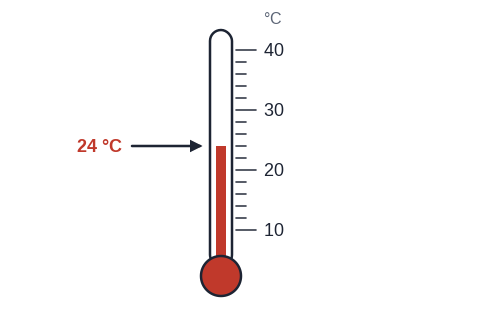
- 10 °C ÷ 5 gaps = 2 °C for each markwhat a mark is worth
- 2 marks × 2 °C = 4 °Chow far above 20
- 20 °C + 4 °C = 24 °C
Example: predict, then measure
- Room 9 predicted the temperature of four cups of water, then measured each one.
- Which prediction was furthest from the measurement?
| Cup | Prediction | Measured |
|---|---|---|
| Water with ice | 0 °C | 2 °C |
| Cold tap water | 10 °C | 14 °C |
| Left on the bench | 20 °C | 19 °C |
| Hot tap water | 60 °C | 48 °C |
- Ice: 2 − 0 = 2 °C out. Cold tap: 14 − 10 = 4 °C out. Bench: 20 − 19 = 1 °C out
- Hot tap: 60 − 48 = 12 °C out
- The hot tap water prediction was furthest out, by 12 °C
How accurate is it?
- Accurate means close to the true value.
- Two thermometers in the same cup can read a little differently.
- Readings go wrong if you read too soon, hold the bulb in your fingers, look from above or below, or lift the thermometer out of the water to read it.
- To check a result, measure more than once, or use two thermometers, and compare.
Example: spot the odd reading
- Four groups measured the same jug of water.
- Which reading is likely to be wrong, and what is the best value for the jug?
| Group | Reading |
|---|---|
| A | 21 °C |
| B | 22 °C |
| C | 21 °C |
| D | 30 °C |
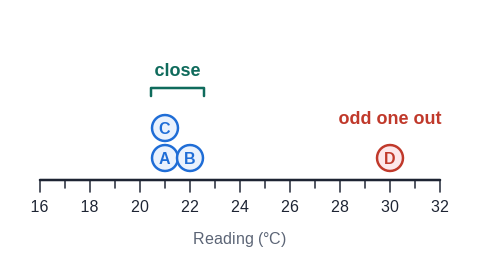
- A, B and C are within 1 °C of each other
- D is 8 °C higher than the others
- D's reading is likely wrong. Maybe the bulb was held in warm fingers. The jug is about 21 °C
Try it: spot the odd reading
Common mistakes
- Every small mark on a thermometer is 1 °C.Count the gaps between two numbers first; on many thermometers each mark is 2 °C or 5 °C.
- You can read the thermometer as soon as it goes in.Wait until the liquid stops moving, then read it while the bulb is still in the water.
- If the water feels warm to my hand, it is warm.Your hand compares with what it touched before; only a thermometer gives a number you can trust.
- The answer is 24.Always write the unit: 24 °C.
Can you trust your hands?
You need: 3 bowls, cold tap water, ice cubes, warm tap water, a towel, a kitchen thermometer, if you have one
- Fill the left bowl with cold tap water and ice. Fill the right bowl with warm tap water. Fill the middle bowl with a mix of the two.
- Put your left hand in the cold bowl and your right hand in the warm bowl. Count slowly to 30.
- Now put both hands into the middle bowl at the same time.
- Say how the water feels to each hand. If you have a thermometer, measure the middle bowl.
- Look for this: the middle bowl feels warm to one hand and cold to the other, even though it is one temperature. That is why we use a thermometer.
Safety: Use warm water that feels comfortable, never hot, and ask an adult to test it first so nobody gets scalded.
Your turn
What unit do we usually use for temperature?
A thermometer has a number every 10 °C and 10 small gaps between numbers. What is each mark worth?
Each mark is 2 °C. The liquid stops 3 marks above 30. What is the temperature?
You predicted 15 °C and measured 19 °C. How far out was your prediction?
Four readings of one cup are 18 °C, 19 °C, 18 °C and 26 °C. Which is likely to be wrong?
Why should the bulb stay in the water while you read the thermometer?
Show answer
1. Degrees Celsius, °C. 2. 1 °C, because 10 ÷ 10 = 1. 3. 36 °C, because 3 × 2 = 6 and 30 + 6 = 36. 4. 4 °C, because 19 − 15 = 4. 5. 26 °C, because it is far from the other three. 6. Out of the water the liquid starts to change straight away, so the reading would be wrong.
Recap
- Temperature is how hot or cold something is, measured in °C with a thermometer.
- Work out what each small mark is worth before you read the scale.
- Read at eye level, after the liquid stops moving, with the bulb still in.
- Predict first, then measure, and see how far out you were.
- Measure more than once and compare to check your results are accurate.
Challenge
Kiri has three bowls of water: A, B and C. She holds her hand in A, then puts it in B. B feels warm. Later she holds her hand in C, then puts it in B. Now B feels cold. A thermometer shows the bowls are 15 °C, 30 °C and 45 °C. Which bowl is which?
Hint
Your hand compares the new water with what it touched last. If B feels warm after A, is A hotter or colder than B?
Answer
A is 15 °C, B is 30 °C and C is 45 °C.
Step by step
- Your skin compares with what it touched last.
- B felt warm after A, so A is colder than B.
- B felt cold after C, so C is hotter than B.
- So from coldest to hottest: A, then B, then C.
- Match them to 15 °C, 30 °C and 45 °C.
Full working
- B feels warm after AA is colder than B
- B feels cold after CC is hotter than B
- order: A, B, Ccoldest to hottest
- A is 15 °C, B is 30 °C, C is 45 °C
Hemi's thermometer has its numbers rubbed off, except 40. The liquid stops 3 small marks above the 40, and his teacher says the water is 52 °C. What is each small mark worth? The numbers on this thermometer go up in 20s. How many small gaps are there between two numbers?
Hint
Work backwards. How far above 40 °C is 52 °C? That distance is shared between 3 marks.
Answer
Each small mark is worth 4 °C, and there are 5 small gaps between two numbers.
Step by step
- 52 °C is 12 °C above 40 °C.
- Those 12 °C are 3 small marks.
- So each mark is worth 12 ÷ 3 = 4 °C.
- From one number to the next is 20 °C.
- 20 ÷ 4 = 5, so there are 5 small gaps between numbers.
Full working
- 52 − 40 = 12 °Chow far above the 40
- 12 ÷ 3 = 4 °C3 marks share the 12 °C
- 20 ÷ 4 = 5gaps between two numbers
- Each mark is 4 °C; 5 gaps between numbers
Ana takes a thermometer from a 20 °C room and puts it in a cup of hot water. She reads it every 10 seconds: 20 °C, 34 °C, 43 °C, 47 °C, 49 °C, 49 °C, 49 °C. What is the temperature of the water? How many seconds should she have waited before reading? Ben read his at 20 seconds. How far out was he, and why will reading too soon always give a reading that is too low in hot water?
Hint
The first reading is at 0 seconds. When does the liquid stop moving?
Answer
The water is 49 °C. She should wait 40 seconds, when the reading stops changing. Ben read 43 °C, 6 °C too low: the liquid was still climbing because the thermometer had not finished warming up to the water's temperature.
Step by step
- The readings are at 0, 10, 20, 30, 40, 50 and 60 seconds.
- The liquid climbs, then stays at 49 °C from 40 seconds on, so the water is 49 °C.
- At 20 seconds the reading was 43 °C.
- 49 − 43 = 6, so Ben was 6 °C out.
- The thermometer starts at room temperature, 20 °C, and warms up slowly, so until it stops moving it always shows less than the hot water.
Full working
- times: 0, 10, 20, 30, 40, 50, 60 sone reading every 10 seconds
- 49 °C at 40 s, 50 s and 60 sthe liquid has stopped moving
- Ben at 20 s: 43 °Cthird reading
- 49 − 43 = 6 °Chow far out
- Water is 49 °C; wait 40 s; Ben was 6 °C too low