
Solids, liquids and gases, and how they change
What this lesson covers
- Solids keep their own shape and size; powders pour but are still solids
- Liquids keep the same amount but take the shape of their container
- Gases spread out to fill whatever they are in
- Melting, freezing, evaporating and condensing are physical changes
- Heating and cooling change matter from one state to another
- Pure water freezes at 0 °C and boils at 100 °C at sea level
Three states of matter
- Matter is anything that takes up space and has mass. Rocks, juice and air are all matter.
- Matter comes in three main states: solid, liquid and gas.
- Volume means how much space something takes up.
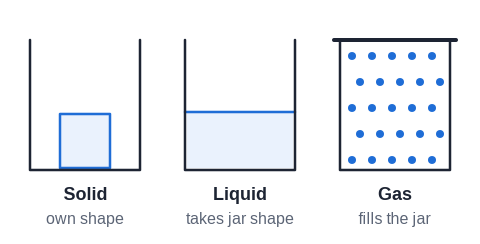
Solids
- A solid keeps its own shape and its own volume.
- A stone is the same shape in a cup or in a box.
- Sugar, flour and sand can be poured, a bit like a liquid.
- But each grain is a tiny solid that keeps its shape. So powders are solids.
Liquids
- A liquid keeps its volume, but it has no shape of its own.
- It flows, and it takes the shape of whatever it is poured into.
- 250 mL of milk in a tall glass or a wide bowl is still 250 mL.
Gases
- A gas has no shape of its own and no fixed volume.
- It flows easily and spreads out to fill whatever it is in.
- The air in a balloon fills all of it.
- A smell from the kitchen spreads through the whole house.
Example: solid, liquid or gas?
- Use two questions: does it keep its own shape, and does it keep its volume?
| Thing | Own shape? | Same volume? | State |
|---|---|---|---|
| Ice cube | Yes | Yes | Solid |
| Honey | No | Yes | Liquid |
| Air in a tyre | No | No, it fills the tyre | Gas |
| Salt | Each grain, yes | Yes | Solid |
- Salt pours, so it looks like a liquid
- But each grain keeps its own shapelook closely
- Salt is a solid, in the form of a powder
Try it: solid, liquid or gas?
Changing state
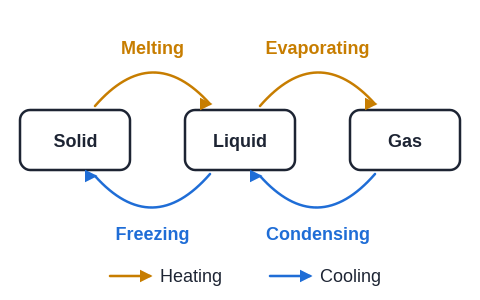
- Heating or cooling can change matter from one state to another.
- Melting: a solid turns into a liquid, like ice into water. Freezing is the opposite.
- Evaporating: a liquid turns into a gas, like a puddle drying up.
- Condensing: a gas turns into a liquid, like drips on a cold window.
- These are physical changes. The state changes, but no new substance is made. Melted chocolate is still chocolate.
Try it: name the change
Water's two special temperatures
- Temperature is measured in degrees Celsius, written °C.
- Pure water freezes at 0 °C.
- Pure water boils at 100 °C at sea level.
- High up a mountain, water boils at a lower temperature than that.
Try it: heat and cool water
Example: testing a prediction with chocolate
- Room 12 predicted: 'Chocolate melts faster in a warmer place.'
- They put the same size square of chocolate in four places and checked it every few minutes for 30 minutes.
- Was their prediction right?
| Place | Temperature | Result |
|---|---|---|
| Fridge | 4 °C | Still solid after 30 minutes |
| Classroom desk | 20 °C | Still solid after 30 minutes |
| Sunny window | 32 °C | Soft after 15 minutes |
| Plate over hot tap water | 45 °C | Melted after 4 minutes |
- 4 °C and 20 °C: too cool, the chocolate stayed solid
- 32 °C: warm enough, it went soft in 15 minutes
- 45 °C: much warmer, it melted in 4 minutes
- Yes. The warmer the place, the faster the chocolate melted
- Put back in the fridge, the melted chocolate set solid again: still chocolate
Common mistakes
- Sand can be poured, so it is a liquid.Each grain of sand keeps its own shape, so sand is a solid; powders just flow like liquids.
- When a puddle evaporates, the water disappears.The water turns into water vapour, a gas we cannot see; it is still water, now in the air.
- The white cloud above a boiling kettle is a gas.The white cloud is tiny drops of liquid water that have condensed; the gas itself is invisible.
- When ice melts it becomes a new substance.Melting is a physical change: it is still water, just in a different state.
The ice cube race
You need: 3 ice cubes the same size, 3 saucers, a clock, paper and a pencil, a kitchen thermometer, if you have one
- Write a prediction: which ice cube will melt first, in the fridge, on the kitchen bench, or on a sunny windowsill?
- Put one ice cube on each saucer, and put a saucer in each place at the same time.
- Check every 5 minutes. Write down what each ice cube looks like.
- Write down the time when each one has fully melted. If you have a thermometer, measure the temperature in each place.
- Look for this: the warmest place melts its ice first. The water in the saucer is the same water, just a liquid now.
Safety: Put the saucers where they will not be knocked over, and wipe up any water straight away so nobody slips.
Your turn
Flour can be poured. Is it a solid, a liquid or a gas?
You pour 300 mL of juice from a bottle into a wide jug. How much juice is in the jug?
Water vapour from a shower turns into drops on a cold mirror. What is this change called?
At what temperature does pure water freeze?
Butter melts in a hot pan. Is a new substance made?
Why does the air in a balloon fill the whole balloon?
Show answer
1. A solid, because each grain keeps its shape. 2. 300 mL, because a liquid keeps its volume. 3. Condensing. 4. 0 °C. 5. No. Melting is a physical change, and it is still butter. 6. Air is a gas, and a gas spreads out to fill its container.
States of Matter: Basics
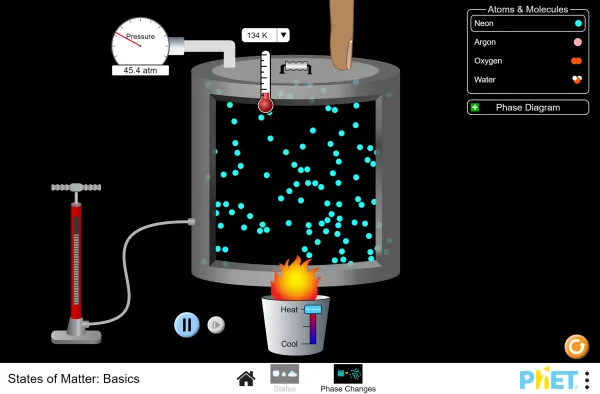
Full screen · PhET Interactive Simulations, University of Colorado Boulder, CC BY 4.0
Recap
- Solids keep their shape and volume; powders are solids that pour.
- Liquids keep their volume but take the shape of their container.
- Gases have no fixed shape or volume and spread to fill their container.
- Heating causes melting and evaporating; cooling causes condensing and freezing.
- Changes of state are physical changes: no new substance is made.
- Pure water freezes at 0 °C and boils at 100 °C at sea level.
Challenge
Leo has two plastic syringes with no needles. Syringe A is full of air. Syringe B is full of water. He puts his thumb tightly over the end of each one and pushes the plunger. In one syringe the plunger moves in a long way. In the other it hardly moves at all. Which is which? Explain using what you know about liquids and gases.
Hint
Which state keeps its volume, and which has no fixed volume?
Answer
The plunger moves a long way in Syringe A (air) and hardly at all in Syringe B (water). A gas has no fixed volume, so the air can be squashed into a smaller space. A liquid keeps its volume, so the water cannot be squashed, and it has nowhere to go.
Step by step
- The thumb stops anything getting out, so the matter inside must fit in less space when the plunger moves.
- Air is a gas. A gas has no fixed volume, so it can be squeezed into a smaller space.
- So the plunger in the air syringe moves in a long way.
- Water is a liquid. A liquid keeps its volume, so it will not squeeze into less space.
- So the plunger in the water syringe hardly moves.
Full working
- end blockednothing can escape
- air is a gasno fixed volume, it can be squashed
- water is a liquidkeeps its volume
- A (air): plunger moves a long way; B (water): hardly moves
Ana puts ice cubes in a jar and screws the lid on tight. The jar and ice weigh 300 g. She waits until all the ice has melted, wipes the outside of the jar dry, and weighs it again. (a) What does the scale say now? Then she takes the lid off and leaves the jar on a sunny windowsill for a week. (b) Will it weigh more, less or the same? Explain both answers.
Hint
When ice melts, is a new substance made, or is it the same water? With the lid off, where could some of the water go?
Answer
(a) 300 g. Melting is a physical change: the ice became liquid water, but none of it left the closed jar. (b) Less. With the lid off, some of the water evaporates into water vapour, a gas that drifts out of the jar into the air, so there is less water left in the jar.
Step by step
- With the lid on, nothing can get in or out of the jar.
- Melting only changes the water from solid to liquid. It is the same water, so the mass stays 300 g.
- With the lid off, the warm sun makes some liquid water evaporate.
- The water vapour is a gas, and it spreads out of the open jar into the room.
- That water has left the jar, so the jar weighs less than 300 g.
Full working
- lid on, ice meltssame water, nothing escapes
- (a) mass = 300 gmelting is a physical change
- lid off, sunny sillwater evaporates
- water vapour spreads into the roomit leaves the jar
- (a) 300 g (b) less than 300 g, because evaporated water has left the jar
In Tauranga, near sea level, Tama heats a pot of pure water. It starts bubbling hard, and his thermometer reads 100 °C. He keeps heating it, still bubbling, for 5 more minutes. His aunt does the same thing in a hut high up on a mountain. Her water bubbles hard, but her thermometer reads less than 100 °C. She says, "My thermometer must be broken." (a) What does Tama's thermometer read after the 5 minutes? (b) Is the aunt right? Explain.
Hint
Once the water is bubbling hard, what is the extra heat busy doing to the liquid water? And does water boil at the same temperature everywhere?
Answer
(a) Still 100 °C. While pure water boils, its temperature stays at the boiling point; the extra heat turns more water into steam. (b) No. High up a mountain, water boils at a lower temperature than 100 °C, so a reading below 100 °C while it boils is just what a working thermometer should show.
Step by step
- At sea level, pure water boils at 100 °C.
- While it boils, the heat is used to turn liquid water into water vapour, so the water does not get any hotter.
- So Tama's thermometer still reads 100 °C.
- 100 °C is the boiling point at sea level only. High up a mountain, water boils at a lower temperature.
- So the aunt's reading below 100 °C is correct, and her thermometer is fine.
Full working
- sea level, pure waterboils at 100 °C
- heat while boilingturns liquid into gas, temperature stays the same
- (a) 100 °Cstill boiling, so still 100 °C
- high on a mountainwater boils below 100 °C
- (a) 100 °C (b) No, water boils below 100 °C up high, so her thermometer works