
Pushes and pulls: what makes things move, stop and turn
What this lesson covers
- A push or a pull happens between two things
- A still object only starts to move when it is pushed or pulled
- Pushes and pulls can start, stop, speed up, slow down or turn a moving thing
- A bigger push or pull makes a bigger change
- Pushes and pulls can change a thing's shape
- Shape, rough or smooth surfaces, air and water all change how things move
Pushes and pulls
- A push moves a thing away from you. A pull moves it towards you.
- Kicking a ball is a push. Opening a drawer is a pull.
- A push or a pull always happens between two things: the one doing it and the one it acts on.
- Scientists call a push or a pull a force.
Still things stay still
- A ball sitting on the grass will not move by itself.
- It starts to move only when something pushes or pulls it.
- That could be a foot, a hand, the wind or a dog's nose.
What a push or pull can do
- A push or a pull can start a thing moving.
- It can stop a moving thing, like a goalkeeper catching a ball.
- It can make a thing go faster or slower.
- It can make a thing change direction, like a bat hitting a ball.
- It can change a thing's shape, like squashing a ball of play dough.
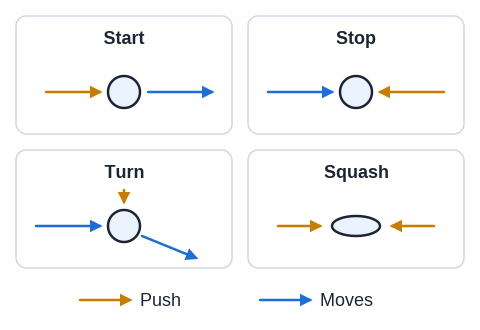
Try it: what did the push or pull do?
Bigger push, bigger change
- A gentle push makes a ball roll slowly, and only a little way.
- A hard push makes it roll fast and far.
- A bigger push or pull makes a bigger change in how a thing moves.
Pushes can change shape
- Squash play dough and it stays flat.
- Squeeze a sponge and it springs back when you let go.
- Push hard on a brick and nothing seems to change.
- What happens depends on what the thing is made of.
Rough, smooth, air and water
- A toy car rolls a long way on a smooth floor. On carpet it slows down and stops quickly.
- Rough surfaces rub more on things moving over them. This rubbing is called friction.
- Air and water push back on things that move through them.
- A thing's shape matters too. A boat with a pointed front moves through water more easily than a flat box.
Example: one car, three surfaces
- Room 3 let the same toy car roll down the same ramp onto three surfaces. They did each surface three times, and the results were close each time.
- Which surface let the car roll furthest, and why?
| Surface | How far it rolled |
|---|---|
| Wood floor | 210 cm |
| Concrete path | 145 cm |
| Carpet | 60 cm |
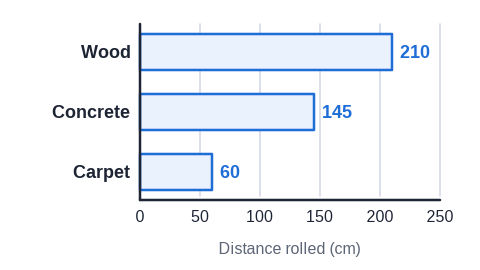
- Same car, same ramp, only the surface changeda fair test
- Wood floor 210 cm is the longest; carpet 60 cm is the shortest
- The smooth wood floor let the car roll furthest. Rough carpet rubbed it most, so it stopped soonest
- The three tries were close, so the pattern is real
Try it: far or short roll?
Example: flat paper or a paper ball?
- Two sheets of the same paper are dropped from the same height. One is flat. One is scrunched into a ball.
- Which lands first?
- Both are the same paper, so only the shape is different
- The flat sheet has to push lots of air out of the way, so it floats down slowly
- The ball pushes only a little air, so it falls fast
- The paper ball lands first, because of its shape
Common mistakes
- A rolling ball stops because it runs out of push.It stops because the ground and the air rub against it; on a smoother surface it rolls further.
- We can change the car and the surface at the same time to test the surface.Change only one thing at a time, or you cannot tell which change made the difference.
- A soft push and a hard push do the same thing.A harder push makes a bigger change, so the ball goes faster and further.
Roll test on different floors
You need: a toy car, a big hardcover book or a flat board, a pile of 3 books, a tape measure, a towel
- Lean the big book on the pile of books to make a ramp on a hard floor.
- Hold the car at the top of the ramp and let it go. Do not push it.
- Measure how far it rolled from the bottom of the ramp. Do it three times.
- Lay the towel flat at the bottom of the ramp and do the same three times.
- Look for this: the car rolls further on the smooth floor than on the rough towel, every time.
Safety: Set up the ramp where nobody is walking, and put the books away afterwards so nobody trips over them.
Your turn
You open a door by pulling the handle towards you. Is that a push or a pull?
A ball is sitting still on the floor. What will make it start to move?
Ana kicks a ball gently, then kicks it hard. Which kick sends it further?
Where would a marble roll furthest: on sand, on grass, or on a kitchen floor?
You squeeze a sponge and let go. What happens to its shape?
Show answer
1. A pull, because the door comes towards you. 2. A push or a pull. 3. The hard kick, because a bigger push makes a bigger change. 4. The kitchen floor, because it is the smoothest. 5. It springs back to its first shape.
Forces and Motion: Basics
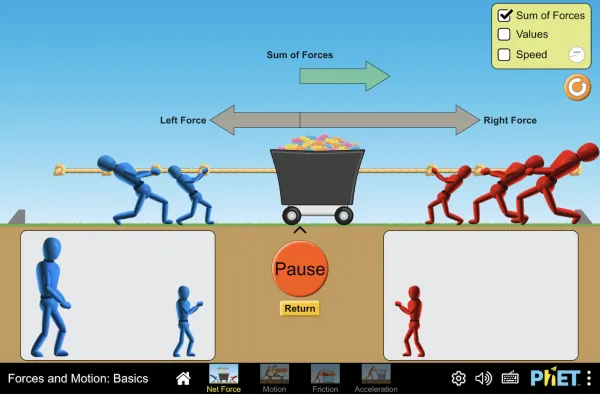
Full screen · PhET Interactive Simulations, University of Colorado Boulder, CC BY 4.0
Recap
- A push or a pull is a force between two things.
- Still things only start moving when they are pushed or pulled.
- Pushes and pulls can start, stop, speed up, slow down or turn things, and change their shape.
- A bigger push makes a bigger change.
- Rough surfaces, air and water slow things down; shape matters too.
- In a test, change only one thing at a time.
Challenge
Tug of war! Every child pulls just as hard. Team Kererū has 5 children and Team Tūī has 3 children. Which way does the rope move? How many more children must join Team Tūī so the rope stays still?
Hint
Each child is one pull. Compare the pulls on each side.
Answer
The rope moves towards Team Kererū. 2 more children must join Team Tūī.
Step by step
- Each child gives the same pull.
- Kererū has 5 pulls and Tūī has 3 pulls, so Kererū pulls harder.
- The rope moves towards the bigger pull: Team Kererū.
- If the pulls are the same on both sides, the rope stays still.
- Tūī needs 5 children, so 2 more must join.
Full working
- 5 pulls against 3 pullsKererū is bigger
- rope moves towards Kererūbigger pull wins
- 5 − 3 = 2children Tūī still needs
- 5 pulls against 5 pullssame both ways, rope stays still
- Rope moves to Kererū; 2 more must join Tūī
Three toy cars are exactly the same except for their colour. Room 3 lets each one roll down the same ramp. One rolls onto a wood floor, one onto a concrete path and one onto carpet. The red car rolls further than the blue car. The green car stops soonest. Which car went onto which surface?
Hint
Which surface rubs on a rolling car the most? Which rubs the least?
Answer
Red: wood floor. Blue: concrete path. Green: carpet.
Step by step
- The cars and the ramp are the same, so only the surface changes how far each car rolls.
- Rough surfaces rub more on a rolling car, so it slows down and stops sooner.
- Carpet rubs the most, then concrete, and smooth wood rubs the least.
- So from furthest to shortest the order is wood, concrete, carpet.
- Green stops soonest, so it went on the carpet. Red went further than blue, so red went on the wood and blue on the concrete.
Full working
- same cars, same ramponly the surface changes
- carpet rubs most, then concrete, wood leastrubbing slows a car
- furthest to shortest: wood, concrete, carpetorder of surfaces
- green stops soonestcarpet
- red further than bluered on wood, blue on concrete
- Red: wood. Blue: concrete. Green: carpet.
On Earth a rolling ball always slows down and stops. Far out in space, a long way from any planet or star, there is no ground and no air. An astronaut out there gives a ball one gentle push and lets go. What happens to the ball?
Hint
What makes a rolling ball slow down on Earth? Is that there in space?
Answer
It keeps moving in a straight line at the same speed. It does not slow down or stop until something pushes or pulls it.
Step by step
- On Earth the ground and the air rub and push back on a moving ball.
- That is what slows it down and stops it.
- Far out in space there is no ground and no air to do that.
- With nothing to push or pull on it, the ball's movement does not change.
- So it keeps going in a straight line at the same speed.
Full working
- Earth: ground and air rub on the ballit slows and stops
- space: no ground, no airnothing rubs on it
- no push or pullno change to how it moves
- same speed, same directionthe push only started it
- The ball keeps going straight at the same speed