
Plant eaters, meat eaters and both: teeth, beaks and food
What this lesson covers
- Herbivores eat plants and have flat teeth or rough tongues to grind and scrape
- Carnivores eat other animals and have sharp teeth, hooked beaks or claws to grip and tear
- Omnivores eat plants and animals, and have a mix of teeth
- Some animals have a beak or mouth made for one kind of food, like the kiwi and the mosquito
- Guessing what an animal eats from its teeth, beak or tongue
- Sorting animals in a table or a Venn diagram
Animals eat different food
- All animals need food.
- But they do not all eat the same food.
- An animal's teeth, beak or mouth are shaped for the food it eats.
- So a mouth is a clue to what an animal eats.
Herbivores: plant eaters
- A herbivore eats plants.
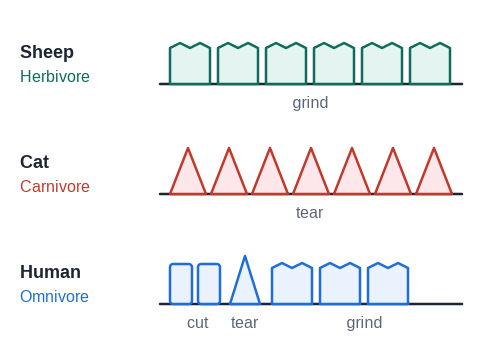
- Sheep, cows and horses are herbivores. They have wide, flat back teeth to grind up grass.
- Snails are herbivores too. They scrape leaves with a rough tongue.
- The kererū, our native wood pigeon, eats fruit and leaves. It can swallow big berries whole.
Carnivores: meat eaters
- A carnivore eats other animals.
- Cats and seals are carnivores. They have long, sharp, pointed teeth to grip and tear.
- The kārearea, the New Zealand falcon, has a hooked beak for tearing meat and sharp claws for catching.
Omnivores: they eat both
- An omnivore eats plants and animals.
- People, pigs and bears are omnivores.
- Omnivores have a mix of teeth.
- Your front teeth cut, your pointy teeth tear, and your flat back teeth grind.
Special beaks and mouths
- Some animals have a beak or mouth for just one kind of food.
- The kiwi has a long, thin beak with its nostrils at the tip. It pokes deep into the soil and sniffs out worms and grubs.
- The tōrea, or oystercatcher, has a long, strong beak to open shellfish like pipi.
- A mosquito has a mouth like a thin needle. It pokes through skin to drink blood.
- A butterfly has a long tongue like a straw. It sips nectar from deep inside flowers.
Try it: match the mouth to the food
Example: what does it eat?
- An animal has long, sharp, pointed teeth at the front and strong jaws.
- What does it probably eat?
- Sharp, pointed teeth grip and teara clue for meat
- No wide, flat teeth for grindingnot a plant eater
- It probably eats other animals, so it is a carnivore
Try it: read the mouth
Example: sorting animals in a Venn diagram
- A Venn diagram has two circles that overlap.
- Animals that eat plants go in one circle. Animals that eat animals go in the other.
- Animals that eat both go in the middle, where the circles overlap.
| Animal | Clue | Group |
|---|---|---|
| Sheep | Flat grinding teeth | Herbivore |
| Kārearea | Hooked beak, sharp claws | Carnivore |
| Pig | Mix of teeth | Omnivore |
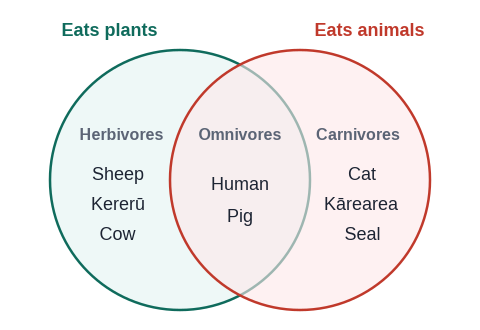
Try it: plant eater, meat eater or both?
Common mistakes
- Big animals must be meat eaters.Size is not the clue. A cow is huge and eats only plants; look at the teeth or beak instead.
- Omnivore means it eats anything at all.An omnivore eats both plants and animals, not every kind of thing.
- All birds eat seeds.Birds eat many foods: a kārearea's hooked beak tears meat, and a kiwi's long beak finds worms.
Which beak works best?
You need: kitchen tongs or a peg, a teaspoon, a cup of dry rice, a bowl of water, a handful of cooked spaghetti pieces, a plate, a timer
- Put the rice on the plate, the water in the bowl and the spaghetti 'worms' on the table.
- Use the peg as a beak. Pick up as much rice as you can in 20 seconds. Count what you got.
- Do the same with the peg for the water and the spaghetti.
- Now do all three again with the teaspoon as the beak.
- Look for this: each beak is best at one kind of food, just like real beaks.
Safety: Ask an adult to cook the spaghetti and let it cool first, and do not eat the food once it has been handled.
Your turn
An animal has wide, flat back teeth for grinding. Is it a herbivore, a carnivore or an omnivore?
A bird has a hooked beak and sharp claws. What does it eat?
A bear eats berries and fish. Which group is it in?
Why does a kiwi have a long, thin beak?
A butterfly has a tongue like a long straw. What does it eat?
Show answer
1. A herbivore, because flat teeth grind plants. 2. Other animals, so it is a carnivore. 3. An omnivore, because it eats plants and animals. 4. To poke deep into soil and find worms and grubs. 5. Nectar from flowers.
Recap
- Herbivores eat plants and have flat teeth or rough tongues to grind and scrape.
- Carnivores eat animals and have sharp teeth, hooked beaks or claws.
- Omnivores eat both and have a mix of teeth.
- Some beaks and mouths are made for one food, like the kiwi's beak and the mosquito's needle.
- Teeth and beaks are clues to what an animal eats.
Challenge
Room 3 sorts these animals into a Venn diagram with a "plant eaters" circle and an "animal eaters" circle: sheep, cat, pig, kererū, kārearea, person, snail, seal, bear. How many animals go in the middle where the circles overlap? How many animals are inside the plant eaters circle altogether?
Hint
Animals that eat both go in the middle. The middle is part of both circles.
Answer
3 in the middle (pig, person, bear). 6 inside the plant eaters circle altogether.
Step by step
- Herbivores, plants only: sheep, kererū, snail.
- Carnivores, animals only: cat, kārearea, seal.
- Omnivores eat both, so they go in the middle: pig, person, bear.
- The middle is inside the plant eaters circle too.
- So the plant eaters circle holds 3 herbivores and 3 omnivores: 6 animals.
Full working
- sheep, kererū, snailplants only
- cat, kārearea, sealanimals only
- pig, person, bearboth, so the middle
- 3 + 3 = 6herbivores plus the middle
- 3 in the middle, 6 in the plant eaters circle
A kiwi and a kererū live in the same patch of bush. They do not fight over food. Use their beaks to explain why.
Hint
Think about where each bird finds its food and what its beak is shaped for.
Answer
They eat different food in different places. The kiwi's long, thin beak pokes into the soil for worms and grubs. The kererū eats fruit and leaves up in the trees and swallows big berries whole. So they do not need the same food.
Step by step
- The kiwi has a long, thin beak with nostrils at the tip.
- It finds worms and grubs deep in the soil.
- The kererū eats fruit and leaves in the trees.
- Their food is different, so one does not take the other's food.
- Different mouths for different foods lets many animals share one place.
Full working
- kiwi: long thin beakworms and grubs in the soil
- kererū: swallows big berriesfruit and leaves in the trees
- different food, different placeno need to fight
- They eat different foods, so they share the bush
A kea has a hooked beak, like a kārearea. Sam says, "A kea must be a meat eater." But kea eat berries, leaves, roots and flower nectar. They also eat insects and grubs. Is Sam right? What group is the kea in?
Hint
A beak is a clue, but what the animal really eats decides its group.
Answer
Sam is wrong. The kea eats plants and animals, so it is an omnivore. It uses its hooked beak to dig up roots and rip open logs for grubs, not just to tear meat.
Step by step
- A hooked beak is often a clue for a meat eater.
- But a clue is not proof. We must check what the animal eats.
- Berries, leaves, roots and nectar are plant foods.
- Insects and grubs are animals.
- An animal that eats both plants and animals is an omnivore, so the kea is an omnivore.
Full working
- hooked beaka clue only, not proof
- berries, leaves, roots, nectarplant food
- insects, grubsanimal food
- plants and animalsomnivore
- Sam is wrong: the kea is an omnivore