
Pushes and pulls: starting, stopping and turning
What this lesson covers
- A force is a push or a pull
- Forces can start something moving or stop it
- Forces can make things faster, slower, or change direction
- Ways things move: rolling, sliding, gliding, bouncing, spinning and falling
- Testing big and small pushes, and recording what happens
A force is a push or a pull
- A force is a push or a pull.
- A push moves something away from you, like shutting a door.
- A pull moves something towards you, like opening a drawer.
- You cannot see a force, but you can see what it does. Arrows show which way a force acts.
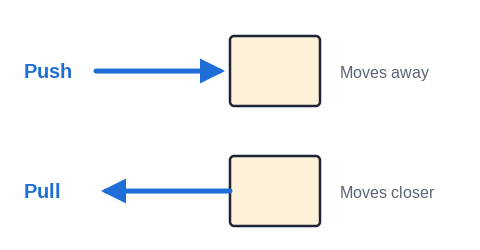
Try it: push or pull?
Starting and stopping
- A ball on the grass stays still until a force moves it.
- A kick is a push that starts the ball moving.
- A goalkeeper's hands push back on the ball and stop it.
Faster, slower, or a new direction
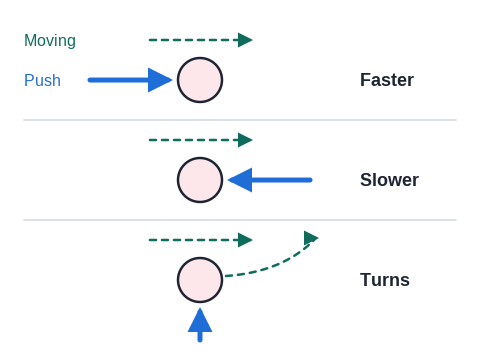
- A force can change how something is already moving.
- A push in the same direction makes it go faster.
- A push the opposite way makes it go slower.
- A push from the side makes it change direction.
Ways things move
- Things can move in different ways.
| Way of moving | Example |
|---|---|
| Rolling | A ball going down a hill |
| Sliding | A book pushed across a table |
| Gliding | A paper plane, a toroa (albatross) over the sea |
| Bouncing | A netball dropped on the court |
| Spinning | A spinning top |
| Falling | An apple dropping from a tree |
Try it: how does it move?
What did the force do?
- Say what each force does: a kick sends a still ball forward; a hand catches a ball; a bat hits a ball back the way it came; a push from behind on a swing.
- Kick: the ball starts movingstart
- Catch: the ball stopsstop
- Bat: the ball changes directionturn
- Push on a swing: it goes fasterspeed up
- Start, stop, change direction, go faster
Big push, small push
- Room 5 predicted that a bigger push would send a toy car further. They pushed it three times and counted the floor tiles it rolled over.
- They wrote down what they saw: faster, slower, stopped or turned.
| Push | Floor tiles rolled | What we saw |
|---|---|---|
| Small | 3 | Rolled slowly, stopped soon |
| Medium | 6 | Rolled faster |
| Big | 10 | Rolled fastest, turned a little at the end |
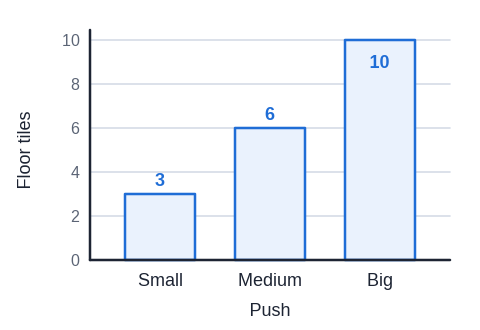
- Small push: 3 tilesshortest
- Big push: 10 tilesfurthest
- A bigger push made the car go faster and further, so the prediction was right
Try it: tiles rolled for each push
Common mistakes
- When I push a heavy box and it does not move, there is no force.You are still pushing; your push is just not big enough to start the box moving.
- A rolling ball stops because it gets tired.The ground and the air rub on the ball, and that rubbing is a force that slows it down.
- A push and a pull are the same thing.A push moves something away from you; a pull moves it towards you.
Toy car push test
You need: a toy car, a strip of tape or a book for a start line, a clear floor, paper and a pencil
- Put the car on the start line.
- Give it a small push and count how many hand spans it rolls. Write it down.
- Give it a big push from the same line and count again.
- Roll the car again, and gently tap it from the side as it goes past.
- Look for this: the big push sends it further, and the side tap makes it turn.
Safety: Do this on a clear floor with an adult nearby, away from stairs, and pick the car up after so nobody trips or slips on it.
Your turn
Opening a drawer: is that a push or a pull?
You push a swing gently, then much harder. What happens with the harder push?
A ball rolls towards you and you put your foot on it. What does your push do?
How does a paper plane move through the air?
In Room 5's test, how far did the car go after the big push?
Show answer
1. A pull. 2. The swing goes faster and higher. 3. It stops the ball. 4. It glides. 5. 10 floor tiles.
Forces and Motion: Basics
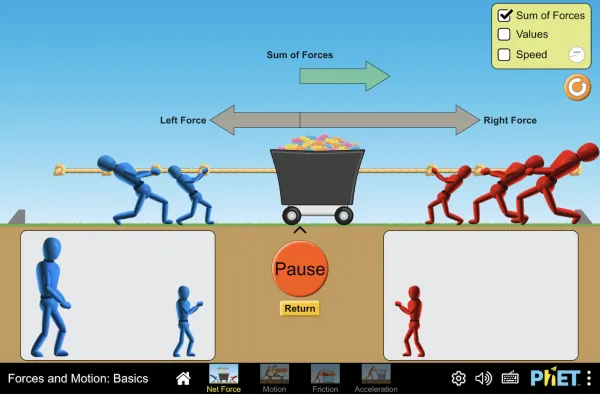
Full screen · PhET Interactive Simulations, University of Colorado Boulder, CC BY 4.0
Recap
- A force is a push or a pull.
- Forces can start or stop movement.
- Forces can make things faster, slower, or turn.
- Things roll, slide, glide, bounce, spin and fall.
- A bigger push makes a bigger change, which we can test and record in a table.
Challenge
Ana and Ben push the same box on a slippery floor. Ana pushes from the left and Ben pushes from the right, just as hard as each other. The box does not move. Ben says, "The box is not moving, so there are no forces on it." Is Ben right? What happens if Ben suddenly lets go?
Hint
Count the pushes. Then think about which way each push is trying to move the box.
Answer
Ben is wrong. There are two pushes on the box, but they are the same size and go opposite ways, so they cancel out. If Ben lets go, only Ana's push is left, and the box starts to slide to the right, away from Ana.
Step by step
- Ana pushes the box to the right. Ben pushes it to the left.
- The two pushes are the same size, so neither one wins.
- That is why the box stays still, even though there are two forces.
- When Ben lets go, his push is gone.
- Ana's push is now on its own, so it starts the box moving to the right.
Full working
- Ana's pushto the right
- Ben's pushto the left, just as big
- Same size, opposite waysthey cancel, the box stays still
- Ben lets goonly Ana's push is left
- Ben is wrong: there are two forces. When he lets go, the box slides to the right.
Kiri rolls a ball along the floor towards a wall. The ball hits the wall and bounces back towards her. On the way back it gets slower and slower, and then it stops before it reaches her. List every force that changed how the ball moved, and say what each one did.
Hint
Go through the story one step at a time: start, hit the wall, slow down, stop. Each change needs a push or a pull.
Answer
Three forces: Kiri's push started the ball moving. The wall's push turned the ball around, so it changed direction. The floor and the air rubbing on the ball slowed it down and then stopped it.
Step by step
- The ball was still, so a force must start it. That was Kiri's push.
- At the wall the ball went back the other way. The wall pushed on the ball and changed its direction.
- The ball got slower. Nobody touched it, so the force was the floor and the air rubbing on it.
- That same rubbing kept going until the ball stopped.
- A ball does not stop because it is tired. A force always does the stopping.
Full working
- StartKiri's push
- Change directionthe wall pushes back on the ball
- Slow downthe floor and the air rub on the ball
- Stopthe same rubbing keeps slowing it to a stop
- Kiri's push starts it, the wall's push turns it, and rubbing from the floor and air slows and stops it.
A marble rolls across the table towards Sam. Sam gives it one push that is just big enough to stop it. Should he push from behind it, from in front of it, or from its side? Next, Mia rolls the marble the same way. She wants it to roll straight back to where it came from. Which way should she push, and should her push be bigger or smaller than Sam's?
Hint
A push the same way as the marble is going makes it faster. A push from the side makes it turn. Which push makes it slower? What happens if that push is even bigger?
Answer
Sam pushes from in front of the marble, the opposite way to how it rolls. Mia also pushes from in front, but with a bigger push than Sam's.
Step by step
- A push from behind goes the same way as the marble, so it makes it faster.
- A push from the side makes it turn, not stop.
- A push from in front goes the opposite way, so it makes the marble slower.
- Sam's push is just big enough to slow the marble all the way to a stop.
- Mia's push must be bigger: it stops the marble and then starts it moving back the other way.
Full working
- From behindfaster
- From the sideturns
- From in frontslower
- Just big enoughit stops: Sam
- Bigger push from in frontit stops, then rolls back: Mia
- Both push from in front. Mia's push is bigger than Sam's.