
Life cycles: from egg or seed to adult
What this lesson covers
- Each kind of living thing has its own life cycle
- Animals are born or hatch, grow up and have young
- Plants grow from seeds, grow up and make new seeds
- Young look like their parents, but not exactly the same
- Every living thing dies in the end
- Comparing life cycles and drawing them with arrows
What is a life cycle?
- A life cycle is the set of stages a living thing goes through, from the start of its life until it has young of its own.
- The young grow up and have young too, so the cycle goes round again.
- Every living thing dies in the end, but its young carry the cycle on.
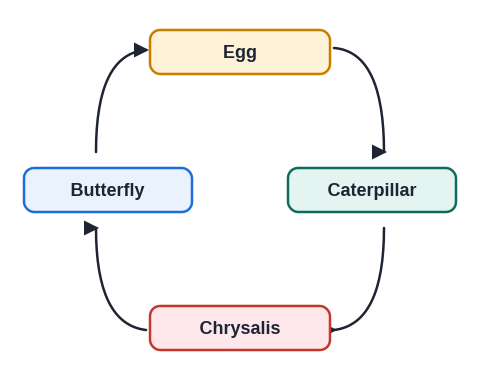
A monarch butterfly
- A monarch butterfly lays tiny eggs on a swan plant.
- Each egg hatches into a caterpillar, which eats swan plant leaves and grows fast.
- The caterpillar makes a hard case called a chrysalis and changes inside it.
- An adult butterfly comes out, and later lays eggs of its own.
A frog
- Frogs in garden ponds lay eggs covered in jelly, called spawn.
- The eggs hatch into tadpoles, which swim and have tails.
- Tadpoles grow legs and lose their tails, and become frogs.
Born or hatched
- Some animals hatch from eggs, like chickens, kiwi and fish.
- Other animals are born, like humans, dogs and sheep.
- A baby grows into a child, then an adult, who can have babies of their own.
Try it: hatched or born?
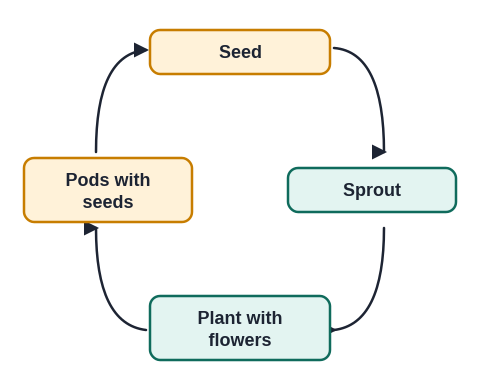
A broad bean plant
- A plant starts as a seed.
- With water and warmth, the seed sprouts a root, then a shoot.
- The young plant grows leaves, then flowers.
- The flowers turn into pods with new seeds inside.
- A kōwhai tree makes seeds in pods too, and new kōwhai trees grow from them.
Butterfly and chicken
- How are the life cycles of a monarch butterfly and a chicken the same, and how are they different?
| Stage | Monarch butterfly | Chicken |
|---|---|---|
| Start | Egg | Egg |
| Young | Caterpillar, looks nothing like the adult | Chick, looks like a small hen |
| Changing | Chrysalis | Grows bigger and gets feathers |
| Adult | Butterfly | Hen or rooster |
- Same: both start as eggs and grow into adults that lay eggscompare starts and ends
- Different: the caterpillar changes its whole shape; the chick just growscompare the young
- Both are life cycles, but a butterfly changes shape and a chicken does not
Try it: butterfly, chicken or both?
Like their parents, but not the same
- The young of a plant or animal are called its offspring.
- Offspring look like their parents. A lamb looks like a sheep, not a dog.
- But they are not exactly the same. Puppies from one litter can have different colours.
Room 6's broad beans
- Room 6 planted broad bean seeds in pots and wrote down what they saw.
| Day | What we saw |
|---|---|
| Day 1 | Planted the seeds |
| Day 10 | A shoot came up through the soil |
| Day 21 | The plant had 4 leaves |
| Day 60 | White and black flowers |
| Day 80 | Green pods with seeds inside |
- Seed, then shoot, then leaves, then flowers, then podsthe order of stages
- The new seeds in the pods can start the cycle again
Common mistakes
- A caterpillar is a different animal from a butterfly.A caterpillar is a young butterfly; it changes shape inside the chrysalis.
- Babies look exactly the same as their parents.Offspring look like their parents, but each one is a little different.
- Plants do not have a life cycle because they do not move.Plants grow from seeds, grow up, make new seeds and die, so they have a life cycle too.
Grow a bean in a jar
You need: a clear jar, paper towels, 2 or 3 dried beans, water
- Line the inside of the jar with damp paper towels.
- Push the beans between the paper towel and the glass so you can see them.
- Keep the paper towel damp, and look at the beans every day for 2 weeks.
- Draw the beans every 2 days, with labels.
- Look for this: a root grows first and points down, then a shoot grows up.
Safety: Ask an adult to handle the glass jar, and never eat the dried beans, because some raw beans are poisonous until they are cooked.
Your turn
Put these in order: butterfly, egg, chrysalis, caterpillar.
Does a kiwi chick hatch from an egg, or is it born?
What grows first from a bean seed: a root or a shoot?
Is a lamb exactly the same as its mother?
In Room 6's beans, on which day did the shoot first come up?
Show answer
1. Egg, caterpillar, chrysalis, butterfly. 2. It hatches from an egg. 3. A root. 4. No, it looks like her but is not exactly the same. 5. Day 10.
Recap
- A life cycle is the stages of life, from the start to having young.
- Animals are born or hatch from eggs, grow up and have young.
- Plants grow from seeds, grow up, flower and make new seeds.
- Young look like their parents, but each one is a little different.
- All living things die in the end, and their young carry on the cycle.
- Arrows in a loop show a life cycle.
Challenge
Mere finds tiny wriggly animals in a pond. They swim, have tails and have no legs. Her friend says, "They are baby fish." A week later, some of them have two little back legs. Who was wrong? What will the animals look like when they are grown up?
Hint
Which young animal in this lesson swims with a tail and then grows legs?
Answer
The friend was wrong. Fish never grow legs, so they are tadpoles. They will grow front legs too, lose their tails and become frogs.
Step by step
- Young fish keep their fins and tails. They never grow legs.
- These animals grew back legs, so they are not fish.
- Tadpoles swim with tails and then grow legs.
- So they are tadpoles, young frogs.
- Next they grow front legs, their tails go, and they become frogs.
Full working
- Tail, no legs, swimscould be a fish or a tadpole
- Back legs grow a week laterfish never grow legs
- So they are tadpolesa young frog
- Front legs grow, tail goesthe next stages
- The friend was wrong. They are tadpoles and will become frogs.
Tama plants 1 broad bean seed. The plant grows 2 pods, and each pod has 2 seeds. Next spring he plants all the new seeds, and every plant grows the same way. How many seeds will Tama have after the second spring?
Hint
First find how many seeds one plant makes. Then each of those seeds becomes a plant that makes the same number.
Answer
16 seeds. One plant makes 4 seeds, and those 4 seeds grow into 4 plants that make 4 seeds each.
Step by step
- One plant has 2 pods with 2 seeds in each, so it makes 4 seeds.
- Tama plants all 4 seeds, so he gets 4 new plants.
- Each new plant makes 4 seeds too.
- 4 plants with 4 seeds each is 4 + 4 + 4 + 4 = 16 seeds.
- The new seeds can start the life cycle again.
Full working
- 2 + 2 = 4seeds from the first plant
- 4 seeds → 4 plantseach seed grows a plant
- Each plant makes 4 seedssame as before
- 4 + 4 + 4 + 4 = 16seeds from 4 plants
- 16 seeds after the second spring
A monarch butterfly comes out of its chrysalis on 30 March. It spent 10 days inside the chrysalis. Before that it was a caterpillar for 14 days. Before that it was an egg for 4 days. On what date was the egg laid?
Hint
Start at the end and go backwards through the life cycle, one stage at a time.
Answer
2 March. Going back 10 days gives 20 March, back 14 more gives 6 March, and back 4 more gives 2 March.
Step by step
- The stages go egg, then caterpillar, then chrysalis, then butterfly.
- Start at the butterfly, 30 March, and count back.
- Back 10 days for the chrysalis: 20 March. That is when the caterpillar made its chrysalis.
- Back 14 days for the caterpillar: 6 March. That is when the egg hatched.
- Back 4 days for the egg: 2 March. That is when the egg was laid.
Full working
- Egg → caterpillar → chrysalis → butterflythe order of stages
- 30 − 10 = 20chrysalis started on 20 March
- 20 − 14 = 6egg hatched on 6 March
- 6 − 4 = 2egg laid on 2 March
- Check: 4 + 14 + 10 = 28 days, and 2 March + 28 days = 30 Marchit works
- The egg was laid on 2 March.