
Chemical processes in the world: from natural gas to urea
What this lesson covers
- Choosing a chemical process (industrial or natural) and setting out its chemistry with balanced equations.
- Steam reforming, the Haber process and urea synthesis, with the conditions explained by rates and Le Chatelier's principle.
- What happens to urea in soil: hydrolysis, nitrification, nitrate leaching and nitrous oxide, and the chemistry of ocean acidification as a second example.
- Environmental and economic consequences, and how to evaluate them with the chemistry linked in.
- How a report moves from an account (Achieved) to linked explanations (Merit) to an evaluation (Excellence).
What this internal asks you to do
- You work from information (articles, data, company and government reports) about a chemical process: either chemistry behind an environmental issue, or chemistry used in a technology that meets a need.
- Good choices have chemistry you can write equations for: ammonia and urea, steel from ironsand at Glenbrook, ocean acidification, acid rain, polymers, batteries or a pharmaceutical.
- Achieved gives an account of the process with correct vocabulary, symbols and equations; Merit explains the links between the processes and their consequences for people or the environment; Excellence evaluates the impacts and issues, comparing and weighing them with the chemistry built in throughout.
The chemistry: from methane to urea
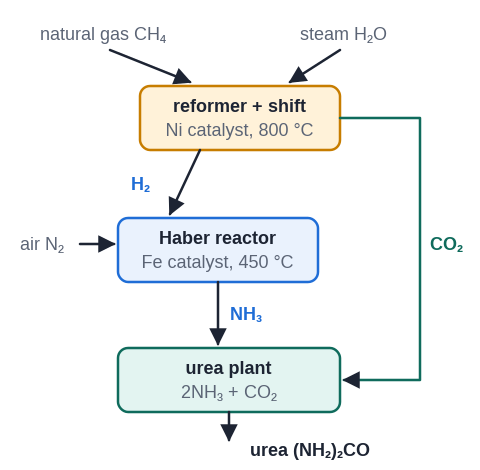
- Steam reforming over a nickel catalyst at about 800 °C makes hydrogen from natural gas: CH₄(g) + H₂O(g) ⇌ CO(g) + 3H₂(g), ΔrH = +206 kJ mol⁻¹.
- The shift reaction turns the carbon monoxide into more hydrogen: CO(g) + H₂O(g) ⇌ CO₂(g) + H₂(g), ΔrH = −41 kJ mol⁻¹. Air is added to supply nitrogen, and its oxygen is burned out.
- The Haber process joins nitrogen and hydrogen over an iron catalyst: N₂(g) + 3H₂(g) ⇌ 2NH₃(g), ΔrH = −92 kJ mol⁻¹.
- Ammonia reacts with the carbon dioxide captured from the reformer, first to ammonium carbamate and then to urea: 2NH₃ + CO₂ → NH₂COONH₄ → (NH₂)₂CO + H₂O.
Rates: getting the reaction to go fast enough
- A reaction happens when particles collide with enough energy (at least the activation energy) and the right orientation.
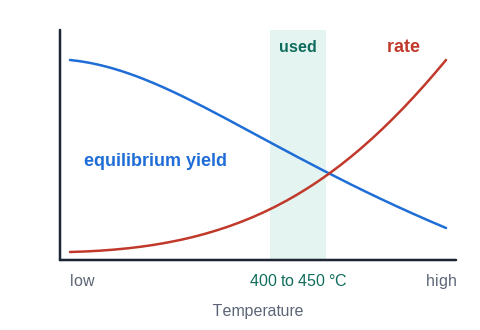
- Raising the temperature makes particles move faster, so more collisions have enough energy and the rate rises steeply.
- Raising the pressure of a gas crowds the particles together, so collisions are more frequent.
- The iron catalyst gives an alternative pathway with a lower activation energy, so many more collisions succeed; it is not used up and does not change ΔrH or the equilibrium position, only how quickly equilibrium is reached.
Try it: what the catalyst does
Equilibrium and the compromise conditions
- Le Chatelier's principle: if conditions change, the equilibrium shifts in the direction that partly opposes the change.
- The forward Haber reaction is exothermic, so a low temperature shifts the equilibrium right and raises the yield, but makes the rate far too slow; plants run at about 400 to 450 °C as a compromise.
- Four moles of gas become two, so high pressure shifts the equilibrium right towards fewer gas particles and also speeds the reaction; around 150 to 250 times atmospheric pressure is used, because higher pressure costs more in energy and stronger equipment.
- Only about 15% of the gas reacts in each pass, so ammonia is cooled until it condenses out and the unreacted nitrogen and hydrogen are recycled; removing product also pulls the equilibrium to the right.
Try it: Le Chatelier's principle
Example: urea from a tonne of ammonia
- Calculate the mass of urea, (NH₂)₂CO, that can be made from 1.00 tonne of ammonia, and the mass of carbon dioxide it uses.
- Overall: 2NH₃ + CO₂ → (NH₂)₂CO + H₂O. M(NH₃) = 17.0, M(CO₂) = 44.0, M((NH₂)₂CO) = 60.0 g mol⁻¹.
- n(NH₃) = 1.00 × 10⁶ g ÷ 17.0 = 5.882 × 10⁴ mol1 tonne = 10⁶ g
- n(urea) = n(CO₂) = ½ × 5.882 × 10⁴ = 2.941 × 10⁴ mol2 NH₃ make 1 urea
- m(urea) = 2.941 × 10⁴ × 60.0 = 1.76 × 10⁶ g = 1.76 t
- m(CO₂) = 2.941 × 10⁴ × 44.0 = 1.29 × 10⁶ g = 1.29 t
- that CO₂ is only stored: urea gives it back when it breaks down in the soila link worth making in the evaluation
What happens to the nitrogen on the farm
- The soil enzyme urease hydrolyses urea: (NH₂)₂CO + H₂O → 2NH₃ + CO₂; in warm, dry or windy weather some ammonia gas escapes to the air (volatilisation), so less nitrogen reaches the grass.
- In moist soil, ammonia becomes ammonium (NH₃ + H₂O ⇌ NH₄⁺ + OH⁻), and bacteria oxidise ammonium to nitrite and then nitrate (nitrification); plants take up nitrate.
- Nitrate ions are negative and are not held by negatively charged soil particles, so nitrate the grass does not use washes down into groundwater, streams and lakes, where it feeds algal blooms (eutrophication).
- In waterlogged soil, bacteria reduce nitrate to N₂ and nitrous oxide, N₂O (denitrification); N₂O is a greenhouse gas about 273 times stronger than CO₂ over 100 years.
- Ways to reduce the losses include urea coated with a urease inhibitor, smaller and more frequent applications, and applying only when the pasture is growing.
Try it: follow the nitrogen
Environmental and economic factors
- Making the hydrogen releases carbon dioxide from the methane, and more natural gas is burned to heat the reformer, so ammonia is one of the most carbon-intensive chemicals made.
- Natural gas is a finite resource, and Taranaki gas output has been falling: in 2025 Ballance wrote down the value of the Kapuni plant and warned it could shut for months without affordable gas.
- Making urea in New Zealand saves importing it, gives local jobs, and secures supply for farmers when shipping is disrupted; nitrogen fertiliser lifts grass growth and farm income.
- A future option is green hydrogen, made by electrolysis of water using renewable electricity (2H₂O → 2H₂ + O₂), which removes the reforming CO₂ but needs a large, cheap supply of electricity.
Example: ocean acidification, an environmental process
- The ocean absorbs about a quarter of the CO₂ people release. The surface ocean's pH has fallen from about 8.2 before industrialisation to about 8.1 today.
- Write the equations, find how much [H₃O⁺] has risen, and link it to shellfish such as Greenshell mussels (kuku) and pāua.
- CO₂(g) ⇌ CO₂(aq), then CO₂(aq) + H₂O(l) ⇌ H₂CO₃(aq)
- H₂CO₃(aq) + H₂O(l) ⇌ HCO₃⁻(aq) + H₃O⁺(aq)this raises [H₃O⁺], so pH falls
- [H₃O⁺] ratio = 10⁻⁸·¹ ÷ 10⁻⁸·² = 10⁰·¹ = 1.26a 26% rise in [H₃O⁺] for 0.1 of a pH unit
- H₃O⁺(aq) + CO₃²⁻(aq) → HCO₃⁻(aq) + H₂O(l)carbonate ions are used up
- less CO₃²⁻ for Ca²⁺ + CO₃²⁻ → CaCO₃, so shells form more slowly and larvae struggle
Example: one point written at each grade
- A linked report is not a list of facts: each paragraph follows a chain from the chemistry to the consequence and then weighs it.
- Here is one point about nitrate from urea, written at each grade.
| Grade | What the student wrote |
|---|---|
| Achieved | Urea is broken down in the soil to ammonia and then nitrate, NO₃⁻. Nitrate can be leached into rivers, where it causes algal blooms. |
| Merit | Urease hydrolyses urea, (NH₂)₂CO + H₂O → 2NH₃ + CO₂, and soil bacteria oxidise the ammonium to nitrate. Nitrate is a negative ion, so it is not held by the negatively charged clay and is leached by rain into groundwater and streams, where the extra nutrient lets algae grow faster than they are eaten. |
| Excellence | The same solubility that makes nitrate easy for grass to take up is what lets it leach, so the loss is greatest when urea is spread on wet soil in winter when grass is barely growing. Splitting the dose into smaller spring applications cuts leaching and saves the farmer money, though it adds spreading costs. Since the plant's CO₂ and the soil's N₂O both count towards emissions, using less urea more precisely does more good than any change at the factory alone. |
Writing a linked report
- Open by naming the process and the issue or need in one or two sentences, with where it happens.
- Give the chemistry in order, with a balanced equation (and states) for every reaction you mention, and explain each condition in terms of rate or equilibrium.
- For each consequence, write the chain: reaction, then what it produces, then the effect on people or the environment.
- Evaluate: compare benefits with costs, compare options (urea with and without an inhibitor, gas with green hydrogen), and say which matters more and why.
- Use your own words, reference your sources, and keep chemistry vocabulary and equations running through every section, not just the first page.
Common mistakes
- The catalyst increases the yield of ammonia.A catalyst speeds up the forward and reverse reactions equally, so equilibrium is reached faster but the yield at equilibrium is the same.
- Plants use a high temperature because the Haber process needs heat.The forward reaction is exothermic, so heat lowers the yield; the high temperature is only there to give a fast enough rate.
- Urea fertiliser releases nitrate, which harms the environment.Give the chain with equations: urease makes ammonia, bacteria oxidise it to nitrate, and nitrate leaches because soil does not hold negative ions.
- The report lists five problems with fertiliser, so it is an evaluation.An evaluation weighs consequences against each other and against the benefits, and reaches a judgement backed by the chemistry.
Model ocean acidification with eggshells
You need: a clean eggshell, white vinegar, soda water, tap water, 3 clear glasses
- Wash the eggshell, then break it into three pieces of about the same size.
- Half fill one glass with vinegar, one with soda water and one with tap water, and drop a piece of shell into each.
- Look closely at the shells for the first 10 minutes, and note where bubbles form.
- Leave the glasses overnight, then lift each piece out and press it gently to feel how hard it is.
- Look for: carbon dioxide bubbles fizzing off the shell in vinegar (CaCO₃ + 2H⁺ → Ca²⁺ + CO₂ + H₂O), a smaller effect in soda water (dissolved CO₂ makes it weakly acidic), and none in tap water.
Safety: Raw eggshell can carry Salmonella bacteria, so wash your hands after handling it and do not drink any of the liquids.
Your turn
Write the balanced equation for urea hydrolysing in the soil.
What happens to the equilibrium yield of ammonia if the pressure is increased, and why?
Overall, CH₄ + 2H₂O → CO₂ + 4H₂ and N₂ + 3H₂ → 2NH₃. What is the minimum mass of CO₂ released in making 1.00 tonne of NH₃?
If ocean pH fell from 8.1 to 7.8, by what factor would [H₃O⁺] increase?
Why does the Haber process use a catalyst, when it does not change the equilibrium yield?
Show answer
1. (NH₂)₂CO + H₂O → 2NH₃ + CO₂. 2. The yield increases: the forward reaction turns 4 mol of gas into 2 mol, so the equilibrium shifts right to reduce the pressure. 3. 4 mol H₂ make 8/3 mol NH₃ for each mol of CO₂, so n(CO₂) = 3/8 × n(NH₃); n(NH₃) = 1.00 × 10⁶ ÷ 17.0 = 5.882 × 10⁴ mol, n(CO₂) = 0.375 × 5.882 × 10⁴ = 2.206 × 10⁴ mol, m = 2.206 × 10⁴ × 44.0 = 9.71 × 10⁵ g = 0.971 t (real plants release more, because they also burn gas for heat). 4. 10⁰·³ = 2.0, so [H₃O⁺] doubles. 5. It lowers the activation energy, so equilibrium is reached quickly at a lower temperature than would otherwise be needed, which keeps the yield higher and saves energy.
Recap
- Pick a process with chemistry you can write as equations, and give every reaction with states.
- Explain conditions two ways: rate (collisions, temperature, pressure, catalyst) and equilibrium (Le Chatelier).
- Follow the products into the world: urea to ammonia, nitrate and N₂O; CO₂ to carbonic acid and fewer carbonate ions.
- Merit links each process to its consequence; Excellence weighs consequences and options and reaches a judgement.
| Reaction | Equation |
|---|---|
| Steam reforming | CH₄ + H₂O ⇌ CO + 3H₂ |
| Shift | CO + H₂O ⇌ CO₂ + H₂ |
| Haber | N₂ + 3H₂ ⇌ 2NH₃ |
| Urea synthesis | 2NH₃ + CO₂ → (NH₂)₂CO + H₂O |
| Urea in soil | (NH₂)₂CO + H₂O → 2NH₃ + CO₂ |
Challenge
A urea plant makes all its hydrogen by steam reforming followed by the shift reaction (overall CH₄ + 2H₂O → CO₂ + 4H₂), turns all of that hydrogen into ammonia (N₂ + 3H₂ → 2NH₃), and has only the CO₂ from reforming to make urea (2NH₃ + CO₂ → (NH₂)₂CO + H₂O). Assume every step goes to completion. M(CH₄) = 16.0, M(NH₃) = 17.0, M((NH₂)₂CO) = 60.0 g mol⁻¹. (a) Starting from 1.00 tonne of methane, find the mass of urea made and the mass of ammonia left over. (b) What fraction of the ammonia becomes urea? (c) A company says 'our urea locks away carbon dioxide'. Use the chemistry to evaluate this claim.
Hint
Follow the moles: 1 mol CH₄ gives 4 mol H₂ and 1 mol CO₂. Find how much ammonia the hydrogen makes, then find which reactant runs out first in the urea step.
Answer
(a) 3.75 t of urea, with 0.708 t of ammonia left over. (b) 34 (75%). (c) Misleading: the CO₂ is held only until the urea is spread, when urease hydrolyses it, (NH₂)₂CO + H₂O → 2NH₃ + CO₂, and every mole of CO₂ comes straight back. The CO₂ came from the methane, so nothing is removed from the air; and real plants also burn extra gas for heat.
Step by step
- n(CH₄) = 1.00 × 10⁶ ÷ 16.0 = 6.25 × 10⁴ mol, giving 2.50 × 10⁵ mol H₂ and 6.25 × 10⁴ mol CO₂.
- 3 H₂ make 2 NH₃, so n(NH₃) = 2.50 × 10⁵ × 23 = 1.667 × 10⁵ mol.
- Urea needs 2 NH₃ per CO₂. The ammonia could use 8.33 × 10⁴ mol CO₂, but only 6.25 × 10⁴ mol is available, so CO₂ runs out first.
- n(urea) = 6.25 × 10⁴ mol, which is 3.75 t. Ammonia used = 1.25 × 10⁵ mol, leaving 4.17 × 10⁴ mol, which is 0.708 t.
- Per CH₄, the plant makes 83 NH₃ but can only turn 2 of them into urea, so 34 of the ammonia becomes urea. Real plants capture CO₂ from the burned fuel gas, or sell the extra ammonia.
- Evaluation: urea stores the CO₂ for weeks at most. In the soil urease releases it all, so the claim describes a delay, not a removal.
Full working
- n(CH₄) = 1.00 × 10⁶ ÷ 16.0 = 6.25 × 10⁴ mol1 tonne = 10⁶ g
- n(H₂) = 4 × 6.25 × 10⁴ = 2.50 × 10⁵ mol; n(CO₂) = 6.25 × 10⁴ mol
- n(NH₃) = 2.50 × 10⁵ × 23 = 1.667 × 10⁵ mol3 H₂ make 2 NH₃
- CO₂ needed = 1.667 × 10⁵ ÷ 2 = 8.33 × 10⁴ mol, more than 6.25 × 10⁴CO₂ is limiting
- n(urea) = 6.25 × 10⁴ mol; m = 6.25 × 10⁴ × 60.0 = 3.75 × 10⁶ g = 3.75 t
- NH₃ left = 1.667 × 10⁵ − 1.25 × 10⁵ = 4.17 × 10⁴ mol; m = 4.17 × 10⁴ × 17.0 = 0.708 t
- fraction = (1.25 × 10⁵) ÷ (1.667 × 10⁵) = 34
- (NH₂)₂CO + H₂O → 2NH₃ + CO₂ in soilall the stored CO₂ returns
- 3.75 t urea, 0.708 t NH₃ left, 34 used; the claim is misleading
Steam reforming, CH₄(g) + H₂O(g) ⇌ CO(g) + 3H₂(g), ΔrH = +206 kJ mol⁻¹, is run at about 800 °C and 30 times atmospheric pressure, with about 3 mol of steam for every mole of methane. The shift reaction, CO(g) + H₂O(g) ⇌ CO₂(g) + H₂(g), ΔrH = −41 kJ mol⁻¹, is run in a separate reactor at 200 to 400 °C. (a) Explain why 800 °C and extra steam both suit the reforming reaction. (b) Low pressure would raise the reforming yield. Explain why, then give two reasons the plant still uses 30 atmospheres. (c) An engineer suggests saving money by running the shift reaction in the same 800 °C reactor. Evaluate this, and explain why changing the pressure would hardly change the shift equilibrium at all.
Hint
For each condition, think twice: what it does to the rate, and which way it shifts the equilibrium. Count the moles of gas on each side of each equation. For pressure, remember the next step, the Haber process, runs at 150 to 250 atmospheres.
Answer
(a) The forward reaction is endothermic, so a high temperature shifts it right and also makes it fast; extra steam (a reactant) shifts it right and uses up more methane. (b) 2 mol of gas become 4, so low pressure favours the products. But 30 atmospheres gives a faster rate and smaller equipment, and compressing the gas before reforming (fewer moles) is cheaper than compressing the larger volume of hydrogen afterwards for the Haber process. (c) A poor idea: the shift reaction is exothermic, so at 800 °C its equilibrium lies further left and much less CO becomes H₂; a cooler, separate reactor with its own catalyst gives a reasonable rate and a high conversion. Pressure has almost no effect because there are 2 mol of gas on each side.
Step by step
- Le Chatelier: raising the temperature of an endothermic reaction shifts it in the forward direction to absorb the heat; the high temperature also gives a fast rate.
- Adding more of a reactant (steam) shifts the equilibrium right, so more of the expensive methane is converted.
- Lower pressure favours the side with more gas particles, 4 mol, so the reforming yield would rise. But higher pressure means more frequent collisions and a faster rate in a smaller reactor, and the hydrogen must be at high pressure later anyway.
- Compressing gas costs energy roughly in proportion to the amount of gas, so it is cheaper to compress 2 mol of reactants than the 4 mol of products.
- The shift reaction gives out heat, so a lower temperature raises its yield. Two separate reactors let each reaction run at the temperature that suits it.
- With 2 mol of gas on each side, a change in pressure cannot be opposed by changing the number of gas particles, so the position barely moves.
Full working
- reforming: ΔrH = +206 kJ mol⁻¹high temperature: shifts right and fast
- extra steammore reactant shifts the equilibrium right, using more CH₄
- reforming: 2 mol gas → 4 mol gaslow pressure favours products
- 30 atmospheres: faster rate, smaller plant, cheaper compression before the gas expandsHaber needs high pressure later
- shift: ΔrH = −41 kJ mol⁻¹low temperature raises yield, so cool it in a separate reactor
- shift: 2 mol gas → 2 mol gaspressure hardly changes the position
- high T and extra steam favour reforming; 30 atm is a rate and cost compromise; keep the shift reactor cooler
A Canterbury dairy farmer spreads 100 kg of urea, (NH₂)₂CO, per hectare. Without an inhibitor, 15% of the nitrogen is lost as ammonia gas before it enters the soil, and 1.0% of the nitrogen that does enter the soil later leaves as nitrous oxide nitrogen (N in N₂O). N₂O is 273 times as strong a greenhouse gas as CO₂. M((NH₂)₂CO) = 60.0, M(N₂O) = 44.0, M(CO₂) = 44.0 g mol⁻¹; N = 14.0 g mol⁻¹. (a) Find the mass of nitrogen in 100 kg of urea, and the mass of nitrogen that enters the soil. (b) Find the mass of N₂O released and its CO₂ equivalent, and compare it with the CO₂ released when 100 kg of urea is hydrolysed in the soil. (c) A urease inhibitor cuts the ammonia loss to 5%. How much urea would give the same nitrogen to the soil? Using your numbers, evaluate the claim that the inhibitor 'cuts the farm's nitrous oxide emissions'.
Hint
Each urea molecule has 2 N atoms, 28.0 g of N per 60.0 g of urea. Each N₂O molecule holds 28.0 g of N in 44.0 g. For (c), set the new mass of urea × 28.060.0 × 0.95 equal to the nitrogen that entered the soil before.
Answer
(a) 46.7 kg of N, of which 39.7 kg enters the soil. (b) 0.623 kg of N₂O, equal to 170 kg of CO₂, about 2.3 times the 73.3 kg of CO₂ from hydrolysis. (c) 89.5 kg of urea, saving 10.5 kg per hectare. The claim is not supported per hectare: the same nitrogen enters the soil, so the N₂O stays about 170 kg CO₂ equivalent. The real gains are less ammonia lost to the air, about 7.7 kg less CO₂ from hydrolysis per hectare, and about 10% less urea to make and buy.
Step by step
- Urea is 28.0 ÷ 60.0 = 46.7% nitrogen by mass, so 100 kg holds 46.7 kg of N. With 15% lost as ammonia, 85% (39.7 kg) enters the soil.
- 1.0% of 39.7 kg is 0.397 kg of N as N₂O. N₂O is 28.0 ÷ 44.0 nitrogen, so the N₂O mass is 0.397 × 44.0 ÷ 28.0 = 0.623 kg, and 0.623 × 273 = 170 kg of CO₂ equivalent.
- (NH₂)₂CO + H₂O → 2NH₃ + CO₂ gives 1 mol CO₂ per mol urea: 100 kg is 1.667 kmol, so 73.3 kg of CO₂. The N₂O does about 2.3 times as much warming.
- With 5% loss, urea mass × 28.060.0 × 0.95 = 39.7 kg, so 89.5 kg of urea delivers the same nitrogen.
- The N₂O comes from nitrogen in the soil, and the soil still gets 39.7 kg, so the N₂O is unchanged. The inhibitor helps by wasting less nitrogen as ammonia gas, cutting the urea bought, made and hydrolysed; to cut N₂O the farmer must put less nitrogen into the soil, for example smaller doses when the grass is growing.
Full working
- N in urea = 100 × 28.0 ÷ 60.0 = 46.7 kg2 N per molecule
- N into soil = 46.7 × 0.85 = 39.7 kg15% lost as NH₃
- N as N₂O = 39.7 × 0.010 = 0.397 kg; m(N₂O) = 0.397 × 44.0 ÷ 28.0 = 0.623 kg
- CO₂ equivalent = 0.623 × 273 = 170 kg
- CO₂ from hydrolysis = 100 ÷ 60.0 × 44.0 = 73.3 kg1 mol CO₂ per mol urea
- 170 ÷ 73.3 = 2.3the N₂O matters more
- new urea × 28.060.0 × 0.95 = 39.7, so new urea = 89.5 kgsaves 10.5 kg per hectare
- N into soil unchanged, so N₂O unchangedhydrolysis CO₂ falls to 65.6 kg
- 89.5 kg of urea; the N₂O stays about 170 kg CO₂ equivalent, so the claim is not supported