
Spectroscopic data: identifying organic compounds
What this lesson covers
- Mass spectra: the molecular ion gives the molar mass, fragment peaks show pieces of the molecule, and M + 2 peaks reveal chlorine or bromine.
- Infrared spectra: bonds absorb at characteristic wavenumbers, so O–H, N–H, C=O, C=C and C–O show which functional groups are present.
- Carbon-13 NMR: the number of peaks is the number of carbon environments, and the chemical shift shows what each carbon is bonded to.
- Combining the three sets of data to decide between structural isomers and justify one structure.
Three techniques, three questions
- Each technique answers a different question about an unknown organic compound, and none of them is enough on its own.
- For this standard the compounds come from the organic families you have met: hydrocarbons (alkanes and alkenes), alcohols, haloalkanes and amines, plus the C=O families: aldehydes, ketones, carboxylic acids, esters, amides and acid chlorides.
- You are given the spectra and data tables in the assessment; the skill is reading them and linking each feature to part of the structure.
| Technique | What it measures | What it tells you |
|---|---|---|
| Mass spectrometry (MS) | Mass to charge ratio (m/z) of ions | Molar mass, and pieces of the molecule |
| Infrared (IR) | Which wavenumbers of infrared are absorbed | Bonds present, so functional groups |
| Carbon-13 NMR | Chemical shift of each kind of carbon | Number of carbon environments and their neighbours |
Mass spectrometry: the molecular ion and fragments
- The sample is vaporised and hit by high-energy electrons, which knock an electron off each molecule to make a positive molecular ion, M⁺.
- Ions carry a charge of 1+, so the peak furthest to the right (apart from small isotope peaks) is at the molar mass of the compound.
- Many molecular ions break apart; only the charged fragments are detected, and the gap between M⁺ and a fragment tells you what was lost (a gap of 15 means a CH₃ was lost).
- The tallest peak is the base peak, set to 100%: it is the most stable fragment, not necessarily the molecular ion.
- Chlorine is ³⁵Cl and ³⁷Cl in a 3 : 1 ratio, so a chloroalkane shows M and M + 2 peaks of heights 3 : 1; bromine (⁷⁹Br and ⁸¹Br) gives two peaks of equal height.
| m/z | Likely fragment ion |
|---|---|
| 15 | CH₃⁺ |
| 29 | C₂H₅⁺ or CHO⁺ |
| 31 | CH₂OH⁺ (from many alcohols) |
| 43 | C₃H₇⁺ or CH₃CO⁺ |
| 45 | COOH⁺ |
| 57 | C₄H₉⁺ or C₂H₅CO⁺ |
Example: the mass spectrum of butanone
- Butanone is CH₃COCH₂CH₃, molecular formula C₄H₈O. Its mass spectrum has peaks at m/z 72, 57, 43 and 29, with the base peak at 43.
- Explain each peak.
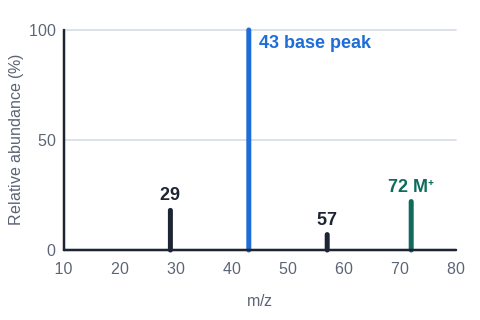
- M = 4(12.0) + 8(1.0) + 16.0 = 72.0 g mol⁻¹, so m/z 72 is M⁺, [CH₃COCH₂CH₃]⁺
- 72 − 57 = 15: loss of CH₃, leaving CH₃CH₂CO⁺
- 72 − 43 = 29: loss of C₂H₅, leaving CH₃CO⁺the base peak: the C=O stabilises this ion
- m/z 29 is C₂H₅⁺, the other half of the same break
- breaking either C–C bond next to the C=O is typical of ketones
Try it: read the mass spectrum
Infrared spectra and functional groups
- Covalent bonds stretch and bend, and each kind of bond absorbs infrared at its own range of wavenumbers (cm⁻¹); the spectrum shows transmittance, so an absorption is a dip.
- The scale runs from 4000 cm⁻¹ on the left to about 500 cm⁻¹ on the right, and the useful dips for this standard are above 1500 cm⁻¹, plus C–O.
- Below 1500 cm⁻¹ is the fingerprint region: too many overlapping dips to assign, but unique to each compound, so it can match an unknown to a known spectrum.
- Hydrogen bonding broadens O–H dips: an alcohol's O–H is a broad rounded dip, and a carboxylic acid's is very broad, running into the C–H dips.
| Bond | Wavenumber (cm⁻¹) | Look of the dip | Found in |
|---|---|---|---|
| O–H | 3200 to 3550 | Broad, rounded | Alcohols |
| O–H | 2500 to 3300 | Very broad | Carboxylic acids |
| N–H | 3300 to 3500 | Medium, sharper than O–H | Amines, amides |
| C–H | 2850 to 3000 | Sharp | Almost every organic compound |
| C=O | 1650 to 1750 | Strong, sharp | Aldehydes, ketones, acids, esters, amides, acid chlorides |
| C=C | 1620 to 1680 | Medium to weak | Alkenes |
| C–O | 1000 to 1300 | Strong | Alcohols, acids, esters |
Example: acid, alcohol or aldehyde?
- A bottle could hold propan-1-ol, propanal or propanoic acid. Its IR spectrum has a very broad dip from 2500 to 3300 cm⁻¹, a strong sharp dip at 1710 cm⁻¹ and a dip at 1240 cm⁻¹.
- Which compound is it?
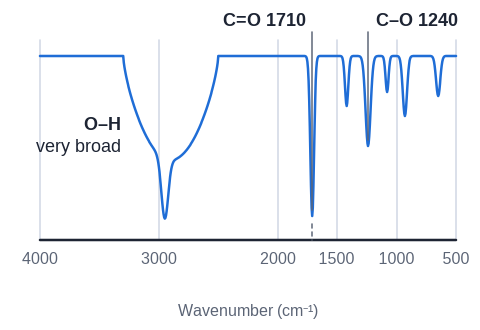
- 1710 cm⁻¹ strong and sharp: C=O presentrules out propan-1-ol, which has no C=O
- very broad 2500 to 3300 cm⁻¹: O–H of a carboxylic acidrules out propanal, which has C=O but no O–H
- 1240 cm⁻¹: C–O, as in COOH
- the compound is propanoic acid, CH₃CH₂COOH
Try it: which bond made that dip?
Carbon-13 NMR: counting carbon environments
- In a magnetic field, each ¹³C nucleus absorbs radio waves at a frequency set by the atoms around it, reported as a chemical shift δ in ppm from 0 to about 220.
- Carbons in identical surroundings give one peak, so the number of peaks is the number of carbon environments, not the number of carbons.
- Look for symmetry: in propan-2-ol, CH₃CH(OH)CH₃, the two CH₃ carbons are equivalent, so three carbons give only two peaks.
- The shift shows the neighbours: a carbon bonded to an electronegative atom such as O or Cl is pulled to a higher δ, and a C=O carbon sits highest of all.
- Peak heights in a ¹³C spectrum do not reliably show how many carbons are in each environment, so use the number and the positions of peaks, not their heights.
| Kind of carbon | Chemical shift δ (ppm) |
|---|---|
| C–C in an alkyl chain (CH₃, CH₂, CH) | 0 to 50 |
| C–Cl or C–Br | 30 to 70 |
| C–N | 30 to 65 |
| C–O (alcohols, ethers, esters) | 50 to 90 |
| C=C | 110 to 150 |
| C=O in acids, esters, amides, acid chlorides | 160 to 185 |
| C=O in aldehydes and ketones | 190 to 220 |
Example: telling the butanol isomers apart
- Four alcohols share the formula C₄H₁₀O, so their mass spectra all show M⁺ at m/z 74 and their IR spectra all show a broad O–H dip.
- Predict the number of peaks in each ¹³C NMR spectrum.
| Alcohol | Structure | Carbon environments | Peaks |
|---|---|---|---|
| Butan-1-ol | CH₃CH₂CH₂CH₂OH | every carbon different | 4 |
| Butan-2-ol | CH₃CH(OH)CH₂CH₃ | every carbon different | 4 |
| 2-methylpropan-1-ol | (CH₃)₂CHCH₂OH | two CH₃ the same | 3 |
| 2-methylpropan-2-ol | (CH₃)₃COH | three CH₃ the same | 2 |
- 2 peaks: only 2-methylpropan-2-ol
- 3 peaks: only 2-methylpropan-1-ol
- 4 peaks: butan-1-ol or butan-2-ol, so look at the C–O carbon and the fragmentsbutan-1-ol gives a strong m/z 31 (CH₂OH⁺); butan-2-ol gives m/z 45 (CH₃CHOH⁺)
- the peak count alone separates two of the four; MS fragments separate the other two
Try it: count the carbon environments
Combining the data
- Start with the mass spectrum: M⁺ gives the molar mass, and with the elements present it fixes the molecular formula.
- Use the IR spectrum to name the functional group, and say which groups are ruled out by missing dips.
- Draw every structural isomer with that formula and group, then use the ¹³C NMR peak count and shifts to cut the list to one.
- Check the answer against all the data: the fragments in the mass spectrum must be pieces your structure can actually make, and every NMR peak must belong to a carbon in it.
Example: naming compound X
- Compound X contains carbon, hydrogen and oxygen. MS: M⁺ at m/z 88, with peaks at 73, 45 and 43. IR: very broad dip from 2500 to 3300 cm⁻¹ and a strong dip at 1710 cm⁻¹. ¹³C NMR: three peaks, at 184, 34 and 19 ppm.
- Identify X and justify it from all three spectra.
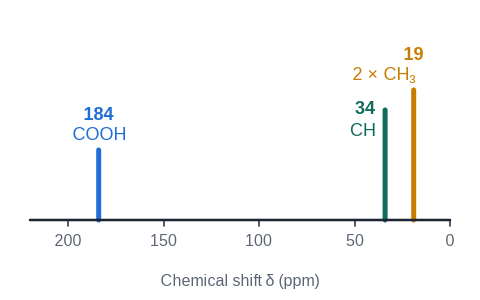
- IR: very broad O–H and C=O at 1710 cm⁻¹, so X is a carboxylic acid, R–COOH
- M = 88: COOH is 45, so R is 43, which is C₃H₇; X is C₄H₈O₂4(12.0) + 8(1.0) + 2(16.0) = 88.0
- isomers: butanoic acid CH₃CH₂CH₂COOH (4 environments) or 2-methylpropanoic acid (CH₃)₂CHCOOH (3 environments)
- NMR shows 3 peaks: 184 ppm COOH, 34 ppm CH, 19 ppm two equivalent CH₃rules out butanoic acid
- MS: 88 − 15 = 73 (loss of CH₃), 45 is COOH⁺, 43 is (CH₃)₂CH⁺
- X is 2-methylpropanoic acid, (CH₃)₂CHCOOH
How it is assessed, and what Merit and Excellence look like
- This is an internal: you are given spectra and data tables for unknown compounds, usually under test conditions, and write your analysis.
- Achieved identifies separate features: a functional group from an IR dip, the molar mass from M⁺, the number of carbon environments.
- Merit uses the data to work out the full structure; Excellence justifies that structure by linking all three spectra and explaining why the other isomers do not fit.
| Grade | What the student wrote |
|---|---|
| Achieved | The dip at 1710 cm⁻¹ shows a C=O bond, and the molecular ion at 88 means the molar mass is 88 g mol⁻¹. |
| Merit | The very broad O–H and the C=O show a carboxylic acid. With M = 88 the formula is C₄H₈O₂, and three ¹³C peaks fit 2-methylpropanoic acid, (CH₃)₂CHCOOH. |
| Excellence | IR gives a carboxylic acid, since the O–H dip is very broad and C=O is at 1710 cm⁻¹. M⁺ at 88 makes the formula C₄H₈O₂, so X is butanoic acid or 2-methylpropanoic acid. Butanoic acid has four carbon environments, but X shows three: 184 ppm (COOH), 34 ppm (CH) and 19 ppm, one peak for two equivalent CH₃ groups. The fragments agree: 73 is M⁺ minus CH₃ and 43 is (CH₃)₂CH⁺. X is 2-methylpropanoic acid. |
Common mistakes
- The tallest peak in the mass spectrum is the molecular ion, so M = 43.The tallest peak is the base peak, the most common fragment; the molecular ion is the last big peak on the right.
- Propan-2-ol has three carbons, so its ¹³C NMR spectrum has three peaks.The two CH₃ groups are equivalent, so there are two carbon environments and two peaks.
- There is a dip at 3000 cm⁻¹, so the compound has an O–H group.C–H dips sit at 2850 to 3000 cm⁻¹ in almost every compound; an alcohol O–H is a broad dip at 3200 to 3550 cm⁻¹.
- A C=O dip at 1715 cm⁻¹ means it is a ketone.Aldehydes, acids, esters and amides all have C=O too; check for O–H or N–H in IR and for the C=O shift in the ¹³C spectrum.
Count carbon environments with models
You need: a stick of Blu Tack or playdough, a box of toothpicks, two colours of felt pen, paper
- Roll black-marked balls for carbon and plain smaller balls for hydrogen, and join them with toothpicks into pentane, CH₃CH₂CH₂CH₂CH₃.
- Turn the model end to end and mark carbons that look the same from their own position with the same colour; count the colours to predict the ¹³C peaks.
- Rebuild the five carbons as 2-methylbutane and then as 2,2-dimethylpropane, and count again.
- Write the three formulas (all C₅H₁₂, all M⁺ at 72) beside your peak counts.
- Look for: pentane gives 3 peaks, 2-methylbutane 4 and 2,2-dimethylpropane 2, so NMR tells apart isomers that MS and IR cannot.
Safety: Toothpick points can pierce skin or an eye, so push them in pointing away from you and keep them away from small children.
Your turn
A C₃H₈O alcohol has a broad IR dip at 3350 cm⁻¹ and two peaks in its ¹³C NMR spectrum. Name it.
How many peaks does pentan-3-one, CH₃CH₂COCH₂CH₃, give in its ¹³C NMR spectrum?
A haloalkane has molecular ion peaks at m/z 78 and 80 in a 3 : 1 ratio. Which halogen is present, and what is the molecular formula?
An ester C₄H₈O₂ has its base peak at m/z 43, a CH₃CO⁺ ion. Is it ethyl ethanoate or methyl propanoate?
Which IR evidence shows a sample is propanal and not propan-1-ol?
Show answer
1. Two peaks means two carbon environments, so it is propan-2-ol, CH₃CH(OH)CH₃ (propan-1-ol has three). 2. The molecule is symmetrical about the C=O: the two CH₃ are equivalent and the two CH₂ are equivalent, so 3 peaks (CH₃, CH₂ and C=O). 3. Two peaks 2 apart in a 3 : 1 ratio show chlorine; 78 − 35 = 43 = C₃H₇, so C₃H₇Cl. 4. Ethyl ethanoate, CH₃COOCH₂CH₃, which breaks to CH₃CO⁺ (m/z 43); methyl propanoate would give CH₃CH₂CO⁺ at m/z 57. 5. A strong sharp C=O dip near 1730 cm⁻¹ and no broad O–H dip at 3200 to 3550 cm⁻¹.
Recap
- MS: M⁺ gives the molar mass, gaps to fragments show what broke off, and M + 2 peaks flag Cl (3 : 1) or Br (1 : 1).
- IR: O–H broad (very broad in acids), N–H, C=O strong near 1700 cm⁻¹, C=C, and C–O; the fingerprint region matches but is not assigned.
- ¹³C NMR: one peak per carbon environment; the shift rises with nearby O, N or halogen and is highest for C=O.
- Combine: formula from MS, group from IR, isomer from NMR, then check every peak against your structure.
| Data | Key question |
|---|---|
| Molecular ion | What is the molar mass? |
| Fragments | Which pieces break off? |
| IR dips | Which functional groups are there, and which are missing? |
| ¹³C peak count | How many carbon environments? |
| ¹³C shifts | What is each carbon bonded to? |
Challenge
Two unlabelled bottles each hold a bromoalkane, C₄H₉Br. Both mass spectra show two molecular ion peaks of equal height at 136 and 138, and a base peak at 57. Both ¹³C NMR spectra show four peaks. Bottle A: highest ¹³C shift 53 ppm, and a pair of equal peaks at 107 and 109. Bottle B: highest ¹³C shift 35 ppm, and a pair of equal peaks at 93 and 95. (a) Draw out all four structural isomers of C₄H₉Br and count the carbon environments in each. (b) Identify A and B, explaining what breaks to make the 107 and 109 pair and the 93 and 95 pair. (c) Explain why the peak at 57 is a single peak, while the others come in equal pairs.
Hint
Bromine is ⁷⁹Br and ⁸¹Br in about a 1 : 1 ratio, so any fragment that still holds the Br shows up as two equal peaks 2 apart. Work out what was lost from 136 to reach 107, and from 136 to reach 93.
Answer
(a) 1-bromobutane (4 environments), 2-bromobutane (4), 1-bromo-2-methylpropane (3), 2-bromo-2-methylpropane (2). (b) A is 2-bromobutane, CH₃CHBrCH₂CH₃: losing C₂H₅ (29) leaves CH₃CHBr⁺ at 107 and 109. B is 1-bromobutane, CH₃CH₂CH₂CH₂Br: losing C₃H₇ (43) leaves CH₂Br⁺ at 93 and 95. (c) 57 is C₄H₉⁺, made by losing the Br atom, so it holds no bromine and has only one mass.
Step by step
- Four peaks rules out 1-bromo-2-methylpropane (two equivalent CH₃, so 3 peaks) and 2-bromo-2-methylpropane (three equivalent CH₃, so 2 peaks). Both bottles are straight-chain isomers.
- 136 − 107 = 29, a C₂H₅ lost. Only 2-bromobutane has an ethyl group on the carbon holding Br, leaving CH₃CHBr⁺.
- 136 − 93 = 43, a C₃H₇ lost. In 1-bromobutane, breaking the C–C bond next to the CH₂Br leaves CH₂Br⁺.
- The shifts agree: in A the C–Br carbon is bonded to two other carbons and sits higher (53 ppm); in B no carbon is above 35 ppm, as the CH₂Br carbon has only one carbon neighbour. Both are inside the C–Br range of 30 to 70 ppm, so the fragments are the stronger evidence.
- Every ion that keeps the Br appears twice, at masses 2 apart and equal heights. Losing Br (79 or 81) from either molecular ion gives the same C₄H₉⁺ at 57, so it is one peak.
Full working
- C₄H₉Br: 4(12.0) + 9(1.0) + 79 = 136; with ⁸¹Br, 138equal heights: one Br
- 4 peaks: 1-bromobutane or 2-bromobutanethe branched isomers give 3 and 2 peaks
- A: 136 − 107 = 29 = C₂H₅ lost; CH₃CHBr⁺ = 2(12.0) + 4(1.0) + 79 = 1072-bromobutane
- B: 136 − 93 = 43 = C₃H₇ lost; CH₂Br⁺ = 12.0 + 2(1.0) + 79 = 931-bromobutane
- 57: C₄H₉⁺ = 4(12.0) + 9(1.0) = 57the Br has gone, so one peak
- A is 2-bromobutane, B is 1-bromobutane
An unknown compound contains only carbon, hydrogen and chlorine. Its mass spectrum has molecular ion peaks at 98, 100 and 102 with heights in the ratio 9 : 6 : 1, a group at 83, 85 and 87 (also 9 : 6 : 1) and a pair at 63 and 65 (3 : 1). Its IR spectrum shows only C–H dips above 1500 cm⁻¹. Its ¹³C NMR spectrum has two peaks, at 69 and 31 ppm. (a) Use the chlorine isotope ratio (³⁵Cl : ³⁷Cl = 3 : 1) to explain why a 9 : 6 : 1 pattern means two Cl atoms. (b) Find the molecular formula and draw the possible isomers. (c) Identify the compound and explain every listed peak.
Hint
Each Cl is ³⁵Cl three times out of four. For two Cl atoms, find the chance of 35 and 35, of one of each (two ways), and of 37 and 37, in sixteenths.
Answer
(a) Chances 916, 616 and 116 for masses M, M + 2 and M + 4, a 9 : 6 : 1 pattern. (b) C₂H₄Cl₂: 1,1-dichloroethane (2 environments) or 1,2-dichloroethane (1 environment). (c) 1,1-dichloroethane, CH₃CHCl₂: 69 ppm is the CHCl₂ carbon and 31 ppm the CH₃; 98, 100, 102 are M⁺; 83, 85, 87 is CHCl₂⁺ after losing CH₃ (15); 63 and 65 is C₂H₄Cl⁺ after losing one Cl.
Step by step
- One Cl is ³⁵Cl with chance 34 and ³⁷Cl with chance 14. Two Cl: both 35 is 34 × 34 = 916; one of each is 2 × 34 × 14 = 616; both 37 is 116.
- So an ion with two Cl gives three peaks 2 apart in the ratio 9 : 6 : 1, and an ion with one Cl gives the 3 : 1 pair.
- With two ³⁵Cl the molecule is 98, so the rest is 98 − 70 = 28 = C₂H₄. The formula is C₂H₄Cl₂.
- Two peaks in ¹³C NMR rules out 1,2-dichloroethane, ClCH₂CH₂Cl, whose two carbons are the same (one peak). It is 1,1-dichloroethane.
- 69 ppm is the carbon with two Cl (pulled high), and 31 ppm the CH₃. 98 − 83 = 15, a CH₃ lost, leaving CHCl₂⁺ with both Cl (9 : 6 : 1). 98 − 63 = 35, a Cl lost, leaving C₂H₄Cl⁺ with one Cl (3 : 1).
Full working
- P(35, 35) = 34 × 34 = 916mass M
- P(35, 37) = 2 × 34 × 14 = 616mass M + 2, two orders
- P(37, 37) = 14 × 14 = 116mass M + 4
- 98 − 2(35) = 28 = C₂H₄formula C₂H₄Cl₂
- CH₃CHCl₂: 2 environments; ClCH₂CH₂Cl: 1 environment2 peaks fits CH₃CHCl₂
- 83 = 12.0 + 1.0 + 70 = CHCl₂⁺lost CH₃, still two Cl, 9 : 6 : 1
- 63 = 2(12.0) + 4(1.0) + 35 = C₂H₄Cl⁺lost one Cl, so 3 : 1
- 1,1-dichloroethane, CH₃CHCl₂
Compound Q contains carbon, hydrogen and oxygen. Mass spectrum: molecular ion at 72, base peak at 57, other peaks at 45 and 27. IR: a broad dip at 3350 cm⁻¹, a medium dip at 1645 cm⁻¹, and no strong dip between 1650 and 1750 cm⁻¹. ¹³C NMR: four peaks, at 142, 113, 69 and 23 ppm. (a) Find the molecular formula and the functional groups. (b) Draw every structural isomer that fits (ignore cis and trans forms, and leave out any with OH on a C=C carbon, which are unstable). (c) Show that the ¹³C NMR peak count cannot decide between them, then use the mass spectrum to identify Q, explaining the peaks at 57, 45 and 27.
Hint
Butanol is C₄H₁₀O, M = 74. A molar mass 2 lower means one C=C. For (c), ask which isomer has a CH₃ joined to the carbon that carries the OH.
Answer
(a) C₄H₈O, an alcohol (broad O–H) with a C=C (1645 cm⁻¹ and two peaks at 113 and 142 ppm), and no C=O. (b) but-3-en-1-ol, but-3-en-2-ol, but-2-en-1-ol and 2-methylprop-2-en-1-ol, each with four carbon environments. (c) All four give four peaks, so the count cannot decide. The peak at 45 is CH₃CHOH⁺, which needs a CH₃–CH(OH)– unit, found only in but-3-en-2-ol, CH₂=CHCH(OH)CH₃. The base peak 57 is the loss of CH₃, leaving the stable CH₂=CHCH=OH⁺ ion, and 27 is CH₂=CH⁺.
Step by step
- IR: the broad dip at 3350 cm⁻¹ is an alcohol O–H; 1645 cm⁻¹ is C=C; no strong dip near 1700 cm⁻¹ means no C=O.
- A C₄ alcohol with one O is C₄H₁₀O (74) if it has no C=C. Q is 72, two H fewer, so C₄H₈O with one C=C. The ¹³C peaks at 142 and 113 ppm (110 to 150) confirm a C=C, and 69 ppm is the C–O carbon.
- Put the C=C and OH on a 4-carbon chain or a branched chain, keeping OH off the C=C carbons: four isomers, and in each one every carbon is different, so each gives four peaks.
- So use the fragments. 72 − 45 = 27: losing CH₂=CH leaves CH₃CHOH⁺, which only forms if a CH₃ and the OH are on the same carbon. Only but-3-en-2-ol has that.
- 72 − 57 = 15: losing that CH₃ leaves CH₂=CHCH=OH⁺, spread over the C=C and the O, so it is the most stable ion and the base peak. 27 is the CH₂=CH⁺ piece itself. The primary alcohols would instead give a strong CH₂OH⁺ peak at 31, which is not listed.
Full working
- C₄H₈O = 4(12.0) + 8(1.0) + 16.0 = 72two H fewer than butanol: one C=C
- IR 3350 broad: O–H; 1645: C=C; no C=Oan unsaturated alcohol
- isomers: CH₂=CHCH₂CH₂OH, CH₂=CHCH(OH)CH₃, CH₃CH=CHCH₂OH, CH₂=C(CH₃)CH₂OH4 environments each
- 45 = CH₃CHOH⁺: 2(12.0) + 5(1.0) + 16.0 = 45needs CH₃ on the C–OH carbon
- 57 = 72 − 15: CH₃ lost27 = C₂H₃⁺: 2(12.0) + 3(1.0) = 27
- ¹³C: 142 and 113 C=C, 69 C–OH, 23 CH₃every peak has a carbon
- Q is but-3-en-2-ol, CH₂=CHCH(OH)CH₃