
Choosing a distribution, and naming it every time
What this lesson covers
- Each distribution has conditions, and the conditions decide the model, not the number it produces.
- Name the distribution and its parameters every time, or the answer cannot earn a grade.
Which distribution?
- Every question starts with a choice.
- Say it clearly, then calculate.
- Unsaid, even a right number earns nothing.
First, say what is random
- X is what you count or measure.
- Write it in words, with units.
- A named 2025 gap: no random variable.
| Situation | Random variable X |
|---|---|
| 20 shots at goal | goals scored |
| 10 minutes at a café | cars that arrive |
| A pie from the oven | its mass in grams |
| Waiting for a bus | minutes waited |
Binomial: four conditions
- Fixed n, two outcomes.
- The same p every trial.
- Trials independent, in context.
| Condition | In context |
|---|---|
| Fixed n | 20 shots |
| Two outcomes | goal or miss |
| Constant p | 0.7 on every shot |
| Independent | no effect on next shot |
| Model | X ~ Bin(20, 0.7) |
Try it: change the distribution
Poisson: two conditions
- Events occur independently.
- At a constant average rate.
- Per unit of time or space.
| Condition | In context |
|---|---|
| Independent | cars arrive separately |
| Constant rate | 3 per 10 minutes |
| No fixed n | no upper limit |
| Model | X ~ Po(3) |
Hints are not conditions
- Rare and discrete: hints only.
- Not conditions about probability.
- Name the cars and the ten minutes.
| Written | Verdict |
|---|---|
| Events are rare | indicator only |
| Counts are discrete | indicator only |
| Probability is small | not a condition |
| Cars independent | condition |
| Constant average rate | condition |
Three models for measurements
- Normal: a symmetric bell.
- Uniform: flat between min and max.
- Triangular: a peak at the mode.
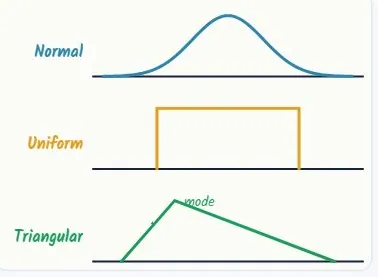
Their parameters
- Normal: the mean and standard deviation.
- Uniform: a minimum and a maximum.
- Triangular: minimum, mode, maximum.
| Model | Shape | Parameters |
|---|---|---|
| Normal | symmetric bell | μ and σ |
| Uniform | flat | min, max |
| Triangular | peak at the mode | min, mode, max |
Probability calculator
Sort the situations
- Counts in n trials: binomial.
- Counts in an interval: Poisson.
- Measurements: normal, uniform, triangular.
| Situation | Model |
|---|---|
| Goals in 20 shots | X ~ Bin(20, 0.7) |
| Cars in 10 minutes | X ~ Po(3) |
| Pie mass, grams | X ~ N(180, 6) |
| Wait, bus every 10 min | uniform, 0 to 10 |
| Bus lateness, minutes | min 0, mode 2, max 10 |
Try it: which model?
Two models, almost the same number
- 100 customers, p = 0.03 each.
- P(X = 2): 0.2252 against 0.2240.
- The number cannot show the model.
| Model | P(X = 2) |
|---|---|
| X ~ Bin(100, 0.03) | 0.2252 |
| X ~ Po(3) | 0.2240 |
| Difference | 0.0011 |
Write it the same way every time
- No named model: no grade.
- X in words, the model, the conditions.
- Only then calculate.
| Step | Write |
|---|---|
| 1. Define X | X = goals in 20 shots |
| 2. Name it | X ~ Bin(20, 0.7) |
| 3. Conditions | in the context |
| 4. Then | the probability |
Try it: name the model in full
Is the condition believable?
- Say which condition might fail.
- Say why, in the context.
- That is Merit and Excellence thinking.
| Condition | Could fail if |
|---|---|
| Independent cars | a tour bus arrives |
| Constant rate | a lunchtime rush |
| Constant p, netball | she tires late on |
Where the marks are
- Achieved: right model, independence in context.
- Merit: why it suits, and its parameters.
- Excellence: judge the model and assumptions.
What to take away
- Define X, name the model with its parameters, and state conditions in context.
| Define X | in words, with units |
| Binomial | fixed n, constant p |
| Poisson | constant average rate |
| Both | independent, in context |
| Rare, discrete | indicators only |
| Every answer | X ~ Bin(n, p) and so on |
Common mistakes
- P(X = 2) = 0.2252, written straight down with no X defined and no model named.Define X in words, then write X ~ Bin(100, 0.03) before calculating; a right number with no named model cannot earn a grade.
- Poisson because the events are rare and the counts are discrete.Rare and discrete are only hints; the conditions are that the cars arrive independently at a constant average rate of 3 per 10 minutes.
- The trials are independent.State each condition in the context, e.g. one shot at goal has no effect on the next shot; a condition with no context earns nothing.
- X ~ Bin(0.7, 20)Write X ~ Bin(n, p) with the number of trials first: X ~ Bin(20, 0.7), and give every parameter.
Your turn: eight questions
- Define X and write the model.
- Question 2: both conditions in context.
| Given | Find | |
|---|---|---|
| 1 | 15 kicks, p = 0.8 each | X and model |
| 2 | 6 emails an hour | conditions |
| 3 | mean 250 mL, sd 4 mL | model |
| 4 | ferry every 20 minutes | your wait |
| 5 | bus late 0 to 15 min, most often 3 | model |
| 6 | 250 orders, 2% faulty each | model and why |
| 7 | "Calls are rare, so Poisson" | verdict |
| 8 | netball shooter, X ~ Bin(30, 0.6) | a condition that could fail |
Show answer
1. X = number of kicks scored out of 15; X ~ Bin(15, 0.8). 2. X = emails in one hour; X ~ Po(6): emails arrive independently, at a constant average rate of 6 per hour. 3. X = volume in mL; X ~ N(250, 4). 4. Uniform, from 0 to 20 minutes, if you arrive at a random time. 5. Triangular, min 0, mode 3, max 15. There are hard limits and one most likely value, so it peaks at the mode 3. 6. X ~ Bin(250, 0.02), because X counts faulty orders in a fixed n of 250. Po(5) gives a close number, but the number cannot show the model. 7. Rare is an indicator only. The conditions are that calls arrive independently and at a constant average rate, stated in context. 8. Constant p could fail: she may tire late in the game, so her chance of scoring drops below 0.6.
The answers
- X ~ Bin(15, 0.8).
- X ~ Po(6): independent, constant rate.
- X ~ N(250, 4).
- Uniform, 0 to 20 minutes.
Sample question: Achieved
A netball shooter scores 82% of her shots. In one quarter she takes 15 shots. Define a random variable, name a suitable distribution with its parameters, state the conditions in context, and find the probability she scores exactly 12.
Hint
Count successes in a fixed number of trials: check the four binomial conditions in netball words.
Answer
X = goals scored out of 15 shots; X ~ Bin(15, 0.82); P(X = 12) = 0.2452
Step by step
- Say what is random first: X = the number of goals she scores from her 15 shots.
- We count successes in a fixed number of trials, so think binomial.
- Fixed n: she takes 15 shots. Two outcomes: each shot is a goal or a miss.
- Constant p: 0.82 on every shot. Independent: one shot does not change the next one.
- So X ~ Bin(15, 0.82).
- Formula: P(X = 12) = 15C12 × 0.82¹² × 0.18³ = 455 × 0.82¹² × 0.18³.
- Calculator, Bin pdf with x = 12, n = 15, p = 0.82: 0.2452.
- Check: the mean is 15 × 0.82 = 12.3, so 12 is the most likely sort of value. A probability near a quarter is sensible.
Full working
- X = goals scored out of 15 shots
- fixed n = 15, goal or miss, p = 0.82 each shot, shots independentbinomial conditions in context
- X ~ Bin(15, 0.82)
- P(X = 12) = 15C12 × 0.82¹² × 0.18³Bin pdf
- P(X = 12) = 0.2452
Sample questions: Merit
Between 9 am and 3 pm, emails reach a school office at an average of 18 per hour. Define a random variable for the emails in a 10-minute period, name a model with its parameter, state its conditions in context, and find the probability of at least 5 emails in a 10-minute period. Give one reason a condition might fail.
Hint
Emails in an interval with no fixed number of trials: Poisson. Scale 18 per hour down to 10 minutes.
Answer
X = emails in 10 minutes, X ~ Po(3); P(X ≥ 5) = 0.1847. A condition fails if, say, a newsletter brings a burst of replies
Step by step
- Define X in words with its interval: X = number of emails that arrive in a 10-minute period.
- We count events in an interval, with no fixed number of trials and no top value. That points to Poisson.
- Conditions in context: emails arrive independently of each other, at a constant average rate.
- Scale the rate: 10 minutes is one sixth of an hour, so λ = 18 ÷ 6 = 3. So X ~ Po(3).
- At least 5 means 1 − P(X ≤ 4). Poisson cdf with x = 4, λ = 3 gives 0.8153.
- So P(X ≥ 5) = 1 − 0.8153 = 0.1847.
- A condition that might fail: independence fails if one email to all parents brings a burst of replies together.
- Or the constant rate fails if mornings are busier than afternoons. Either reason, in context, is enough.
- Classic mistake: writing rare events as a condition. Rare is only a hint, not a condition.
Full working
- X = emails in a 10-minute period
- independent arrivals, constant average ratePoisson conditions in context
- λ = 18 ÷ 6 = 3scale to 10 minutes
- X ~ Po(3)
- P(X ≥ 5) = 1 − P(X ≤ 4) = 1 − 0.8153
- fails if replies come in bursts, or mornings are busier
- X ~ Po(3); P(X ≥ 5) = 0.1847
A carton holds 200 eggs. Each egg, independently, has a 1.5% chance of being cracked. Find the probability that at most 2 eggs are cracked using a binomial model, and again using a Poisson model with the same mean. Explain which model is correct here and why the two answers are so close.
Hint
The binomial is X ~ Bin(200, 0.015). The Poisson with the same mean has λ = np.
Answer
Binomial 0.4215, Poisson 0.4232. The binomial is correct (fixed n = 200, constant p); the Poisson is close because n is large and p is small
Step by step
- Define X = number of cracked eggs in a carton of 200.
- There are 200 eggs (fixed n), each cracked or not, p = 0.015 each, independently. Those are the binomial conditions, so X ~ Bin(200, 0.015).
- Binomial cdf with x = 2, n = 200, p = 0.015 gives P(X ≤ 2) = 0.4215.
- A Poisson model with the same mean uses λ = np = 200 × 0.015 = 3. So Y ~ Po(3).
- Poisson cdf with x = 2, λ = 3 gives P(Y ≤ 2) = 0.4232.
- Which is correct? The binomial, because the situation has a fixed number of trials. A Poisson count has no upper limit, but here at most 200 eggs can be cracked.
- Why so close? When n is large and p is small, the binomial and Poisson shapes nearly match.
- The lesson's point: a number cannot tell you the model. The conditions in context decide it.
Full working
- X ~ Bin(200, 0.015)fixed n, constant p, independent
- P(X ≤ 2) = 0.4215Bin cdf
- λ = np = 200 × 0.015 = 3
- Y ~ Po(3): P(Y ≤ 2) = 0.4232Poisson cdf
- difference 0.0017large n, small p
- Binomial 0.4215 (correct model), Poisson 0.4232
Sample questions: Excellence
A takeaway's delivery times are never under 15 minutes or over 45 minutes, and are most often about 22 minutes. Explain why a triangular model suits better than a normal or a uniform model, and give its parameters. Find the probability that a delivery takes more than 35 minutes. The takeaway gives a free meal if a delivery takes more than 40 minutes. Find the probability of more than 2 free meals in 50 deliveries, and state the condition this needs.
Hint
Triangular for the times, then the chance of over 40 minutes becomes p in a binomial model for 50 deliveries.
Answer
Triangular with a = 15, c = 22, b = 45; P(X > 35) = 0.1449; P(more than 2 free meals) = 0.2715, assuming deliveries are independent
Step by step
- Choose the model from the facts. There are hard limits at 15 and 45 minutes and one most likely value, 22, that is not in the middle.
- A normal model is symmetric and has no hard limits, so it does not fit. A uniform model would say 22 is no more likely than 40, which is wrong.
- So X = delivery time in minutes is triangular with a = 15, c = 22, b = 45. The peak height is 2b − a = 230.
- More than 35 minutes is the right tail: a small triangle from 35 to 45.
- Its height at 35 is 45 − 3545 − 22 × 230 = 1023 × 230. Area = ½ × 10 × that height = 100690 = 0.1449.
- The same way, the tail over 40 has base 5: P(X > 40) = 25690 = 0.0362.
- Now count free meals. Each of 50 deliveries is free or not, with p = 0.0362 each. So Y ~ Bin(50, 0.0362), Y = free meals in 50 deliveries.
- More than 2 means 1 − P(Y ≤ 2). Binomial cdf with x = 2 gives 0.7285, so P(Y ≥ 3) = 0.2715.
- The binomial needs deliveries to be independent with the same p. A wet Friday night, with many slow deliveries together, would break that.
- Classic mistake: using 1b − a for the peak. A triangle's peak is 2b − a, so the total area is 1.
Full working
- hard limits 15 and 45, a mode of 22 off-centrenot normal, not uniform
- X ~ triangular, a = 15, c = 22, b = 45peak 230
- P(X > 35) = ½ × 10 × 1023 × 230 = 100690 = 0.1449right-tail triangle
- P(X > 40) = 25690 = 0.0362
- Y ~ Bin(50, 0.0362)Y = free meals in 50 deliveries
- P(Y ≥ 3) = 1 − P(Y ≤ 2) = 1 − 0.7285
- assumes deliveries are independent with the same p
- P(X > 35) = 0.1449; P(Y > 2) = 0.2715
A rugby club recorded the number of tries its team scored in 40 games: 0 tries in 6 games, 1 in 11, 2 in 12, 3 in 7, 4 in 3 and 5 in 1. Find the mean number of tries per game. Using a Poisson model with that mean, find the expected number of games with 0, 1, 2 and 3 tries. Judge whether a Poisson model is suitable, with reference to the data and the conditions.
Hint
Mean = total tries ÷ 40. Expected games = 40 × P(X = x). Then compare the counts, the variance with the mean, and the conditions.
Answer
Mean 1.825 tries per game. Expected games: 6.4, 11.8, 10.7, 6.5 against 6, 11, 12, 7. The fit is good and the variance (about 1.54) is close to the mean, but the constant rate condition is doubtful because opponents differ in strength
Step by step
- Define X = number of tries the team scores in a game.
- Mean from the data: total tries = 0×6 + 1×11 + 2×12 + 3×7 + 4×3 + 5×1 = 73. Mean = 73 ÷ 40 = 1.825.
- Model: X ~ Po(1.825). Expected games for each value = 40 × P(X = x).
- P(X = 0) = 0.1612, so 40 × 0.1612 = 6.4 games. P(X = 1) = 0.2942, so 11.8 games.
- P(X = 2) = 0.2685, so 10.7 games. P(X = 3) = 0.1633, so 6.5 games.
- Compare: 6.4 against 6, 11.8 against 11, 10.7 against 12, 6.5 against 7. Every count is within about 1 game of the model.
- Another check: for a Poisson model the variance equals the mean. The data's variance is 195 ÷ 40 − 1.825² = 1.5444, close to 1.825.
- Now the conditions. Tries are not fully independent: a team on top often scores several in a row.
- The rate is not truly constant: a strong opponent cuts the rate, a weak one raises it.
- Conclusion: the numbers say Poisson is a reasonable model here, but the conditions are only roughly met. With 40 games, small differences can also be chance.
Full working
- mean = 73 ÷ 40 = 1.825total tries over games
- X ~ Po(1.825)X = tries in a game
- expected = 40 × P(X = x): 6.4, 11.8, 10.7, 6.50, 1, 2, 3 tries
- observed: 6, 11, 12, 7all within about 1 game
- variance = 195 ÷ 40 − 1.825² = 1.5444close to the mean
- rate changes with the opponent; tries can come in runsconditions doubtful
- Mean 1.825; Poisson fits the data well, but the conditions are only roughly met
Challenge
A school raffle sells all 200 tickets, and 10 of them win a prize. Wiremu buys 20 tickets. Let X be the number of his tickets that win. His friend models X ~ Bin(20, 0.05) and finds P(at least one win) = 0.6415. (a) Explain which binomial condition fails and why. (b) Find the exact probability that Wiremu wins at least one prize. (c) Explain why the binomial answer is smaller than the exact answer, and say when a binomial model would be a good approximation here.
Hint
The winning tickets are drawn without replacement. For (b), find the probability that all 20 of his tickets are losers, one ticket at a time.
Answer
(a) Independence and constant p fail: once one of his tickets is a loser, fewer losers are left, so the chance for the next ticket changes. (b) P(no win) = (190 × 189 × … × 171) ÷ (200 × 199 × … × 181) = 0.3398, so P(at least one win) = 0.6602. (c) Each losing ticket of his makes the rest of his tickets slightly more likely to win, so the exact chance of no win (0.3398) is smaller than 0.95²⁰ = 0.3585. A binomial model is a good approximation when he buys only a small fraction of a large number of tickets.
Step by step
- Binomial needs a constant p and independent trials; drawing from a fixed set of tickets breaks both.
- All 20 tickets lose: the first is a loser with probability 190200, then 189199, and so on down to 171181.
- Multiply the 20 fractions (or use 190C20 ÷ 200C20) to get P(no win).
- The complement gives P(at least one win).
- Without replacement, losers run out faster, which pushes the chance of no win down compared with the binomial.
Full working
- friend: 1 − 0.95²⁰ = 1 − 0.3585 = 0.6415binomial, assumes constant p
- P(no win) = (190200) × (189199) × … × (171181)without replacement
- = 190C20 ÷ 200C20 = 0.3398same product
- P(at least one win) = 1 − 0.3398 = 0.6602complement
- 0.3398 < 0.3585exact chance of no win is smaller
- exact P(at least one win) = 0.6602, against 0.6415 from the binomial
A netball shooter scores each shot with probability 0.8, independently. At practice she keeps shooting until she misses. Let X be the number of goals she scores before her first miss. (a) Explain why X is neither binomial nor Poisson. (b) Find a formula for P(X = k), and show that P(X ≥ 5) equals a probability from a binomial model. (c) She has 10 practice sessions. Define a suitable random variable and find the probability that she scores at least 5 goals before her first miss in at least 3 of the sessions.
Hint
Scoring at least 5 before the first miss means only one thing about her first 5 shots.
Answer
(a) No fixed number of trials, so not binomial; it is not a count of events in an interval of time or space at a constant rate, so not Poisson. (b) P(X = k) = 0.8ᵏ × 0.2 for k = 0, 1, 2, …; X ≥ 5 exactly when her first 5 shots all score, so P(X ≥ 5) = 0.8⁵ = 0.32768, which is P(W = 5) for W ~ Bin(5, 0.8). (c) Y = number of sessions with a run of at least 5, Y ~ Bin(10, 0.32768); P(Y ≥ 3) = 0.6875.
Step by step
- Binomial counts successes in a fixed n; here she decides when to stop by what happens.
- Poisson counts events at a constant average rate in a fixed interval; there is no such interval.
- X = k means k goals in a row and then a miss: multiply 0.8 k times, then 0.2.
- X ≥ 5 happens exactly when the first 5 shots all score, whatever comes after.
- Each session is now a trial with success probability 0.32768, and sessions are independent: a binomial.
Full working
- P(X = k) = 0.8ᵏ × 0.2k goals, then a miss
- X ≥ 5 means shots 1 to 5 all scorethe rest does not matter
- P(X ≥ 5) = 0.8⁵ = 0.32768= P(W = 5), W ~ Bin(5, 0.8)
- Y = sessions with at least 5 goals before a missdefine the variable
- Y ~ Bin(10, 0.32768)fixed 10 sessions, constant p, independent
- P(Y ≥ 3) = 1 − P(Y ≤ 2) = 1 − 0.3125 = 0.6875complement
- P(X ≥ 5) = 0.32768; P(at least 3 sessions) = 0.6875
Three invented data sets each have a mean of 4. (A) Emails reaching a school office in 5-minute periods: variance 4.1. (B) Seeds that sprout in each tray at a nursery, where every tray was planted with the same number of seeds but the label giving that number is lost: variance 2.4. (C) Snapper caught on each trip by a fishing charter: variance 9. (a) For each data set, decide whether a Poisson model, a binomial model or neither suits, giving its parameters where you can. (b) For (B), find the probability that a tray has at least 7 seeds sprouting. (c) For (C), give a reason in context why the variance is so large.
Hint
For a Poisson model the variance equals the mean. For a binomial model the mean is np and the variance is np(1 − p), so the variance is less than the mean, and dividing them gives 1 − p.
Answer
(a) A: Poisson, Po(4), as the variance 4.1 is close to the mean 4. B: binomial, since the variance is less than the mean: 1 − p = 2.4 ÷ 4 = 0.6, so p = 0.4 and n = 4 ÷ 0.4 = 10, Bin(10, 0.4). C: neither, as the variance 9 is far above the mean. (b) P(X ≥ 7) = 1 − P(X ≤ 6) = 0.0548. (c) Fish are caught in schools, and some days have good weather or spots and some do not, so catches are not independent at a constant rate: trips are either very good or very poor.
Step by step
- Poisson: mean = variance, so a variance close to the mean fits.
- Binomial: variance = np(1 − p) is smaller than the mean np; the ratio variance ÷ mean is 1 − p.
- From 1 − p = 0.6 get p = 0.4, then n = mean ÷ p = 10 seeds per tray.
- A variance much bigger than the mean fits neither model; it signals clustering or a changing rate.
- For (B) use the complement with X ~ Bin(10, 0.4).
Full working
- A: mean 4, variance 4.1, about equalPoisson, X ~ Po(4)
- B: np = 4 and np(1 − p) = 2.4binomial mean and variance
- 1 − p = 2.4 ÷ 4 = 0.6, so p = 0.4divide
- n = 4 ÷ 0.4 = 10X ~ Bin(10, 0.4)
- C: variance 9 > mean 4neither model
- P(X ≥ 7) = 1 − P(X ≤ 6) = 1 − 0.9452 = 0.0548binomial cdf, x = 6
- A: Po(4); B: Bin(10, 0.4), P(at least 7) = 0.0548; C: neither
Practise this
Report a mistake
More in AS 91586
Choosing a distribution, and naming it every time7 min Discrete random variables: mean and standard deviation9 min
 Binomial and Poisson: at least, at most, and the rate10 min
 The normal distribution: forwards, backwards and conditional11 min
 Uniform and triangular distributions, and judging a model10 min
 Choosing a distribution: 7 exam questions solved step by step10 min
 Discrete random variables: 7 exam questions solved step by step11 min
 Binomial and Poisson: 7 exam questions solved step by step10 min
 Normal distribution: 7 exam questions solved step by step10 min
 Uniform and triangular: 7 exam questions solved step by step10 min