
Light: mirrors, refraction, total internal reflection and lenses
What this lesson covers
- The law of reflection, plane mirror images, and ray diagrams for concave and convex mirrors.
- Refraction: light changes speed and bends at a boundary; n₁ sin θ₁ = n₂ sin θ₂ and n₁ ÷ n₂ = v₂ ÷ v₁ = λ₂ ÷ λ₁.
- The critical angle, sin θc = n₂ ÷ n₁, and when total internal reflection happens.
- Converging and diverging lenses: the three standard rays and how to locate an image.
- The lens formula 1/f = 1/do + 1/di, magnification m = di ÷ do = hi ÷ ho, and describing an image as real or virtual, upright or inverted, enlarged or diminished.
Reflection: plane and curved mirrors
- All angles are measured from the normal, the line at 90° to the surface where the ray hits; the law of reflection says the angle of reflection equals the angle of incidence.
- A plane mirror gives an image that is virtual (no light actually reaches it), upright, the same size, and as far behind the mirror as the object is in front.
- A concave mirror curves inwards like the inside of a spoon and brings parallel rays together at its focal point F; a convex mirror bulges outwards and spreads them so they seem to come from F behind it.
- To locate an image, draw two rays from the top of the object and find where they meet; if the reflected rays only meet when you extend them behind the mirror, draw those extensions dashed and the image is virtual.
- The lens formula and magnification formula work for mirrors too, with f positive for a concave mirror and negative for a convex one.
| Ray from the top of the object | Concave mirror | Converging lens |
|---|---|---|
| Parallel to the principal axis | reflects through F | refracts through F on the far side |
| Through (or towards) F | reflects back parallel to the axis | refracts parallel to the axis |
| To the centre | through C, the centre of curvature, reflects straight back | through the optical centre, goes straight on |
Refraction and Snell's law
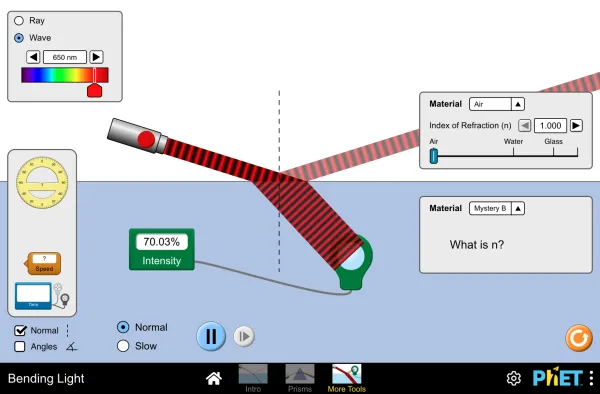
- Refraction is the change in direction when light crosses a boundary at an angle, because its speed changes.
- The refractive index n of a material tells you how much slower light goes in it: n = c ÷ v, so in glass with n = 1.5 light travels at 3.00 × 10⁸ ÷ 1.5 = 2.0 × 10⁸ m s⁻¹.
- Snell's law: n₁ sin θ₁ = n₂ sin θ₂, with both angles measured from the normal.
- Going into a higher n, light slows and bends towards the normal; going into a lower n, it speeds up and bends away from the normal.
- The frequency never changes at a boundary (the source sets it), so with v = fλ the wavelength shrinks in the same ratio as the speed: n₁ ÷ n₂ = v₂ ÷ v₁ = λ₂ ÷ λ₁.
| Substance | Refractive index | Speed of light (× 10⁶ m/s) |
|---|---|---|
| Air | 1.00 | 300 |
| Water | 1.33 | 226 |
| Glass | 1.5 | 200 |
| Diamond | 2.4 | 125 |
Example: light entering a swimming pool
- Sunlight hits the surface of a pool at 40° to the normal. Water has n = 1.33.
- Find the angle of refraction and the speed of light in the water.
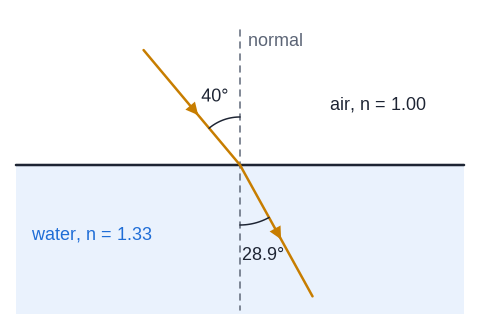
- n₁ sin θ₁ = n₂ sin θ₂Snell's law, angles from the normal
- 1.00 × sin 40° = 1.33 × sin θ₂air is medium 1, water is medium 2
- sin θ₂ = 0.6428 ÷ 1.33 = 0.4833
- θ₂ = sin⁻¹(0.4833) = 28.9°
- v = c ÷ n = 3.00 × 10⁸ ÷ 1.33 = 2.26 × 10⁸ m s⁻¹
- 28.9° is smaller than 40°: the light bent towards the normal as it slowed down
The critical angle and total internal reflection
- When light goes from a higher n to a lower n, it bends away from the normal, so the refracted angle is always bigger than the incident angle.
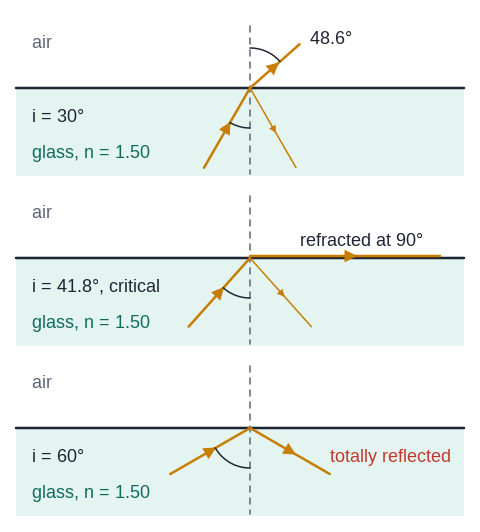
- The critical angle θc is the angle of incidence that makes the refracted ray travel along the boundary, at 90° to the normal.
- Put θ₂ = 90° into Snell's law: n₁ sin θc = n₂ × 1, so sin θc = n₂ ÷ n₁.
- If the angle of incidence is bigger than θc, no light refracts out at all and the boundary acts as a perfect mirror: total internal reflection (TIR).
- TIR needs both conditions: the light must be in the material with the higher refractive index, heading towards a lower one, and it must hit the boundary at more than the critical angle.
- Optical fibres use it: the core has a higher n than the cladding around it, so light hitting the core's wall at more than θc is reflected again and again along the fibre.
Light and waves
Example: critical angle in an optical fibre
- An optical fibre has a core with n = 1.48 and cladding with n = 1.46.
- Find the critical angle at the core and cladding boundary, and the speed of light in the core.
- sin θc = n₂ ÷ n₁ = 1.46 ÷ 1.48 = 0.9865light goes from the core (higher n) towards the cladding
- θc = sin⁻¹(0.9865) = 80.6°
- v = c ÷ n = 3.00 × 10⁸ ÷ 1.48 = 2.03 × 10⁸ m s⁻¹
- rays that strike the wall at more than 80.6° (nearly along the fibre) are totally internally reflected
Converging and diverging lenses
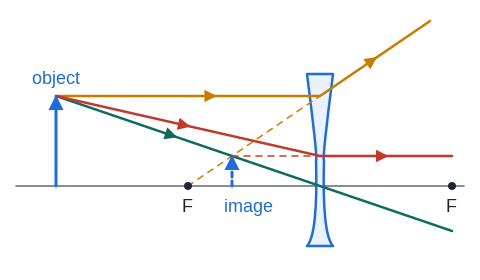
- A converging (convex) lens is thicker in the middle and bends parallel rays to meet at its focal point F; a diverging (concave) lens is thinner in the middle and spreads parallel rays out as if they came from F on the near side.
- The focal length f is the distance from the centre of the lens to F; there is an F on each side, the same distance away.
- Lens formula: 1/f = 1/do + 1/di, where do is the object distance and di the image distance; magnification m = di ÷ do = hi ÷ ho.
- Signs: f is positive for a converging lens and negative for a diverging lens; a negative di means a virtual image on the same side as the object.
- The resource sheet also gives Newton's form: so × si = f², where so and si are measured from each F, and m = f ÷ so = si ÷ f.
- Ray diagrams in the exam must be ruled, with arrows on every ray, and two correct rays are enough to locate the image.
Try it: a ray diagram
Example: a projector lens making a bigger image
- A converging lens has f = 10 cm. A 3.0 cm tall object stands 15 cm from it.
- Find the image distance, the magnification and the image height, then describe the image.
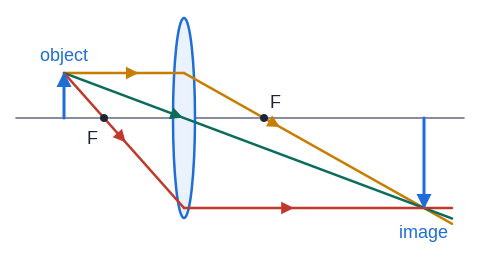
- 1/f = 1/do + 1/dilens formula
- 1/di = 1/10 − 1/15 = 3/30 − 2/30 = 1/30f = +10 cm for a converging lens
- di = 30 cmpositive, so a real image on the far side of the lens
- m = di ÷ do = 30 ÷ 15 = 2magnification
- hi = m × ho = 2 × 3.0 = 6.0 cm
- Newton's form: so = 15 − 10 = 5 cm, si = f² ÷ so = 100 ÷ 5 = 20 cm, so di = 10 + 20 = 30 cm
- real, inverted, enlarged (6.0 cm tall), 30 cm from the lens
Describing the image
- A full description gives three properties: real or virtual, upright or inverted, and enlarged, the same size or diminished.
- A real image is where light really meets, so it can be caught on a screen; with one lens or mirror it is always inverted.
- A virtual image is where rays only seem to come from, found by extending rays backwards with dashed lines; it is always upright and cannot be put on a screen.
- For a converging lens or a concave mirror, the image depends on where the object is; a diverging lens or a convex mirror always gives a virtual, upright, diminished image.
| Object position (converging lens) | Image |
|---|---|
| Beyond 2F | real, inverted, diminished, between F and 2F on the far side |
| At 2F | real, inverted, same size, at 2F on the far side |
| Between F and 2F | real, inverted, enlarged, beyond 2F on the far side |
| At F | no image: the rays leave parallel |
| Inside F | virtual, upright, enlarged, on the same side (a magnifying glass) |
Light and waves
Example: a diverging lens
- A diverging lens has a focal length of 12 cm. A 3.0 cm tall object is 24 cm from it.
- Find the image distance and height, and describe the image.
- f = −12 cma diverging lens has a negative focal length
- 1/di = 1/f − 1/do = −1/12 − 1/24 = −2/24 − 1/24 = −3/24
- di = −8.0 cmnegative: a virtual image on the same side as the object
- m = di ÷ do = 8.0 ÷ 24 = 0.33use the size of di for the magnification
- hi = 0.33 × 3.0 = 1.0 cm
- virtual, upright, diminished (1.0 cm tall), 8.0 cm from the lens on the object side
Example: a concave shaving mirror
- A concave mirror has a focal length of 40 cm. Tama's face is 25 cm in front of it.
- Find where the image is, how much bigger it is, and describe it.
- 1/di = 1/f − 1/do = 1/40 − 1/25 = 5/200 − 8/200 = −3/200f = +40 cm for a concave mirror
- di = −66.7 cmnegative: the image is behind the mirror, so virtual
- m = di ÷ do = 66.7 ÷ 25 = 2.7
- virtual, upright, enlarged 2.7 times, 66.7 cm behind the mirror
- his face is inside F (25 cm is less than 40 cm), which is why the mirror magnifies
Try it: call the image
What Achieved, Merit and Excellence look like
- Achieved names the idea or gives one condition; Merit gives the conditions with a reason; Excellence links every idea to the context, often with a calculation.
- Examiners reward answers that use the numbers and materials in the question, not a learned paragraph.
| Grade | A model answer |
|---|---|
| Achieved | The light stays in by total internal reflection. |
| Merit | Total internal reflection happens because the core has a higher refractive index than the cladding and the light hits the wall at more than the critical angle. |
| Excellence | Light goes from the core (n = 1.48) towards the cladding (n = 1.46), a lower index. The critical angle is sin⁻¹(1.46 ÷ 1.48) = 80.6°. Rays travelling nearly along the fibre meet the wall at more than 80.6°, so none refracts into the cladding; it is all reflected back into the core, again at every bounce. |
Common mistakes
- The ray hits the surface at 30°, so I put 30° into Snell's law.Angles are measured from the normal, so a ray 30° from the surface has an angle of incidence of 60°.
- For the diverging lens I used f = +12 cm and got a real image.A diverging lens has f negative (−12 cm), and its image is always virtual, with di negative.
- Light changes frequency when it goes into glass, which is why its wavelength changes.The frequency stays the same; the speed drops, so by v = fλ the wavelength gets shorter.
- Total internal reflection happens when light goes from air into glass at a big angle.TIR only happens going from a higher n to a lower n (glass to air), at more than the critical angle.
Flip an arrow with a bottle of water
You need: a clear, round plastic drink bottle with smooth sides, water, a sheet of paper, a marker pen, a ruler
- Draw a bold arrow about 5 cm long pointing left on the paper.
- Fill the bottle with water, put the lid on, and stand it on a table.
- Hold the paper flat against the back of the bottle and look at the arrow through the water from the front: it still points left, and it looks wider.
- Slowly move the paper away from the bottle, keeping your eyes level with the arrow, until it suddenly points right; measure that distance from the bottle with the ruler.
- Look for: the bottle is a converging lens (in the side to side direction only); close up the arrow is inside F and you see a virtual, upright, magnified image, and once the arrow is beyond F the image is real and inverted, so it flips.
Safety: Use a plastic bottle rather than a glass, because a dropped glass of water can shatter and cut you, and wipe up any spills so nobody slips.
Your turn
Light goes from air into glass (n = 1.50) at an angle of incidence of 35°. Find the angle of refraction.
Use the table: what is the speed of light in diamond (n = 2.4)?
Find the critical angle for light going from water (n = 1.33) into air.
A converging lens has f = 20 cm, and an object is 60 cm away. Find the image distance and the magnification.
A concave make-up mirror has f = 30 cm, and a face is 10 cm in front of it. Find the image distance and describe the image.
Show answer
1. sin θ₂ = 1.00 × sin 35° ÷ 1.50 = 0.5736 ÷ 1.50 = 0.3824, so θ₂ = 22.5°. 2. v = c ÷ n = 3.00 × 10⁸ ÷ 2.4 = 1.25 × 10⁸ m s⁻¹. 3. sin θc = 1.00 ÷ 1.33 = 0.7519, so θc = 48.8°. 4. 1/di = 1/20 − 1/60 = 2/60, so di = 30 cm; m = 30 ÷ 60 = 0.5 (real, inverted, diminished). 5. 1/di = 1/30 − 1/10 = −2/30, so di = −15 cm; m = 15 ÷ 10 = 1.5, so the image is virtual, upright and enlarged 1.5 times, 15 cm behind the mirror.
Exam-style question: the magnifying glass
- Hemi reads the small print on a museum label with a glass magnifying lens. The lens is converging, with a focal length of 8.0 cm. The letters are 2.0 mm tall, and he holds the lens 6.0 cm from the label.
Describe the nature of the image Hemi sees.
Calculate the image distance and the height of the image of a letter.
Hemi lifts the lens until it is 12 cm from the label. Explain what happens to the image, with a calculation.
Explain, in terms of the speed of light, why the glass lens changes the direction of the light.
Show answer
1. Virtual, upright and enlarged, because the label is inside the focal length (Achieved). 2. 1/di = 1/8.0 − 1/6.0 = 3/24 − 4/24 = −1/24, so di = −24 cm (virtual, on the label's side); m = 24 ÷ 6.0 = 4.0; hi = 4.0 × 2.0 = 8.0 mm (Merit for the full working with units). 3. Now 1/di = 1/8.0 − 1/12 = 1/24, so di = +24 cm and m = 24 ÷ 12 = 2.0: the label is beyond F, so the image becomes real and inverted, twice the size, 24 cm on Hemi's side of the lens. Light from the label really meets there, so the image could be caught on a screen, and with his eye well back from it Hemi sees the print upside down (Excellence links the calculation to the change from virtual and upright to real and inverted). 4. Light slows down when it enters glass (n = 1.5, so v = 2.0 × 10⁸ m s⁻¹) and speeds up when it leaves; it meets the curved surfaces at an angle to the normal, so it refracts, bending towards the normal going in and away from the normal coming out, and the curved shape bends rays from each point towards a common point (Merit, with Snell's law named).
Bending Light
Full screen · PhET Interactive Simulations, University of Colorado Boulder, CC BY 4.0
Recap
- Measure every angle from the normal; reflection angle equals incidence angle.
- Snell's law n₁ sin θ₁ = n₂ sin θ₂, with n₁ ÷ n₂ = v₂ ÷ v₁ = λ₂ ÷ λ₁ and the frequency unchanged.
- TIR needs light heading into a lower n at more than the critical angle, where sin θc = n₂ ÷ n₁.
- Lenses and mirrors: 1/f = 1/do + 1/di and m = di ÷ do; negative f for diverging lenses and convex mirrors, negative di for virtual images.
- Describe every image three ways and draw ruled rays with arrows.
| Formula | Use it to find |
|---|---|
| n₁ sin θ₁ = n₂ sin θ₂ | an angle of refraction or a refractive index |
| n₁ ÷ n₂ = v₂ ÷ v₁ = λ₂ ÷ λ₁ | speed or wavelength in a material |
| sin θc = n₂ ÷ n₁ | the critical angle |
| 1/f = 1/do + 1/di | where the image is |
| m = di ÷ do = hi ÷ ho | how big the image is |
Challenge
A glass prism has a cross-section that is a right-angled triangle with two 45° angles. A ray enters one short face at right angles, carries straight on, and meets the long face. (a) Find the angle of incidence on the long face. (b) Find the smallest refractive index the glass could have for the ray to be totally internally reflected there, with air outside. (c) The prism is made of glass with n = 1.50 and is then put under water (n = 1.33). Does total internal reflection still happen? If not, find the angle at which the ray leaves into the water.
Hint
Draw the normal to the long face; the ray travels parallel to one short face. For TIR the angle of incidence must be bigger than the critical angle, and sin θc = n₂ ÷ n₁ uses the material outside as n₂.
Answer
(a) 45°. (b) n = √2 = 1.41 (strictly, more than 1.41). (c) No: under water the critical angle is 62.5°, which is bigger than 45°, so the ray refracts out into the water at 52.9° to the normal.
Step by step
- The ray meets the long face at 45° to the normal, because the prism's angles are 45°.
- TIR needs 45° to be more than the critical angle, so sin θc must be less than sin 45°.
- With air outside, sin θc = 1 ÷ n, so n must be more than 1 ÷ sin 45° = √2.
- Under water, n₂ = 1.33, so the critical angle grows to 62.5°.
- 45° is now below the critical angle, so the ray refracts out and Snell's law gives the angle.
Full working
- angle of incidence = 45°the normal to the long face makes 45° with the ray
- sin θc = 1 ÷ n < sin 45° = 0.7071TIR needs θ > θc
- n > 1 ÷ 0.7071 = 1.414smallest index
- in water: sin θc = 1.33 ÷ 1.50 = 0.8867, θc = 62.5°n₂ is now water
- 45° < 62.5°, so no TIRthe ray escapes
- 1.50 × sin 45° = 1.33 × sin θ₂, sin θ₂ = 1.0607 ÷ 1.33 = 0.7975Snell's law
- θ₂ = sin⁻¹(0.7975) = 52.9°bent away from the normal
- 45°; n at least 1.41; under water no TIR, the ray leaves at 52.9°
A school projector must make a sharp image of a slide picture 24 mm tall that is 1.20 m tall on a screen 5.10 m from the slide. (a) Find how far from the slide the converging lens must be, and its focal length. (b) Show that there is a second position of the same lens, between the same slide and screen, that also gives a sharp image, and find the height of that image. (c) Describe both images.
Hint
The magnification tells you di ÷ do, and do + di must add to 5.10 m. In the lens formula, do and di can swap places without changing 1f.
Answer
(a) The lens is 0.100 m (10.0 cm) from the slide, and f = 9.80 cm. (b) With the lens 5.00 m from the slide (0.100 m from the screen), do and di swap, so the image is sharp again; it is 0.48 mm tall. (c) First: real, inverted, enlarged 50 times. Second: real, inverted, diminished to 150 of the size.
Step by step
- The magnification is 1200 mm ÷ 24 mm = 50, so di = 50 do.
- The slide and screen are 5.10 m apart, so do + 50 do = 5.10 m.
- Put do and di into the lens formula to find f.
- Swapping do and di leaves 1do + 1di the same, so the second position also focuses.
- In the second position m = 0.100 ÷ 5.00, so the image is 50 times smaller than the slide.
Full working
- m = 1200 ÷ 24 = 50, so di = 50dom = hi ÷ ho = di ÷ do
- do + di = 51do = 5.10 m, do = 0.100 m, di = 5.00 mslide to screen distance
- 1f = 10.100 + 15.00 = 10.0 + 0.20 = 10.2 m⁻¹lens formula
- f = 1 ÷ 10.2 = 0.0980 m = 9.80 cmconverging, so positive
- second position: do = 5.00 m, di = 0.100 m, 1f = 0.20 + 10.0 = 10.2 m⁻¹still sharp
- m = 0.100 ÷ 5.00 = 0.020, hi = 0.020 × 24 = 0.48 mmthe small image
- lens 10.0 cm from slide, f = 9.80 cm; second position 5.00 m from slide gives a real, inverted 0.48 mm image
A small lamp sits on the flat bottom of a pool, 1.80 m below the water surface (water n = 1.33). (a) Find the critical angle for light going from water into air. (b) Light only escapes through a circle of the surface directly above the lamp. A round, opaque floating cover is centred over the lamp. Find the smallest radius the cover needs so that no light at all escapes from the pool. (c) A layer of oil (n = 1.47) 0.10 m thick now floats on the water, and the cover sits on top of the oil. Show that a ray escapes into the air only if it met the water surface at less than the same critical angle as in (a), even though light can enter the oil at steeper angles. Then find the smallest cover radius now.
Hint
A ray leaving the lamp at angle θ to the vertical reaches the surface a horizontal distance 1.80 tan θ from the point above the lamp. For (c), write Snell's law at both boundaries: n sin θ is the same in every layer.
Answer
(a) 48.8°. (b) About 2.05 m. (c) n sin θ is the same in every layer, so leaving into air needs 1.33 sin θ < 1, the same condition as before; in the oil the limiting ray travels at 42.9° to the vertical and spreads 0.093 m further sideways, so the cover needs a radius of about 2.15 m.
Step by step
- The critical angle comes from sin θc = n₂ ÷ n₁ with air outside the water.
- Rays steeper than θc are totally internally reflected, so the escaping light lands inside a circle of radius depth × tan θc.
- With oil on top, Snell's law makes n sin θ equal in water, oil and air, so the escape condition still depends only on the angle in the water.
- The limiting ray bends towards the normal in the oil but still moves sideways as it crosses the 0.10 m layer, so the circle grows a little.
Full working
- sin θc = 11.33 = 0.752critical angle, water to air
- θc = 48.8°inverse sine
- r = 1.80 × tan 48.8° = 1.80 × 1.140 = 2.05 medge of the circle of escaping light
- 1.33 sin θ = 1.47 sin φ = 1 × sin(angle in air)n sin θ is the same at both boundaries
- escape needs 1.33 sin θ < 1, so θ < 48.8°same condition as with no oil
- sin φ = 11.47 = 0.680, φ = 42.9°angle of the limiting ray in the oil
- extra spread = 0.10 × tan 42.9° = 0.093 msideways travel through the oil
- r = 2.05 + 0.093 = 2.15 mcover radius with the oil layer