
Physics in a selected context: the bungy jump

What this lesson covers
- What this internal asks for, and how to choose a context with enough Level 2 physics in it.
- Free fall, and energy changing from gravitational to kinetic to elastic potential energy.
- Hooke's law, the forces on a jumper, and why the top speed comes before the lowest point.
- Impulse and momentum: why a stretchy cord is safer than a rope.
- Evaluating a model and writing a report that describes, explains and then links the physics.
What the standard asks for
- You research a context, a real situation, and write about the physics in it; your teacher may give you resource material, and you may find more.
- The context needs several Level 7 physics ideas, so a whole bungy jump works better than one isolated fact about it.
- Copied or closely reworded sources do not count as evidence: the marker wants your own explanations, calculations and diagrams.
- Achieved identifies and describes the physics; Merit explains how and why it applies; Excellence links the ideas together and analyses them, for example by evaluating a model or comparing two situations.
| Context | Physics you could use |
|---|---|
| Bungy jump | free fall, energy changes, Hooke's law, forces, impulse |
| Hydro power station | gravitational potential energy, power, efficiency, electromagnetic induction |
| Car crash safety | momentum, impulse, crumple zones, seat belts, Newton's laws |
| Rowing | torque, forces, momentum, centre of mass |
The context: a jump at the Kawarau Bridge
- AJ Hackett and Henry van Asch opened the world's first commercial bungy jump on the Kawarau Bridge near Queenstown in 1988, 43 m above the river.
- A jump has four stages: free fall until the cord is straight; the cord stretching while the jumper still speeds up; the cord slowing the jumper to a stop at the lowest point; and the rebound.
- Each stage brings in different physics, which is what makes it a strong context.
| Fact | Value |
|---|---|
| Height of the bridge above the Kawarau River | 43 m |
| Year the world's first commercial bungy jump opened there | 1988 |
Building a model of the jump
- A model makes stated assumptions so the physics can be calculated; these are a student's assumptions, not the operator's figures.
- The jumper's mass is 80 kg, and the cord is 12 m long before it stretches.
- The lowest point is 40 m below the platform, leaving 3 m above the river.
- Take g = 9.8 N kg⁻¹, ignore air resistance, and assume the cord obeys Hooke's law, F = kx, where x is how far it has stretched.
- Measure every height from the lowest point, so the jumper starts with 80 × 9.8 × 40 = 31 360 J of gravitational potential energy.
Example: the first 12 m of free fall
- Find the jumper's speed when the cord becomes straight, and how long the free fall takes.
- mgh = ½mv², so v = √(2gh)gravitational potential energy becomes kinetic energy
- v = √(2 × 9.8 × 12) = √235.2 = 15.3 m s⁻¹
- t = v ÷ g = 15.3 ÷ 9.8 = 1.56 sfrom v = gt, starting at rest
- Ek = mgh = 80 × 9.8 × 12 = 9408 Jthe kinetic energy at that moment
- 15.3 m s⁻¹ after 1.56 s of free fall, with 9408 J of kinetic energy
Example: how stiff must the cord be?
- At the lowest point the jumper is momentarily still, so all 31 360 J is stored as elastic potential energy, Ep = ½kx².
- Find the spring constant k of the cord.
- x = 40 − 12 = 28 mthe stretch is the distance fallen beyond the cord's own length
- mgh = ½kx², so k = 2mgh ÷ x²
- k = 2 × 80 × 9.8 × 40 ÷ 28² = 62 720 ÷ 78428² = 784
- k = 80 N m⁻¹
- ½ × 80 × 28² = 31 360 J, the same as the energy at the top
Try it: how stiff is the cord?
Example: following the energy
- With no air resistance the total energy stays at 31 360 J; it only changes form.
- The table follows it through the jump. Check the fastest point, 21.8 m down, where the cord has stretched 9.8 m.
| Point in the jump | Gravitational (J) | Kinetic (J) | Elastic (J) |
|---|---|---|---|
| Top, 0 m down | 31 360 | 0 | 0 |
| Cord straight, 12 m down | 21 952 | 9408 | 0 |
| Fastest, 21.8 m down | 14 268.8 | 13 249.6 | 3841.6 |
| Lowest, 40 m down | 0 | 0 | 31 360 |
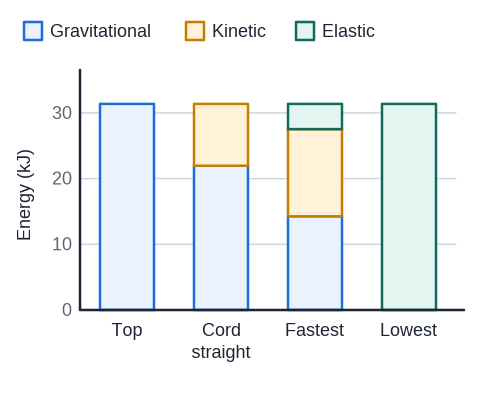
- gravitational: 80 × 9.8 × (40 − 21.8) = 784 × 18.2 = 14 268.8 Jheight above the lowest point
- elastic: ½ × 80 × 9.8² = 40 × 96.04 = 3841.6 J
- kinetic: 31 360 − 14 268.8 − 3841.6 = 13 249.6 Jthe energy that is left
- v = √(2 × 13 249.6 ÷ 80) = √331.24 = 18.2 m s⁻¹
Try it: the bungy jump
Example: the forces, and why the top speed comes early
- Once the cord is straight, its tension (kx, upward) grows as it stretches, while the weight (784 N, downward) stays the same.
- Find where the jumper stops speeding up, and the force and acceleration at the lowest point.
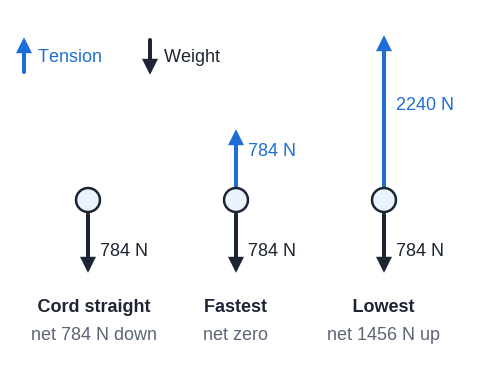
- weight = mg = 80 × 9.8 = 784 N
- net force is zero when kx = mg: x = 784 ÷ 80 = 9.8 m12 + 9.8 = 21.8 m down
- above that point the weight is bigger, so the jumper speeds up; below it the tension is bigger, so the jumper slows down
- at the lowest point: tension = kx = 80 × 28 = 2240 Nstretched 28 m
- net force = 2240 − 784 = 1456 N upward, so a = F ÷ m = 1456 ÷ 80 = 18.2 m s⁻²
- fastest at 21.8 m down; at the bottom the jumper accelerates upward at 18.2 m s⁻², about 1.9 g
Example: impulse, or why the cord must stretch
- Impulse is the change in momentum, and it equals the average net force multiplied by the time it acts: FΔt = Δp.
- In the model, the stretching cord takes about 2.1 s to stop the jumper from 15.3 m s⁻¹. Compare that with a rope that hardly stretches and stops the jumper in 0.1 s.
- Δp = mΔv = 80 × 15.3 = 1224 kg m s⁻¹the same for both, because the jumper goes from 15.3 m s⁻¹ to rest
- cord: F = Δp ÷ Δt = 1224 ÷ 2.1 = 583 Naverage net force
- rope: F = 1224 ÷ 0.1 = 12 240 N
- the rope's average force is 21 times bigger, about 16 times the jumper's weight, enough to cause serious injury
Excellence: evaluating the model
- Air resistance takes energy from the jumper all the way down, so the real speeds are a little lower and the lowest point a little higher than the model gives.
- A real cord is not a perfect spring: it warms up as it stretches and relaxes, turning some energy into thermal energy, so each rebound is lower than the last until the jumper hangs still.
- Real cords do not stretch in exact proportion to the force on them, so Hooke's law is only an approximation over a stretch of 28 m.
- The model also shows why operators match the cord to each jumper's mass: a heavier jumper has more gravitational potential energy to store, so the same cord would stretch further and take them closer to the water.
- Saying what an assumption leaves out, which way it changes the answer and why it matters for safety is the kind of linking that earns Excellence.
Try it: forces, impulse and what ifs
Writing the report
- Open with the context in two or three sentences, then take one physics idea at a time.
- For each idea: name it and describe it (Achieved), then explain how and why it applies to this context, with a formula, a calculation or a labelled diagram (Merit).
- Then link it to the next idea, so the energy, the forces and the impulse tell one story of the jump (Excellence).
- Finish by evaluating: what your model leaves out, and how the real situation differs.
- Write in your own words, show every calculation with units, and list the sources you used.
Example: one idea at each grade
- The same idea, the jumper's top speed, written for each grade.
| Grade | What the student wrote |
|---|---|
| Achieved | The jumper speeds up as they fall because gravity pulls them down. Gravitational potential energy changes into kinetic energy. |
| Merit | After the cord goes straight, its tension grows as it stretches (F = kx). The jumper keeps speeding up until the tension equals the weight, 784 N, which happens 21.8 m down, so that is the fastest point. |
| Excellence | Below 12 m the cord pulls up with kx while the 784 N weight pulls down. Until kx reaches 784 N, at a stretch of 9.8 m, the net force is still downward, so the jumper keeps accelerating; after that it is upward and they slow. At that point the energy is shared: 14 268.8 J gravitational, 3841.6 J elastic and 13 249.6 J kinetic, giving 18.2 m s⁻¹. Air resistance would make the real top speed slightly lower. |
The same approach in another context
- A hydro power station: water stored high behind a dam has gravitational potential energy, which becomes kinetic energy as it falls through the penstock and spins a turbine connected to a generator.
- The power available rises with the height the water falls and the mass of water per second, P = mgh ÷ t, and efficiency compares the electrical energy out with the energy the water loses.
- A car crash: crumple zones, airbags and seat belts all make the stopping time longer, so by FΔt = Δp the force on the people inside is smaller.
- Whatever the context, the pattern is the same: identify each idea, explain how and why it applies, then link the ideas and evaluate.
Common mistakes
- The jumper is fastest at the lowest point because they have fallen furthest.They are momentarily still at the lowest point; they are fastest where the tension equals the weight, before the bottom.
- In Ep = ½kx², I used x = 40 m, the whole fall.x is how far the cord has stretched, 40 − 12 = 28 m, not the distance fallen.
- The stretchy cord makes the change in momentum smaller.The change in momentum is the same; the cord makes the stopping time longer, so the force is smaller.
- I copied a good paragraph from a website and referenced it.Copied or closely reworded text is not evidence of your understanding; explain it in your own words with your own calculations.
A rubber band bungy
You need: 8 rubber bands of the same size, a small zip-lock bag, 20 coins of the same kind, sticky tape, a ruler or tape measure, a table
- Loop two rubber bands together into a chain, tape one end firmly to the edge of a table, and hang the bag from the other end.
- Measure the stretch of the chain with 5, 10, 15 and 20 coins in the bag, letting the bag hang still each time.
- With 10 coins in the bag, hold it up at the taped end and let it drop, watching closely for the lowest point it reaches; repeat three times and measure.
- Add bands to the chain until the bag, dropped from the table edge, just misses the floor.
- Look for: the stretch grows in step with the number of coins (Hooke's law), and the dropped bag stretches the bands more than twice as far as when it hangs still, because the bands must store the energy it gained by falling.
Safety: A stretched rubber band can snap or slip and flick into an eye, so stretch the bands gently, keep your face back from the table edge, and throw away any band with a nick in it.
Your turn
A 60 kg jumper falls freely for 15 m. Find their speed. Use g = 9.8 N kg⁻¹.
A cord with k = 80 N m⁻¹ is stretched by 20 m. Find its tension.
How much elastic potential energy does that cord store?
A 70 kg jumper moving at 14 m s⁻¹ is brought to rest in 2.0 s. Find the average net force.
Explain, using impulse, why a stiffer cord would hurt the jumper more.
Show answer
1. v = √(2gh) = √(2 × 9.8 × 15) = √294 = 17.1 m s⁻¹. 2. F = kx = 80 × 20 = 1600 N. 3. Ep = ½kx² = ½ × 80 × 20² = 16 000 J. 4. Δp = mΔv = 70 × 14 = 980 kg m s⁻¹, so F = Δp ÷ Δt = 980 ÷ 2.0 = 490 N. 5. The jumper's change in momentum is the same either way, but a stiffer cord stops them in a shorter time, so by FΔt = Δp the force on them is bigger.
Recap
- Choose a context with several Level 2 physics ideas, and state the assumptions of any model you build.
- Energy changes form, but if nothing is lost the gravitational, kinetic and elastic energy always add up to the same total, 31 360 J in the model.
- The top speed comes where the tension equals the weight, not at the lowest point.
- A longer stopping time means a smaller force for the same change in momentum.
- Describe for Achieved, explain how and why for Merit, and link and evaluate for Excellence, in your own words.
| Formula | Use it to find |
|---|---|
| Ep = mgh | gravitational potential energy |
| Ek = ½mv² | kinetic energy and speed |
| F = kx and Ep = ½kx² | cord tension and stored elastic energy |
| F = ma | acceleration from the net force |
| FΔt = Δp = mΔv | the average force while stopping |
Challenge
Hydro power as a context. A farm's small hydro scheme sends 0.040 m³ of water each second (40 kg each second) down a pipe that drops 30 m vertically to a nozzle. The water leaves the nozzle as a jet at 21 m s⁻¹ and drives a turbine, and the generator delivers 6.0 kW of electrical power. Take g = 9.8 N kg⁻¹. (a) Find the gravitational energy the water loses each second. (b) What percentage of that reaches the nozzle as kinetic energy, and where does the rest go? (c) Find the efficiency of the whole scheme, and of the turbine and generator together. (d) With the turbine held still, the buckets turn the jet straight back at the same speed. Find the force of the water on the turbine.
Hint
Work with one second of water, 40 kg: energy per second is power. For (d), the force equals the change in momentum each second, and a reversed velocity changes sign.
Answer
(a) 11 760 J each second, about 11.8 kW. (b) 8820 W, which is 75%; the other 2940 W is lost to friction in the pipe and nozzle, heating the water and pipe (a little goes to sound). (c) The whole scheme is 51.0% efficient; the turbine and generator together are 68.0% efficient. (d) 1680 N, twice what it would be if the buckets only stopped the water.
Step by step
- Each second, 40 kg of water falls 30 m, so the power is mgh for that mass.
- The jet's kinetic energy each second is ½mv² for the same 40 kg.
- The jet is slower than free fall from 30 m (24.2 m s⁻¹), because friction in the pipe turns some energy into heat.
- Efficiency is useful output power divided by input power: compare 6.0 kW with each earlier power.
- The water's velocity changes from 21 m s⁻¹ forward to 21 m s⁻¹ backward, a change of 42 m s⁻¹.
- Force = change in momentum ÷ time, so for each second it is 40 × 42.
Full working
- P = mgh each second = 40 × 9.8 × 30 = 11 760 Wgravitational energy lost each second
- Ek each second = ½ × 40 × 21² = 20 × 441 = 8820 Wkinetic energy of the jet
- 8820 ÷ 11 760 = 0.75 = 75%fraction reaching the nozzle
- 11 760 − 8820 = 2940 Wlost to friction as heat
- 6000 ÷ 11 760 = 0.510 = 51.0%whole scheme
- 6000 ÷ 8820 = 0.680 = 68.0%turbine and generator
- Δv = 21 − (−21) = 42 m s⁻¹, F = 40 × 42 ÷ 1.0 = 1680 NF = Δp ÷ Δt for one second of water
- 11 760 W; 75% reaches the nozzle; 51.0% and 68.0% efficient; 1680 N
Car crash safety as a context. A 1200 kg car travelling at 15 m s⁻¹ (54 km per hour) hits a solid barrier, and its crumple zone squashes by 0.75 m as it stops. A 70 kg passenger wears a seat belt that stretches, so she moves 0.30 m further forward than the car as she stops. (a) Use work and energy to find the average force on the car, and check it with impulse, assuming steady deceleration. (b) Find the average force on the belted passenger, and compare it with her weight. (c) An unbelted passenger keeps going at 15 m s⁻¹ until hitting the hard dashboard, which dents only 5.0 cm. Find the average force on them, and explain the difference using impulse.
Hint
Average force × stopping distance = kinetic energy lost. With steady deceleration the average speed is half the starting speed, which gives the stopping time. The belted passenger stops over the car's crumple distance plus the belt's stretch.
Answer
(a) 180 000 N on the car; it stops in 0.10 s and 18 000 kg m s⁻¹ ÷ 0.10 s = 180 000 N agrees. (b) 7500 N over 1.05 m, about 11 times her weight of 686 N. (c) 157 500 N, about 230 times their weight: the change in momentum, 1050 kg m s⁻¹, is the same, but it happens in about 0.0067 s instead of 0.14 s, so the force is 21 times bigger.
Step by step
- The kinetic energy of the car is removed by the barrier's force acting over the crumple distance.
- With steady deceleration the average speed is 7.5 m s⁻¹, which gives the stopping time.
- Impulse F × Δt = Δp gives the same force, a good check.
- The belted passenger stops over 0.75 + 0.30 = 1.05 m.
- The unbelted passenger stops over only 0.050 m, so the time is much shorter.
- Same change in momentum, shorter time, much bigger force.
Full working
- Ek = ½ × 1200 × 15² = 135 000 Jthe car's kinetic energy
- F = 135 000 ÷ 0.75 = 180 000 Nwork done = F × d
- Δt = 0.75 ÷ 7.5 = 0.10 s, F = 1200 × 15 ÷ 0.10 = 180 000 Nimpulse check, average speed 7.5 m s⁻¹
- passenger: F = ½ × 70 × 15² ÷ 1.05 = 7875 ÷ 1.05 = 7500 Nstops over 1.05 m
- weight = 70 × 9.8 = 686 N, 7500 ÷ 686 = 10.9about 11 times her weight
- unbelted: F = 7875 ÷ 0.050 = 157 500 N, 157 500 ÷ 686 = 230stops over 5.0 cm
- times: 1.05 ÷ 7.5 = 0.14 s and 0.050 ÷ 7.5 = 0.0067 s; Δp = 70 × 15 = 1050 kg m s⁻¹ for bothFΔt = Δp
- car 180 000 N; belted 7500 N (about 11 × weight); unbelted 157 500 N (about 230 × weight)
Evaluating the bungy model. A video shows that the real 80 kg jumper on the 12 m cord (k = 80 N m⁻¹) only reaches 38.0 m below the platform, not the 40 m the model predicts. Take g = 9.8 N kg⁻¹. (a) How much energy was transferred out of the jumper and cord system on the way down? (b) Find the average resistive force on the way down. (c) Assuming the same average resistive force on the way up, find how far below the platform the first rebound peaks. (d) Give one reason the real rebound is probably not exactly this, and say which way it changes the answer.
Hint
At 38.0 m down the jumper is still, so compare the gravitational energy lost with the elastic energy stored. Energy lost = average force × distance. On the way up, the cord's stored energy pays for both the height gained and the work against resistance.
Answer
(a) 2752 J. (b) About 72 N. (c) The jumper rises 31.6 m, so the rebound peaks about 6.4 m below the platform. (d) The resistive force is not constant: air resistance grows with speed. On the way up the jumper has less energy and moves more slowly than on the way down, so the average air resistance is smaller, less energy is lost, and the real rebound would peak a little higher (closer to the platform) than 6.4 m below it.
Step by step
- Gravitational energy lost over 38.0 m is compared with the elastic energy at a 26.0 m stretch.
- The difference has gone to the air and to heating the cord.
- Dividing by the 38.0 m fallen gives the average resistive force.
- On the way up the cord's 27 040 J is shared between gravitational energy gained and work against the resistive force.
- The rise h is bigger than 26 m, so the cord is slack at the peak and all its energy has been used.
- The model treats resistance as constant, which a real cord and real air do not do.
Full working
- Eg lost = 80 × 9.8 × 38.0 = 29 792 Jmgh over the whole fall
- stretch = 38.0 − 12 = 26.0 m, Ep = ½ × 80 × 26.0² = 27 040 Jelastic energy at the bottom
- energy lost = 29 792 − 27 040 = 2752 Jto air and cord heating
- F = 2752 ÷ 38.0 = 72.4 Nwork = F × d
- 27 040 = 784h + 72.4h = 856.4hcord energy = Eg gained + work against resistance
- h = 27 040 ÷ 856.4 = 31.6 m, and 31.6 m is more than 26.0 mthe cord is slack at the peak
- 38.0 − 31.6 = 6.4 mdepth of the peak below the platform
- 2752 J lost, about 72 N, rebound peak about 6.4 m below the platform