
Modelling with systems
What this lesson covers
- Define the variables in words.
- Each fact gives one equation.
- Answer in context.
Tickets
- 120 tickets are sold for $1240. Adults pay $15 and children pay $8.
- a + c = 120
- 15a + 8c = 1240
- 15a + 8(120 − a) = 1240
- 7a = 280
- 40 adults and 80 children
Try it: where the lines cross
Break even
- Costs start at $200 and rise $5 an item. Income is $15 an item.
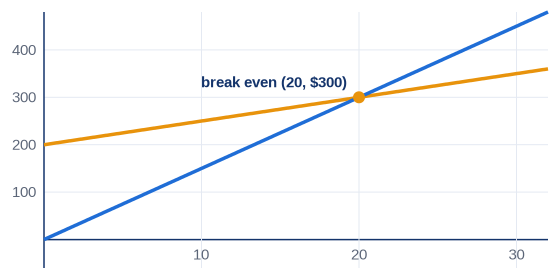
Finding break even
- Costs: 200 + 5x. Income: 15x.
- 15x = 200 + 5x
- 10x = 200
- x = 20 items
Try it: break even
Common mistakes
- Writing x and y with no meaning given.Say what each letter stands for.
- Giving x = 40 as the final answer.Finish in words, with the units of the story.
Try it: tickets as a system
Your turn
Two numbers add to 20 and differ by 4. Find them.
2 apples and a pear cost $4. An apple and a pear cost $3. Find the apple price.
Costs 100 + 2x, income 7x. Find break even.
Each fact in a story gives what?
A Rotorua bakery sells 50 pies and sausage rolls for $240. Pies are $6 and rolls are $4. Which equations model this, with p pies and r rolls?
Mere uses a + c = 90 and 12a + 5c = 730. Her next line is 12a + 450 − a = 730. What went wrong?
Van hire A costs $40 plus $0.80 a km. Hire B costs $64 plus $0.50 a km. For which trip lengths is B cheaper?
A kayak goes 12 km down the Whanganui River in 1 hour and takes 2 hours to come back up. Find the speed of the current.
Show answer
1. 12 and 8 2. $1 3. x = 20 4. One equation 5. p + r = 50 and 6p + 4r = 240. One fact is the count of items and the other is the money, so p = 20 and r = 30. 6. 5(90 − a) is 450 − 5a, not 450 − a. The 5 multiplies both terms in the bracket, giving 7a = 280 and a = 40. 7. More than 80 km. 40 + 0.8x = 64 + 0.5x gives 0.3x = 24, so x = 80 km, and past that B's lower rate per km makes it cheaper. 8. 3 km/h. With kayak speed k and current c: k + c = 12 and k − c = 6, so adding gives k = 9 and then c = 3 km/h.
Sample question: Achieved
At a café, 3 pies and 2 coffees cost $26, and 1 pie and 4 coffees cost $22. Find the price of a pie and of a coffee.
Hint
Let p be the price of a pie and c of a coffee. Write one equation for each order, then solve.
Answer
A pie costs $6 and a coffee costs $4
Step by step
- Name the unknowns in words: p = price of one pie in dollars, c = price of one coffee in dollars.
- Each fact gives one equation. First order: 3p + 2c = 26. Second order: p + 4c = 22.
- The second equation has p on its own, so rearrange it: p = 22 − 4c.
- Substitute into the first: 3(22 − 4c) + 2c = 26, so 66 − 12c + 2c = 26.
- Then −10c = −40, so c = 4.
- Back into p = 22 − 4c: p = 22 − 16 = 6.
- The classic mistake is to finish with "p = 6, c = 4". Answer in words: a pie costs $6 and a coffee $4.
- Check: 3 × 6 + 2 × 4 = 26 and 6 + 4 × 4 = 22. Both orders match.
Full working
- 3p + 2c = 26 and p + 4c = 22one equation per order
- p = 22 − 4crearrange the second
- 3(22 − 4c) + 2c = 26, so c = 4
- p = 22 − 16 = 6check: 18 + 8 = 26
- pie $6, coffee $4
Sample questions: Merit
A lab technician mixes a 20% salt solution with a 50% salt solution to make 30 litres of a 40% solution. How many litres of each should she use?
Hint
One equation for the total volume, and one for the amount of salt.
Answer
10 L of the 20% solution and 20 L of the 50% solution
Step by step
- Name the unknowns: x litres of the 20% solution and y litres of the 50% solution.
- Fact 1, the volume: x + y = 30.
- Fact 2, the salt. 20% of x is 0.2x litres of salt, and 50% of y is 0.5y. The final mix has 40% of 30 = 12 litres of salt. So 0.2x + 0.5y = 12.
- Rearrange the first: y = 30 − x.
- Substitute: 0.2x + 0.5(30 − x) = 12, so 0.2x + 15 − 0.5x = 12.
- Then −0.3x = −3, so x = 10, and y = 30 − 10 = 20.
- Sense check: 40% is closer to 50% than to 20%, so we need more of the 50% solution. 20 L is more than 10 L.
- The classic mistake is to write 20x + 50y = 40. Percentages must be applied to the amounts, and the totals must match.
- Check the salt: 0.2 × 10 + 0.5 × 20 = 2 + 10 = 12 litres, which is 40% of 30.
Full working
- x + y = 30the volume
- 0.2x + 0.5y = 0.4 × 30 = 12the salt
- 0.2x + 0.5(30 − x) = 12substitute y = 30 − x
- −0.3x = −3, x = 10, y = 20
- 10 L of 20% and 20 L of 50%
A ferry travels 24 km down a river with the current in 48 minutes. The return trip against the current takes 72 minutes. Find the speed of the ferry in still water and the speed of the current, in km per hour.
Hint
With the current the speeds add; against it they subtract. Change the times to hours first.
Answer
The ferry travels at 25 km per hour in still water and the current flows at 5 km per hour
Step by step
- Name the unknowns: b = the ferry's speed in still water and c = the current's speed, both in km per hour.
- Downstream the current helps, so the speed is b + c. Upstream it works against the ferry, so the speed is b − c.
- The speeds are per hour, so change the times: 48 minutes = 48 ÷ 60 = 0.8 hours and 72 minutes = 1.2 hours.
- Recall distance = speed × time. Downstream: (b + c) × 0.8 = 24, so b + c = 30.
- Upstream: (b − c) × 1.2 = 24, so b − c = 20.
- Add the two equations: 2b = 50, so b = 25. Then c = 30 − 25 = 5.
- The classic mistake is to use 48 and 72 as hours, or to divide by minutes. The units must match km per hour.
- Check: downstream 30 km per hour for 0.8 hours is 24 km, and upstream 20 km per hour for 1.2 hours is 24 km.
Full working
- 48 min = 0.8 h, 72 min = 1.2 hmatch the units
- (b + c) × 0.8 = 24, so b + c = 30with the current
- (b − c) × 1.2 = 24, so b − c = 20against the current
- 2b = 50, b = 25, c = 5add
- ferry 25 km per hour, current 5 km per hour
Sample questions: Excellence
A rectangular vege garden has a perimeter of 34 m and an area of 60 m². Find its length and width. Then find the smallest perimeter a rectangle with area 60 m² can have, and explain why a perimeter of 30 m is impossible.
Hint
Perimeter gives l + w = 17 and area gives lw = 60. For the second part, replace 17 with P ÷ 2 and ask when the quadratic has real solutions.
Answer
12 m by 5 m; the smallest perimeter is 4√60 ≈ 30.98 m (a square), so 30 m is impossible
Step by step
- Name the unknowns: length l and width w, in metres.
- Perimeter: 2l + 2w = 34, so l + w = 17. Area: lw = 60. One linear and one non-linear equation.
- Substitute l = 17 − w into lw = 60: w(17 − w) = 60, so w² − 17w + 60 = 0.
- Factorise: (w − 5)(w − 12) = 0, so w = 5 or 12. The two answers are the same rectangle turned round: 12 m by 5 m.
- Now generalise. For perimeter P, l + w = P ÷ 2. Call that s. Then w² − sw + 60 = 0.
- A real rectangle needs real solutions, so the discriminant must not be negative: s² − 240 ≥ 0, so s ≥ √240.
- Then P = 2s ≥ 2√240 = 4√60 ≈ 30.98 m.
- At the smallest perimeter the discriminant is 0, so the two sides are equal: a square with side √60 ≈ 7.75 m.
- For P = 30, s = 15 and s² − 240 = 225 − 240 = −15. Negative, so there is no rectangle: 30 m is impossible.
- The classic mistake is to guess a 6 by 10 rectangle for 30 m. Its area is 60, but its perimeter is 32 m, not 30.
- Check the garden: 2 × (12 + 5) = 34 and 12 × 5 = 60.
Full working
- l + w = 17 and lw = 60perimeter and area
- w² − 17w + 60 = 0, (w − 5)(w − 12) = 0
- w² − sw + 60 = 0 with s = P ÷ 2general perimeter
- s² − 240 ≥ 0, so P ≥ 4√60 ≈ 30.98real sides need b² − 4ac ≥ 0
- P = 30: 225 − 240 < 0no real rectangle
- 12 m by 5 m; smallest perimeter ≈ 30.98 m
A small business making carved boards has weekly revenue R = 40x − 0.5x² dollars and weekly costs C = 300 + 10x dollars, where x is the number of boards made and sold. Find the exact break-even values of x. For which whole numbers of boards does the business make a profit, and what is the greatest weekly profit?
Hint
Break even where R = C. Profit is R − C, a quadratic that opens down, so it is positive between its roots and largest halfway between them.
Answer
Break even at x = 30 ± 10√3 (about 12.68 and 47.32); a profit for 13 to 47 boards; the greatest profit is $150, at 30 boards
Step by step
- Break even means revenue equals costs: 40x − 0.5x² = 300 + 10x.
- Rearrange: −0.5x² + 30x − 300 = 0. Multiply by −2 to tidy it: x² − 60x + 600 = 0.
- It does not factorise, so use the quadratic formula: x = 60 ± √(3600 − 2400)2 = 60 ± √12002.
- √1200 = √(400 × 3) = 20√3, so x = 30 ± 10√3. These are about 12.68 and 47.32.
- Profit P = R − C = −0.5x² + 30x − 300. Its x² term is negative, so it is a hill shape: positive between the two roots.
- Boards are whole numbers, so the business makes a profit for 13 to 47 boards.
- Check the edges: at 12 boards P = −12, a loss; at 13 boards P = 5.5, a small profit; at 47 boards P = 5.5; at 48 boards P = −12.
- The greatest profit is at the top of the hill, halfway between the roots: x = 30.
- P(30) = −0.5 × 900 + 30 × 30 − 300 = −450 + 900 − 300 = 150. So $150 a week.
- In context: making more than 47 boards loses money because the revenue model has the price per board falling as more are sold.
- The classic mistake is to round 12.68 to 13 and call it the break-even point. It is the first whole number of boards that makes a profit.
Full working
- 40x − 0.5x² = 300 + 10xbreak even: R = C
- x² − 60x + 600 = 0× −2
- x = 30 ± 10√3 ≈ 12.68 or 47.32quadratic formula
- P(12) = −12, P(13) = 5.5, P(47) = 5.5, P(48) = −12
- P(30) = 150the top is halfway between the roots
- profit for 13 to 47 boards; greatest $150 at 30 boards
What to take away
- Name the unknowns first.
- One fact, one equation.
Challenge
Mere and Tai run laps of a 400 m track at steady speeds, starting from the same spot at the same time. If they run in the same direction, Mere passes Tai every 200 seconds. If they run in opposite directions, they pass each other every 40 seconds. Find each runner's speed, and how many times Mere passes Tai in a 30 minute run in the same direction.
Hint
When Mere laps Tai, she has run exactly 400 m more than him. When they run towards each other and meet, together they have covered 400 m.
Answer
Mere runs at 6 m s⁻¹ and Tai at 4 m s⁻¹; Mere passes Tai 9 times in 30 minutes
Step by step
- Name the unknowns: m = Mere's speed and t = Tai's speed, both in metres per second.
- Same direction: in 200 s Mere gains a full lap, 400 m, on Tai, so 200(m − t) = 400 and m − t = 2.
- Opposite directions: in 40 s they cover 400 m between them, so 40(m + t) = 400 and m + t = 10.
- Add the equations: 2m = 12, so m = 6 and t = 4.
- 30 minutes is 1800 s, and she gains a lap every 200 s, so she passes him 1800 ÷ 200 = 9 times.
Full working
- 200(m − t) = 400, so m − t = 2same direction: she gains a lap
- 40(m + t) = 400, so m + t = 10opposite: together they cover a lap
- 2m = 12, m = 6, t = 4add
- 1800 ÷ 200 = 930 minutes in seconds
- Mere 6 m s⁻¹, Tai 4 m s⁻¹; she passes him 9 times
A jeweller has two gold alloys, A and B. Melting 3 g of A with 2 g of B gives an alloy that is 76% gold. Melting 1 g of A with 4 g of B gives an alloy that is 64% gold. (a) Find the percentage of gold in each alloy. (b) How many grams of each should be melted together to make 20 g of an alloy that is 82% gold? (c) A customer asks for a 90% gold alloy made only from A and B. Explain why it cannot be done.
Hint
Let a% and b% be the gold contents. Count grams of gold: 3 g of A holds 3a ÷ 100 g of gold. Each mix gives one equation. Part (b) is a second system: one equation for the total mass and one for the gold.
Answer
(a) A is 88% gold and B is 58% gold. (b) 16 g of A and 4 g of B. (c) Any mix of A and B has a gold content between 58% and 88%, so 90% is impossible
Step by step
- Name the unknowns: alloy A is a% gold and alloy B is b% gold.
- First mix: 3 g of A and 2 g of B make 5 g at 76%, so 3a100 + 2b100 = 5 × 76100. Multiply by 100: 3a + 2b = 380.
- Second mix, in the same way: a + 4b = 5 × 64 = 320. Rearrange: a = 320 − 4b. Substitute: 3(320 − 4b) + 2b = 380, so 960 − 10b = 380, b = 58 and a = 320 − 232 = 88.
- (b) Let x g of A and y g of B make 20 g. Mass: x + y = 20. Gold: 0.88x + 0.58y = 0.82 × 20 = 16.4. Substitute y = 20 − x: 0.88x + 11.6 − 0.58x = 16.4, so 0.30x = 4.8, x = 16 and y = 4. Check: 14.08 + 2.32 = 16.4.
- (c) A mix is never richer than its richest part. Adding any B to A pulls the gold content below 88%, so no mix reaches 90%. In the system, 0.88x + 0.58y = 0.9(x + y) gives −0.02x = 0.32y, which forces a negative amount.
Full working
- 3a + 2b = 380 and a + 4b = 320gold in each 5 g mix
- 3(320 − 4b) + 2b = 380, so b = 58, a = 88
- x + y = 20 and 0.88x + 0.58y = 16.4(b) mass and gold
- 0.30x = 4.8, x = 16, y = 4
- check: 0.88 × 16 + 0.58 × 4 = 14.08 + 2.32 = 16.4
- 0.88x + 0.58y = 0.9(x + y) gives −0.02x = 0.32y, impossible for positive amounts(c)
- (a) A 88%, B 58%; (b) 16 g of A and 4 g of B; (c) impossible, every mix is at most 88% gold
Two towns are 90 km apart. At 8 am Ana sets off cycling from town A towards town B, and Ben sets off from town B towards town A. Both ride at steady speeds and they pass each other at 11 am. Ana reaches town B 2 hours 30 minutes before Ben reaches town A. Find each rider's speed, how far from town A they pass, and the time each one arrives.
Hint
Let a and b be the speeds in km per hour. Meeting after 3 hours gives a linear equation. The arrival times give 90b − 90a = 2.5. Substitute from the linear equation to get a quadratic, and check both roots.
Answer
Ana rides at 18 km per hour and Ben at 12 km per hour. They pass 54 km from town A. Ana arrives at 1 pm and Ben at 3:30 pm
Step by step
- Name the unknowns: a = Ana's speed and b = Ben's speed, in km per hour. Ana arrives first, so she is faster.
- In the 3 hours to 11 am they cover the 90 km between them: 3a + 3b = 90, so a + b = 30.
- Ana takes 90a hours and Ben 90b hours, so 90b − 90a = 2.5. Multiply by ab: 90a − 90b = 2.5ab, so 36(a − b) = ab.
- Substitute a = 30 − b: 36(30 − 2b) = b(30 − b), so 1080 − 72b = 30b − b², giving b² − 102b + 1080 = 0 and (b − 12)(b − 90) = 0.
- b = 90 would make a = −60, which is impossible, so b = 12 and a = 18. Ana rides 3 × 18 = 54 km to the meeting point. Her trip takes 90 ÷ 18 = 5 hours, arriving at 1 pm; Ben's takes 90 ÷ 12 = 7.5 hours, arriving at 3:30 pm, which is 2.5 hours later.
Full working
- 3a + 3b = 90, so a + b = 30they meet after 3 hours
- 90b − 90a = 2.5, so 36(a − b) = abarrival times
- 36(30 − 2b) = b(30 − b)substitute a = 30 − b
- b² − 102b + 1080 = 0, (b − 12)(b − 90) = 0
- b = 12, a = 18reject b = 90: a would be −60
- 3 × 18 = 54 km; 90 ÷ 18 = 5 h, 90 ÷ 12 = 7.5 h
- Ana 18 km per hour, Ben 12 km per hour; they pass 54 km from A; Ana arrives 1 pm, Ben 3:30 pm