
Sigma notation
What this lesson covers
- The numbers on sigma give the first and last value of k.
- Writing out a few terms shows the type of series.
- A written-out series can be packed back into sigma.
Reading the symbol
- Σ with k = 1 underneath and 5 on top means use k = 1, 2, 3, 4, 5.
- Put each value into the rule, then add the results.
Try it: read the symbol
Σ (2k + 1), k = 1 to 5
- Write the terms out.
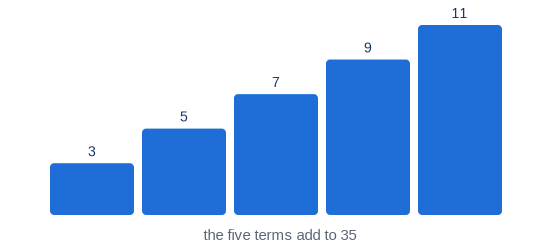
- 3 + 5 + 7 + 9 + 11
- = 35
Σ (4k − 1), k = 1 to 50
- The first few terms show that it is arithmetic.
- 3 + 7 + 11 + ...
- a = 3, last term = 199, n = 50
- S = 25(3 + 199)
- S = 5050
Write 2 + 5 + 8 + ... + 29 in sigma
- Find the rule and the number of terms.
- difference 3, so the rule is 3k − 1
- 3k − 1 = 29, so k = 10
- Σ (3k − 1), k = 1 to 10
When k does not start at 1
- Find Σ 2k, k = 3 to 7.
- 6 + 8 + 10 + 12 + 14
- = 50
Picture a sum
- Σ (2k + 1), k = 1 to 5, is the total height of these bars.
Try it: arithmetic or geometric
Common mistakes
- Adding the top and bottom numbers.They are limits for k, not values in the sum.
- Treating a sum that starts at k = 2 as having the same count.Count the terms: top − bottom + 1.
Try it: crack the sigma
Your turn
Find Σ k, k = 1 to 4.
Find Σ 2ᵏ, k = 1 to 3.
How many terms are in Σ, k = 3 to 10?
Find Σ 3, k = 1 to 10.
Find Σ (5 − k), k = 1 to 4.
Write 4 + 8 + 12 + ... + 60 in sigma notation.
Find Σ 3 × 2ᵏ, k = 0 to 4.
Find Σ (3k + 2), k = 1 to 40.
Show answer
1. 10 2. 2 + 4 + 8 = 14 3. 10 − 3 + 1 = 8 4. 30 5. 10. The terms are 4 + 3 + 2 + 1 = 10. 6. Σ 4k, k = 1 to 15. The rule is 4k, and 4k = 60 gives k = 15. 7. 93. k starts at 0, so the terms are 3 + 6 + 12 + 24 + 48 = 93. 8. 2,540. It is arithmetic with a = 5, last term = 122 and n = 40, so S = 20(5 + 122) = 2,540.
Sample question: Achieved
Evaluate Σ (5k − 2) from k = 1 to 6.
Hint
Put k = 1, 2, 3, 4, 5, 6 into 5k − 2 and add the results.
Answer
93
Step by step
- Sigma means add. The numbers below and above tell you k runs from 1 to 6.
- k = 1 gives 3, k = 2 gives 8, k = 3 gives 13, k = 4 gives 18, k = 5 gives 23, k = 6 gives 28.
- Add them: 3 + 8 + 13 + 18 + 23 + 28 = 93.
- The terms go up by 5 each time, so the series is arithmetic.
- Check with the formula: (62)(3 + 28) = 3 × 31 = 93. The same.
Full working
- 3 + 8 + 13 + 18 + 23 + 28k = 1 to 6
- (62)(3 + 28)arithmetic, first plus last
- 93
Sample questions: Merit
Write the series 7 + 11 + 15 + ... + 203 in sigma notation, and find its value.
Hint
Find the rule for the kth term from the difference, then solve rule = 203 to find the last k.
Answer
Σ (4k + 3) from k = 1 to 50, which equals 5250
Step by step
- The difference is 4, so the rule is 4k plus something.
- k = 1 must give 7: 4(1) + c = 7, so c = 3. The rule is 4k + 3.
- Last term: 4k + 3 = 203, so 4k = 200 and k = 50. There are 50 terms.
- In sigma: Σ (4k + 3) from k = 1 to 50.
- It is arithmetic with a = 7, last term 203 and n = 50: S = (502)(7 + 203) = 25 × 210 = 5250.
- Classic mistake: counting terms as (203 − 7) ÷ 4 = 49. That counts the gaps; there is one more term than gaps.
- Check the rule: k = 2 gives 11 and k = 3 gives 15. Correct.
Full working
- rule 4k + 3difference 4, first term 7
- 4k + 3 = 203, so k = 50number of terms
- Σ (4k + 3), k = 1 to 50
- S = (502)(7 + 203)
- Σ (4k + 3), k = 1 to 50, = 5250
Evaluate Σ 3(2)ᵏ from k = 1 to 8 without listing every term.
Hint
Write out the first few terms to find a and r, then use the geometric sum formula.
Answer
1530
Step by step
- Write the first few terms to see the type: k = 1 gives 6, k = 2 gives 12, k = 3 gives 24.
- Each term doubles, so it is geometric with a = 6 and r = 2. There are 8 terms.
- Sₙ = a(rⁿ − 1)r − 1 = 6(2⁸ − 1)2 − 1 = 6 × 255 = 1530.
- Classic mistake: taking a = 3. The first term comes from k = 1, which gives 3 × 2 = 6, not 3.
- Check a smaller case: k = 1 to 3 gives 6 + 12 + 24 = 42, and 6(2³ − 1) = 42. The method works.
Full working
- 6 + 12 + 24 + ...k = 1, 2, 3
- a = 6, r = 2, n = 8
- S₈ = 6(2⁸ − 1)2 − 1 = 6 × 255
- 1530
Sample questions: Excellence
Find n if Σ (2k + 3) from k = 1 to n equals 320. Explain why only one answer from your working is valid.
Hint
Write the sum in terms of n using the arithmetic sum formula, set it to 320 and solve the quadratic.
Answer
n = 16; the other root, n = −20, is rejected because the number of terms must be a positive whole number
Step by step
- Write a few terms: 5 + 7 + 9 + ..., arithmetic with a = 5 and d = 2.
- The last term is 2n + 3, so the sum is (n2)(5 + 2n + 3) = (n2)(2n + 8) = n(n + 4).
- Set it equal to 320: n² + 4n = 320, so n² + 4n − 320 = 0.
- Factorise: two numbers that multiply to −320 and add to 4 are 20 and −16. So (n + 20)(n − 16) = 0.
- n = 16 or n = −20.
- n counts the terms, so it must be a positive whole number. Reject n = −20.
- Check: n = 16 gives 16 × 20 = 320. Correct.
- Classic mistake: forgetting that the first term is 5, not 3. Put k = 1 in to find it.
Full working
- 5 + 7 + 9 + ...a = 5, d = 2
- Σ = (n2)(5 + 2n + 3) = n(n + 4)
- n² + 4n − 320 = 0
- (n + 20)(n − 16) = 0n must be positive
- n = 16
Evaluate Σ 12(−12)ᵏ from k = 3 to infinity. Then explain why Σ 12(32)ᵏ from k = 3 to infinity has no value.
Hint
Find the first term by putting k = 3 in. The ratio is the number being raised to the power k.
Answer
The sum is −1; the second series has r = 32, outside −1 < r < 1, so its terms grow and the sum has no limit
Step by step
- The series starts at k = 3, so the first term is 12 × (−12)³ = 12 × (−18) = −1.5.
- Each next term multiplies by −12, so r = −12.
- −1 < r < 1, so the sum to infinity exists: S∞ = a1 − r.
- S∞ = −1.5 ÷ (1 − (−12)) = −1.5 ÷ 1.5 = −1.
- Classic mistake: using a = 12 × (−12) = −6 from k = 1. The bottom of the sigma says k starts at 3.
- Check: the terms go −1.5, 0.75, −0.375, 0.1875, ... and the totals −1.5, −0.75, −1.125, −0.9375, ... close in on −1.
- The second series has r = 32. That is more than 1, so every term is bigger than the last.
- Adding ever-larger positive terms makes the total grow without limit, so there is no sum to infinity.
- Putting it into the formula anyway gives a1 − 32, a negative number. That is meaningless for a sum of positive terms, which is why the condition −1 < r < 1 matters.
Full working
- a = 12 × (−12)³ = −1.5k = 3
- r = −12−1 < r < 1
- S∞ = −1.51 + 12 = −1
- r = 32 > 1terms grow, no limit
- −1; the second series has no sum to infinity
What to take away
- Sigma is an instruction to add.
- Write a few terms before choosing a formula.
Challenge
For every positive whole number n, Σ (ak + b) from k = 1 to n equals 2n² + 5n. Find a and b. Then find Σ (ak + b) from k = 21 to 40 without listing any terms.
Hint
Put n = 1 and then n = 2 into 2n² + 5n. The first gives the first term; the difference between them gives the second term.
Answer
a = 4 and b = 3; the sum from k = 21 to 40 is 2500
Step by step
- n = 1: the sum is just the first term, a + b = 2 + 5 = 7.
- n = 2: the sum is 8 + 10 = 18, so the second term is 18 − 7 = 11.
- The terms ak + b go up by a each time, so a = 11 − 7 = 4 and b = 7 − 4 = 3.
- Terms 21 to 40 are the first 40 terms take away the first 20: (2 × 40² + 5 × 40) − (2 × 20² + 5 × 20).
- That is 3400 − 900 = 2500.
- Check: Σ (4k + 3) from 1 to n is (n2)(7 + 4n + 3) = n(2n + 5) = 2n² + 5n. Correct.
Full working
- a + b = 7n = 1
- second term = 18 − 7 = 11n = 2
- a = 11 − 7 = 4, b = 3difference is a
- S₄₀ − S₂₀ = 3400 − 900k = 21 to 40
- a = 4, b = 3; sum 2500
Show that Σ (2ᵏ + 2k) from k = 1 to n equals 2ⁿ⁺¹ + n² + n − 2. Then find the smallest n for which this sum is more than 10 000, and explain which part of the sum decides the answer.
Hint
Sigma of a sum can be split into two sigmas. One part is geometric and the other is arithmetic.
Answer
Σ 2ᵏ = 2ⁿ⁺¹ − 2 and Σ 2k = n(n + 1), giving 2ⁿ⁺¹ + n² + n − 2; the smallest n is 13 (n = 12 gives 8346, n = 13 gives 16 564); the geometric part decides it
Step by step
- Split it: Σ (2ᵏ + 2k) = Σ 2ᵏ + Σ 2k, both from k = 1 to n.
- Σ 2ᵏ is 2 + 4 + 8 + ..., geometric with a = 2 and r = 2: 2(2ⁿ − 1)2 − 1 = 2ⁿ⁺¹ − 2.
- Σ 2k is 2 + 4 + 6 + ... + 2n, arithmetic: (n2)(2 + 2n) = n(n + 1) = n² + n.
- Together: 2ⁿ⁺¹ + n² + n − 2. That is what we had to show.
- n = 12: 8192 + 144 + 12 − 2 = 8346, not enough. n = 13: 16 384 + 169 + 13 − 2 = 16 564, more than 10 000. So n = 13.
- The geometric part doubles each time while the arithmetic part grows slowly (only 156 at n = 12), so the powers of 2 decide the answer.
Full working
- Σ (2ᵏ + 2k) = Σ 2ᵏ + Σ 2ksplit the sigma
- Σ 2ᵏ = 2(2ⁿ − 1)2 − 1 = 2ⁿ⁺¹ − 2geometric, a = 2, r = 2
- Σ 2k = (n2)(2 + 2n) = n² + narithmetic
- n = 12: 8346; n = 13: 16 564try values
- 2ⁿ⁺¹ + n² + n − 2; smallest n = 13
Find Σ (−1)ᵏk² from k = 1 to 40. Then find the value of m for which Σ (−1)ᵏk² from k = 1 to m equals 1275, and explain why the sum is negative whenever m is odd.
Hint
Group the terms in pairs: −1² + 2², then −3² + 4², and so on. Each pair is a difference of two squares.
Answer
820; m = 50; when m is odd the sum is −2n² − 3n − 1 (with m = 2n + 1), which is always negative
Step by step
- Pair the terms: (2j)² − (2j − 1)² = (2j − (2j − 1))(2j + 2j − 1) = 4j − 1.
- So the first 2n terms make Σ (4j − 1) from j = 1 to n, an arithmetic series: (n2)(3 + 4n − 1) = 2n² + n.
- 40 terms is n = 20 pairs: 2 × 400 + 20 = 820.
- Set 2n² + n = 1275: 2n² + n − 1275 = 0, so n = (−1 + √(1 + 10 200)) ÷ 4 = (−1 + 101) ÷ 4 = 25. That is m = 50 terms.
- For odd m = 2n + 1, there is one extra term −(2n + 1)² after the pairs: 2n² + n − (4n² + 4n + 1) = −2n² − 3n − 1, which is negative for every n ≥ 0.
- So 1275 can only come from an even number of terms, and m = 50 is the only answer.
Full working
- (2j)² − (2j − 1)² = 4j − 1difference of two squares
- Σ (4j − 1), j = 1 to n = 2n² + narithmetic, 2n terms of the original
- n = 20: 800 + 20 = 820k = 1 to 40
- 2n² + n − 1275 = 0, so n = 25 (reject the negative root)m = 2n
- 2n² + n − (2n + 1)² = −2n² − 3n − 1 < 0m odd
- 820; m = 50