Combining events, and estimating from trials
What this lesson covers
- In joint events, events can be dependent or independent.
- Probabilities for joint events cannot simply be added, because doing so would double-count outcomes that are common to both events.
- Mutually exclusive events cannot occur together.
- The estimated probability of an event from an experiment is the number of times the event happens divided by the total number of trials in the experiment (i.e. the relative frequency for that event).
Two questions answer all of this
- Can both of these things happen at the same time?
- And does one of them change the other?
- Answer those in order and every question here follows.
| Ask | Then |
|---|---|
| Can both happen at once? | no: you may add |
| yes: adding double-counts | |
| Does one affect the other? | no: multiply them |
| yes: the second one has changed |
When you may simply add
- Rolling a two, or rolling a five. Both cannot happen at once.
- So the chance of either is a sixth plus a sixth. A third.
- Events that cannot happen together are mutually exclusive.
| Situation | Why | Answer |
|---|---|---|
| Rolling a 2, or a 5 | cannot both happen | |
| So add them | 1/6 + 1/6 | 1/3 |
| Heads or tails | cannot both happen | |
| Mutually exclusive | is the name for that |
And when you may not
- A card is drawn. What is the chance it is red, or a king?
- Twenty-six red cards, four kings. So thirty out of fifty-two?
- No. And the reason is worth counting rather than being told.
Try it: run an experiment
Count the cards you counted twice
- The king of hearts is red, and it is a king.
- So is the king of diamonds. Both are in both lists.
- Adding twenty-six and four counted those two cards twice.
| Group | Working | Count |
|---|---|---|
| Red cards | 26 | |
| Kings | 4 | |
| Added | 26 + 4 | 30 |
| But red kings | counted twice | only 2 exist |
Try it: take the overlap off
So take the overlap off once
- Twenty-six plus four, minus the two counted twice.
- Twenty-eight cards out of fifty-two, which is seven thirteenths.
- Or count the actual cards. Same twenty-eight.
| Step | Working | Result |
|---|---|---|
| Take the overlap off once | 26 + 4 − 2 | 28 |
| So P(red or king) | 28 / 52 | 7/13 |
| Or just count | the actual cards | 28 |
| Same answer | either way |
Which is why the rule exists
- Adding is only safe when nothing is in both groups.
- If something is, you have counted it twice and must take it off.
- That is the whole of it. No formula needed.
The second question: does one affect the other?
- Two coins. The first one tells you nothing about the second.
- So the chance of both heads is a half times a half. A quarter.
- A six on a die and a head on a coin: a sixth times a half.
| Events | Working | Answer |
|---|---|---|
| Two coins | the first tells you nothing | |
| P(both heads) | 1/2 × 1/2 | 1/4 |
| A die and a coin | 1/6 × 1/2 | 1/12 |
| Independent | multiply them |
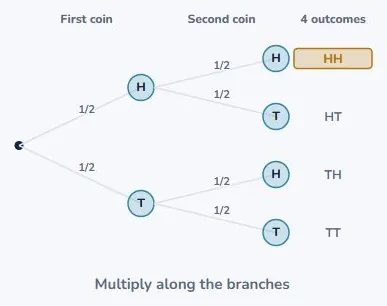
On a tree, you multiply along the path
- Each branch carries its own probability.
- Follow a path down and multiply what you pass.
- A half, then a half, gives a quarter at the end of that path.
When the first one does change things
- A bag with five red and three blue. First draw: five out of eight.
- Now keep it out. The bag has seven balls, four of them red.
- So the second draw is four out of seven. Look in the bag again.
| Step | The bag now | Chance |
|---|---|---|
| Bag: 5 red, 3 blue | P(red) | 5/8 |
| Keep it out | now 4 red of 7 | |
| P(red then red) | 5/8 × 4/7 | 5/14 |
| Put it back instead | 5/8 × 5/8 | 25/64 |
Try it: when the first one changes the second
That is not a special kind of problem
- A bag with a ball taken out is just a different bag.
- You are not applying a dependent-events rule. You are looking again.
- Put the ball back and the second draw is five eighths once more.
Try it: either, both, and the bag
Estimating from an experiment
- How many times it happened, divided by how many trials.
- That is the estimated probability, also called relative frequency.
- Twenty-one sixes in a hundred rolls is nought point two one.
| Idea | Detail |
|---|---|
| Estimated probability | times it happened ÷ trials |
| Also called | the relative frequency |
| 21 sixes in 100 rolls | 0.21 |
| 46 in 200 trials | 0.23 |
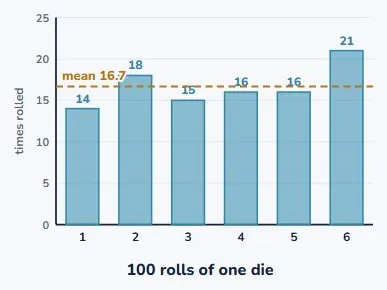
What a hundred rolls actually looks like
- Expect about seventeen of each face. Here is a real run.
- Fourteen, eighteen, fifteen, sixteen, sixteen, twenty-one.
- Not one of them is seventeen, and not one is alarming.
Compare every outcome, not just one
- Looking only at sixes, twenty-one out of a hundred looks high.
- Seen beside the other five, it is the top of a normal spread.
- One outcome on its own cannot tell you whether a die is fair.
What to take away
- Seven lines, and the first two are one question.
| Ask: can both happen at once? | if not, you may add |
| If they can | adding counts the overlap twice |
| Mutually exclusive | means never together |
| Ask: does one affect the other? | if not, multiply |
| If it does | the second probability has changed |
| Estimated probability | is times happened over trials |
| More trials | a better estimate |
Common mistakes
- P(red or king) = 26/52 + 4/52 = 30/52The 2 red kings were counted twice, so take them off once: (26 + 4 − 2)/52 = 28/52 = 7/13.
- 5 red, 3 blue, two out without replacing: P(red, red) = 5/8 × 5/8 = 25/64With one red kept out the bag has 4 red in 7, so 5/8 × 4/7 = 20/56 = 5/14.
- Two coins: P(both heads) = 1/2 + 1/2 = 1Independent events on one path multiply: 1/2 × 1/2 = 1/4.
- 21 sixes in 100 rolls, so the die is biased towards six.Compare every face, not just one: 21 is the top of a normal spread for 100 rolls, which is about 17 each.
Your turn: eight questions
- Work all eight.
- Question 1 has an overlap in it.
- Question 3 says the ball does not go back.
One card from 52. P(red or a king)?
Two coins. P(both heads)?
5 red, 3 blue. Two out, no replacing. P(red, red)?
46 times in 200 trials. Estimate?
One die is rolled. Which pair of events is mutually exclusive?
Tama says P(even or more than 3 on one die) = 3/6 + 3/6 = 1. What is his mistake?
Each school day P(the bus is late) = 0.2, and days are independent. What is P(the bus is late on neither Monday nor Tuesday)?
A die rolled 120 times gives 17, 22, 19, 21, 25 and 16 for faces 1 to 6. Is there evidence the die is unfair?
Show answer
1. 28 out of 52, which is 7/13. There are 26 red cards and 4 kings, but two of the kings are red, so adding 26 and 4 counts those two twice. Take the overlap off once. 2. One quarter. The coins do not affect each other, so multiply a half by a half. 3. 5/14. The first draw is 5 out of 8. Then the bag has 7 balls and 4 of them are red, so the second is 4 out of 7. Multiply: 20 over 56, which cancels to 5 over 14. 4. 0.23, from 46 divided by 200. That is an estimate from this experiment, and a different 200 trials would give something a little different. 5. Rolling a 1 and rolling an even number. 1 is odd, so they can never happen together; each other pair shares an outcome. 6. He counted 4 and 6 twice, as they are in both events. Take the overlap off once: 3 + 3 − 2 = 4 outcomes, so 4/6, which is 2/3. 7. 0.64. P(not late) is 0.8 each day, and on a tree you multiply along the path: 0.8 × 0.8 = 0.64. 8. No. You expect about 20 of each face, and seen side by side every count is an ordinary spread around 20.
The answers
- Twenty-eight out of fifty-two, which is seven thirteenths.
- A quarter.
- Five eighths times four sevenths, which is five fourteenths.
- Forty-six over two hundred, nought point two three.
Challenge
A Year 10 group has 120 students. 70 play a sport, 45 play a musical instrument and 25 do neither. One student is chosen at random. What is the probability that they play a sport and an instrument?
Hint
First find how many students do at least one of the two. Adding 70 and 45 counts some students twice: which ones?
Answer
20120 = 16
Step by step
- 25 do neither, so 120 − 25 = 95 students do sport, music or both.
- Adding 70 and 45 gives 115, which is more than 95.
- The extra 20 are students counted twice, because they are in both groups.
- So 20 students do both, and the probability is 20 out of 120, which is 16.
Full working
- 120 − 25 = 95students in at least one group
- 70 + 45 = 115adding counts the overlap twice
- 115 − 95 = 20the students counted twice do both
- P(both) = 2012020 of the 120 students
- P(both) = 16
A bag holds 5 red and 3 blue counters. Three counters are taken out one at a time and not put back. What is the probability that at least one of them is blue?
Hint
"At least one blue" has many paths through the tree. The opposite event has only one path. What is it?
Answer
2328
Step by step
- The only way to get no blue at all is red, then red, then red.
- First draw: 5 red out of 8. With one red kept out, the second is 4 red out of 7.
- Then the bag has 3 red out of 6, so the third is 36.
- P(all red) = 58 × 47 × 36 = 60336 = 528.
- Every other outcome has at least one blue, so the answer is 1 − 528 = 2328.
Full working
- opposite event: red, red, redthe one path with no blue
- 58 × 47 × 36the bag changes after each draw
- = 60336 = 528simplify by 12
- P(at least one blue) = 1 − 528everything else
- = 2328
A bag holds 10 balls, some red and the rest blue. Two balls are taken out without putting the first back. The probability that both are red is exactly 13. How many red balls are in the bag? Then find the probability that the two balls are the same colour.
Hint
If there are r red balls, the chance of red then red is r10 × r − 19. Try values of r until it equals 13.
Answer
6 red balls; P(same colour) = 4290 = 715
Step by step
- With r red balls, P(red then red) = r10 × r − 19 = r × (r − 1) ÷ 90.
- This must equal 13, which is 3090, so r × (r − 1) must be 30.
- Two whole numbers next to each other that multiply to 30 are 6 and 5, so r = 6.
- That leaves 4 blue. P(blue then blue) = 410 × 39 = 1290.
- Same colour means both red or both blue, which cannot happen together, so add: 3090 + 1290 = 4290 = 715.
Full working
- P(red, red) = r10 × r − 19first red not put back
- r × r − 190 = 309013 written over 90
- r × (r − 1) = 30 = 6 × 5consecutive numbers
- r = 6, so 4 blue10 − 6
- P(blue, blue) = 410 × 39 = 1290same idea for blue
- 3090 + 1290 = 4290mutually exclusive, so add
- 6 red; P(same colour) = 715