
Diffusion, photosynthesis and respiration
What this lesson covers
- Diffusion, and what makes it faster or slower
- How oxygen and carbon dioxide diffuse in the lungs, in cells and in leaves
- Photosynthesis: what goes in, what comes out, and where it happens
- How leaves are built for photosynthesis
- Where the glucose goes: respiration, starch and cellulose
- Aerobic respiration: breaking down glucose to release energy, with carbon dioxide and water as waste
- Turning a question into a fair test and explaining the results
Diffusion: particles spreading out
- The particles in liquids and gases are always moving and bumping in random directions.
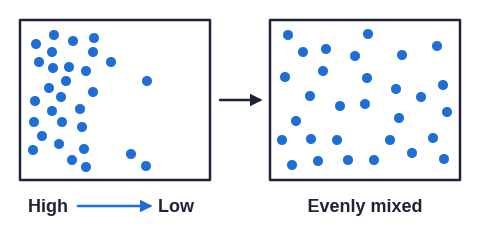
- Where there are lots of particles of a substance, more of them move away than move in, so overall they spread from the crowded area to the less crowded one.
- This overall spreading from a higher concentration to a lower concentration is called diffusion, and it carries on until the particles are evenly mixed.
- Diffusion needs no energy from the cell; the particles' own motion does all the work.
- Smelling someone's lunch from across the classroom is diffusion: scent particles spread through the air from where they are concentrated.
What makes diffusion faster
- Four factors control how quickly diffusion moves a substance, and living things are shaped to make the most of them.
- A big difference in concentration between two places is called a steep concentration gradient, and it drives faster diffusion.
| Factor | Faster when | Where you see it |
|---|---|---|
| Concentration difference | the difference is large | blood flow keeps carrying oxygen away from the lungs, so the difference stays large |
| Temperature | warmer, because particles move faster | a tea bag colours hot water faster than cold |
| Distance | the distance is short | the walls between air and blood in the lungs are one cell thick |
| Surface area | the area is large | millions of tiny air sacs and broad, flat leaves |
Gases move in and out by diffusion
- Your cells use oxygen all the time, so the oxygen concentration inside them stays low and oxygen keeps diffusing in from the blood.
- Cells also keep making carbon dioxide, so its concentration builds up inside and it diffuses out into the blood.
- In the lungs, air in the tiny air sacs (alveoli) is rich in oxygen, so oxygen diffuses into the blood, while carbon dioxide diffuses out of the blood into the air you breathe out.
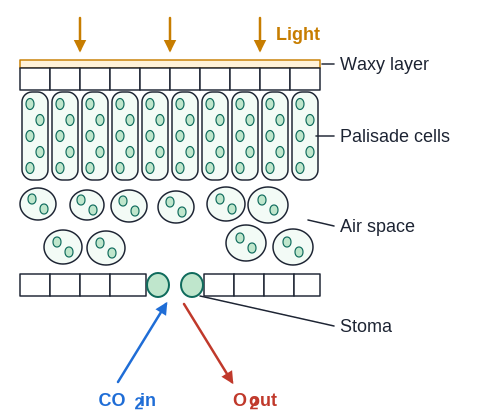
- Leaves swap gases through tiny pores called stomata: in light, carbon dioxide diffuses in and oxygen diffuses out.
| Place | Gas | Moves from | Moves to |
|---|---|---|---|
| Lungs | oxygen | air in the alveoli | blood |
| Lungs | carbon dioxide | blood | air in the alveoli |
| Body cells | oxygen | blood | cells |
| Body cells | carbon dioxide | cells | blood |
| Leaf in light | carbon dioxide | air | leaf cells, through the stomata |
| Leaf in light | oxygen | leaf cells | air, through the stomata |
Body explorer
Does temperature change the rate?
- A purple crystal of potassium permanganate is dropped into still water. In 6 minutes the colour spreads 12 mm at 20 °C and 24 mm at 40 °C.
- Work out each rate and explain the difference.
- rate = distance ÷ timehow far the colour spreads each minute
- 20 °C: 12 mm ÷ 6 min = 2 mm/mincool water
- 40 °C: 24 mm ÷ 6 min = 4 mm/minwarm water
- Diffusion was twice as fast at 40 °C
- Warmer particles move faster, so they spread out soonerthe explanation, not just the pattern
Photosynthesis: making food from light
- Plants, algae and some bacteria make their own food by photosynthesis, using light energy to turn carbon dioxide and water into glucose.
- Oxygen is released as a by-product, and nearly all the oxygen in the air came from photosynthesis.
- It happens in chloroplasts, where the green pigment chlorophyll absorbs the light.
- Carbon dioxide enters from the air through the stomata, and water travels up from the roots through veins.
- Carbon dioxide + water → glucose + oxygen, with light and chlorophyll needed. In symbols: 6CO₂ + 6H₂O → C₆H₁₂O₆ + 6O₂.
Cell explorer
A leaf is built for the job
- Picture a leaf cut across: a waxy top layer, a row of tall cells packed with chloroplasts, a looser layer with air gaps, and a bottom layer dotted with stomata.
- Each feature helps get light, carbon dioxide and water to the chloroplasts, or gets oxygen out.
| Feature | How it helps photosynthesis |
|---|---|
| Broad and flat | large surface area to catch light |
| Thin, often under 0.5 mm | short distance for gases to diffuse to every cell |
| Tall cells packed with chloroplasts near the top | chloroplasts sit where the light is strongest |
| Air spaces inside | carbon dioxide can reach cells deep in the leaf |
| Stomata, mostly underneath | let carbon dioxide in and oxygen out |
| Veins | bring water from the roots and carry sugars away |
Where the glucose goes
- Some glucose is broken down straight away in respiration to release energy for the plant's own cells.
- Glucose dissolves easily, so extra glucose is joined into long chains of starch for storage. Starch does not dissolve, so it stays put; potatoes and kūmara are full of it.
- Glucose is also built into cellulose, the tough fibre that makes up plant cell walls, so it is what lets a plant grow.
- Because starch builds up in leaves that have had light, testing a leaf for starch is a good way to tell whether it has been photosynthesising.
Respiration: releasing energy from glucose
- Aerobic respiration is a chemical reaction in which glucose is broken down using oxygen, releasing the chemical energy stored in it.
- It happens in the mitochondria of every living cell, in plants and animals, day and night. It is not the same as breathing, which only moves air in and out.
- Cells use the energy to move muscles, keep warm, grow, repair themselves and build new substances.
- Carbon dioxide and water are the waste products, which is why your breath clouds a cold window and turns limewater milky.
- Glucose + oxygen → carbon dioxide + water, with energy released. In symbols: C₆H₁₂O₆ + 6O₂ → 6CO₂ + 6H₂O.
| Photosynthesis | Respiration | |
|---|---|---|
| Takes in | carbon dioxide and water | glucose and oxygen |
| Gives out | glucose and oxygen | carbon dioxide and water |
| Energy | light energy stored in glucose | chemical energy released from glucose |
| Where | chloroplasts | mitochondria |
| Which organisms | plants, algae, some bacteria | almost all living things |
| When | only in light | all the time |
Tracing a carbon atom through a flow chart
- A flow chart of the two processes is a loop with arrows. Follow one carbon atom around it, starting in the air you breathe out.
- Each step names the substance and how it moves.
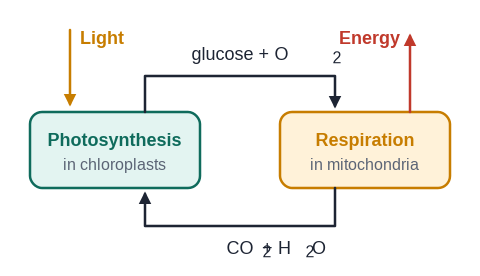
- CO₂ in the air → into a leafdiffuses in through a stoma
- CO₂ + H₂O → glucose (in a chloroplast)photosynthesis, using light
- glucose → starch in a kūmarastored, then eaten by you
- glucose + O₂ → CO₂ + H₂O (in your mitochondria)respiration releases its energy
- CO₂ diffuses cell → blood → alveoli → airdown its concentration gradient
- The carbon is back in the air, ready to go round again
Try it: follow the gases
Testing whether a leaf needs light
- Testable question: does a leaf need light to make starch? Light is the variable you change, and starch is what you measure.
- Keep a potted plant in the dark for two days so its leaves use up their starch, then cover half of one leaf with foil and leave the plant in bright light for a day.
- Dip the leaf in boiling water to soften it, then warm it in ethanol in a water bath to remove the green chlorophyll. Ethanol catches fire easily, so no flames nearby.
- Rinse the leaf and add iodine solution: it stays orange-brown with no starch and turns blue-black where starch is present.
- Keep the same plant, leaf, temperature and time; if only the uncovered half turns blue-black, light is needed to make starch.
Pondweed bubbles and light
- Pondweed under water gives off bubbles of oxygen. A lamp is placed 10 cm away and then 40 cm away, and bubbles are counted for 2 minutes each time.
- At 10 cm there were 60 bubbles; at 40 cm, 14 bubbles. Find the rates and what they show.
- 10 cm: 60 ÷ 2 min = 30 bubbles/minrate = count ÷ time
- 40 cm: 14 ÷ 2 min = 7 bubbles/minsame method
- Closer lamp, brighter light, more oxygenmore light means faster photosynthesis
- Photosynthesis was about 4 times faster with the lamp at 10 cm
- Same plant, same water temperature, same counting timeotherwise the test is not fair
Try it: pondweed bubbles
Common mistakes
- Plants photosynthesise and animals respire.Plants respire all the time in their mitochondria, just like animals; in light they also photosynthesise.
- Respiration is the same thing as breathing.Respiration is the reaction in every cell that releases energy from glucose; breathing only moves air in and out of the lungs.
- Particles diffuse because they want to spread out into empty space.Particles move randomly, and more leave a crowded area than enter it, so the overall movement is from higher to lower concentration.
- Photosynthesis makes energy for the plant.Energy cannot be made; photosynthesis stores light energy in glucose, and respiration later releases it.
Race food colouring in hot and cold water
You need: 2 identical clear plastic cups, cold tap water, hot tap water, food colouring, a sheet of white paper, a timer or phone
- Stand the cups in front of the white paper and fill one with cold tap water and the other with hot tap water to the same level.
- Leave them for one minute so the water is still.
- Add one drop of food colouring to the middle of each cup at the same moment, without stirring, and start the timer.
- Every minute for 5 minutes, note how far the colour has spread in each cup.
- Look for the difference: the colour spreads through the hot water much faster, because warmer particles move faster and so mix sooner.
Safety: Hot tap water can scald and food colouring stains, so fill the hot cup at the sink and keep the bottle over the sink when you add the drops.
Your turn
Explain, using the word concentration, why oxygen moves from the blood into a muscle cell.
Write the word equation for photosynthesis and name where in the cell it happens.
Jelly babies left in water swell up. Write a testable question about temperature and say what you would measure and keep the same.
Germinating peas in a sealed flask warm up, and limewater connected to the flask turns milky. Which process is happening and what two pieces of evidence show it?
Is a plant respiring at night, photosynthesising, or both? Explain.
The walls between the air and the blood in your lungs are only one cell thick. Which diffusion factor does this help?
Pondweed gives 45 bubbles in 3 minutes with a lamp 20 cm away, and 12 bubbles in 3 minutes at 50 cm. Find both rates and what they show.
A student foils half a leaf but skips keeping the plant in the dark first. After a day in light, both halves turn blue-black with iodine. Why?
Show answer
1. The muscle cell uses oxygen in respiration, so its oxygen concentration is lower than in the blood, and oxygen diffuses from high to low concentration. 2. carbon dioxide + water → glucose + oxygen, using light and chlorophyll, in the chloroplasts. 3. For example: does water temperature change how much a jelly baby's mass increases in an hour? Measure the mass before and after; keep the jelly baby type, the volume of water and the time the same. 4. Respiration: the heat shows energy being released, and the milky limewater shows carbon dioxide being produced. 5. Only respiring. With no light it cannot photosynthesise, but respiration goes on all the time. 6. Distance: a wall one cell thick gives gases a very short distance to travel, so they diffuse faster. 7. 45 ÷ 3 = 15 bubbles/min at 20 cm and 12 ÷ 3 = 4 bubbles/min at 50 cm. The closer lamp gives more light, so photosynthesis is faster. 8. Starch made before the test was still in the leaf. Keeping the plant in the dark for two days first lets the leaves use up that starch.
Diffusion
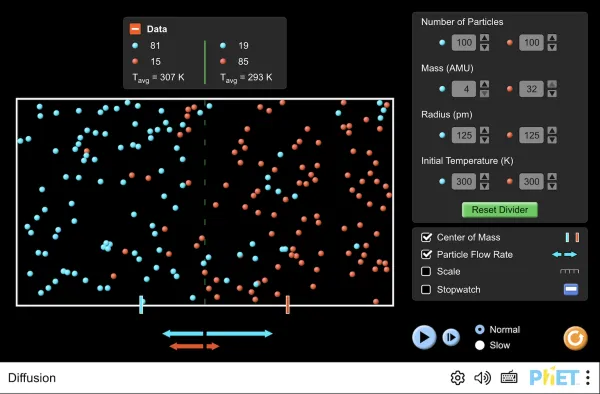
Full screen · PhET Interactive Simulations, University of Colorado Boulder, CC BY 4.0
What to take away
- Diffusion is the spreading of particles from higher to lower concentration, faster when warmer, over short distances, across large areas and with a big concentration difference.
- Oxygen and carbon dioxide move into and out of cells, alveoli and leaves by diffusion.
- Photosynthesis in chloroplasts: carbon dioxide + water → glucose + oxygen, powered by light.
- Leaves are broad, thin and packed with chloroplasts, with stomata for gases.
- A plant breaks down some glucose in respiration, keeps some as starch and builds some into cellulose cell walls.
- Respiration in mitochondria: glucose + oxygen → carbon dioxide + water, releasing energy for the cell.
Challenge
Pink agar jelly contains an indicator that turns colourless when acid reaches it. A class cuts three cubes of this jelly, 1 cm, 2 cm and 4 cm along each edge, and drops them into dilute acid. In this made-up result, after 10 minutes the colourless layer has reached 0.5 cm in from every face of every cube. (a) For each cube, what percentage of its volume is still pink? (b) Find each cube's surface area ÷ volume. (c) Use the pattern to explain why a single-celled organism can get all its oxygen by diffusion through its surface, but a large animal needs lungs and blood.
Hint
The pink part left inside each cube is a smaller cube: 0.5 cm has been lost from both sides of every edge. A cube has 6 square faces.
Answer
(a) 1 cm cube: 0 percent pink. 2 cm cube: 12.5 percent pink. 4 cm cube: about 42 percent pink (2764). (b) 6, 3 and 1.5 (per cm). (c) As the size doubles, surface area ÷ volume halves, so less surface serves each bit of inside and the centre is further from the surface. A single cell is tiny, so diffusion through its surface reaches every part quickly; a large animal has far too little surface for its volume and its middle is too far away, so it needs lungs with a huge surface area and blood to carry oxygen the long distance.
Step by step
- Acid reaches 0.5 cm in from each face, so each edge of the untouched pink cube is 1 cm shorter than the whole cube.
- The 1 cm cube has nothing left; the 2 cm cube keeps a 1 cm cube; the 4 cm cube keeps a 3 cm cube.
- Compare the pink volume with the whole volume to get each percentage.
- Surface area is 6 × edge × edge and volume is edge × edge × edge; dividing them gives 6, 3 and 1.5.
- Bigger objects have less surface for their volume and longer distances to the centre, so diffusion alone cannot keep up.
Full working
- volumes: 1³ = 1, 2³ = 8, 4³ = 64 cm³edge cubed
- pink cubes: edges 0, 1 and 3 cmedge − 2 × 0.5 cm
- pink volumes: 0, 1, 27 cm³edge cubed
- 2 cm cube: 1 ÷ 8 = 0.125 = 12.5% pinkpink ÷ total
- 4 cm cube: 27 ÷ 64 ≈ 0.42 = about 42% pinkpink ÷ total
- surface areas: 6, 24, 96 cm²6 × edge²
- SA ÷ V: 6 ÷ 1 = 6, 24 ÷ 8 = 3, 96 ÷ 64 = 1.5halves each time the edge doubles
- (a) 0%, 12.5%, about 42% pink; (b) 6, 3, 1.5; (c) big bodies have too little surface and too far to the centre, so they need lungs and blood
A fish's gills take oxygen from water into blood by diffusion. In this made-up model, oxygen is measured in units: water arriving at the gill has 100 units and blood arriving has 10 units, and the water and blood carry the same amount of liquid, so every unit the water loses, the blood gains. Arrangement P: water and blood flow the same way, side by side. Arrangement C (what real fish have): they flow in opposite directions. In C, at five points along the gill the water has 100, 80, 60, 40 and 20 units, and the blood beside it has 90, 70, 50, 30 and 10 units. (a) In P, what is the most oxygen the blood can leave with? Explain why it cannot get more. (b) In C, find the difference between water and blood at each point, and explain why diffusion keeps going along the whole gill. (c) How many units does the blood pick up in each arrangement, and how many times as much is that in C? (d) What fraction of the water's oxygen does the fish take in C?
Hint
Diffusion only moves oxygen from where there is more to where there is less. In P, follow both liquids from the same end: what happens as they get closer to each other?
Answer
(a) 55 units: the water falls and the blood rises until both are 55, and then there is no difference left, so diffusion stops. (b) The difference is 10 units at every point, so the water is always richer than the blood beside it and oxygen keeps diffusing in. (c) P: 45 units. C: 80 units, about 1.8 times as much. (d) 80 of the 100 units, which is 45.
Step by step
- Diffusion needs a concentration difference, and stops when the two sides are equal.
- In P, the water loses what the blood gains, so they meet halfway between 100 and 10.
- In C, blood that has already picked up oxygen meets fresher water, so there is always a difference.
- Compare how much the blood picks up in each arrangement, and how much the water gives up in C.
Full working
- (100 + 10) ÷ 2 = 55in P both liquids end equal, so diffusion stops
- 55 − 10 = 45 unitsoxygen picked up by blood in P
- 100 − 90 = 80 − 70 = 60 − 50 = 40 − 30 = 20 − 10 = 10difference at every point in C
- 90 − 10 = 80 unitsblood enters with 10 and leaves with 90 in C
- 80 ÷ 45 ≈ 1.8how many times as much in C
- 100 − 20 = 80, and 80100 = 45the water leaves with 20 units in C
- P 45 units, C 80 units (about 1.8 times); the fish takes 45 of the oxygen
The lesson's symbol equation for photosynthesis is 6CO₂ + 6H₂O → C₆H₁₂O₆ + 6O₂. (a) Show that it is balanced by counting each kind of atom on both sides. (b) In 1941 scientists gave plants water made with oxygen-18, an isotope of oxygen, and found that every oxygen atom in the oxygen gas given off came from water, none from carbon dioxide. How many protons and neutrons does an oxygen-18 atom have (atomic number 8)? (c) Show that the equation as written cannot fit this result. (d) What is the smallest number of water molecules that must be split to supply all the oxygen gas? Write a balanced equation that fits the result, and say where the oxygen atoms from carbon dioxide end up.
Hint
Count how many oxygen atoms 6O₂ contains, and how many oxygen atoms 6H₂O can supply. If extra water goes in on the left, the oxygen and hydrogen that are not needed must come out somewhere on the right.
Answer
(a) Each side has 6 C, 12 H and 18 O. (b) 8 protons and 10 neutrons. (c) 6O₂ contains 12 oxygen atoms, but 6H₂O holds only 6, so water alone cannot supply them all. (d) 12 water molecules: 6CO₂ + 12H₂O → C₆H₁₂O₆ + 6O₂ + 6H₂O. The 12 oxygen atoms from carbon dioxide end up in the glucose (6) and in the newly made water (6).
Step by step
- Count atoms: carbon dioxide gives 6 C and 12 O; water gives 12 H and 6 O; glucose has 6 C, 12 H and 6 O; oxygen gas has 12 O.
- Oxygen-18 has 8 protons like every oxygen atom, and 18 − 8 = 10 neutrons.
- The oxygen gas holds 12 oxygen atoms, but 6 water molecules hold only 6, so the written equation cannot be what really happens.
- Each water molecule gives 1 oxygen atom, so 12 water molecules are needed.
- Those 12 waters bring 24 hydrogen atoms; glucose uses 12, and the other 12 join oxygen from carbon dioxide to make 6 new water molecules.
- Check the new equation balances, then trace carbon dioxide's 12 oxygen atoms: 6 into glucose, 6 into new water.
Full working
- left: C 6, H 6 × 2 = 12, O 6 × 2 + 6 = 186CO₂ + 6H₂O
- right: C 6, H 12, O 6 + 6 × 2 = 18C₆H₁₂O₆ + 6O₂
- oxygen-18: 8 protons, 18 − 8 = 10 neutronsmass number − atomic number
- O atoms in 6O₂ = 12, O atoms in 6H₂O = 66 < 12, so water cannot supply them all
- water needed = 12 molecules1 O atom each
- 6CO₂ + 12H₂O → C₆H₁₂O₆ + 6O₂ + 6H₂Oextra H and O leave as new water
- left: C 6, H 24, O 12 + 12 = 24; right: C 6, H 12 + 12 = 24, O 6 + 12 + 6 = 24balanced
- CO₂ oxygen: 12 atoms → 6 in glucose + 6 in new waterwater's 12 O atoms make the 6O₂
- (a) 6 C, 12 H, 18 O each side; (b) 8 p, 10 n; (c) 12 O needed, 6 available; (d) 6CO₂ + 12H₂O → C₆H₁₂O₆ + 6O₂ + 6H₂O