
The rock cycle, fossils, soil and using Earth materials
What this lesson covers
- Igneous, sedimentary and metamorphic rock
- The rock cycle and the processes that drive it
- How fossils form in sediment
- What soil is made of
- Choosing Earth materials for a job by their properties
Three main types of rock
- Geologists group rocks by how they formed, not by how they look.
- Igneous rock forms when molten rock (magma underground, lava at the surface) cools and hardens.
- Sedimentary rock forms from bits of older rock, shells or plant remains (sediment) that settle in layers, get buried, and are squeezed and cemented together.
- Metamorphic rock forms when existing rock is changed by great heat and pressure deep underground, without melting.
| Type | How it forms | New Zealand examples |
|---|---|---|
| Igneous | Molten rock cools | Basalt of Auckland's volcanic cones, pumice from Taupō |
| Sedimentary | Layers of sediment buried and cemented | Greywacke of the main ranges, Ōamaru limestone |
| Metamorphic | Heat and pressure change a rock | Otago schist, used for stone walls in Central Otago |
Crystal size tells you how fast it cooled
- As molten rock cools, mineral crystals grow in it.
- Magma that cools slowly, deep underground, gives crystals time to grow large, like the big crystals in granite.
- Lava that cools quickly at the surface gives only tiny crystals, like those in basalt.
- Lava that cools almost instantly can form glassy obsidian with no crystals at all, and lava full of gas bubbles cools into light, frothy pumice that floats.
Try it: igneous, sedimentary or metamorphic?
The rock cycle
- Rocks are not permanent. Over thousands to millions of years they are broken down, moved, buried, heated and melted, so one type of rock becomes another.
- Weathering breaks rock at the surface into pieces; erosion carries the pieces away by water, wind or ice; deposition drops them in layers.
- Burial, compaction and cementation turn those layers into sedimentary rock.
- Heat and pressure turn any rock into metamorphic rock; enough heat melts it into magma, which cools into igneous rock.
- There is no single route: any type of rock can be weathered, changed by heat and pressure, or melted.
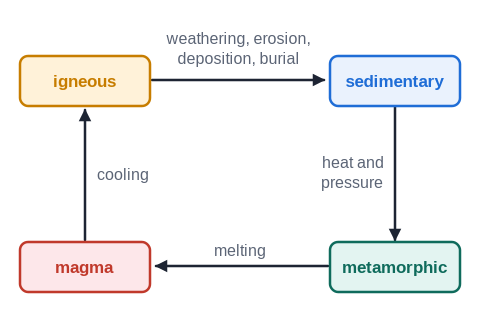
Tracing a journey round the cycle
- A piece of basalt on Rangitoto ends up, millions of years later, as part of a band of schist deep underground. Describe one possible route.
- Basalt is igneouscooled lava
- Rain, waves and plant roots break it into grainsweathering
- Streams and the sea carry grains off and drop them on the sea floorerosion and deposition
- Buried under more layers, the grains are squeezed and cementedbecomes sedimentary rock
- Pushed deep where it is hot and squeezed, it turns to schistbecomes metamorphic rock
- Igneous, then sediment, then sedimentary, then metamorphic
How a fossil forms
- An animal or plant dies and is quickly covered by sediment, such as mud or sand on a sea floor or lake bed. Being buried fast stops it being eaten or rotting away completely.
- Soft parts usually rot; hard parts such as shells, bones and teeth last longer.
- More layers pile on top. Water seeping through the sediment carries dissolved minerals, which slowly fill and replace the material of the hard parts.
- Over a very long time the remains become a stony copy inside sedimentary rock. Much later the rock may be lifted and worn away, exposing the fossil.
- This is why fossils are found in sedimentary rock and almost never in igneous rock, which forms from melted material.
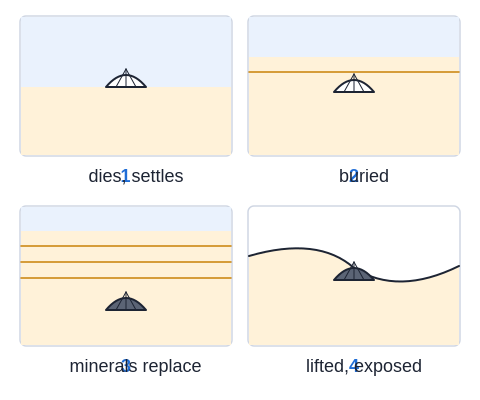
What soil is made of
- Soil is much more than crumbled rock. It has five main parts.
- Rock particles of sand, silt and clay, made by weathering.
- Humus: the dark, decaying remains of plants and animals.
- Living things: plant roots, fungi, bacteria, worms, insects and many more.
- Air and water, held in the spaces between the particles.
Properties decide uses
- People choose Earth materials by matching their properties to the job.
| Material | Key property | Use |
|---|---|---|
| Iron (made into steel) | Strong and dense | Bridges, building frames, nails |
| Aluminium | Strong but much less dense than steel | Aircraft, boats, window frames |
| Salt | Dissolves in water, stops bacteria growing | Preserving food, flavouring |
| Mica | Splits into thin sheets that resist heat and do not conduct electricity | Insulating parts in toasters and heaters |
| Limestone | Neutralises acid, easy to crush | Lime to sweeten farm soils, gravel for paths, cement |
| Pounamu | Very tough, takes a sharp edge and a polish | Traditional adzes (toki) and taonga |
| Volcanic hāngī stones | Hold heat and do not crack when heated | Cooking food in a hāngī |
Try it: match the material to the job
Why not any old river stone?
- A school is planning a hāngī. Someone suggests using sandstone pebbles from a nearby stream. Explain why the hāngī team will say no.
- A hāngī stone must be heated until very hot without breakingthe job
- Sandstone is grains cemented together and can soak up waterits properties
- Heated, the water in it turns to steam and can split the stone apart violentlythe danger
- Use dense volcanic stones chosen for the job, because they hold heat and do not shatter
Common mistakes
- Metamorphic rock forms when rock melts and cools again.Melting and cooling makes igneous rock; metamorphic rock is changed by heat and pressure without melting.
- The rock cycle always goes igneous, sedimentary, metamorphic in that order.Any rock type can turn into any other, so there are many routes round the cycle.
- A fossil is the actual bone or shell of the animal.In most fossils, minerals have replaced the original material, leaving a stony copy.
- Soil is just ground-up rock.Soil also holds humus, living things, air and water, which is why it can grow plants.
Make sediment layers in a jar
You need: a large clear jar with a lid, a cup of garden soil, a cup of sand, a handful of small gravel, water
- Put the gravel, sand and soil into the jar.
- Fill the jar about three-quarters full with water and screw the lid on tightly.
- Shake it hard for 30 seconds, then stand it on a shelf where it will not be bumped.
- Check it after 5 minutes, after an hour and the next day, and draw the layers each time.
- Look for sorting: the gravel settles first at the bottom, then sand, then fine silt and clay on top, with bits of humus floating; this is how sediment layers build up before they become sedimentary rock.
Safety: Garden soil can carry germs such as tetanus bacteria, so wear gloves or wash your hands well afterwards, and keep the lid tight while shaking.
Your turn
A rock has large interlocking crystals. Is it more likely to have cooled quickly at the surface or slowly underground?
Which type of rock forms when limestone is changed by heat and pressure into marble?
Name the three processes, in order, that move a rock at the surface into a new sediment layer.
Why are fossils rarely found in igneous rock?
Why is aluminium chosen over steel for an aircraft body?
Show answer
1. Slowly underground, which gives crystals time to grow large. 2. Metamorphic rock. 3. Weathering, erosion, then deposition. 4. Igneous rock forms from molten rock, which would destroy any remains. 5. It is strong but much less dense, so the aircraft is lighter.
Recap
- Igneous rock forms from cooled molten rock, sedimentary rock from buried and cemented sediment, and metamorphic rock from heat and pressure.
- In the rock cycle, weathering, erosion, deposition, burial, heat, pressure, melting and cooling keep turning one type of rock into another.
- Fossils form when remains are buried in sediment and minerals slowly replace them.
- Soil is rock particles, humus, living things, air and water.
- People choose Earth materials, from steel to pounamu, by matching their properties to the job.
Challenge
A school has four igneous rock samples. Each was weighed, then lowered into a measuring cylinder of water to find its volume (D had to be held under with a thin wire). These are made-up results. A: 81 g, 30 mL, large interlocking crystals. B: 90 g, 30 mL, crystals too small to see without a lens. C: 48 g, 20 mL, smooth and glassy, no crystals. D: 12 g, 20 mL, full of small holes like a sponge. Water has a density of 1 g per mL. (a) Find each density. Which sample floats? (b) Name a likely rock for each, and put them in order from the slowest cooling to the fastest. (c) D had to be held under, yet its rock material between the holes is denser than water. Explain how it can float. (d) Pumice from the Taupō eruption is found on beaches far from Taupō. Suggest how it got there.
Hint
Density = mass ÷ volume. Anything less dense than water floats. Crystal size tells you how long the crystals had to grow before the rock went solid.
Answer
(a) A 2.7, B 3.0, C 2.4 and D 0.6 g per mL. Only D floats. (b) A granite (slowest, deep underground), B basalt (lava at the surface, fast), C obsidian (almost instant), D pumice (gas-filled lava that cooled very fast). Slowest to fastest: A, B, then C and D. (c) The holes are gas bubbles trapped as the lava cooled. They hold air, so the whole lump has a small mass for its large volume, giving an average density less than water. (d) It floats, so rivers such as the Waikato carried it downstream and out to sea, and waves washed it up on distant beaches.
Step by step
- Divide each mass by its volume.
- Only D is under 1 g per mL, so only D floats.
- Large crystals need slow cooling deep underground; tiny crystals mean fast cooling; no crystals mean almost instant cooling.
- Pumice and obsidian both cooled too fast for crystals; the gas bubbles turned one into a froth.
- The air in the holes lowers the average density, so it floats and can travel on water.
Full working
- A: 81 ÷ 30 = 2.7 g per mLlarge crystals: granite
- B: 90 ÷ 30 = 3.0 g per mLtiny crystals: basalt
- C: 48 ÷ 20 = 2.4 g per mLglassy: obsidian
- D: 12 ÷ 20 = 0.6 g per mLless than 1, so it floats: pumice
- Cooling: A slowest, then B, then C and D fastestcrystal size
- 2.7, 3.0, 2.4 and 0.6 g per mL; only the pumice floats; order slowest to fastest: granite, basalt, then obsidian and pumice
A river carries gravel, sand and mud from the mountains into a still, deep lake. Leaves from the forest fall into the lake and sink. (a) Describe where the gravel, the sand and the mud settle, from the river mouth outwards, and explain why. (b) Over millions of years these layers become rock. Name the sedimentary rock that each one becomes. (c) A palaeontologist wants fossil leaves showing fine detail such as veins. Which of the three rocks should she search, and why? (d) Later, part of the mud layer is pushed deep under a mountain range, where it is heated and squeezed but not melted, and becomes a metamorphic rock with shiny, flat mineral grains. Would she still find good leaf fossils in it? Explain.
Hint
When the river slows down at the lake, think about which grains it can carry furthest. For (c), think about what kind of sediment can press around a leaf closely, and how quickly the leaf must be covered.
Answer
(a) Gravel settles first, right at the river mouth, then sand further out, and mud furthest out in the deep, still water. The water slows as it enters the lake and drops its heaviest grains first; fine mud stays suspended longest. (b) Gravel becomes conglomerate, sand becomes sandstone and mud becomes mudstone (or shale). (c) The mudstone: fine mud settles gently, covers a leaf quickly and closely in still water where it is not torn up or rotted, and its tiny grains can record fine detail. (d) Probably not. Heat and pressure change the minerals and grow new, flat grains, which squash and blur or destroy the delicate fossil.
Step by step
- Fast water carries big grains; when it slows, it drops the biggest first.
- So the grains are sorted: gravel near the mouth, sand further out, mud furthest.
- Each sediment, buried, squeezed and cemented, becomes its own sedimentary rock.
- Fine mud in still water buries leaves gently and records small details.
- Metamorphism changes the minerals, so delicate fossils are lost.
Full working
- River slows at the lakeit can carry less
- Gravel at the mouth → sand → mud far outheaviest dropped first
- Gravel → conglomerate; sand → sandstone; mud → mudstoneburial, compaction, cementation
- Fine mud, still water, quick gentle burialbest fossil detail
- Heat and pressure grow new flat mineralsfossils blurred or destroyed
- Search the mudstone; the metamorphic rock will have lost the fine fossils
Hemi compares two soils: A from under native bush and B from a freshly dug road cutting. These are made-up results. He weighs 200 g of each, dries them in a low oven, and weighs again: A 150 g, B 184 g. His teacher then heats the dry soils very strongly to burn away the humus: A 120 g, B 182 g. Finally a settling jar shows the rock particles. A: 40% sand, 40% silt, 20% clay. B: 85% sand, 10% silt, 5% clay. (a) What percentage of each fresh sample was water? (b) What percentage of each dry sample was humus? (c) Classify each soil and say which is better for growing plants, giving three reasons from the data. (d) Why must the soil be dried before it is burnt, not burnt straight away? (e) What would have to happen, over many years, for soil like B to become like A?
Hint
Water lost = fresh mass − dry mass. Humus lost = dry mass − burnt mass, and compare it with the dry mass. For (d), think about what the scale would show if water and humus were both lost in one step.
Answer
(a) A 25%, B 8%. (b) A 20%, B about 1%. (c) A is a loam: a mix of sand, silt and clay with lots of humus. B is a sandy soil with almost no humus. A is better for plants: it holds more water, it has much more humus to supply nutrients, and its silt and clay hold water and nutrients that would drain straight through B's sand. (d) Heating strongly also drives off water, so burning fresh soil would count the water as humus and give the wrong answer. Drying first removes the water so the second loss is humus only. (e) Plants would need to grow on it, and their dead leaves and roots, and animals, would have to be broken down by decomposers into humus, while living things such as worms mix it in.
Step by step
- The loss on drying is the water; divide by the fresh mass.
- The loss on burning is the humus; divide by the dry mass.
- Mixed particle sizes plus plenty of humus make a loam; mostly sand with no humus is a sandy soil.
- Doing one change at a time lets you measure each part separately.
- Humus only builds up when living things grow, die and are decomposed in the soil.
Full working
- Water A: 200 − 150 = 50 g; 50 ÷ 200 × 100 = 25%loss on drying
- Water B: 200 − 184 = 16 g; 16 ÷ 200 × 100 = 8%loss on drying
- Humus A: 150 − 120 = 30 g; 30 ÷ 150 × 100 = 20%loss on burning
- Humus B: 184 − 182 = 2 g; 2 ÷ 184 × 100 ≈ 1%loss on burning
- A: mixed sand, silt, clay plus humus → loam; B: 85% sand, little humus → sandysettling jar
- Water 25% and 8%; humus 20% and about 1%; A is a loam and better for plants