
Simple circuits: loops, switches and circuit diagrams
What this lesson covers
- The three parts every simple circuit needs
- Closed circuits and open circuits
- How a switch turns a circuit on and off
- Why charge moves through metal but not plastic
- The standard symbols for circuit parts
- Drawing and reading circuit diagrams
What a simple circuit needs
- Electric charge is the tiny moving "stuff" of electricity. It can flow through some materials, such as metals.
- A circuit is a path that charge can travel all the way round.
- A simple circuit has three parts: a power source, such as a cell or battery, that pushes the charge; wires that carry it; and a load, such as a lamp, buzzer or motor, that uses the energy.
- The parts must join up in a loop that goes from one end of the battery, through the load, and back to the other end.
Closed and open circuits
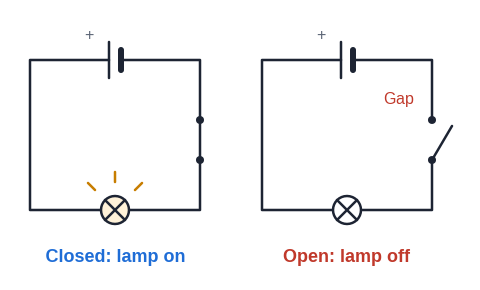
- A closed circuit is a complete loop with no gaps. Charge flows all the way round, so the lamp lights.
- An open circuit has a gap somewhere. Charge stops flowing everywhere in the loop, not just at the gap, so the lamp goes out.
- A gap can be a loose wire, a broken lamp, a flat battery, or a switch that is off.
What a switch does
- A switch is a part that opens or closes a gap in a circuit, so you can control whether charge flows.
- When a switch is on, its metal parts touch and close the circuit. When it is off, they pull apart and open the circuit.
- The light switch on your wall works the same way. Never open one up: the mains electricity in a house can kill.
Try it: open and close the switch
Conductors and insulators
- Charge travels through the metal wires and through the metal parts inside each component, such as the thin wire inside a lamp.
- A conductor is a material that lets charge flow through it easily. Most metals are good conductors.
- An insulator is a material that does not let charge flow, such as plastic, rubber, wood and glass.
- A wire has a copper conductor inside and a plastic insulator outside, so the charge stays in the wire and does not reach your fingers.
| Material | Conductor or insulator? |
|---|---|
| Copper | Conductor |
| Aluminium foil | Conductor |
| Steel paper clip | Conductor |
| Plastic | Insulator |
| Rubber | Insulator |
| Dry wood | Insulator |
Circuit symbols
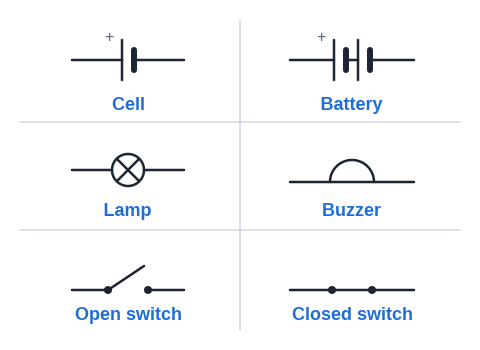
- A circuit diagram is a simple drawing of a circuit that uses standard symbols instead of pictures.
- The symbols are the same all over the world, so anyone can read your diagram and build the same circuit.
- A cell is drawn as a long thin line beside a short thick line; the long line is the positive (+) end. A battery is two or more cells joined together.
- Wires are drawn as straight lines with square corners, even if the real wires are curly.
Drawing a torch as a circuit diagram
- A torch has two cells, a switch and a lamp. Draw its circuit diagram.
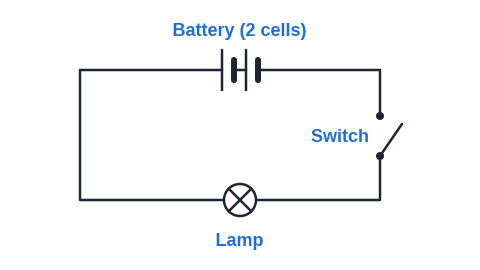
- Draw the battery: two cells side by side, long line to short line each timetwo cells
- Draw the switch symbol in the loopit opens and closes the gap
- Draw the lamp symbol: a circle with a crossthe load
- Join them with straight wires and square corners into one loop
Testing what closes a circuit
- Room 5 built a circuit with a gap in it and put different objects across the gap. Which objects closed the circuit?
| Object across the gap | Lamp | Circuit |
|---|---|---|
| Steel paper clip | Lit | Closed |
| Plastic ruler | Off | Open |
| Aluminium foil strip | Lit | Closed |
| Rubber eraser | Off | Open |
| Pencil lead (graphite) | Lit, dimly | Closed |
| Wooden pop stick | Off | Open |
- The clip and the foil are metal, and both lit the lampmetals conduct
- Plastic, rubber and wood left the lamp offinsulators
- Pencil lead lit it dimly: graphite conducts, but not as well as metala surprise
- The paper clip, the foil and the pencil lead closed the circuit
Try it: conductor or insulator?
Try it: lit, off or fixed?
Common mistakes
- One wire from the battery to the lamp is enough to light it.The lamp needs two wires so charge can go out from the battery and come back; it must be a complete loop.
- When a switch is off, the circuit is closed.Off means the switch has opened a gap, so the circuit is open and no charge flows.
- The charge gets used up in the lamp, so less comes back to the battery.The charge flows all the way round and back; it is energy that the lamp uses, not the charge.
- In a diagram, a lamp is drawn as a little picture of a light bulb.A lamp is drawn as a circle with a cross inside it, the standard symbol.
Find the circuit inside a torch
You need: a torch that takes AA or AAA batteries, paper, a pencil
- With an adult, open the torch, take the batteries out and lay all the parts on a table.
- Trace the path with your finger: from one end of the batteries, through the spring and metal strips, to the switch, the lamp and back to the other end.
- Put the batteries back the right way and switch on. Then slide a small piece of paper between the batteries and switch on again.
- Take the paper out and draw the torch's circuit diagram with the standard symbols.
- Look for this: the torch only lights when the loop is complete; the paper is an insulator that opens the circuit.
Safety: Use only a torch with AA or AAA batteries, never one with coin or button cells, which can badly burn a small child who swallows one; ask an adult to help.
Your turn
A lamp will not light because one wire has come loose. Is the circuit open or closed?
Which of these would close the gap in a circuit: a plastic straw, a steel spoon, or a wooden pop stick?
What are the three parts every simple circuit needs?
In a circuit diagram, what does a circle with a cross inside it show?
Why do wires have a plastic coating?
Show answer
1. Open: there is a gap, so no charge flows. 2. The steel spoon, because steel is a metal and a conductor. 3. A power source (a cell or battery), wires, and a load such as a lamp. 4. A lamp. 5. Plastic is an insulator, so it keeps the charge in the wire and away from your fingers.
Circuit Construction Kit: DC
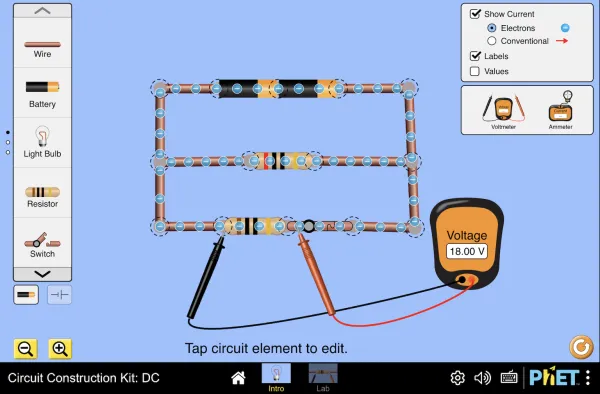
Full screen · PhET Interactive Simulations, University of Colorado Boulder, CC BY 4.0
Recap
- A simple circuit is a complete loop of a power source, wires and a load.
- A closed circuit has no gaps and charge flows; an open circuit has a gap and charge stops.
- A switch opens or closes a gap to turn the circuit off or on.
- Charge flows through conductors such as metals, not through insulators such as plastic.
- Circuit diagrams use standard symbols and straight wires with square corners.
Challenge
Room 9 builds a 'steady hand' game. A bare metal wire is bent into a wiggly track and fixed to a wooden base. A small metal ring on a plastic handle goes round the track. One end of the battery is wired to the track, and the other end is wired through a buzzer to the ring. (a) Explain why the buzzer sounds whenever the ring touches the track. (b) Which circuit part does the ring and track together act like? (c) At the start, the ring rests on a short piece of track wrapped in tape, and nothing buzzes. Why? (d) Rua builds the same game, but his buzzer never sounds, even when the ring clearly touches the track. He used plastic-coated wire for his track. Explain what went wrong.
Hint
Trace the path from one end of the battery all the way back to the other end. Where is the gap, and what can close it?
Answer
(a) Touching joins two metal parts, closing the gap so the loop is complete. (b) A switch. (c) Tape is an insulator, so the gap stays open. (d) The plastic coating is an insulator, so the metal ring never touches metal and the circuit stays open.
Step by step
- The loop goes battery, track, ring, buzzer and back to the battery, but there is a gap between the ring and the track.
- When the metal ring touches the metal track, the gap closes and the circuit is complete, so charge flows and the buzzer sounds.
- Opening and closing a gap is exactly what a switch does, so the ring and track act as a switch.
- Tape is an insulator, so when the ring rests on the taped part the gap is still open.
- Rua's track has plastic on the outside. The ring only ever touches the plastic insulator, never the copper, so the circuit never closes.
Full working
- battery → track → ring → buzzer → batterythe loop
- ring not touching track: gapopen circuit, buzzer silent
- metal ring touches metal trackgap closed, circuit closed, buzzer sounds
- ring and track = a switchthey open and close a gap
- ring on tapetape is an insulator, circuit stays open
- ring on plastic-coated wireinsulator in the way, circuit never closes
- (a) touching closes the loop, (b) a switch, (c) tape insulates, (d) plastic coating insulates the track
Kiri builds one loop: a battery, a switch, lamp A and lamp B. She switches on, but neither lamp lights. She has a spare wire, and with the switch on she lays it across one part at a time, touching the metal on each side of that part, so charge can go round that part. Across the switch: neither lamp lights. Across lamp B: lamp A stays off. Across lamp A: lamp B lights. (a) Which part is faulty? (b) How do her results show that the battery and all the wires are fine? (c) Why did going round lamp B not make lamp A light?
Hint
When the spare wire goes round a part, that part is skipped. If a lamp lights after skipping something, the rest of the loop must be complete.
Answer
(a) Lamp A has a gap in it (for example a broken thin wire inside, or it is loose in its holder). (b) Lamp B lit when only lamp A was skipped, so every other part of the loop, including the battery and wires, carried charge. (c) Lamp A's gap was still in the loop, so the circuit stayed open.
Step by step
- One gap anywhere stops charge flowing everywhere, so both lamps are off.
- Skipping the switch changed nothing, so the gap is not in the switch.
- Skipping lamp A made lamp B light, so the loop without lamp A is complete: the gap must be in lamp A.
- For lamp B to light, charge went from the battery through the wires, switch and lamp B and back, so all of those are fine.
- Skipping lamp B left lamp A, with its gap, still in the loop, so the circuit stayed open and nothing could light.
Full working
- both lamps offthere is a gap somewhere in the loop
- skip switch: still offthe gap is not only in the switch
- skip lamp B: still offthe gap is not in lamp B
- skip lamp A: lamp B lightsthe loop without lamp A is complete
- battery, wires, switch, lamp B all carry chargethey must be fine
- (a) lamp A is faulty; (b) lamp B lit with only lamp A skipped, so the battery, wires, switch and lamp B are fine; (c) lamp A's gap stayed in the loop
A sealed box has four metal screws on its lid, labelled A, B, C and D. Inside, some screws may be joined by bare metal wires, and nothing else is inside. Mere has a tester: a battery and a lamp with two free wires. The lamp lights when she touches the free wires to two screws that are joined. She tests only three pairs: A and B: lights. A and D: lights. C and D: stays off. (a) Without testing them, predict the results for the other three pairs: B and D, A and C, B and C. Explain each. (b) What is the fewest wires that could be inside the box, and how might they be joined?
Hint
Metal joined to metal is all one path. If A is joined to B and A is joined to D, think about what that says about B and D. Then ask: could C be joined to A without being joined to D?
Answer
(a) B and D lights; A and C stays off; B and C stays off. (b) 2 wires, for example A to B and A to D. C is joined to nothing.
Step by step
- A and B are joined, and A and D are joined. Charge can go from B to A to D through metal, so B and D lights.
- So A, B and D are all one connected path.
- If C were joined to A, then C would also be joined to D through A. But C and D stayed off, so C is not joined to A.
- The same reason shows C is not joined to B. So A and C, and B and C, both stay off.
- Joining three screws into one path needs at least 2 wires, and C needs none.
Full working
- A–B lit, A–D litA, B and D are joined by metal
- B → A → Dso B and D lights
- if C joined A, then C → A → DC and D would light, but it did not
- C not joined to A, B or DA and C off, B and C off
- 3 screws in one path needs 2 wirese.g. A to B and A to D
- B–D lights, A–C off, B–C off; at least 2 wires, C joined to nothing