
Habitats: measuring their features and who lives where
What this lesson covers
- Te Taiao and what a habitat is
- Physical features of habitats you can observe and measure
- Why different habitats are home to different living things
- Why similar conditions in different places suit similar living things
- Recording a habitat along a transect line
- Predicting where an organism lives, and planning a garden
Te Taiao and habitats
- Te Taiao means the natural world. New Zealand's science curriculum describes it as the home that cares for, supports and links every living thing.
- An organism is any living thing: a plant, an animal, a fungus or a tiny microbe.
- A habitat is the place where an organism lives and finds what it needs to survive: food, water, shelter and space.
Physical features you can measure
- The physical features of a habitat are its non-living conditions, such as how much water there is, how much sun it gets, and how warm it is.
- You can observe some features and measure others with simple tools, so you can compare habitats fairly.
| Feature | How to observe or measure it |
|---|---|
| Temperature | A thermometer, in °C |
| Sun exposure | Rate it: full sun, part shade or full shade |
| Water | Squeeze a handful of soil: dry, damp or wet |
| Wind | A strip of ribbon: still, moving or flapping |
| Ground | Look: bare soil, sand, rock or leaf litter |
Different features, different living things
- Habitats with different features are home to different organisms, because each organism needs particular conditions.
- A native forest is shady, damp and sheltered. It suits tall trees, ferns, and birds such as tūī and kererū that feed on nectar and fruit.
- A rocky shore is salty and is covered and uncovered by the tide. It suits crabs, limpets and seaweeds.
- A sand dune is sunny, dry and windy. It suits tough plants with deep roots, such as pīngao, the golden sand sedge.
Similar conditions, similar living things
- Places with similar features tend to have similar kinds of organisms, even when they are far apart.
- Damp, shady spots, such as a bush gully, the shady side of a school building, or the ground under a rotting log, usually have mosses, fungi and lichens.
- Hot, dry, sunny spots, such as a rock wall facing north, often have skinks basking and plants with thick, waxy leaves that hold water.
- The same pattern happens across the whole world: deserts on different continents have similar kinds of plants.
Recording along a transect
- A transect is a straight line, usually a long tape measure, laid across a habitat so you can see how things change along it.
- You stop at regular distances, such as every 2 metres. At each stop you measure the same features and list the organisms, in the same way each time.
- Recording in the same way at every stop is called being systematic. It makes the results fair to compare.
Try it: sample along a line
Reading a transect
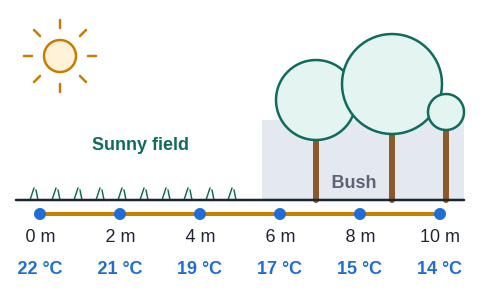
- Room 10 laid a 10 m tape from the middle of the school field into the bush at its edge. What changed along the line, and why?
| Distance (m) | Temperature (°C) | Sun | Soil | Organisms found |
|---|---|---|---|---|
| 0 | 22 | Full sun | Dry | Grass, clover |
| 2 | 21 | Full sun | Dry | Grass, daisies |
| 4 | 19 | Part shade | Damp | Grass, a few fern seedlings |
| 6 | 17 | Shade | Damp | Ferns, moss |
| 8 | 15 | Shade | Wet | Moss, fungi, slaters |
| 10 | 14 | Full shade | Wet | Ferns, moss, fungi, slaters |
- From 0 m to 10 m the temperature fell from 22 °C to 14 °Ccooler
- The sun went from full sun to full shade, and the soil from dry to wetshadier and damper
- Grass grew in the sunny, dry part; ferns, moss, fungi and slaters lived in the shady, wet partorganisms changed
- Moving into the bush, it got cooler, shadier and wetter, so the organisms changed from sun-loving grass to shade-loving ferns, moss and fungi
Try it: temperature along the transect
Predicting where an organism lives
- Slaters are small grey animals that dry out quickly in the sun and eat rotting leaves. Predict where in a garden you would find them.
- They dry out in the sun, so they need shade and dampneed: water
- They eat rotting leaves, so they need leaf litterneed: food
- Under logs, stones, pots or piles of damp leaves, in shady parts of the garden
Planning a garden that plants will thrive in
- Plants grow best where the features match their needs, so start by finding the sunny, shady, dry and damp parts of the garden.
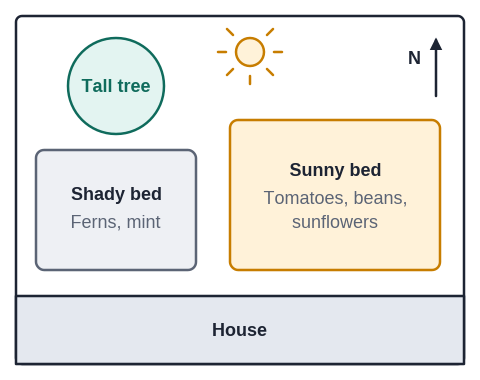
- In New Zealand the sun is in the northern part of the sky, so the north side of a garden gets the most sun, and a tall tree or fence throws shade on its south side.
- Tomatoes, beans and sunflowers need lots of sun and warmth, so they go in the sunny bed. Ferns and mint cope well with shade and damp soil, so they go under the tree.
Try it: sunny or shady spot?
Common mistakes
- A habitat is just the home an animal sleeps in, like a nest.A habitat is the whole place where an organism finds food, water, shelter and space.
- Measuring only one spot is enough to describe a habitat.Measure at many stops along a transect, the same way each time, to see how the features change.
- In New Zealand the sunniest side of a garden is the south side.We are in the southern half of the world, so the sun is in the northern sky and the north side gets the most sun.
Compare a sunny spot and a shady spot
You need: a measuring tape or a 1 metre piece of string, 4 sticks or pegs, gardening gloves, paper and a pencil, a thermometer, if you have one
- Choose a sunny patch and a shady patch of garden, such as open lawn and the ground under a tree or hedge.
- Mark out a 1 metre square in each with the sticks and string.
- In each square, rate the sun, squeeze the soil to test how damp it is, and take the temperature if you have a thermometer.
- Wearing gloves, gently lift leaves and small stones and count each kind of living thing you see, then put everything back as it was.
- Look for this: the shady square is usually cooler and damper, with more moss, slaters and worms; the sunny square has more grass and flowers.
Safety: Ask an adult to come with you, wear gloves, and never put your hand where you cannot see, because spiders and wasps can bite or sting; wash your hands afterwards.
Your turn
Name two physical features of a habitat you could measure.
A plant needs full sun and dry, sandy soil. Would it grow better on a sand dune or on a forest floor?
Where would you expect to find moss in a school playground?
In Room 10's transect, how much cooler was it at 10 m than at 0 m?
You want to grow lettuces, which like some shade on hot summer afternoons. Where in an NZ garden could you plant them?
Show answer
1. Any two of: temperature, sun exposure, how damp the soil is, wind, type of ground. 2. A sand dune, which is sunny with dry, sandy soil. 3. In a damp, shady place, such as the shady side of a building or under a tree. 4. 22 − 14 = 8 °C cooler. 5. Somewhere with sun in the morning but shade in the afternoon, such as the east side of a fence or tree.
Recap
- A habitat is where an organism finds food, water, shelter and space.
- Habitats differ in physical features such as water, sun and temperature, which you can observe and measure.
- Different features suit different organisms, and similar features suit similar organisms.
- A transect records the features and organisms at regular stops, the same way each time.
- Knowing what an organism needs lets you predict where it lives and plan a garden that suits each plant.
Challenge
On a hot, sunny day, Room 4 tested two rock pools at the end of low tide, plus the open sea. These are made-up readings. High pool (cut off from the sea for 7 hours): 27 °C, 38 g of salt in each litre. Low pool (cut off for 2 hours): 18 °C, 35 g of salt in each litre. Open sea: 16 °C, 35 g of salt in each litre. (a) Explain why the high pool became warmer and saltier. (b) A sea animal dies if its water goes above 24 °C or above 37 g of salt in each litre. Which pool could it live in, and why does that also tell you where on the shore to look for it? (c) Predict how the high pool's saltiness would change if heavy rain fell during low tide, and explain.
Hint
When water evaporates from a pool, does the salt go with it? And which pool spends longer in the sun without fresh seawater?
Answer
(a) The high pool sat in the sun for longer without new seawater, so it warmed up, and water evaporated from it while the salt stayed behind, making it saltier. (b) Only the low pool (18 °C and 35 g are both inside its limits). It would be found low on the shore, where pools are cut off for a short time. (c) The high pool would become less salty, because rain is fresh water that adds water but no salt.
Step by step
- The high pool was cut off for 7 hours, so the sun had longer to heat it, and no cool seawater came in.
- Water evaporated from the warm pool, but salt does not evaporate, so the same salt was left in less water.
- The high pool breaks both limits (27 °C is above 24 °C; 38 g is above 37 g). The low pool meets both.
- Pools low on the shore are covered by the sea most of the time, so their features stay close to the sea's.
- Rain adds fresh water to the pool, so the salt is spread through more water and the pool gets less salty.
Full working
- high pool: 7 hours in the sun, no new seawaterwarmer
- water evaporates, salt stayssaltier: 38 g compared with 35 g
- high pool: 27 > 24 and 38 > 37fails both limits
- low pool: 18 ≤ 24 and 35 ≤ 37inside both limits
- rain: water in, no salt inless salty
- Evaporation in the sun made the high pool warm and salty; the animal lives in the low pool, low on the shore; rain would make the high pool less salty
In Central Otago, a road is cut straight through a hill from east to west, so one bank of the cutting faces north and the other faces south. One bank is dry, with tussock and skinks basking on the rocks. The other bank is damp, covered in moss, with small ferns. (a) Which bank is which? Explain. (b) A second cutting nearby runs from north to south, so one bank faces east and the other faces west. Would the difference between its two banks be bigger or smaller than in the first cutting? Explain. (c) On a hillside in Southland, far from Central Otago, on which slope would you look for moss and ferns? Explain why places with similar features tend to have similar kinds of living things, even when they are far apart.
Hint
In New Zealand the sun rises in the east, crosses the northern part of the sky and sets in the west. Which way must a bank face to look at the sun for most of the day?
Answer
(a) The north-facing bank is the dry one with tussock and skinks; the south-facing bank is the damp, mossy one. (b) Smaller. The east-facing bank gets the morning sun and the west-facing bank gets the afternoon sun, so each bank gets sun for part of the day and neither is shaded all day. (c) The south-facing slope. Similar features, such as shade and damp, suit organisms with similar needs, so mosses and ferns grow on shady, damp slopes wherever they are.
Step by step
- In New Zealand the sun is in the northern sky, so a bank facing north gets the most sun.
- More sun makes that bank warmer and drier, which suits tussock and skinks that bask to warm up.
- The south-facing bank is shaded, so it stays cool and damp, which suits moss and ferns.
- In a north to south cutting, the sun shines on the east-facing bank in the morning and on the west-facing bank in the afternoon, so the two banks are much more alike.
- A south-facing slope in Southland is shaded and damp too, and it is the conditions, not the place, that decide which kinds of organisms do well.
Full working
- NZ: sun in the northern skynorth-facing bank gets the sun
- north-facing: warm, drytussock and skinks
- south-facing: shade, dampmoss and ferns
- east-facing: morning sun; west-facing: afternoon suneach bank gets some sun, so a smaller difference
- Southland south-facing slope: shade, dampsimilar conditions, similar kinds of organisms
- North-facing dry, south-facing mossy; the east to west difference is smaller; look on the south-facing slope
Room 12 used one thermometer to measure the temperature along a 20 m transect running up a slope. They walked up the line, stopping every 4 m, one stop each half hour. These are made-up readings. 0 m at 9:00, 12 °C; 4 m at 9:30, 13 °C; 8 m at 10:00, 14 °C; 12 m at 10:30, 15 °C; 16 m at 11:00, 16 °C; 20 m at 11:30, 17 °C. They concluded, "The top of the slope is 5 °C warmer than the bottom." Their teacher had left a second thermometer at the 0 m spot all morning. It read 12 °C at 9:00 and rose steadily by 0.5 °C each half hour. (a) Explain why their conclusion is not fair. (b) Assuming the whole slope warmed up by the same amount as the 0 m spot, how much warmer is the 20 m spot than the 0 m spot at the same time? (c) Describe a better way to measure the temperature along the transect.
Hint
What else changed between 9:00 and 11:30, apart from the place? Work out what the 0 m thermometer read at 11:30.
Answer
(a) Two things changed at once: the place and the time of day. Part of the rise was just the morning warming up. (b) 2.5 °C warmer. (c) Read the temperature at every stop at the same time, for example with several thermometers read together, or take each reading at the same time of day; repeat on other days.
Step by step
- Each stop was read half an hour later than the one before, and the morning was warming up.
- From 9:00 to 11:30 is 5 half hours, so the 0 m spot warmed by 5 × 0.5 = 2.5 °C, to 14.5 °C.
- At 11:30 the 20 m spot read 17 °C and the 0 m spot 14.5 °C, a difference of 2.5 °C.
- So only 2.5 °C of the 5 °C rise is about the place; the other 2.5 °C is the time of day.
- A fair, systematic method changes only the place, so every stop must be measured at the same time.
Full working
- 17 − 12 = 5 °Ctheir difference, mixing place and time
- 9:00 to 11:30 = 5 half hourstime between first and last readings
- 5 × 0.5 = 2.5 °C; 12 + 2.5 = 14.5 °C0 m spot at 11:30
- 17 − 14.5 = 2.5 °C20 m compared with 0 m at the same time
- The conclusion mixed up time and place; the top is about 2.5 °C warmer; measure every stop at the same time