
Sorting living things: plants, animals and keys
What this lesson covers
- Why scientists sort living things into groups
- How a classification key works, and how to make one
- The main groups of plants: flowering plants, cone-bearing plants, ferns and mosses
- Why algae are a separate group from plants
- Vertebrates and invertebrates, and the main groups of each
- Microorganisms, which are too small to see without a microscope
Why sort living things?
- An organism is any living thing: a plant, an animal, a mushroom or a germ.
- Classification means sorting organisms into groups by the features they share, such as having feathers or making seeds.
- Small groups fit inside bigger groups, like books on shelves inside sections of a library.
- Organisms in the same group are usually related to each other, the way cousins share the same grandparents. Over a very long time, groups of living things have changed and split into new groups.
- Sorting this way helps scientists all over the world talk about the same organism and spot new ones.
Groups of plants
- Plants are sorted by their structures, which means their body parts, such as flowers, cones, roots and leaves.
- They are not sorted by where they live. Seagrass grows under the sea in New Zealand estuaries, but it has flowers, so it belongs with the flowering plants.
| Group | Key features | New Zealand examples |
|---|---|---|
| Flowering plants | Have flowers; seeds form inside a fruit | Kōwhai, pōhutukawa, grasses, seagrass |
| Cone-bearing plants | No flowers; seeds grow in cones | Kauri, pine trees |
| Ferns | No flowers or seeds; fronds with spores underneath | Ponga (silver fern), kiokio |
| Mosses | Tiny, soft, no true roots; spores, no seeds | Moss on damp rocks and logs |
Try it: which plant group?
Algae are a group of their own
- Algae (say "al-gee") are living things that make their own food from sunlight, like plants do.
- Seaweeds such as kelp are algae, and so is the green slime that grows in a pond.
- Algae do not have true roots, stems or leaves. A seaweed holds onto a rock with a holdfast, but it does not take in water through it like a root does.
- Because their structures are so different, scientists put algae in a separate group from plants.
Vertebrates and invertebrates
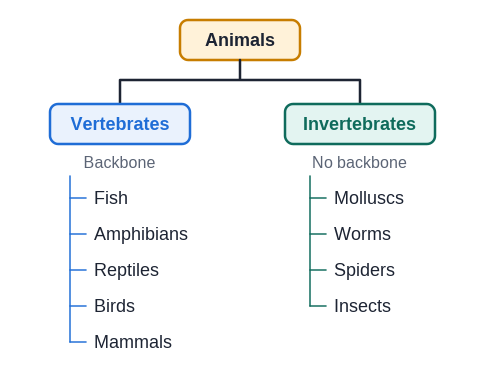
- Animals are first sorted into two big groups by one feature: a backbone.
- A vertebrate is an animal with a backbone. Fish, amphibians, reptiles, birds and mammals are vertebrates.
- An invertebrate is an animal without a backbone. Molluscs, worms, spiders and insects are invertebrates.
| Group | Backbone? | New Zealand example |
|---|---|---|
| Fish | Yes | Snapper |
| Amphibians | Yes | Archey's frog |
| Reptiles | Yes | Tuatara, geckos |
| Birds | Yes | Kiwi, tūī |
| Mammals | Yes | Long-tailed bat, people |
| Molluscs | No | Pāua, garden snail |
| Worms | No | Earthworm |
| Spiders | No | Kātipo |
| Insects | No | Wētā, monarch butterfly |
Try it: backbone or not?
Microorganisms
- A microorganism is a living thing so small that you need a microscope to see it. "Micro" means very small.
- A microscope is a tool with lenses that makes tiny things look many times bigger.
- Bacteria are microorganisms, and so are some algae and yeasts.
- A single drop of pond water can hold hundreds of microorganisms that you cannot see with your eyes alone.
Classification keys
- A classification key is a tool for finding out what an organism is.
- It is a list of questions about features you can see, each with two answers, such as "Does it have flowers? Yes or no."
- Each answer sends you to the next question, until you reach the organism's name.
- Good questions are about features anyone can check, such as legs, shells or flowers. Questions about colour or size can trick you, because these can change.
Example: using a key on four plants
- Tama finds four plants on a bush walk: a kōwhai, a kauri, a ponga and a patch of moss.
- Use the key in the figure to name a plant that has no flowers, no cones and large fronds.
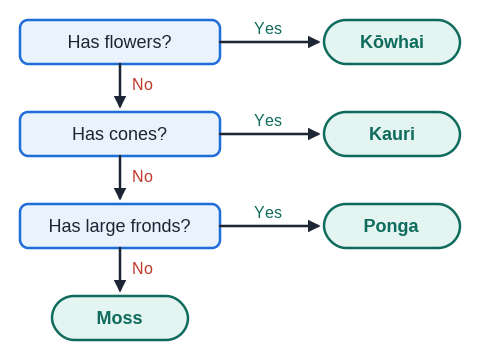
- Has flowers? Nogo to the next question
- Has cones? Nogo to the next question
- Has large fronds? Yesfollow the yes arrow
- The plant is a ponga
Example: designing a key for four animals
- Make a key that separates a kiwi, a tuatara, a wētā and a pāua.
- 1. Has a backbone? Yes: go to 2. No: go to 3.split vertebrates from invertebrates
- 2. Has feathers? Yes: kiwi. No: tuatara.a bird and a reptile
- 3. Has a shell? Yes: pāua. No: wētā.a mollusc and an insect
- Three questions name all four animals
Common mistakes
- Seaweed is a plant because it is green and lives in water.Seaweed is an alga: it has no true roots, stems or leaves, so it is in a separate group from plants.
- Plants that live in water all go in the same group.Plants are grouped by their structures, not where they live; seagrass has flowers, so it is a flowering plant.
- A spider is an insect.Spiders have eight legs and two body parts; insects have six legs and three body parts, so they are different groups.
- A key question can be "Is it big?"Use features anyone can check the same way, such as "Does it have a shell?", because big means different things to different people.
Make a key for leaves from your garden
You need: 6 different leaves from a garden or park, a sheet of paper, a pencil, a family member to test your key
- With an adult, collect six leaves that look different from each other.
- Lay them out and find one feature that splits them into two groups, such as "Is the edge smooth or jagged?"
- Keep splitting each group with a new yes or no question until every leaf is on its own.
- Write your questions down as a key, then hand one leaf to a family member and ask them to name it using only your key.
- If they get it wrong, look for the question that confused them and make it clearer.
Safety: Have an adult check each plant before you pick from it, because some garden plants are poisonous or prickly, and wash your hands afterwards.
Your turn
A kauri makes seeds in cones and has no flowers. Which plant group is it in?
A tuatara has a backbone. Is it a vertebrate or an invertebrate?
Why is kelp not classified as a plant?
An animal has eight legs, two body parts and no backbone. Is it an insect or a spider?
Which of these can only be seen with a microscope: a bacterium, a moss or an ant?
Show answer
1. Cone-bearing plants. 2. A vertebrate (it is a reptile). 3. It has no true roots, stems or leaves, so it is an alga, not a plant. 4. A spider, because insects have six legs and three body parts. 5. A bacterium, because it is a microorganism.
Recap
- Classification sorts organisms into groups by shared features; related organisms end up together.
- Plants are grouped by structure: flowering plants, cone-bearing plants, ferns and mosses.
- Algae have no true roots, stems or leaves, so they are not plants.
- Vertebrates (fish, amphibians, reptiles, birds, mammals) have a backbone; invertebrates (molluscs, worms, spiders, insects) do not.
- Microorganisms can only be seen with a microscope.
- A classification key uses yes or no questions about features you can see to name an organism.
Challenge
A bug jar holds only wētā and kātipo spiders. Altogether the animals have 50 legs and 17 body parts. How many wētā and how many kātipo are in the jar? Are any of them vertebrates?
Hint
A wētā is an insect and a kātipo is a spider. Write down how many legs and how many body parts each has, then try small numbers of wētā.
Answer
3 wētā and 4 kātipo. None are vertebrates: insects and spiders have no backbone.
Step by step
- A wētā is an insect: 6 legs and 3 body parts. A kātipo is a spider: 8 legs and 2 body parts.
- Body parts: the kātipo give an even number, so the wētā must give an odd number, so there is an odd number of wētā.
- Try 1 wētā: 3 + 2 × 7 = 17 body parts means 7 kātipo, but 6 + 56 = 62 legs. Too many.
- Try 3 wētā: 9 + 8 = 17 body parts means 4 kātipo, and 18 + 32 = 50 legs. It works.
- Insects and spiders are both invertebrates, so there are no vertebrates in the jar.
Full working
- wētā: 6 legs, 3 body parts; kātipo: 8 legs, 2 body partsinsect and spider
- 1 wētā, 7 kātipo: 3 + 14 = 17 parts, 6 + 56 = 62 legswrong
- 3 wētā, 4 kātipo: 9 + 8 = 17 parts, 18 + 32 = 50 legsboth match
- 5 wētā, 1 kātipo: 15 + 2 = 17 parts, 30 + 8 = 38 legswrong
- 3 wētā and 4 kātipo; all invertebrates, no vertebrates
Ana wrote a key for sea life. 1. Does it live in the sea? Yes: go to 2. No: go to 4. 2. Does it swim with fins? Yes: it is a fish. No: go to 3. 3. Is it green? Yes: it is a seaweed (alga). No: it is a mollusc. She tests it on a snapper, a pāua, a Hector's dolphin, seagrass and bull kelp (a brown seaweed). Which organisms does her key get wrong, and why? What is the lesson for writing key questions?
Hint
Run each organism through the key and write the answer it gives. A Hector's dolphin breathes air with lungs and feeds its baby on milk.
Answer
Three are wrong. The Hector's dolphin comes out as a fish, but it is a mammal. Seagrass comes out as a seaweed, but it has flowers, so it is a flowering plant. Bull kelp is brown, so it comes out as a mollusc, but it is an alga. Key questions should ask about a feature that only one group has (gills, flowers, a shell), not colour or a feature that different groups share, like fins.
Step by step
- Snapper: lives in the sea, has fins, so fish. Correct.
- Pāua: sea, no fins, not green, so mollusc. Correct.
- Hector's dolphin: sea, has fins, so the key says fish. But it breathes air and feeds its young milk, so it is a mammal.
- Seagrass: sea, no fins, green, so the key says seaweed. But it has flowers, so it is a flowering plant.
- Bull kelp: sea, no fins, brown, so the key says mollusc. But it is a seaweed, an alga.
- The mistakes come from question 2 (dolphins have fins too) and question 3 (not all seaweeds are green, and not every non-green thing is a mollusc). Ask about a feature only one group has, like gills, flowers or a shell.
Full working
- snapper: sea, fins → fishcorrect
- pāua: sea, no fins, not green → mollusccorrect
- Hector's dolphin: sea, fins → fishwrong, a mammal
- seagrass: sea, no fins, green → seaweedwrong, a flowering plant
- bull kelp: sea, no fins, brown → molluscwrong, an alga
- Wrong: dolphin, seagrass and kelp; ask about a feature only one group has, not colour or shared features like fins
Make a key that names each of these six animals: kererū, snapper, long-tailed bat, kātipo, earthworm and garden snail. Each question has a yes or no answer, and each answer leads to one animal or to another question. How many questions does your key need? Could a different key use fewer questions? Could any key name every animal by asking at most 2 questions?
Hint
Start with the backbone question. Then think about it like this: each question splits one group into two smaller groups. How many splits turn 1 group into 6 single animals?
Answer
A model key: 1. Has a backbone? Yes: 2. No: 4. 2. Has feathers? Yes: kererū. No: 3. 3. Has fins? Yes: snapper. No: long-tailed bat. 4. Has a shell? Yes: garden snail. No: 5. 5. Has legs? Yes: kātipo. No: earthworm. It uses 5 questions, and every working key for six animals uses exactly 5. No key can name all six in at most 2 questions, because 2 questions give at most 4 different endings.
Step by step
- The backbone question splits the three vertebrates from the three invertebrates.
- Feathers pick out the kererū, then fins split the snapper from the bat. ("Can it fly?" would be a poor question here: the kererū and the bat both fly.)
- A shell picks out the snail, then legs split the kātipo from the earthworm.
- Each question splits one group into two, so it adds exactly one group. Going from 1 group to 6 single animals needs 6 − 1 = 5 questions in any key.
- After 1 question there are at most 2 endings, after 2 questions at most 4. Four is fewer than six, so some animal needs a third question.
Full working
- 1. backbone? yes: kererū, snapper, bat; no: kātipo, earthworm, snailvertebrates and invertebrates
- 2. feathers? yes: kererūthe only bird
- 3. fins? yes: snapper; no: batfish and mammal
- 4. shell? yes: snailthe only mollusc
- 5. legs? yes: kātipo; no: earthwormspider and worm
- each question adds one group: 1 + 5 = 6always 5 questions
- 2 questions: at most 2 × 2 = 4 endings, and 4 < 6some animal needs 3
- 5 questions, never fewer; no key names all six in 2 questions