
Food webs: who eats what in a New Zealand forest
What this lesson covers
- What a habitat is, and how living things use its food and shelter
- Producers, which make their own food using light
- Consumers, which get their food by eating other living things
- Herbivores, carnivores and omnivores
- Food chains, and how they join together into food webs
- What the arrows in a food web mean
Habitats
- An organism is any living thing.
- A habitat is the place where an organism lives. It gives the organism what it needs to survive: food, water and shelter.
- In a New Zealand forest, tree wētā shelter in holes in tree trunks during the day, kererū find fruit in the treetops, and moss and ferns grow in the damp shade on the forest floor.
- Different organisms use the same habitat in different ways, so many kinds can live there together.
Producers make their own food
- Nutrition is the food a living thing uses to stay alive and grow.
- A producer is an organism that makes its own food. Producers are mostly plants and algae.
- They use energy from light, water and minerals from the soil, and a gas from the air called carbon dioxide to make food in their leaves.
- In a forest the producers include trees like māhoe and kōwhai, shrubs like kawakawa, and ferns. In the sea they include seaweeds and tiny floating algae.
Consumers eat to live
- A consumer is an organism that cannot make its own food, so it gets nutrition by eating other living things. All animals are consumers.
- Consumers are sorted by what they eat.
| Kind of consumer | Eats | Forest example |
|---|---|---|
| Herbivore | Only plants (leaves, fruit, seeds, nectar) | Tree wētā eat leaves; kererū eat fruit and leaves |
| Carnivore | Only other animals | Ruru (morepork) eat wētā, moths and small birds |
| Omnivore | Both plants and animals | Rats eat fruit, seeds, wētā and birds' eggs |
Try it: producer or consumer?
Food chains
- A food chain shows one path that food takes through a habitat.
- It always starts with a producer, because producers are where the food is first made.
- Each arrow points from the food to the organism that eats it. You can read the arrow as "is eaten by".
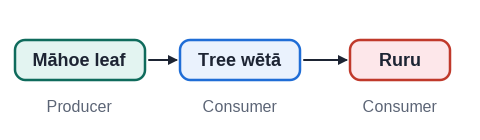
- So "māhoe leaf → tree wētā → ruru" means the leaf is eaten by the wētā, and the wētā is eaten by the ruru.
Food webs
- Most animals eat more than one kind of food, and most are eaten by more than one kind of animal.
- So the food chains in a habitat cross over and join together. A food web is all the feeding links in a habitat drawn together.
- A food web shows how nutrition moves between the organisms living there.
- Producers go at the bottom, and the animals that eat them and each other go above.
Example: reading the forest food web
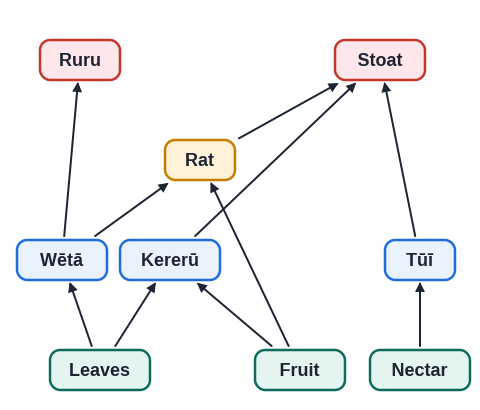
- Use the forest food web to answer: What does a rat eat? What eats wētā? Which organisms are producers?
- Arrows into the rat come from fruit and wētāarrows point to the eater
- Arrows out of wētā go to ruru and ratthese eat wētā
- Leaves, fruit and nectar have no arrows coming inthey come from plants, which make their own food
- Rats eat fruit and wētā; ruru and rats eat wētā; the plants (leaves, fruit, nectar) are the producers
Try it: draw the arrows
Example: what if the rats were removed?
- Many New Zealand groups trap rats in forests to protect native wildlife.
- Use the food web to predict what might happen if all the rats were removed.
- Rats eat wētā, so fewer wētā are eatenwētā numbers can grow
- Rats eat fruit, so more fruit is leftmore food for kererū
- Stoats eat rats, so stoats lose a foodthey may hunt more birds
- Wētā and kererū would probably increase, but stoats might eat more tūī and kererū, so stoats need controlling too
Try it: remove the rats
Example: a garden survey
- Room 3 searched part of their school garden, looking under logs and stones and on plants. They recorded each organism, where it was and what it used. Which organisms are producers, and what links can you draw?
| Organism | Found | Food | Shelter |
|---|---|---|---|
| Lettuce | Vegetable bed | Makes its own | None needed |
| Grass | Lawn | Makes its own | None needed |
| Garden snail | Under lettuce leaves | Lettuce leaves | Under leaves and pots |
| Earthworm | In the soil | Dead leaves in the soil | Soil |
| Spider | Web on the fence | Flies and moths | Its web, cracks in the fence |
| Song thrush | On the lawn | Snails and earthworms | Hedge |
- Lettuce and grass make their own foodthe producers
- Lettuce → snail → song thrushone food chain
- Earthworm → song thrushthe thrush also eats worms, so the chains join
- Lettuce and grass are producers; snail, earthworm, spider and thrush are consumers, linked in a small web
Common mistakes
- In a food chain the arrow points to the thing that gets eaten: ruru → wētā.The arrow points to the eater, the way the food moves: wētā → ruru.
- Plants get their food from the soil.Plants make their own food using light; they only take water and minerals from the soil.
- One food chain shows everything that happens in a habitat.Most animals eat several things and are eaten by several, so you need a food web to show all the links.
- Removing one animal from a food web only affects the animal that ate it.The change spreads through the web: its food can increase and its predators may switch to other prey.
Survey a patch of your garden
You need: 4 sticks and a piece of string, a magnifying glass, if you have one, garden gloves, paper and a pencil
- Push in the sticks to mark a square about one big step wide, and run the string round them.
- Search the square slowly: the plants, under leaves, under stones and in the top of the soil.
- For each living thing, write down where you found it and what it might use there for food or shelter.
- Put every stone and log back exactly the way you found it.
- Draw a food web for your square, with the plants at the bottom and arrows pointing to the eaters.
Safety: Have an adult with you, wear gloves when lifting stones or logs because spiders and sharp edges may hide underneath, and wash your hands afterwards.
Your turn
In the food chain "grass → snail → song thrush", which organism is the producer?
A rat eats seeds and wētā. Is it a herbivore, a carnivore or an omnivore?
Which way does the arrow point between a wētā and the ruru that eats it?
Why is one food chain not enough to show the feeding links in a forest?
In Room 3's garden, spiders eat flies. Predict what would happen to the number of flies if the spiders disappeared.
Show answer
1. The grass, because it makes its own food. 2. An omnivore, because it eats both plants and animals. 3. From the wētā to the ruru (wētā → ruru), the way the food moves. 4. Most animals eat more than one thing and are eaten by more than one thing, so the chains join into a web. 5. The number of flies would probably go up, because fewer flies would be eaten.
Recap
- A habitat gives organisms food, water and shelter.
- Producers, mostly plants and algae, make their own food using light, water and minerals.
- Consumers eat other organisms: herbivores eat plants, carnivores eat animals, omnivores eat both.
- A food chain shows one path of food; arrows point from the food to the eater.
- A food web joins many chains to show how nutrition moves through a habitat.
- A change to one organism spreads through the whole web.
Challenge
Room 5 studies a stream. Mayfly nymphs eat algae. Snails eat algae. Kōura (freshwater crayfish) eat algae, mayfly nymphs and snails. Trout eat mayfly nymphs, snails and kōura. Shags eat trout and kōura. Is the kōura a herbivore, a carnivore or an omnivore? How many different food chains start at the algae and end at the shag?
Hint
Draw the web first, with algae at the bottom. Then follow the arrows upward, one path at a time. It helps to sort the paths by the last animal before the shag.
Answer
The kōura is an omnivore. There are 8 food chains from the algae to the shag.
Step by step
- Kōura eat algae (a producer) and also mayfly nymphs and snails (animals), so they are omnivores.
- Every chain ends with either kōura → shag or trout → shag.
- Chains ending kōura → shag: the food reaches the kōura straight from algae, or through mayfly nymphs, or through snails. That is 3 chains.
- Chains ending trout → shag: the food reaches the trout through mayfly nymphs, snails, or kōura. The kōura route itself has 3 ways in, so there are 2 + 3 = 5 chains.
- Altogether 3 + 5 = 8 chains.
Full working
- kōura eats algae and animalsomnivore
- algae → kōura → shag1
- algae → mayfly nymph → kōura → shag2
- algae → snail → kōura → shag3
- algae → mayfly nymph → trout → shag4
- algae → snail → trout → shag5
- algae → kōura → trout → shag6
- algae → mayfly nymph → kōura → trout → shag7
- algae → snail → kōura → trout → shag8
- Kōura: omnivore. 8 food chains from algae to shag
In a forest, tūī drink nectar from rātā flowers. Possums eat rātā leaves and flowers, and they also eat the eggs and chicks of tūī. Rua says possums are herbivores because they mostly eat leaves. Is he right? Then explain three different ways that removing possums from this forest could help, using feeding links.
Hint
Look at every arrow that goes into the possum. Then think about what the possum takes away from the tūī, and from the rātā tree itself.
Answer
No. Possums eat plants and animals (eggs and chicks), so they are omnivores. Removing them helps: 1) more rātā flowers are left, so tūī have more nectar; 2) fewer tūī eggs and chicks are eaten; 3) rātā trees keep their leaves, so they stay healthy and can make more flowers.
Step by step
- Arrows go into the possum from rātā leaves, rātā flowers and tūī eggs and chicks.
- Eating eggs and chicks means eating animals, so the possum is an omnivore, even if most of its food is leaves.
- Possums and tūī both feed on rātā flowers, so without possums more flowers and nectar are left for tūī.
- Without possums, the link tūī eggs and chicks → possum is gone, so more young tūī survive.
- Without possums, rātā leaves are not stripped, so the trees stay healthy and can flower more, which also helps tūī.
Full working
- rātā leaves → possum, rātā flowers → possumplant food
- tūī eggs and chicks → possumanimal food
- eats plants and animalsomnivore, so Rua is wrong
- rātā flowers → tūī and rātā flowers → possumboth share the same food
- remove possummore nectar left for tūī
- remove possumfewer eggs and chicks eaten
- remove possumrātā keeps its leaves, more flowers
- Possum is an omnivore; removing it gives tūī more nectar, saves their eggs and chicks, and keeps rātā healthy
In a tussock grassland: grasshoppers eat tussock leaves. Mice eat tussock seeds and grasshoppers. Chaffinches eat tussock seeds. Skinks eat grasshoppers. Kārearea (NZ falcons) eat mice, chaffinches and skinks. One dry year the tussocks make almost no seeds, but they still have plenty of leaves. Skinks never eat seeds, yet the skinks become fewer. Give two different reasons why.
Hint
Draw the web. First find which animals lose food when the seeds are missing. Then ask what those hungry animals, and the animals that hunt them, might do instead.
Answer
1) Mice have no seeds, so they eat more grasshoppers, leaving less food for skinks. 2) With fewer mice and chaffinches to catch, kārearea hunt more skinks instead.
Step by step
- Only mice and chaffinches eat seeds, so they are the ones that lose food first.
- Mice also eat grasshoppers. Without seeds they eat more grasshoppers, and skinks eat grasshoppers too, so skinks have less food.
- Chaffinches and mice go hungry and become fewer, so kārearea have less of their usual prey.
- Kārearea also eat skinks, so they are likely to catch more skinks.
- So skinks are hit twice: less food and more hunting, even though they never touched a seed.
Full working
- tussock seeds → mouse, tussock seeds → chaffinchthe only seed eaters
- grasshopper → mouse and grasshopper → skinkmice and skinks share grasshoppers
- no seedsmice eat more grasshoppers
- fewer grasshoppersless food for skinks (reason 1)
- fewer mice and chaffincheskārearea short of usual prey
- skink → kāreareakārearea hunt more skinks (reason 2)
- Skinks fall because mice take more of their grasshoppers and kārearea hunt more skinks