
Digestion, part 1: from your mouth to your small intestine
What this lesson covers
- What digestion is, and the difference between mechanical and chemical digestion
- How teeth and saliva start digestion in the mouth
- Enzymes, the chemicals your body makes to break food down
- How food travels down the oesophagus to the stomach
- How churning and acid in the stomach help break food down
- How the small intestine finishes turning food into nutrients
- Making a model of the digestive system that shows what each part does
What is digestion?
- Nutrients are the useful substances in food that your body needs, such as sugars, proteins, fats and vitamins.
- Most food is made of pieces far too big to get into your blood. Digestion is the process of breaking food down into pieces small enough for your body to take in.
- Mechanical digestion breaks food into smaller lumps by force, like chewing or squeezing. The food is still the same stuff, just in smaller bits.
- Chemical digestion uses chemicals to change food into different, much smaller substances. For example, starch in bread is changed into sugar.
The digestive system
- An organ is a part of the body with a special job, like the heart or the stomach.
- The digestive system is the group of organs that food passes through, joined together as one long tube from your mouth to your bottom.
- In this lesson you follow food through the first four parts: the mouth, the oesophagus, the stomach and the small intestine.
- Part 2 follows what happens next, in the large intestine and the rectum.
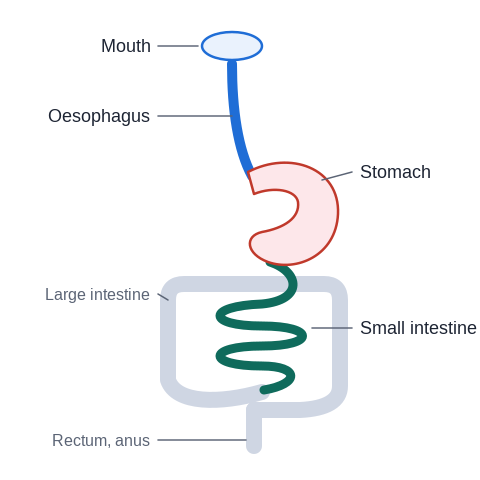
Try it: follow food through the gut
The mouth: teeth and saliva
- Digestion starts the moment you take a bite.
- Your teeth do mechanical digestion. Incisors at the front cut, canines grip and tear, and molars at the back grind food into a mush.
- Saliva (spit) wets the food so it is easy to swallow. It also contains a chemical that starts chemical digestion, changing starch into sugar.
- Your tongue mixes the food with saliva and rolls it into a soft ball, ready to swallow.
| Teeth | Where | Job |
|---|---|---|
| Incisors | Front | Cut and bite |
| Canines | Beside the incisors, pointed | Grip and tear |
| Molars | Back, wide and flat | Crush and grind |
Enzymes: the body's chemical scissors
- A molecule is a tiny particle of a substance, far too small to see.
- Many food molecules are long chains, like a string of beads. Starch is a long chain of sugar molecules.
- Digestive enzymes are chemicals made by your body that cut these chains into small pieces, like scissors snipping a string of beads.
- Each kind of enzyme works on one kind of food. One works on starch, another on proteins, and another on fats.
- Enzymes are not alive. They are chemicals, and they are not used up, so the same enzyme can cut chain after chain.
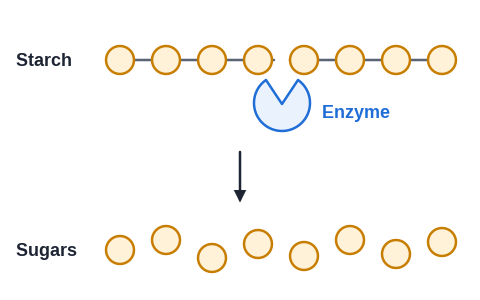
Example: why chewed bread tastes sweet
- Aroha chews a piece of plain white bread for a whole minute without swallowing. It starts to taste a little sweet.
- Explain why, using the words starch, enzyme and sugar.
- Bread is mostly starchstarch does not taste sweet
- Saliva contains an enzyme that cuts starchchemical digestion in the mouth
- Starch is cut into sugar, which tastes sweetthe product of the enzyme
- The enzyme in Aroha's saliva changed some of the starch into sugar
Swallowing: the oesophagus
- The oesophagus (say "ee-soff-a-gus") is the tube that carries food from your throat to your stomach.
- Food does not just fall down it. Rings of muscle in its wall squeeze one after another, pushing the food along in a wave.
- That is why you can still swallow when you are lying down, or even upside down.
- When you swallow, a small flap covers your windpipe so food goes down the oesophagus and not into your lungs.
The stomach
- The stomach is a stretchy, muscly bag. It can hold a whole meal.
- Its muscles churn the food, squeezing and mixing it. This is mechanical digestion.
- The stomach also makes a strong acid. The acid kills many germs in the food and helps an enzyme break down proteins, from foods like meat, eggs and beans.
- After a few hours of churning, the food has become a thick, soupy liquid, and it is squirted a little at a time into the small intestine.
Try it: mechanical or chemical?
The small intestine
- The small intestine is a long, narrow tube, folded and coiled up to fit inside your belly.
- It is called small because it is thin, not because it is short. It is the longest part of the digestive system.
- Here more enzymes are added to the food. Together they finish breaking down starch, proteins and fats.
- By the end of this stage the food has been turned into nutrients that are small enough for your body to take in. Part 2 shows how they get into your blood.
Example: a model digestive system
- Room 15 built a model to show how the parts link to their jobs. A model is a simple copy of something that helps explain how it works.
- What does each part of the model show, and what can the model not show?
| Model part | Real part | What it shows |
|---|---|---|
| Crackers broken by a rolling pin | Teeth in the mouth | Mechanical digestion makes food smaller |
| Water poured on the crumbs | Saliva | Food is wetted so it can move |
| A zip-lock bag squeezed by hand | Stomach | Churning mixes food into a mush |
| An old stocking the mush is pushed through | Small intestine | A long tube the food moves along |
- Each model part does the same kind of job as the real partthis is what makes it a good model
- There are no enzymes or acid in the modela limit of the model
- The model shows mechanical digestion well, but it cannot show chemical digestion
Common mistakes
- Digestion starts in the stomach.Digestion starts in the mouth, where teeth break food up and saliva starts changing starch into sugar.
- Food falls down the oesophagus because of gravity.Muscles in the oesophagus squeeze food along in waves, which is why you can swallow lying down.
- Enzymes are tiny living things, like germs.Enzymes are chemicals made by your body; they are not alive and are not used up.
- The small intestine is short, because it is called small.It is called small because it is narrow; it is actually the longest part of the digestive system.
Squeeze a model stomach
You need: 2 zip-lock bags, 4 plain crackers, a measuring cup, water, a timer
- Put 2 crackers in each bag and pour half a cup of water into each one.
- Squeeze out the air and seal both bags tightly.
- Leave one bag still on the bench. Squeeze and squash the other bag in your hands for 2 minutes.
- Lay the two bags side by side and compare them.
- Look for this: the squeezed bag has turned into a smooth mush, while the still bag has soggy lumps, which shows how churning helps the stomach break food up.
Safety: Ask an adult before using food from the kitchen, check the seals are closed so the bags cannot burst over the bench, and do not eat the mixture afterwards.
Your turn
Which teeth grind food at the back of your mouth?
Is chewing mechanical digestion or chemical digestion?
What does the enzyme in saliva change starch into?
What is the name of the tube that carries food from your mouth to your stomach?
Give two jobs of the acid in your stomach.
Show answer
1. Molars. 2. Mechanical digestion, because it only breaks food into smaller pieces. 3. Sugar. 4. The oesophagus. 5. It kills many germs in the food, and it helps an enzyme break down proteins.
Recap
- Digestion breaks food into nutrients small enough for your body to take in.
- Mechanical digestion breaks food into smaller lumps; chemical digestion uses enzymes to change it into smaller substances.
- In the mouth, teeth cut and grind, and saliva starts changing starch into sugar.
- Muscles in the oesophagus push food down to the stomach.
- The stomach churns food and adds acid, which kills germs and helps break down proteins.
- In the small intestine more enzymes finish breaking food down into nutrients.
Challenge
Hana has two jars. In jar A she puts 2 whole crackers. In jar B she puts 2 crackers that she has crushed into fine crumbs. She pours the same amount of the same starch-cutting enzyme into each jar, at the same warm temperature. In which jar will the starch be changed into sugar faster? Explain why, and use your answer to explain why chewing well helps chemical digestion, even though chewing itself is mechanical digestion.
Hint
An enzyme can only cut the starch it touches. Where can the enzyme reach in a whole cracker, and where can it reach in crumbs?
Answer
Jar B. The crumbs have much more surface, so the enzyme touches much more starch at once. Chewing does not change starch into sugar, but by breaking food into small pieces it gives the enzymes in saliva, and later in the gut, much more food surface to work on.
Step by step
- Both jars have the same crackers, the same enzyme and the same temperature, so the only difference is the size of the pieces.
- The enzyme works on the outside of each piece, where it touches the food.
- Crushing the crackers makes lots of new surfaces, so much more starch is touching the enzyme.
- So more starch is cut into sugar at the same time in jar B.
- Chewing is mechanical, but it makes the pieces small, so the chemical digestion that follows is faster.
Full working
- same crackers, enzyme and temperature in both jarsa fair test
- jar A: enzyme reaches only the outside of 2 big pieceslittle surface
- jar B: enzyme reaches the outside of thousands of crumbsmuch more surface
- more starch touching the enzyme, more starch cut at oncethe enzyme can only cut what it touches
- chewing (mechanical) makes more surface for enzymes (chemical)the two kinds work together
- Jar B is faster, because the crumbs give the enzyme more surface; chewing helps chemical digestion the same way
Birds have no teeth. A chicken swallows its grain whole, and also swallows small stones. The stones stay in a thick, very muscly part of its gut called the gizzard, which squeezes hard over and over. Explain what the stones and the gizzard are doing, say whether this is mechanical or chemical digestion, and name the parts of the human digestive system that do a similar job.
Hint
Think about what the chicken is missing. What do the gizzard's squeezing muscles do to the stones and the grain inside it?
Answer
The gizzard muscles squeeze, and the stones rub against the grain and grind it into small pieces. This is mechanical digestion. It does the job of our molars (grinding) and is like the churning of our stomach muscles.
Step by step
- A chicken has no teeth, so it cannot chew or grind its food in its mouth.
- When the gizzard squeezes, the hard stones rub against the grain and crush it.
- The grain is broken into smaller pieces, but it is still the same stuff, so this is mechanical digestion.
- In people, molars grind food in the mouth, and stomach muscles churn it.
- Smaller pieces give the chicken's enzymes more surface to work on, so chemical digestion can happen faster later.
Full working
- no teeththe chicken cannot grind food in its mouth
- muscles squeeze, stones rub and crush the graingrinding by force
- the grain is smaller but still the same substanceso mechanical, not chemical
- human molars grind, the stomach churnsthe same kind of job
- Mechanical digestion; the stones and gizzard do the job of our molars and our churning stomach
Hemi uses iodine, which turns blue-black when starch is there and stays brown when there is no starch. He sets up three tubes, all with starch and water, kept at body temperature for 10 minutes. Tube A has nothing else added. Tube B has some fresh saliva added. Tube C has saliva that was boiled and then cooled before it was added. Then he adds iodine to each tube. A turns blue-black, B stays brown, and C turns blue-black. Explain each result. Hemi says: "Boiling killed the enzyme in tube C." What is wrong with how he said this?
Hint
Which tubes still had starch at the end? Then think about what the lesson says enzymes are, and whether something that is not alive can be killed.
Answer
A: no enzyme, so the starch stayed. B: the saliva's enzyme changed the starch into sugar, so no starch was left. C: boiling damaged the enzyme so it no longer worked, so the starch stayed. Enzymes are chemicals, not living things, so boiling cannot kill them; it changes them so they stop working.
Step by step
- Blue-black means starch is still there. Brown means the starch has gone.
- Tube A has no saliva, so nothing cut the starch. A is there to compare with, so we know the starch does not just change by itself.
- In tube B the enzyme in saliva cut the starch into sugar, so by the end there was no starch to turn the iodine blue-black.
- Tube C had the same saliva, but boiled. Its starch was still there, so the boiled enzyme no longer worked.
- Enzymes are chemicals, not alive, so they cannot be killed. Strong heat damages them so they stop working.
Full working
- blue-black = starch present, brown = no starchhow to read iodine
- A blue-black: no enzyme, starch unchangedthe comparison tube
- B brown: saliva enzyme changed starch into sugarchemical digestion
- C blue-black: boiled saliva did not change the starchthe enzyme stopped working
- enzymes are chemicals, not alivethey cannot be killed
- Boiling did not kill the enzyme; it damaged it so it could no longer change starch into sugar