
The equals sign, and growing patterns
What this lesson covers
- Numbers can be compared using “greater than” (>), “less than” (<), and equals (=).
- Applying the same operation to both sides of a number sentence preserves the balance.
- Growing patterns can increase or decrease by the addition or subtraction of a constant (arithmetically) or multiplication or division by a constant (geometrically).
What the equals sign really means
- You have seen = thousands of times, like this: 4 + 3 = __
- So it looks like it means "work it out and write it here".
- It does not. It means "is the same as".
| what people think = means | what it actually means |
|---|---|
| "here comes the answer" | "is the same as" |
| an instruction | a claim about both sides |
Why that matters
- Try this one: 8 + 4 = __ + 5
- Most people write 12. But 12 + 5 is 17, not 12.
- Both sides have to match. The answer is 7.
| if you write | the sentence says | true? |
|---|---|---|
| 12 | 8 + 4 = 12 + 5 | no, 12 is not 17 |
| 7 | 8 + 4 = 7 + 5 | yes, both sides are 12 |
A number sentence is a claim
- Someone writes 11 × 7 = 78. That is not a question.
- It is a claim, and you are allowed to disagree with it.
- 11 × 7 is 77. So the claim is false.
| sentence | true or false? | why |
|---|---|---|
| 11 × 7 = 78 | false | 11 × 7 is 77 |
| 8205 − 4721 = 3484 | true | check it and it holds |
| 6 × 5 = 30 + 0 | true | both sides are 30 |
| 9 + 3 = 12 + 1 | false | 12 is not 13 |
Three things you can claim
- = says the two sides are the same.
- > says the left one is bigger.
- < says the left one is smaller.
| sign | means | for example |
|---|---|---|
| = | is the same as | 4 + 3 = 7 |
| > | is bigger than | 9 > 4 |
| < | is smaller than | 4 < 9 |
Sentences with a hole in them
- 7 + __ = 12. There is a gap.
- Your job is to fill it so the claim becomes true.
- 7 and 5 is 12, so the gap is 5.
| open sentence | fill the gap with | and now |
|---|---|---|
| 7 + __ = 12 | 5 | both sides are 12 |
| 4200 − __ = 4001 | 199 | both sides are 4001 |
| __ ÷ 10 = 12 | 120 | both sides are 12 |
Do the same to both sides
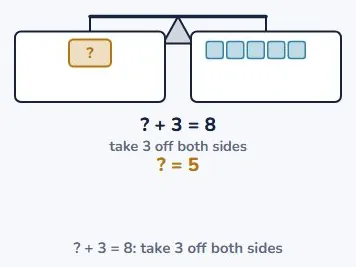
- Picture a balance. Both pans weigh the same.
- Take 3 off one pan only, and it tips. The claim breaks.
- Take 3 off both, and it still balances.
Try it: make it balance
A pattern is a rule
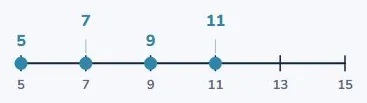
- 5, 7, 9, 11. What is the rule?
- Add 2 each time.
- And a rule is a claim; you can check it on every step.
Some patterns multiply instead
- 3, 6, 12, 24. The gaps are not equal.
- Each one is double the one before.
- Multiplying patterns take off much faster.
| pattern | the rule | what comes next |
|---|---|---|
| 5, 7, 9, 11, … | add 2 each time | 13, 15 |
| 30, 25, 20, 15, … | subtract 5 each time | 10, 5 |
| 3, 6, 12, 24, … | multiply by 2 each time | 48, 96 |
Say the rule, then test it
- Find the rule by looking at the gap between two terms.
- Then check it works for every other pair.
- If it holds all the way along, you have the rule.
| step | to step | gap |
|---|---|---|
| 30 | 25 | − 5 |
| 25 | 20 | − 5 |
| 20 | 15 | − 5 |
Try it: grow the pattern
Common mistakes
- 8 + 4 = __ + 5, so the gap is 12.Both sides must be the same: 8 + 4 is 12, and 7 + 5 is 12, so the gap is 7.
- 11 × 7 = 78 has an equals sign, so it must be true.A number sentence is a claim you check: 11 × 7 is 77, so 11 × 7 = 78 is false.
- 4200 − __ = 4001, so the gap is 4001.Find what you take away to get 4001: 4200 − 199 = 4001, so the gap is 199.
- 3, 6, 12, 24: add 3 each time, so next is 27.The gaps are not equal, so check again: each number is double the one before, so next is 48.
Your turn
True or false: 6 × 9 = 54 + 0
Fill the gap: 15 − __ = 8
What number comes next in 4, 8, 16, 32, …? Check the rule on every pair.
Fill the gap so both sides match: 9 + 6 = __ + 10
Which sign makes this true: 7 × 4 __ 30?
Show answer
1. True: 6 × 9 is 54, and 54 + 0 is 54, so both sides match. 2. 7, because 15 − 7 is 8. 3. 64: each number doubles, so 32 × 2 is 64. The gaps grow: 4, then 8, then 16. 4. 5: 9 + 6 is 15, and 5 + 10 is also 15, so both sides match. 5. <, as 7 × 4 is 28, and 28 is smaller than 30.
Equality Explorer: Basics
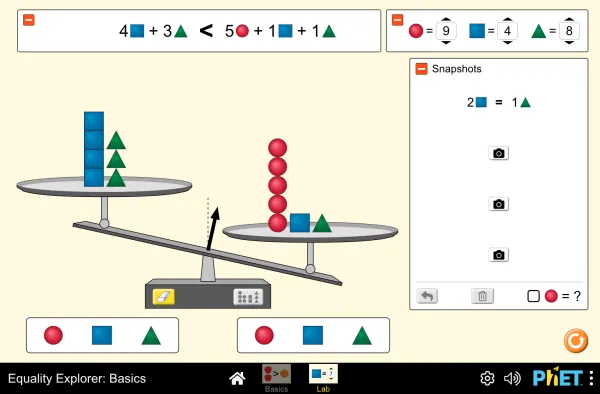
Full screen · PhET Interactive Simulations, University of Colorado Boulder, CC BY 4.0
Equals, and rules
- = means "is the same as", not "answer goes here".
- A number sentence is a claim, so it can be false.
- A pattern rule is a claim too: test it on every step.
| idea | what to remember |
|---|---|
| = | is the same as |
| > and < | the open end faces the bigger number |
| a number sentence | a claim: it can be true or false |
| an open sentence | fill the gap to make it true |
| both sides | do the same to each, and it stays true |
| a pattern | a rule that holds at every step |
Challenge
Each box hides the same number. □ × 4 = □ + 18. What number is in the box?
Hint
On the left there are 4 lots of the box. On the right there is 1 lot of the box and 18 more. Take 1 box off both sides.
Answer
6
Step by step
- The left side is 4 lots of the box.
- The right side is 1 lot of the box and 18.
- Take 1 lot of the box away from both sides, and it still balances.
- Now 3 lots of the box are the same as 18.
- 18 shared into 3 is 6. Check: 6 × 4 = 24 and 6 + 18 = 24.
Full working
- □ + □ + □ + □ = □ + 184 lots of the box
- □ + □ + □ = 18take one box off both sides
- □ = 18 ÷ 3 = 6share 18 into 3
- 6 × 4 = 24 and 6 + 18 = 24both sides match
- □ = 6
Ana and Ben start saving. Ana has $3 in week 1 and adds $4 every week after that. Ben has $1 in week 1 and doubles his money every week after that. In which week does Ben first have more money than Ana, and how much does each of them have then?
Hint
Write both patterns week by week. One adds the same amount each time, the other multiplies.
Answer
Week 6: Ben has $32 and Ana has $23
Step by step
- Ana's pattern adds 4 each time: 3, 7, 11, 15, 19, 23.
- Ben's pattern doubles each time: 1, 2, 4, 8, 16, 32.
- In week 5 Ana still has more: $19 against $16.
- In week 6 Ben jumps to $32, and Ana has $23.
- A doubling pattern starts slowly but soon passes an adding pattern.
Full working
- Ana: 3, 7, 11, 15, 19, 23add 4 each week
- Ben: 1, 2, 4, 8, 16, 32double each week
- week 5: 16 < 19Ben still behind
- week 6: 32 > 23Ben is ahead
- week 6: Ben $32, Ana $23
A pattern goes up by the same amount every time. The 3rd number is 17 and the 7th number is 37. What is the 1st number, and what is the 10th number?
Hint
How many steps are there from the 3rd number to the 7th number? How much did the pattern grow in those steps?
Answer
The 1st number is 7 and the 10th number is 52
Step by step
- From the 3rd number to the 7th number is 4 steps.
- In those 4 steps the pattern grew from 17 to 37, which is 20.
- 20 shared into 4 equal steps is 5, so the rule is add 5.
- Go back 2 steps from 17: 12, then 7. The 1st number is 7.
- Go on 3 steps from 37: 42, 47, 52. The 10th number is 52.
Full working
- 7 − 3 = 4 stepsfrom the 3rd to the 7th number
- 37 − 17 = 20growth in those 4 steps
- 20 ÷ 4 = 5the rule is add 5
- 17 − 5 − 5 = 7back to the 1st number
- 37 + 5 + 5 + 5 = 52on to the 10th number
- check: 7, 12, 17, 22, 27, 32, 37, 42, 47, 52the 3rd is 17 and the 7th is 37
- 1st number 7, 10th number 52