
Food chains: who eats what, starting with a plant
What this lesson covers
- Plants make their own food from sunlight, water and carbon dioxide
- Every food chain starts with a plant
- Food passes along a chain when one living thing eats another
- The arrows in a food chain point to the eater
- Living things in a food chain depend on each other
- A change to one living thing changes the others too
Plants make their own food
- Animals have to eat. Plants do not.
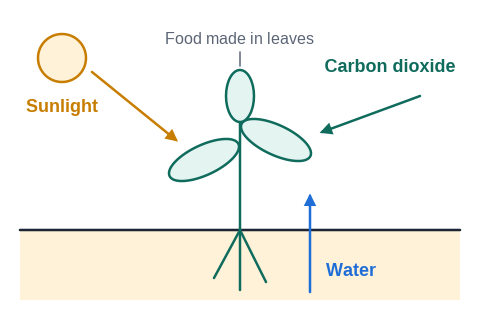
- Plants make their own food.
- They use sunlight, water from the soil, and a gas from the air called carbon dioxide.
- The food is made in the leaves.
What a food chain shows
- A food chain shows who eats what.
- It always starts with a plant, because plants make food.
- Here is one: grass → rabbit → hawk.
- The food, and the energy in it, passes along the chain from one living thing to the next.
Which way the arrows go
- The arrow means 'is eaten by'.
- It points to the eater.
- In leaf → caterpillar → bird, the caterpillar eats the leaf, and the bird eats the caterpillar.
Example: a food chain in the bush
- In the New Zealand bush, tree wētā come out at night to eat leaves.
- Ruru, also called moreporks, catch and eat wētā.
- Write the food chain.
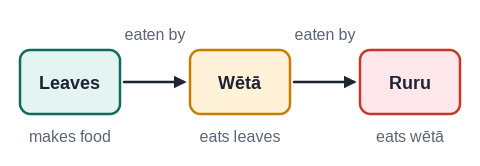
- Start with the plant: leaves
- Leaves are eaten by wētā: leaves → wētā
- Wētā are eaten by ruru
- leaves → wētā → ruru
Example: a food chain in the sea
- Kina are spiky sea animals that eat kelp, a big seaweed. Big snapper eat kina.
- Put these in a food chain: snapper, kelp, kina.
- Kelp is the plant, so it goes firstit makes its own food
- Kina eat kelp: kelp → kina
- kelp → kina → snapper
Try it: where in the chain?
Living things need each other
- In a food chain, each living thing needs the one before it for food.
- So if one changes, the others change too.
- If the rabbits got sick and died, the hawks would have less food.
- If the hawks were gone, there would be more rabbits, and they would eat more grass.
Try it: change a forest food web
Example: what if the snapper go?
- People catch lots of snapper in one bay. Use the chain kelp → kina → snapper.
- What happens to the kelp?
- Fewer snapper eat kina
- So more kina are left alive
- More kina eat more kelp
- The kelp gets eaten away, so there is less of it
Try it: build a food chain
Common mistakes
- In grass → rabbit, the arrow means the grass eats the rabbit.The arrow points to the eater: the grass is eaten by the rabbit.
- A food chain can start with any animal.Every food chain starts with a plant, because only plants make their own food.
- Plants get their food from the soil.Plants make their own food from sunlight, water and carbon dioxide; the soil gives them water.
Make a hanging food chain
You need: 4 pieces of card, coloured pencils, a long piece of string or wool, sticky tape, scissors
- Go into the garden or a park with an adult. Find a plant and look for animals near it, such as a snail, a slater or a bird.
- Draw the plant on one card and one animal on each of the other cards.
- Tape the cards onto the string in order, with the plant at the top.
- Draw an arrow on each card pointing down to the next one, the eater.
- Check your chain: does it start with a plant, and does every arrow point to the eater?
Safety: Do not touch or pick up wild animals, and wash your hands after being in the garden.
Your turn
What three things does a plant use to make its food?
Put these in a food chain: hawk, grass, rabbit.
In leaf → caterpillar → thrush, what eats the caterpillar?
What is always at the start of a food chain?
In grass → rabbit → hawk, the rabbits get sick and die. What happens to the hawks?
Show answer
1. Sunlight, water and carbon dioxide. 2. grass → rabbit → hawk. 3. The thrush. 4. A plant. 5. The hawks have less food, so there will be fewer hawks.
Recap
- Plants make food from sunlight, water and carbon dioxide.
- A food chain shows who eats what, and it starts with a plant.
- The arrow means 'is eaten by' and points to the eater.
- Food and its energy pass along the chain.
- Living things in a chain need each other, so a change to one changes the rest.
Challenge
Here are some clues. A looper caterpillar eats kawakawa leaves. A stoat eats sparrows. Sparrows eat caterpillars. Nothing in this chain eats the stoat. Write the food chain. How many arrows does it have, and which living thing makes its own food?
Hint
Start with the plant. Each arrow points to the eater.
Answer
kawakawa → caterpillar → sparrow → stoat. It has 3 arrows. The kawakawa makes its own food.
Step by step
- The chain starts with the plant, kawakawa, because plants make their own food.
- The caterpillar eats kawakawa, so kawakawa → caterpillar.
- The sparrow eats the caterpillar, so caterpillar → sparrow.
- The stoat eats the sparrow, so sparrow → stoat.
- 4 living things are joined by 3 arrows.
Full working
- kawakawaplant, makes its own food, goes first
- kawakawa → caterpillarcaterpillar is the eater
- caterpillar → sparrowsparrow is the eater
- sparrow → stoatstoat is the eater, end of chain
- kawakawa → caterpillar → sparrow → stoat, 3 arrows, kawakawa makes its food
Use the chain kawakawa → caterpillar → sparrow → stoat. People set traps and catch all the stoats. What happens to the kawakawa plants? Explain each step.
Hint
Go along the chain one living thing at a time, starting next to the stoat.
Answer
The kawakawa gets more leaves. With no stoats, there are more sparrows. More sparrows eat more caterpillars, so there are fewer caterpillars. Fewer caterpillars eat fewer kawakawa leaves.
Step by step
- Stoats eat sparrows. With no stoats, more sparrows stay alive.
- More sparrows eat more caterpillars.
- So there are fewer caterpillars.
- Fewer caterpillars eat fewer kawakawa leaves.
- So the kawakawa plants have more leaves.
Full working
- no stoatstrapped
- more sparrowsnothing eats them now
- fewer caterpillarsmore sparrows eat them
- fewer leaves eatenfewer caterpillars
- More kawakawa leaves
In the sea, kina eat kelp and pāua eat kelp too. Snapper eat kina, but snapper do not eat pāua. People catch nearly all the snapper in one bay. Why could there soon be fewer pāua, even though snapper never ate them?
Hint
Kina and pāua both need the kelp. Follow what happens to the kina first.
Answer
With fewer snapper, more kina stay alive. More kina eat more kelp, so there is less kelp left. The pāua need kelp for food too, so with less kelp there will be fewer pāua.
Step by step
- Snapper eat kina. With fewer snapper, there are more kina.
- More kina eat more kelp.
- So the kelp gets eaten away and there is less of it.
- Pāua need kelp for food too.
- Less food for pāua means fewer pāua, even though snapper never ate them.
Full working
- kelp → kina → snapperone chain
- kelp → pāuaa second chain, same kelp
- fewer snapper → more kinafewer kina eaten
- more kina → less kelpkina eat more kelp
- less kelp → fewer pāuathey share the kelp
- Fewer pāua, because kina eat the kelp pāua need