
Materials: natural or made, and how they bend and break
What this lesson covers
- Every material takes up space, even air
- Natural materials and manufactured materials
- How different materials act when bent, stretched or handled
- Materials broken into small pieces are still the same material
- Predicting, testing, and putting results in a table
Materials take up space
- Everything is made of materials, and every material takes up space.
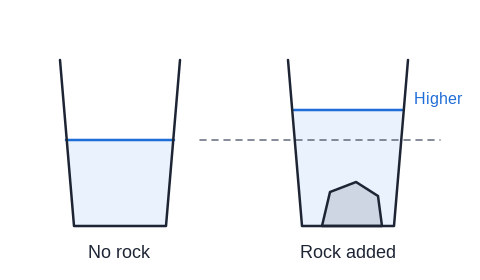
- Drop a rock into a cup of water and the water level goes up, because the rock needs room.
- Air is a material too. Blow up a balloon and it gets bigger, because the air inside takes up space.
Natural or manufactured?
- A natural material comes from plants, animals or the ground.
- A manufactured material is made by people, often from natural ones.
- Paper is made from wood. Glass is made from sand. Bricks are made from baked clay.
| Natural | Manufactured |
|---|---|
| Wood | Paper and cardboard |
| Rock | Brick |
| Sand | Glass |
| Wool | Plastic |
Sorting four materials
- Is each one natural or manufactured: a wool jersey, a plastic bottle, a brick, a pebble?
- Wool: grows on sheep, so naturalfrom an animal
- Plastic: made in a factory, so manufacturedmade by people
- Brick: clay baked by people, so manufacturedchanged by people
- Pebble: found on a beach, so naturalfrom the ground
- Natural: wool, pebble. Manufactured: plastic, brick
Try it: natural or manufactured?
Bend, stretch, squash
- Materials act in different ways when you handle them.
- Rubber stretches, then springs back to its shape.
- Paper bends and folds easily, and it tears if you pull hard.
- Wood bends a little, then snaps if you push too far.
- Glass, brick and rock do not bend. If you push too hard, they crack.
Predict, then test
- Room 7 predicted what 5 materials would do when bent, then tested each one gently and filled in a table.
- Each row is one material. Each column is one thing they wrote down.
| Material | We predicted | What happened |
|---|---|---|
| Rubber band | Stretches | Stretched and sprang back |
| Paper strip | Bends | Bent and folded |
| Ice block stick | Bends | Bent a little, then snapped |
| Plastic ruler | Snaps | Bent and sprang back |
| Cardboard | Stays stiff | Bent and made a crease |
- Rubber band and paper strip: as predictedright
- Ice block stick: it bent first, then snappedpartly right
- Plastic ruler and cardboard: not as predictedwrong
- The test, not the guess, shows what a material really does
Try it: what happened when it bent?
Breaking into smaller pieces
- Materials can be cut, broken or worn down into smaller pieces.
- The small pieces are still the same material.
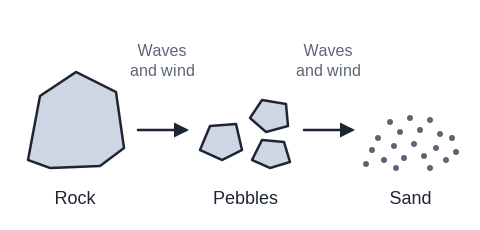
- Sand is rock that waves and wind have worn into tiny grains over a very long time.
- Breadcrumbs are still bread. Broken glass is still glass, and its small pieces are sharp.
Common mistakes
- Air is nothing, so it does not take up space.Air is a material; a balloon gets bigger as you blow air in because the air takes up space.
- Paper is natural because it comes from trees.Paper is made from wood by people in a factory, so it is manufactured.
- When rock turns into sand, the rock is gone.The rock is still there as tiny grains; breaking a material makes smaller pieces of the same stuff.
A bend and stretch test
You need: a rubber band, a strip of paper, an ice block stick, a piece of tinfoil, paper and a pencil
- Draw a table with three columns: Material, I predict, What happened.
- For each material, write what you think it will do when you bend it.
- Bend or stretch each one gently with both hands.
- Write what happened in the last column.
- Look for this: which ones sprang back, which stayed bent, and which broke?
Safety: Ask an adult to help, and bend things below your face and pointing away from people, because a snapping stick or flicked rubber band can hit an eye.
Your turn
Is wool natural or manufactured?
Is a brick natural or manufactured?
In Room 7's test, what happened to the ice block stick?
You crush a cracker into crumbs. Are the crumbs still cracker?
Does the air in a balloon take up space?
Show answer
1. Natural, because it grows on sheep. 2. Manufactured, because people bake clay to make it. 3. It bent a little, then snapped. 4. Yes, they are smaller pieces of the same cracker. 5. Yes, which is why the balloon gets bigger.
Recap
- Every material takes up space, even air.
- Natural materials come from plants, animals or the ground; manufactured materials are made by people.
- Materials act differently when bent or stretched: some spring back, some stay bent, some break.
- Broken pieces are still the same material.
- Predict, test, and record the results in a table.
Challenge
A clear cup has lines numbered up the side. The water is at line 10. Kiri drops in a rock and the water goes up to line 14. She takes the rock out, and the water goes back to line 10. Then she drops in a pebble, and the water goes up to line 12. Which one takes up more space? Where will the water be if she puts both in together?
Hint
How many lines did each one push the water up?
Answer
The rock takes up more space (it pushed the water up 4 lines, the pebble only 2). With both in, the water goes up 4 + 2 = 6 lines, to line 16.
Step by step
- Things take up space, so they push the water up.
- The rock pushed the water from 10 to 14: up 4 lines.
- The pebble pushed the water from 10 to 12: up 2 lines.
- 4 is more than 2, so the rock takes up more space.
- Together they push the water up 4 + 2 = 6 lines, from 10 to 16.
Full working
- 14 − 10 = 4the rock pushes the water up 4 lines
- 12 − 10 = 2the pebble pushes it up 2 lines
- 4 is more than 2the rock takes up more space
- 4 + 2 = 6both together
- 10 + 6 = 16start at line 10
- The rock takes up more space. With both in, the water is at line 16.
Hemi stuffs a dry tissue into the bottom of an empty cup. He turns the cup upside down and pushes it straight down into a bowl of water, all the way under, without tipping it. Then he lifts it straight out. Is the tissue wet or dry? Why?
Hint
The cup is not really empty. What is in it?
Answer
The tissue stays dry. The cup is full of air, and air takes up space, so the water cannot get up to the tissue.
Step by step
- The cup looks empty, but it is full of air.
- Air is a material, and it takes up space.
- When the cup goes down, the air is trapped inside.
- The water cannot fill the cup, because the air is already there.
- So the water does not reach the tissue, and it stays dry.
Full working
- Empty cup = cup full of airair is a material
- Cup pushed down upside downthe air is trapped
- Air takes up spacewater cannot fill the cup
- Water does not reach the tissueit stays at the bottom of the cup
- The tissue stays dry, because air takes up space.
Ana finds smooth green "sea glass" on a beach. It started as a broken glass bottle, and the waves and sand rubbed it smooth over many years. Her brother says, "It came from the beach, so it is a natural material." Is he right? Is it still glass?
Hint
What is glass made from, and who makes it? Does breaking or rubbing a material change what it is?
Answer
He is not right. It is still glass, and glass is a manufactured material, because people make it from sand. Finding it on a beach and wearing it into smaller pieces does not change what material it is.
Step by step
- Glass is made by people, from sand, so glass is manufactured.
- The bottle broke into pieces, but small pieces are still the same material.
- The waves rubbed the pieces smooth, but they are still glass.
- Where you find something does not change what it is made of.
- So sea glass is glass, a manufactured material.
Full working
- Glass is made by people from sandmanufactured
- Bottle → broken piecesstill glass
- Waves rub it smoothstill glass, just smaller and smoother
- Found on a beachthe place does not change the material
- Not right. Sea glass is still glass, a manufactured material.