
Habitats: where living things live
What this lesson covers
- A habitat is the place where a living thing lives
- A habitat gives food, water, shelter and space
- New Zealand has many habitats, from forests and streams to beaches and wetlands
- Looking carefully at a small habitat
- Counting, about how many of each kind of living thing
What is a habitat?
- A habitat is the place where a living thing lives.
- A good habitat gives it food, water, shelter and a safe place to raise its young.
- A tūī lives in forest, where it feeds on nectar from flowers.
- A pāua lives on rocks in the sea, where it eats seaweed.
Habitats in New Zealand
- New Zealand has many different habitats, and each one has its own living things.
| Habitat | What it is like | Who lives there |
|---|---|---|
| Forest | Tall trees, shady and damp | Tūī, kererū, wētā |
| Stream | Cool, flowing fresh water | Kōura, eels |
| Sandy beach | Sand, waves and salty water | Sand hoppers, gulls, tuatua |
| Rocky shore | Rocks and rock pools | Pāua, crabs, sea anemones |
| Wetland | Wet, muddy ground with reeds | Pūkeko, frogs |
| Tussock grassland | Open, dry and windy | Skinks, grasshoppers |
Try it: who lives where?
Each living thing suits its habitat
- Different living things use different parts of the same habitat.
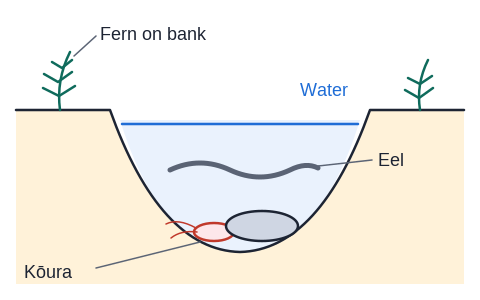
- In a stream, a kōura (freshwater crayfish) hides under stones, an eel swims in the deeper water, and ferns grow on the damp bank.
- A kōura needs cool, clean water. It could not live on a dry beach.
Looking at a small habitat
- A habitat can be as small as the ground under a log.
- Mark out a square with string, about one big step along each side.
- Look slowly and carefully, because small animals hide.
- Count each kind of living thing. If there are too many to count, give a sensible guess, like about 20.
- Put logs and stones back gently, the way you found them.
Under the log
- Room 1 marked out a square under an old log at school and counted the animals they found.
| Animal | How many |
|---|---|
| Ants | 9 |
| Slaters | 7 |
| Worms | 3 |
| Snails | 2 |
| Spiders | 1 |
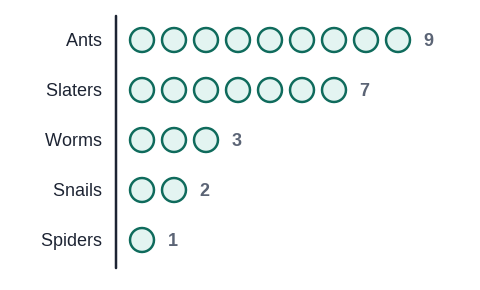
- Most: ants, 9biggest number
- Fewest: spiders, 1smallest number
- 5 kinds of animal, and ants were the most common
Try it: the animals under the log
Log or lawn?
- Room 1 then counted in a square of the same size on the open lawn.
| Animal | Under the log | On the lawn |
|---|---|---|
| Ants | 9 | 4 |
| Slaters | 7 | 0 |
| Worms | 3 | 0 |
| Snails | 2 | 0 |
| Spiders | 1 | 1 |
- Under the log: 5 kinds of animalcount the kinds
- On the lawn: 2 kinds of animalants and a spider
- The dark, damp log gave more shelter, so more kinds of animal lived there
Common mistakes
- A habitat is just an animal's nest or burrow.A habitat is the whole place it lives, including where it finds food and water, not only its nest.
- Any animal can live anywhere if it has food.Each living thing needs its own conditions; a kōura needs cool water and would die on a dry beach.
- I looked once, so I counted everything.Small animals hide under leaves and stones, so look slowly and count more than once.
A backyard habitat hunt
You need: string or 4 sticks, paper, a pencil, a magnifying glass if you have one
- With an adult, choose a spot in a garden or park, such as under a bush or beside a log.
- Mark out a square about one big step on each side.
- Look slowly for 10 minutes and make a tally for each kind of animal you find.
- Gently lift a stone or log, look underneath, and put it back the way it was.
- Look for this: which animal did you find most, and was the spot damp or dry, dark or sunny?
Safety: Go with an adult, look but do not touch spiders, bees, wasps or mushrooms, and wash your hands when you come inside.
Your turn
What is a habitat?
Which habitat suits a pāua?
Under Room 1's log, which animal did they count most of?
How many slaters were on the lawn?
Why did more kinds of animal live under the log than on the lawn?
Show answer
1. The place where a living thing lives. 2. A rocky shore. 3. Ants, 9 of them. 4. 0, none. 5. The log is dark and damp and gives shelter.
Recap
- A habitat is the place where a living thing lives.
- It gives food, water, shelter and space.
- New Zealand has forests, streams, beaches, rocky shores, wetlands and grasslands.
- Each living thing suits its own habitat.
- We study a small habitat by looking slowly and counting each kind of living thing.
Challenge
In a story book, three animals got mixed up. A kōura is living in dry tussock grassland. A pūkeko is living in a cool stream. A skink is living in a muddy wetland with reeds. Swap them around so each animal is in the habitat that suits it, and say why.
Hint
Think about what each animal needs: cool water, mud and reeds, or a dry open place.
Answer
The kōura goes to the stream, because it needs cool, clean fresh water. The pūkeko goes to the wetland, with wet mud and reeds. The skink goes to the tussock grassland, which is open and dry.
Step by step
- A kōura is a freshwater crayfish. It needs cool, clean water, so it would die in dry grassland.
- So the kōura goes to the stream, where it can hide under stones.
- A pūkeko lives in wet, muddy places with reeds, so it goes to the wetland.
- A skink lives on dry, open ground, so it goes to the tussock grassland.
- Each living thing needs its own habitat.
Full working
- Kōura needs cool fresh waterso not dry grassland
- Kōura → streamhides under stones
- Pūkeko → wetlandwet mud and reeds
- Skink → tussock grasslandopen and dry
- Kōura: stream. Pūkeko: wetland. Skink: tussock grassland.
Room 3 marks out a big square under a tree and splits it into 4 small squares that are all the same size. In one small square they count 6 slaters. The other 3 small squares look just the same: damp leaves and shade. About how many slaters live in the big square?
Hint
The small square is one quarter of the big square. How many quarters make the whole?
Answer
About 24 slaters, because the big square is 4 quarters and each quarter has about 6.
Step by step
- The big square is made of 4 equal small squares, so each one is a quarter.
- The small squares look the same, so each one should have about the same number of slaters.
- One quarter has 6, so each quarter has about 6.
- 4 quarters: 6 + 6 + 6 + 6 = 24.
- This is a sensible guess, not an exact count, because small animals hide.
Full working
- Big square = 4 small squares4 equal parts
- 1 small square has 6the count
- Other squares look the sameso about 6 each
- 6 + 6 + 6 + 6 = 244 quarters make the whole
- About 24 slaters
Room 8 wants to know if more animals live under a log or on the lawn. They look under the log for 10 minutes and find 15 animals. Then the bell goes, so they look on the lawn for only 1 minute and find 2 animals. Leo says, "This proves the log has more animals." Is the test fair? What should they change?
Hint
Small animals hide. What happens if you only look for a very short time?
Answer
It is not fair. They looked at the lawn for much less time, so they could have missed animals hiding there. They should look in both places for the same time (for example 10 minutes each) in squares of the same size.
Step by step
- Small animals hide, so the longer you look, the more you find.
- They looked under the log for 10 minutes but on the lawn for only 1 minute.
- So the lawn might really have more animals than 2. They did not look long enough.
- To be fair, only one thing should be different: the place.
- Look for the same time, in a square of the same size, in both places.
- Then they can compare the counts and see if the log really has more.
Full working
- Log: 10 minutes, 15 animalslong look
- Lawn: 1 minute, 2 animalsvery short look
- Different timesso the test is not fair
- Same time and same size square in both placesonly the place changes
- Not fair. Look for the same time, in the same size square, in both places.