
Trends in human biological evolution
What this lesson covers
- Hominids and hominins, and where living apes and fossil species fit.
- Skeletal changes for bipedalism in the skull, spine, pelvis, femur, knee and foot.
- Trends in the skull: cranial capacity, face, jaw, teeth and brow ridge.
- The hand: opposable thumb, precision and power grips, and the link to tool use.
- Advantages and disadvantages of bipedalism, and the selection pressures that may have favoured it.
Hominids and hominins
- Hominids (the family Hominidae) are the great apes and humans: orangutans, gorillas, chimpanzees, bonobos and humans, plus their extinct relatives.
- Hominins are the narrower group: modern humans and every extinct species on our side of the split from the chimpanzee line, about 6 to 7 million years ago.
- So a chimpanzee is a hominid but not a hominin, and Australopithecus afarensis is both.
- Key hominins in order: Australopithecus afarensis (about 3.9 to 2.9 million years ago), Homo habilis (about 2.4 to 1.4 million), Homo erectus (about 1.9 million to 110 000 years ago), Homo neanderthalensis (about 400 000 to 40 000) and Homo sapiens (from about 300 000 years ago).
- Bipedalism came first; large brains came much later, so the trends did not all happen together.
Bipedalism: skull and spine
- The foramen magnum, the hole where the spinal cord leaves the skull, moved forward to sit centrally under the skull, so the head balances on top of an upright spine instead of hanging forward.
- That needs smaller neck muscles, so the bony ridges at the back of the skull where they attach are smaller in hominins.
- The human spine has an S-shape, with an inward (lumbar) curve in the lower back that brings the trunk's weight over the hips; an ape's spine is a single C-shaped curve.
- Lumbar vertebrae are larger and wedge-shaped in hominins, because they carry the whole upper body's weight when upright.
Bipedalism: pelvis, femur and knee
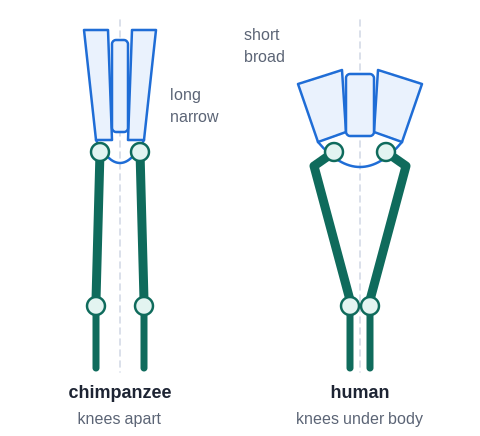
- The hominin pelvis is short, broad and bowl-shaped, which supports the guts from below and lowers the centre of gravity; the ape pelvis is long and narrow.
- The blades of the ilium curve round to the sides, so the gluteal muscles can hold the pelvis level while the body stands on one leg in each stride.
- The femur angles inwards from hip to knee (the carrying angle), putting the knees and feet under the body's centre of gravity, so the body does not sway side to side as an ape's does.
- The knee joint is larger and can lock straight, so the leg works like a pillar and standing costs little muscle energy; the femoral head is larger too, to carry all the weight on two legs.
- Legs became long relative to arms, lengthening the stride.
Bipedalism: the foot
- The big toe lines up with the other toes and cannot grasp, so it can push the body off the ground at the end of each step.
- Arches along and across the foot act as springs that absorb shock and return energy; an ape's foot is flat and flexible, for grasping branches.
- A large heel bone takes the impact of each heel strike.
- Footprints preserved in volcanic ash at Laetoli in Tanzania, about 3.6 million years old, show an arch and an in-line big toe, so hominins were walking upright by then.
Try it: ape or modern human?
Why bipedalism was selected
- Advantages: walking on two legs uses less energy than knuckle-walking over long distances, frees the hands to carry food, tools and infants, lifts the eyes above tall grass to spot predators, and exposes less of the body to the overhead sun while catching more breeze, which helps keep cool.
- Disadvantages: slower sprinting and poorer climbing, more strain on the back, knees and hips, and a narrower birth canal that makes birth difficult.
- Selection pressures thought to favour it include a cooler, drier climate in East Africa that replaced continuous forest with open woodland and grassland, so food was more spread out and long walks between trees were needed.
- Individuals that walked upright more efficiently found more food and kept cooler, so survived and reproduced more, and the alleles behind those skeletal features increased.
Try it: advantage or disadvantage of walking upright?
Trends in the skull and teeth
- Cranial capacity roughly tripled from australopithecines to modern humans, and the skull became higher and rounder, with a near-vertical forehead.
- The face became flatter (less prognathism), and the jaw and teeth smaller, as food was cut with tools and cooked rather than chewed hard.
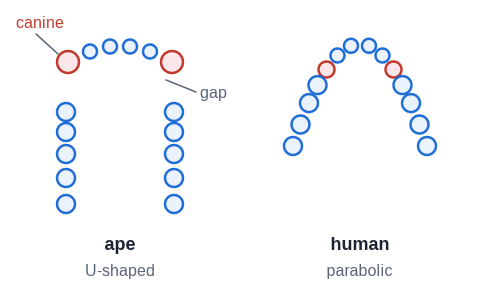
- The tooth rows changed from a U-shape with parallel sides to a curved, parabolic arch; canines shrank to the size of the other teeth, so the gap (diastema) that ape jaws need for the opposite canine disappeared.
- Brow ridges became smaller, and Homo sapiens alone has a chin; the bony sagittal crest that anchors large chewing muscles in gorillas and Paranthropus is missing in Homo.
Example: how much bigger did the brain get?
- The table gives typical cranial capacities. Find how many times bigger the Homo sapiens brain is than the A. afarensis brain, and the percentage increase.
| Species | Average cranial capacity (cm³) |
|---|---|
| Australopithecus afarensis | 430 |
| Homo habilis | 610 |
| Homo erectus | 1050 |
| Homo neanderthalensis | 1500 |
| Homo sapiens | 1300 |
- ratio = 1300 ÷ 430 = 3.0how many times bigger
- increase = 1300 − 430 = 870 cm³
- percentage increase = 870 ÷ 430 × 100 = 202%
- a tripling is a 200% increase, so 3.0 times and 202% agree
- Neanderthals had larger brains than ours, so size alone does not rank speciesbody size and brain structure matter too
Try it: build an upright hominin
The hand: precision and power
- The human thumb is long, strong and fully opposable: it can rotate to meet the tip of every finger, which gives the precision grip used to hold a needle, a pen or a small stone flake.
- The power grip wraps the fingers and thumb around an object, such as a hammerstone or a spear shaft; both grips need a powerful thumb muscle (flexor pollicis longus) that apes barely have.
- Hominin fingers became shorter and straighter with broad fingertip pads; A. afarensis still had long, curved fingers, a sign it still climbed trees.
- Freed from walking, the hand could be selected for making and using tools, and better tool use selected for a better hand and a bigger brain to plan with it: a positive feedback between biology and culture.
What Achieved, Merit and Excellence look like
- Achieved describes the feature; Merit explains how its structure helps bipedal walking; Excellence links the change to its function, the advantage it gave, and the selection pressure behind it, comparing with an ape.
| Grade | A model answer |
|---|---|
| Achieved | Humans have an arch in the foot and a big toe in line with the other toes. Apes have a flat foot with a grasping big toe. |
| Merit | The arch acts like a spring, absorbing the shock of each step and giving back energy, and the in-line big toe pushes the body forward at the end of each stride, so walking on two legs uses less energy. |
| Excellence | An ape's grasping toe and flexible flat foot suit holding branches, but on open ground they waste energy. As forests thinned and food spread out, hominins with arched feet and in-line big toes walked further for the same energy, so they found more food and reproduced more, and these features increased. The cost was losing the grasping foot, so hominins became poorer climbers, which shows a trade-off between walking and climbing. |
Common mistakes
- Humans evolved from chimpanzees.Humans and chimpanzees share a common ancestor that lived about 6 to 7 million years ago; neither is the other's ancestor.
- The foramen magnum moved to the back of the skull in bipeds.It moved forward to a central position under the skull, so the head balances on top of the spine.
- Hominins became bipedal because their brains got bigger.Bipedalism came first: australopithecines walked upright with brains of about 430 cm³, millions of years before brains expanded.
- The opposable thumb means apes cannot grip at all.Apes have opposable thumbs too, but they are short and weak, so apes lack the strong, precise grip of the fingertip pads.
Test the precision grip
You need: paper medical tape or a soft hair tie, a shirt with buttons, a pen and paper, a few grains of dry rice, a shoelace, a timer on a phone
- Time yourself doing four tasks: doing up three buttons, writing your full name, picking up five grains of rice one at a time, and tying a shoelace bow.
- Loosely tape your thumb flat against the side of your hand, or hold it there with a soft hair tie, so it cannot rotate to meet your fingertips.
- Repeat the four tasks and time them again.
- Remove the tape and compare the times in a table.
- Look for: the biggest slowdown in tasks that need the thumb tip pressed against a fingertip. That is the precision grip, and tool-making depends on it.
Safety: Keep the tape loose enough that your thumb stays warm and pink, and peel it off slowly so it does not tear the skin.
Your turn
Using the table, find the percentage increase in cranial capacity from Homo habilis to Homo erectus, to the nearest whole number.
Where is the foramen magnum in a fully bipedal hominin?
Explain how the angled femur helps bipedal walking.
Which grip is used to hold a pen?
Is a chimpanzee a hominid, a hominin, or both?
Show answer
1. 1050 − 610 = 440, and 440 ÷ 610 × 100 = 72%. 2. Central, underneath the skull, so the head balances on the spine. 3. It brings the knees and feet under the body's centre of gravity, so the body does not sway sideways with each step. 4. The precision grip: thumb tip against the fingertips. 5. A hominid only: hominins are the human line after the split from chimpanzees.
Exam-style question: three skulls
- Skull A has a cranial capacity of about 430 cm³, a projecting face, large canines and a U-shaped tooth row. Skull B has about 1050 cm³, a large brow ridge, a lower, longer braincase and no chin. Skull C has about 1300 cm³, a flat face, a high rounded braincase, a small brow ridge and a chin.
Describe two trends shown by the teeth and jaws from A to C.
Calculate the percentage increase in cranial capacity from B to C, to the nearest whole number.
Explain why the brain could only enlarge after the diet changed.
Discuss one advantage and one disadvantage of a larger brain for hominins, linking each to a selection pressure.
Show answer
1. The tooth row changed from a U-shape with parallel sides to a parabolic curve; canines became smaller with no diastema; jaws and teeth became smaller and the face flatter (Achieved for two). 2. 1300 − 1050 = 250, and 250 ÷ 1050 × 100 = 24% (Achieved). 3. Brain tissue uses a lot of energy (about 20% of a resting human's energy for about 2% of body mass), so a bigger brain could only be supported once hominins ate energy-rich food such as meat and marrow, cut with tools and later cooked, which also meant smaller teeth and jaws were enough (Merit). 4. Advantage: a larger brain allowed planning, better tools, cooperation and language, so individuals could hunt, share food and survive changing climates, and these were selected in a variable, competitive environment. Disadvantage: the large head makes birth difficult through a pelvis narrowed for bipedal walking, so babies are born helpless and need long care, and the brain's energy demand risks starvation when food is short. The trend continued because the survival benefit outweighed these costs (Excellence: links both sides to selection and to bipedalism).
Recap
- Hominids are great apes and humans; hominins are the human line after the chimpanzee split.
- Bipedalism changed the whole skeleton: a central foramen magnum, S-shaped spine, broad bowl pelvis, angled femur, locking knee and arched foot.
- Later the brain roughly tripled while the face, jaw, teeth and brow ridge shrank.
- A strong opposable thumb and precision grip linked biological change to tool use.
| Feature | Ape | Modern human |
|---|---|---|
| Foramen magnum | Towards the back | Central, under the skull |
| Spine | C-shaped | S-shaped with a lumbar curve |
| Pelvis | Long and narrow | Short, broad, bowl-shaped |
| Femur | Straight down, knees apart | Angled in, knees under the body |
| Foot | Flat, grasping big toe | Arched, in-line big toe |
| Tooth row | U-shaped, big canines, diastema | Parabolic, small canines, no gap |
Challenge
Use these approximate figures (practice values for body mass): A. afarensis, brain 430 cm³, body 35 kg; H. erectus, brain 1050 cm³, body 60 kg; H. sapiens, brain 1300 cm³, body 65 kg; H. neanderthalensis, brain 1500 cm³, body 75 kg. (a) Calculate brain volume per kilogram of body mass for each, to 1 decimal place. (b) A student says Neanderthals must have been more intelligent because their brains were bigger. Use your answers to evaluate this. (c) The human brain is about 2% of body mass but uses about 20% of resting energy. How many times more energy does a kilogram of brain use than an average kilogram of the rest of the body?
Hint
Divide brain by body for each species. For (c), compare the share of energy with the share of mass for the brain, and then for the other 98% of the body.
Answer
(a) A. afarensis 12.3, H. erectus 17.5, H. sapiens 20.0, H. neanderthalensis 20.0 cm³ per kg (b) relative to body size, Neanderthal and modern brains are the same, so the bigger brain mostly reflects a bigger, heavier body; size alone cannot show intelligence, and brain structure matters too (c) about 12 times
Step by step
- Brain size depends partly on body size, so dividing by body mass gives a fairer comparison.
- Relative brain size rose from about 12 to about 20 cm³ per kg from A. afarensis to H. sapiens, a real trend.
- Neanderthals and modern humans both come out at 20.0 cm³ per kg, so the extra 200 cm³ matches their heavier, stockier bodies (suited to a cold climate).
- Bigger relative brains do not prove more intelligence either: organisation, such as the size of the frontal regions, also matters, and behaviour must be judged from evidence like tools and art.
- The brain uses 20% of energy for 2% of mass, 10 units of energy per unit of mass; the rest of the body uses 80% for 98%, about 0.82, so a kilogram of brain uses about 12 times as much.
Full working
- A. afarensis: 430 ÷ 35 = 12.3 cm³ per kgbrain ÷ body
- H. erectus: 1050 ÷ 60 = 17.5 cm³ per kgbrain ÷ body
- H. sapiens: 1300 ÷ 65 = 20.0 cm³ per kgbrain ÷ body
- H. neanderthalensis: 1500 ÷ 75 = 20.0 cm³ per kgsame as ours
- brain: 20 ÷ 2 = 10share of energy ÷ share of mass
- rest of body: 80 ÷ 98 = 0.816the other 98% of mass
- 10 ÷ 0.816 = 12.3brain against the rest
- (a) 12.3, 17.5, 20.0, 20.0 cm³ per kg (b) same relative size, so the claim fails (c) about 12 times
A new fossil skeleton, Specimen X, has a foramen magnum central under the skull, a short, broad pelvis with ilium blades curving round to the sides, a femur angled in towards the knee, a cranial capacity of about 450 cm³, long, curved finger bones, and long arms compared with its legs. (a) Classify Specimen X as a hominid, a hominin, both or neither, with reasons. (b) A student says the fossil proves bipedalism and a big brain evolved together. Explain why the specimen shows the opposite. (c) Give two possible explanations for the curved fingers and long arms, and explain what further evidence could decide between them.
Hint
Sort the features into three groups: those linked to walking upright, those linked to the brain, and those linked to climbing. A feature can be kept because it is still useful, or simply because there has not been time or pressure for it to change.
Answer
(a) both: the skull base, pelvis and femur show habitual bipedalism, which places it in the human line, and all hominins are also hominids (b) it is fully adapted for walking but has an ape-sized brain, so bipedalism came first; the trends happened at different times (mosaic evolution) (c) it still climbed regularly, so selection kept these features; or they are leftovers from a climbing ancestor that were not yet lost. Evidence: the internal structure of the hand and arm bones (strong, thick bone where climbing loads were high), foot bones (a grasping or in-line big toe), and the habitat from plants and animals found with it
Step by step
- A central foramen magnum, bowl-shaped pelvis and angled femur are all adaptations for walking upright, so Specimen X is on the human side of the chimpanzee split: a hominin, and therefore also a hominid.
- Its brain of about 450 cm³ is about the size of a chimpanzee's and of A. afarensis, nowhere near the 1300 cm³ of modern humans.
- So the skeleton was already rebuilt for walking while the brain had not grown: different traits changed at different times, a pattern called mosaic evolution.
- Curved fingers and long arms suit climbing, and may have been actively selected if trees gave food and safety at night, or may be inherited features with no strong selection to remove them yet.
- Bone shape is inherited, but bone thickness responds to how a limb is used in life, so thick, strong finger and arm bones would show the animal really climbed; a fossil environment with trees, and the foot structure, would add support.
Full working
- central foramen magnum, broad pelvis, angled femuradaptations for bipedalism
- bipedal, so on the human line: homininafter the chimpanzee split
- every hominin is in Hominidaeso also a hominid
- brain ≈ 450 cm³ ≈ ape-sizednot enlarged
- full bipedal skeleton + small brainbipedalism came first
- curved fingers, long arms: active climbing or leftover traitstwo hypotheses
- test with bone thickness, foot bones and habitatevidence of use in life
- (a) both (b) bipedalism before brain expansion, mosaic evolution (c) climbing still selected, or traits retained; test with bone strength and habitat
Approximate brain volumes: a newborn chimpanzee about 150 cm³ and an adult chimpanzee about 390 cm³; a newborn human about 380 cm³ and an adult human about 1300 cm³. (a) Calculate each newborn's brain as a percentage of the adult brain. (b) If human babies were born with the same percentage as chimpanzees, what would their brain volume be, and by what percentage would head width have to increase? (Volume grows with the cube of width.) (c) Discuss how bipedalism and brain enlargement together explain why human babies are born so helpless, and how this links biological evolution to culture.
Hint
For head width, a volume that is k times bigger needs a width that is the cube root of k times bigger. Then think about what the bipedal pelvis does to the space a baby's head must pass through.
Answer
(a) chimpanzee 38%, human 29% (b) about 500 cm³, about 32% more volume, which needs about a 10% wider head (c) a pelvis narrowed for efficient walking limits the birth canal, so with a large adult brain, babies are born with a smaller share of it and do most brain growth after birth; they need long, intensive care, which favoured cooperation, teaching and learning, and so culture
Step by step
- A newborn chimpanzee has 150 ÷ 390 = 38% of its adult brain; a newborn human has 380 ÷ 1300 = 29%.
- At the chimpanzee proportion, a human newborn's brain would be 0.385 × 1300 ≈ 500 cm³, 32% more than now.
- Because volume grows with the cube of width, 1.32 times the volume needs a head only about 1.10 times as wide, about 10% wider.
- The bipedal pelvis is short and broad but its birth canal is tight, so even a 10% wider head would make birth far more dangerous.
- Selection therefore favoured birth at an earlier stage of brain growth, so human babies are helpless for longer than other apes.
- Long childhoods need parents and others to provide food and care, and give years for learning, which links bipedalism and brain size to cooperation, teaching and cultural evolution.
Full working
- chimpanzee: 150 ÷ 390 × 100 = 38%newborn as a share of adult
- human: 380 ÷ 1300 × 100 = 29%newborn as a share of adult
- at chimpanzee proportion: 150 ÷ 390 × 1300 = 500 cm³same share of a human adult brain
- 500 ÷ 380 = 1.3232% more volume
- width factor = ∛1.32 = 1.10volume grows with width cubed
- about 10% wider headthrough a narrow bipedal birth canal
- (a) 38% and 29% (b) 500 cm³, about 10% wider head (c) bipedal pelvis + big brain = early, helpless birth, long care and learning, which supports culture