
Homeostasis: how animals keep their internal environment stable
What this lesson covers
- Homeostasis, the internal environment, set points and negative feedback, compared with positive feedback.
- The parts of a control system: stimulus, receptors, control centre, effectors and response.
- Thermoregulation in endotherms and ectotherms, including physiological and behavioural responses.
- Blood glucose control by insulin and glucagon, and water balance by ADH and the kidney.
- How a disruption triggers responses, and how a control system breaks down, for Merit and Excellence.
How the assessment works
- This is an internal standard: you research one control system in one animal, often the human, and write a report or annotated diagram explaining it.
- Choose from body temperature, blood glucose, water balance, blood pressure or respiratory gases, and include the purpose, the parts, how they interact and what happens when the system is disrupted.
- A single specific example, such as a swimmer in cold water or a person with type 1 diabetes, gives your explanation something concrete to work through.
| Grade | What the report does |
|---|---|
| Achieved | Describes the control system: what it keeps stable, its receptors, control centre and effectors, and how negative feedback works. |
| Merit | Explains how a specific disruption sets off responses that bring the variable back to its normal range. |
| Excellence | Links ideas: the adaptive advantage of the system, the biochemical or biophysical processes behind it, or an analysis of how a particular influence breaks it down. |
Homeostasis and negative feedback
- Cells are bathed in tissue fluid, the internal environment, and their enzymes and membranes work properly only within narrow limits of temperature, pH, glucose and water.
- Homeostasis keeps each variable within a normal range around a set point, such as a core temperature of about 37 °C.
- In negative feedback a change away from the set point triggers responses that reverse the change, so the variable swings slightly above and below the set point rather than staying perfectly still.
- Positive feedback does the opposite and amplifies a change, as when oxytocin strengthens contractions during birth; it ends with an event, not a stable state, and in a homeostatic system it usually means breakdown.
The parts of a control system
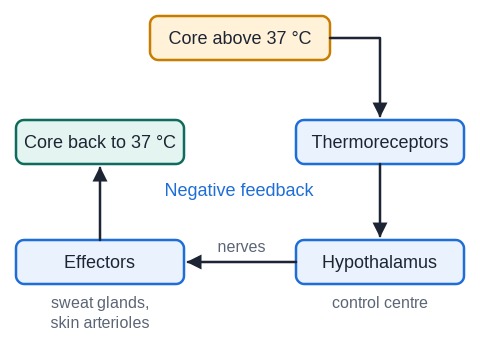
- The stimulus is a change in the variable; receptors detect it, such as thermoreceptors in the skin and in the hypothalamus itself.
- The control centre compares the input with the set point and sends signals out by nerves (fast, short-lived) or hormones (slower, longer-lasting); for temperature, water and blood glucose it is the hypothalamus or the pancreas.
- Effectors, muscles and glands, carry out the response, and the changed variable is detected again by the receptors, closing the loop.
- Many systems have separate effectors for each direction, such as insulin and glucagon, which gives finer control than switching one effector on and off.
Body explorer
Endotherms and ectotherms
- Endotherms, birds and mammals, generate most of their body heat from metabolism and keep a high, steady core temperature, so they can stay active in cold air or water.
- The cost is food: an endotherm needs several times the energy of an ectotherm of the same mass, much of it simply to make heat.
- Ectotherms, such as tuatara, skinks and fish, take heat from their surroundings and regulate mostly by behaviour: basking on sunny rocks, pressing against warm surfaces, retreating to burrows.
- Tuatara stay active in air as cold as about 6 °C, lower than most reptiles, which suits cool southern islands but means they grow and reproduce very slowly.
Thermoregulation in a mammal
- Too hot: the hypothalamus triggers sweating, so evaporation removes heat, and widens (vasodilates) the arterioles supplying the skin, so more warm blood flows near the surface and loses heat by radiation.
- Too cold: skin arterioles narrow (vasoconstrict), keeping warm blood in the core, skeletal muscles shiver to release heat from respiration, and hair erector muscles raise the hairs to trap air.
- Brown fat releases heat directly because its mitochondria let protons leak back across the inner membrane without making ATP, and thyroxine raises metabolic rate over longer cold spells.
- Kororā (little penguins) cut heat loss in cold water with countercurrent exchange: arteries to the flippers and feet run beside veins coming back, so heat passes into the returning blood instead of the sea.
Try it: negative feedback
Example: core and skin temperature during exercise
- A Year 13 class measured one student's ear (core) temperature and forehead skin temperature every 5 minutes while she cycled on an exercise bike for 20 minutes, then rested for 10.
- Use the data to explain the control system at work.
| Time (min) | Activity | Core (°C) | Skin (°C) |
|---|---|---|---|
| 0 | Rest | 36.8 | 33.0 |
| 5 | Cycling | 37.2 | 33.8 |
| 10 | Cycling | 37.6 | 34.6 |
| 15 | Cycling | 37.8 | 35.0 |
| 20 | Cycling | 37.9 | 35.2 |
| 25 | Rest | 37.5 | 34.4 |
| 30 | Rest | 37.1 | 33.6 |
- core rise during exercise = 37.9 − 36.8 = 1.1 °Crespiration in muscles releases heat
- skin rise = 35.2 − 33.0 = 2.2 °Cvasodilation brings warm blood to the skin
- core rise from 15 to 20 min = 37.9 − 37.8 = 0.1 °Cheat loss now nearly matches heat production
- after exercise the core falls back towards 37 °C
- the core changed by only 1.1 °C while heat output rose many times: negative feedback
Blood glucose: insulin and glucagon
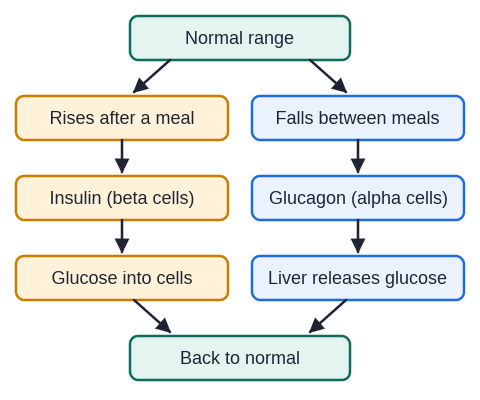
- Blood glucose is normally kept at about 4 to 8 mmol/L: too low and the brain, which relies on glucose, is starved; too high and water is drawn out of cells by osmosis and proteins are damaged.
- After a meal beta cells in the islets of the pancreas detect the rise and release insulin; it makes muscle and fat cells move GLUT4 transporter proteins into their membranes so glucose enters, and makes liver cells store glucose as glycogen.
- Between meals alpha cells detect the fall and release glucagon, which makes the liver break glycogen down to glucose and make new glucose from amino acids, releasing it into the blood.
- The pancreas is both receptor and control centre here, and the two hormones act as an antagonistic pair.
Try it: up or down?
Water balance: ADH and the kidney
- Osmoreceptors in the hypothalamus detect when the blood becomes too concentrated, after sweating hard or eating salty food.
- The posterior pituitary releases antidiuretic hormone (ADH), which travels in the blood to the collecting ducts of the kidney.
- ADH makes collecting duct cells insert aquaporin water channels into their membranes, so more water moves back into the blood by osmosis and a small volume of concentrated urine is made; thirst rises too.
- When the blood is too dilute, ADH release falls, aquaporins are removed, and a large volume of dilute urine is made.
When the system breaks down
- In type 1 diabetes the immune system destroys the beta cells, so no insulin is made; glucose stays high after meals, cells switch to burning fat, and acidic ketones build up, which can be fatal without insulin injections.
- In hypothermia, such as a tramper soaked and caught in wind on the Tongariro Alpine Crossing, heat loss outruns heat production and the core drops below 35 °C; judgement fails, and below about 32 °C shivering stops and enzymes slow.
- In heat stroke, during long exertion in hot, humid weather, sweat cannot evaporate fast enough and dehydration cuts sweating, so the core rises above about 40 °C.
- In both temperature cases the extremes drive positive feedback: a cold body makes less heat and a hot one makes more, so the change speeds up instead of correcting.
Example: one disruption explained at three grades
- Each answer explains what happens when a person swims for 20 minutes in 14 °C sea water; notice what is added at each step.
| Grade | What the student wrote |
|---|---|
| Achieved | Thermoreceptors in the skin detect the cold and the hypothalamus makes the body shiver and narrows the blood vessels in the skin, so less heat is lost. This is negative feedback. |
| Merit | Water removes heat about 25 times faster than air, so the skin cools quickly and skin thermoreceptors signal the hypothalamus. It sends nerve impulses that constrict skin arterioles, keeping warm blood in the core, and make skeletal muscles shiver, releasing heat from respiration, so the core temperature stays near 37 °C. |
| Excellence | Shivering releases heat because muscle contraction uses ATP and respiration is far from 100% efficient, but it also burns glucose quickly, so after long immersion falling blood glucose and fatigue reduce shivering. Once the core drops below about 32 °C the hypothalamus itself is too cold to respond, enzymes slow and less heat is made, so heat loss speeds up: negative feedback has given way to positive feedback. Endothermy is an advantage on land, but in cold water the cost of heat production outruns the supply, which is why swimmers should leave the water before shivering becomes violent. |
Common mistakes
- When you are hot, the blood vessels move closer to the skin.Blood vessels do not move; the skin arterioles widen, so more blood flows through the surface capillaries.
- Glucagon is stored in the liver and turned into glucose.Glycogen is the stored carbohydrate; glucagon is the hormone that tells the liver to break glycogen down.
- Negative feedback keeps the temperature at exactly 37 °C.It keeps the temperature within a narrow range, with small swings above and below the set point.
- Ectotherms are cold-blooded, so they cannot control their body temperature.Ectotherms regulate mostly by behaviour, such as basking or sheltering, and can hold a fairly steady temperature.
See your skin's blood vessels respond to cold
You need: a bowl of cold tap water, a hand towel, a phone camera, a phone timer
- Photograph the backs of both hands side by side in good light, and feel how warm each one is against your cheek.
- Put one hand in the bowl of cold tap water for 1 minute, keeping the other hand dry as the control.
- Take the hand out, pat it dry and photograph both hands again straight away.
- Photograph them again after 2, 4 and 6 minutes, comparing warmth against your cheek each time.
- Look for: the cooled hand turning paler at first as skin arterioles constrict, then pinker than the control as they widen and warm blood flows back.
Safety: Use cold tap water only, never ice, and skip this if you have Raynaud's or poor circulation in your hands.
Your turn
Name the control centre for body temperature and for water balance.
In the class's data, by how much did the core temperature fall in the 10 minutes after exercise?
After a big lunch, which hormone rises and which cells release it?
Explain how ADH reduces the volume of urine.
Why does a skink bask on a rock in the morning?
Show answer
1. The hypothalamus controls both. 2. 37.9 − 37.1 = 0.8 °C. 3. Insulin, released by beta cells in the islets of the pancreas. 4. ADH makes collecting duct cells insert aquaporins into their membranes, so more water moves back into the blood by osmosis and less leaves as urine. 5. It is an ectotherm, so it absorbs heat from the sun and the warm rock to raise its body temperature until its enzymes and muscles work well enough to hunt.
Your turn: explain a disruption
A runner loses 2 L of sweat in a hot half marathon. Explain how the body reduces further water loss.
Why does glucose stay high after meals in type 1 diabetes?
Explain why hypothermia gets worse faster once the core falls below about 32 °C.
Show answer
1. Sweating makes the blood more concentrated; osmoreceptors in the hypothalamus detect this and the posterior pituitary releases more ADH, so the collecting ducts reabsorb more water and less urine is made, and thirst makes the runner drink. 2. The beta cells have been destroyed by the immune system, so no insulin is released; muscle and fat cells do not move GLUT4 into their membranes and the liver does not store glycogen, so glucose stays in the blood. 3. The hypothalamus and muscles are too cold to keep up shivering, and enzymes slow, so less heat is made; as heat production falls the core cools faster, a positive feedback that negative feedback can no longer correct.
Recap
- Homeostasis keeps the internal environment within a normal range by negative feedback: stimulus, receptor, control centre, effector, response.
- Endotherms make their own heat at a high food cost; ectotherms regulate mostly by behaviour.
- Insulin and glucagon control blood glucose; ADH and aquaporins control water balance.
- Merit explains a specific disruption and the response; Excellence links in the adaptive advantage, the biochemistry, or how the system breaks down.
| System | Receptor | Control centre | Effectors |
|---|---|---|---|
| Temperature | Skin and hypothalamic thermoreceptors | Hypothalamus | Sweat glands, arterioles, muscles |
| Blood glucose | Alpha and beta cells | Pancreas | Liver, muscle and fat cells |
| Water balance | Hypothalamic osmoreceptors | Hypothalamus and pituitary | Kidney collecting ducts |
Challenge
An adult's kidneys filter about 180 L of fluid out of the blood each day, and normally about 1.5 L leaves as urine (practice values). Patient P has a damaged posterior pituitary and releases no ADH; they make 18 L of urine a day. (a) Calculate the percentage of filtered water reabsorbed by a healthy person and by Patient P. (b) Explain why a fairly small fall in the percentage reabsorbed makes such a large difference to urine volume, and what keeps Patient P alive. (c) Patient Q makes the same 18 L of dilute urine a day, but their blood ADH level is much higher than normal. Explain where Q's control system has broken down and why their ADH is high.
Hint
Reabsorbed = filtered − urine. For (b), compare how many times bigger the urine volume is with how much the percentage changed. For (c), go round the loop: which part is still detecting and signalling, and which part is not responding?
Answer
(a) healthy 99.2%, Patient P 90.0% (b) urine is the small leftover of a huge filtered volume, so a fall of about 9 percentage points in reabsorption multiplies urine 12 times; thirst makes P drink about 18 L a day (c) Q's effector has failed: collecting duct cells do not respond to ADH, so no aquaporins are inserted; the blood stays concentrated, so osmoreceptors keep signalling and the pituitary keeps releasing more ADH
Step by step
- Healthy: 180 − 1.5 = 178.5 L reabsorbed, which is 99.2% of the filtrate.
- Patient P: 180 − 18 = 162 L reabsorbed, which is 90.0%.
- Because almost all the filtrate is normally reabsorbed, the urine is only the last 0.8%; dropping to 90% leaves 10%, which is 12 times as much.
- With no ADH the collecting ducts stay without aquaporins, so P stays alive only because the blood becomes concentrated, osmoreceptors trigger thirst, and P drinks to replace the loss.
- Q's receptors, control centre and hormone all work: the blood is concentrated, so the osmoreceptors keep stimulating ADH release.
- The break is at the effector: the collecting duct cells cannot respond (for example faulty ADH receptors or aquaporins), so the negative feedback loop never closes and ADH keeps rising.
Full working
- healthy reabsorbed = 180 − 1.5 = 178.5 Lfiltered − urine
- 178.5 ÷ 180 × 100 = 99.2%percentage reabsorbed
- Patient P reabsorbed = 180 − 18 = 162 L, 162 ÷ 180 × 100 = 90.0%no ADH, no aquaporins
- urine ratio = 18 ÷ 1.5 = 12a 9.2 percentage point fall gives 12 times the urine
- Q: concentrated blood → osmoreceptors → more ADH → no response at collecting ducteffector failure, loop not closed
- (a) 99.2% and 90.0% (b) 12 times the urine; thirst and drinking keep P alive (c) Q's collecting ducts do not respond to ADH, so ADH stays high
A kororā (little penguin) swims in 10 °C sea water with a core temperature of 38 °C. Blood flowing to its two flippers carries heat at a rate of 0.5 W for every 1 °C that the blood cools before it comes back to the core (practice values), and the bird's resting heat production is 8 W. (a) With no countercurrent exchange, arterial blood reaches the flippers at 38 °C and returns to the core at 10 °C. Find the rate of heat loss through the flippers. (b) With countercurrent exchange, arterial blood reaches the flippers at 12 °C, cools to 10 °C, and the returning venous blood is warmed back to 36 °C before it reaches the core. Find the rate of heat loss now, and show it two different ways. (c) Use your answers to explain why countercurrent exchange is essential for this bird, and why a kororā that has overheated ashore on a hot day holds its flippers out and they turn pink.
Hint
Heat lost = 0.5 × (temperature the blood leaves the core at − temperature it comes back at). For the second method, look at the flipper itself: only the cooling that happens there passes into the sea.
Answer
(a) 14 W (b) 1 W: 0.5 × (38 − 36) = 1 W, or 0.5 × (12 − 10) = 1 W (c) without exchange the flippers alone would lose almost twice the bird's resting heat output, so it would need extra heat from shivering and food; ashore it opens up blood flow to the flippers (vasodilation) and lets warm blood reach them, so they act as radiators and lose heat
Step by step
- Without exchange, blood leaves the core at 38 °C and returns at 10 °C, a drop of 28 °C.
- So heat is lost at 0.5 × 28 = 14 W, which is more than the 8 W the bird makes at rest.
- With exchange, blood leaves at 38 °C and returns at 36 °C, so the core loses only 0.5 × 2 = 1 W.
- Check at the flipper: blood arrives at 12 °C and leaves at 10 °C, so the sea also gains 0.5 × 2 = 1 W; the rest of the heat was passed from artery to vein and kept in the body.
- Exchange cuts flipper heat loss by 13 W, about 93%, so the bird can stay in cold water without burning extra food to make heat.
- Overheated ashore, the response reverses: arterioles to the flippers dilate and more warm blood reaches them, so they turn pink and radiate heat away: negative feedback in the other direction.
Full working
- no exchange: loss = 0.5 × (38 − 10) = 0.5 × 28 = 14 Wblood cools by 28 °C
- 14 W > 8 W resting heat productionflippers alone outrun heat production
- with exchange, at the core: 0.5 × (38 − 36) = 1 Wblood returns warm
- with exchange, at the flipper: 0.5 × (12 − 10) = 1 Wonly the flipper cooling reaches the sea
- saving = 14 − 1 = 13 W, 13 ÷ 14 × 100 = 93%countercurrent exchange
- (a) 14 W (b) 1 W (c) exchange keeps heat in the core in water; ashore vasodilation sends warm blood to the flippers to lose heat
In a 70 kg adult, glucose is spread through about 15 L of blood plasma and tissue fluid, at 5.0 mmol per L after an overnight fast. Glucose has a molar mass of 180 g per mol; the brain uses about 5.0 g of glucose an hour; the liver can store about 90 g of glucose as glycogen (practice values). (a) Find the mass of glucose dissolved in the body fluids. (b) How long would this supply the brain alone if nothing replaced it, and how long would a full liver store add? Use this to explain how blood glucose stays steady through a night without food, and what must happen if fasting goes on past about a day. (c) A person absorbs a 75 g glucose drink within an hour. Show that if no glucose entered cells, it would rise to about 33 mmol per L. In a healthy person it peaks near 8 mmol per L. Explain the difference, and predict what the test shows in a person with untreated type 1 diabetes.
Hint
mmol = concentration × volume; grams = mol × 180. For (c), turn 75 g into mmol and share it through the same 15 L, then add it to the fasting level.
Answer
(a) 13.5 g (b) 2.7 hours, plus 18 hours from the liver; glucagon makes the liver break glycogen down overnight; after the store runs out the liver must make new glucose from amino acids (c) 75 g = 417 mmol, 417 ÷ 15 = 27.8 mmol per L, so about 32.8 mmol per L; insulin from beta cells makes muscle and fat cells take glucose in through GLUT4 and the liver store it as glycogen; in type 1 diabetes no insulin is released, so glucose rises far higher and stays high
Step by step
- The fluids hold 5.0 × 15 = 75 mmol = 0.075 mol of glucose, which is 0.075 × 180 = 13.5 g.
- At 5.0 g an hour the brain would use this up in 13.5 ÷ 5.0 = 2.7 hours, yet glucose stays steady all night.
- As glucose falls, alpha cells release glucagon and the liver breaks glycogen down; 90 g covers the brain for about 18 more hours.
- Past about a day the glycogen is gone, so glucagon drives the liver to make new glucose from amino acids, taken from body protein.
- 75 g is 75 ÷ 180 = 0.417 mol = 417 mmol; spread through 15 L that adds 27.8 mmol per L, so 5.0 + 27.8 = 32.8 mmol per L.
- The real peak is only about 8 because the rise triggers insulin, which moves glucose into muscle, fat and liver cells; without insulin, glucose would climb towards the higher figure and spill into urine.
Full working
- amount = 5.0 × 15 = 75 mmol = 0.075 molconcentration × volume
- mass = 0.075 × 180 = 13.5 gmol × molar mass
- brain time = 13.5 ÷ 5.0 = 2.7 hourssupply ÷ rate
- liver store = 90 ÷ 5.0 = 18 hoursglucagon → glycogen breakdown
- drink = 75 ÷ 180 = 0.417 mol = 417 mmolgrams to mmol
- rise = 417 ÷ 15 = 27.8 mmol per L, so 5.0 + 27.8 = 32.8 mmol per Lno uptake into cells
- (a) 13.5 g (b) 2.7 h plus 18 h from glycogen, then new glucose from amino acids (c) 32.8, about 33 mmol per L; insulin keeps the peak near 8; in type 1 diabetes it stays far higher