
Standing waves, harmonics, resonance and beats
What this lesson covers
- How two identical waves travelling in opposite directions superpose to form a standing wave with nodes and antinodes.
- Strings fixed at both ends: λ = 2L/n, f = nv/2L, and how tension and mass per unit length set the wave speed.
- Pipes open at both ends (all harmonics) and closed at one end (odd harmonics only), with displacement nodes at closed ends.
- Resonance: a driving frequency that matches a natural frequency builds up a large amplitude.
- Beats: two close frequencies give a loudness that rises and falls at f_beat = |f₁ − f₂|.
How a standing wave forms
- A wave sent along a string reflects at the fixed end and travels back, so two identical waves move through each other in opposite directions.
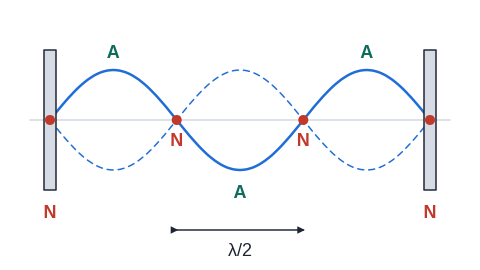
- Where they always cancel, the string never moves: a node. Halfway between, they add to the largest swing: an antinode.
- Nodes are half a wavelength apart, and so are antinodes; a node and the next antinode are a quarter wavelength apart.
- All the points between two neighbouring nodes move in phase, and the next loop moves in antiphase; the pattern stays in place, so no energy travels along it.
Standing waves on strings
- Both ends of a string are fixed, so both are nodes, and only standing waves with a whole number of loops fit: L = nλ/2, so λ = 2L/n.
- The frequencies are f = v/λ = nv/2L: the first harmonic (fundamental) is f₁ = v/2L and the others are whole-number multiples, 2f₁, 3f₁ and so on.
- The wave speed depends on the string: v = √(T/μ), where T is the tension and μ the mass per unit length (kg m⁻¹).
- So a tighter, lighter or shorter string plays a higher note; pressing a finger on a fret shortens L and raises every harmonic.
Try it: harmonics on a 10 m string
Example: a guitar's top string
- A guitar's high E string is 0.648 m long between its fixed ends and has a fundamental of 329.6 Hz. Its mass per unit length is 4.01 × 10⁻⁴ kg m⁻¹.
- Find the wave speed on the string, the frequency of its third harmonic, and the tension.
- λ₁ = 2L = 2 × 0.648 = 1.296 mone loop: half a wavelength fills the string
- v = fλ = 329.6 × 1.296 = 427.2 m s⁻¹
- f₃ = 3 × 329.6 = 988.8 Hzharmonics are whole-number multiples of f₁
- T = μv² = 4.01 × 10⁻⁴ × 427.2² = 73.2 Nrearrange v = √(T/μ)
- v = 427 m s⁻¹, f₃ = 989 Hz, T = 73.2 N
Open and closed pipes
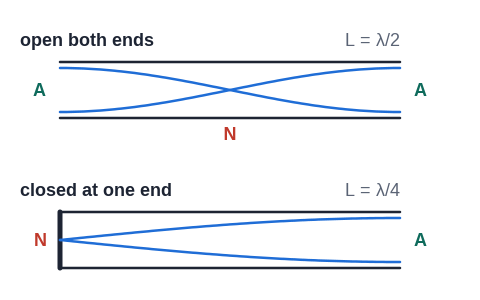
- In a pipe the standing wave is in the air. Air cannot move at a closed end, so it is a displacement node; air moves freely at an open end, so it is a displacement antinode.
- Open at both ends: antinodes at each end, so L = nλ/2 and f = nv/2L, with every harmonic present, just like a string.
- Closed at one end: a node at one end and an antinode at the other, so L = λ/4, 3λ/4, 5λ/4..., giving f = nv/4L with n odd only.
- So a closed pipe plays an octave lower than an open pipe of the same length (f₁ = v/4L instead of v/2L) and is missing the even harmonics, which changes its tone.
- The antinode actually sits a little beyond the open end, so real pipes behave as if slightly longer (the end correction).
Example: the same tube, open and closed
- A tube 0.400 m long is played first with both ends open, then with one end closed. Take sound's speed as 343 m s⁻¹ and ignore end corrections.
- Find the first three frequencies that can sound in each case.
- open: f₁ = v ÷ 2L = 343 ÷ 0.800 = 428.75 Hz
- open: 429 Hz, 858 Hz, 1286 Hz (n = 1, 2, 3)
- closed: f₁ = v ÷ 4L = 343 ÷ 1.600 = 214.4 Hz
- closed: 214 Hz, 643 Hz, 1072 Hz (n = 1, 3, 5)
- closed f₁ is half of open f₁, and 2f₁ = 429 Hz is missing from the closed pipe
Harmonics and the sound of an instrument
- A plucked string or blown pipe vibrates in several harmonics at once; the fundamental sets the pitch you hear.
- The mix of harmonics, how strong each one is, gives the instrument its tone (timbre), which is why a clarinet and a flute playing the same note sound different.
- A clarinet behaves roughly like a pipe closed at the reed end, so its low notes are strong in odd harmonics; a flute is open at both ends and has all harmonics.
- Touching a string lightly at its midpoint forces a node there, which kills the odd harmonics and leaves 2f₁, 4f₁...: a guitarist's harmonic.
Resonance
- Every object that can vibrate has natural frequencies: for a string or pipe, its harmonics.
- If something drives it at one of those frequencies, each push arrives in step with the motion, energy builds up, and the amplitude grows large: resonance.
- A guitar body resonates with the strings to make them loud; a singer can shatter a wine glass by matching its natural frequency.
- Resonance can be harmful: buildings with a natural frequency close to the shaking of an earthquake sway the most, which is why New Zealand engineers design for the ground conditions under each site.
- A resonance tube finds the speed of sound: hold a tuning fork over a tube in water and raise it until the air column booms, which first happens at L = λ/4.
Example: speed of sound from a resonance tube
- A 512 Hz tuning fork is held over a tube whose bottom end stands in water. Loud resonances are heard at air column lengths of 16.0 cm and 49.5 cm.
- Find the wavelength, the speed of sound and the end correction.
- the resonances are λ/4 and 3λ/4 from the antinode, so they are λ/2 apartthe end correction cancels in the difference
- λ/2 = 49.5 − 16.0 = 33.5 cm, so λ = 67.0 cm = 0.670 m
- v = fλ = 512 × 0.670 = 343 m s⁻¹
- λ/4 = 16.75 cm, but the first resonance was at 16.0 cm
- end correction = 16.75 − 16.0 = 0.75 cmthe antinode sits just above the tube's open end
Beats
- Two notes of slightly different frequency drift in and out of phase with each other.
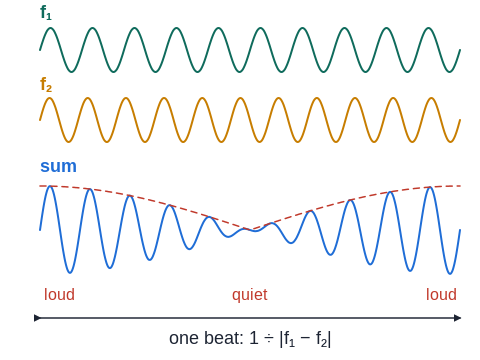
- When they are in phase they interfere constructively and the sound is loud; half a beat later they are 180° out of phase, interfere destructively, and the sound is quiet.
- The loudness rises and falls at the beat frequency f_beat = |f₁ − f₂|, while the pitch you hear is about the average of the two.
- Musicians tune by beats: as two frequencies get closer the beats slow down, and they stop completely when the notes match; above about 15 Hz difference the ear hears two separate notes instead.
Try it: two close frequencies
Example: tuning a string to a 440 Hz fork
- A guitarist plays a string with a 440 Hz tuning fork and hears 4 beats per second. Tightening the string slightly makes the beats faster, 6 per second.
- Find the string's original frequency and say what the guitarist should do.
- f_string = 440 ± 4 Hz, so 436 Hz or 444 Hz
- tightening raises T, so v = √(T/μ) and f rise
- if it were 436 Hz, rising would bring it closer to 440 Hz and slow the beats
- the beats got faster, so it started at 444 Hz and is now 446 Hz
- original 444 Hz; loosen the string until the beats stop
Try it: fit, boom and tune
What Achieved, Merit and Excellence look like
- Achieved names the feature (node at the closed end, odd harmonics); Merit gives the reason; Excellence links the boundary conditions to the wavelengths that fit and then to the frequencies.
- Draw the displacement pattern: a labelled diagram is often the clearest evidence.
| Grade | A model answer |
|---|---|
| Achieved | A closed pipe has a node at the closed end and an antinode at the open end. |
| Merit | With a node at one end and an antinode at the other, the pipe must hold an odd number of quarter wavelengths: L = λ/4, 3λ/4, 5λ/4. |
| Excellence | The air cannot move at the closed end (node) but moves freely at the open end (antinode), so L can only be an odd number of quarter wavelengths, λ = 4L/n with n odd. Since f = v/λ = nv/4L, the frequencies are f₁, 3f₁, 5f₁: the even multiples would need a node or antinode at both ends, which this pipe cannot have. |
Common mistakes
- Nodes on a string are one wavelength apart.Neighbouring nodes are λ/2 apart, so one loop is half a wavelength.
- A closed pipe's next harmonic after f₁ is 2f₁.Only odd harmonics fit a closed pipe, so the next one is 3f₁.
- Two notes of 256 Hz and 260 Hz give a beat frequency of 258 Hz.The beat frequency is the difference, 4 Hz; about 258 Hz is the pitch you hear.
- Doubling the tension doubles the frequency.f is proportional to v = √(T/μ), so doubling T multiplies f by √2; quadrupling T doubles it.
Tune a bottle with water
You need: an empty glass or plastic bottle, a jug of water, a ruler, a phone with a free tuner or frequency app
- Blow gently across the top of the empty bottle until it sounds a steady note, and read the frequency on the tuner app.
- Measure the length of the air column from the water level (or the bottom) to the top of the neck.
- Add water in steps to shorten the air column, measuring the length and the frequency each time.
- For each step, work out v = 4Lf, treating the bottle as a pipe closed at the water surface.
- Look for: shorter air columns give higher notes, and 4Lf comes closest to 343 m s⁻¹ once the water is up in the narrow neck; with a wide body of air under a narrow neck the bottle resonates differently and 4Lf comes out well below 343 m s⁻¹.
Safety: Do not blow so hard or so long that you feel dizzy, and if you use a glass bottle keep it on a towel so it cannot roll off and break.
Your turn
A string 0.500 m long carries waves at 200 m s⁻¹. Find its fundamental frequency.
Find the wavelength of the 4th harmonic on that string.
A pipe 0.250 m long is closed at one end. Using v = 340 m s⁻¹, find the next frequency it can play above its fundamental.
Two tuning forks of 256 Hz and 260 Hz are struck together. Find the beat frequency.
The tension in a string is quadrupled. What happens to its fundamental frequency?
Show answer
1. f₁ = v ÷ 2L = 200 ÷ 1.00 = 200 Hz. 2. λ = 2L ÷ n = 1.00 ÷ 4 = 0.250 m. 3. f₁ = v ÷ 4L = 340 ÷ 1.00 = 340 Hz; the next harmonic is the 3rd, 3 × 340 = 1020 Hz. 4. f_beat = 260 − 256 = 4 Hz. 5. v = √(T/μ) doubles when T is multiplied by 4, and f = v/2L, so the fundamental doubles.
Exam-style question: a pan flute
- Wiremu makes a pan flute from plastic tubes, each closed at the bottom. Take sound's speed as 343 m s⁻¹ and ignore end corrections.
Calculate the fundamental frequency of a tube 0.180 m long.
Describe the displacement pattern of the next harmonic this tube can produce and calculate its frequency.
He plays the tube next to a 480 Hz tuning fork. Calculate the beat frequency and explain how the beats form.
On a hot day the speed of sound rises to 349 m s⁻¹. Explain what happens to the tube's fundamental and to the beats with the fork.
Show answer
1. f₁ = v ÷ 4L = 343 ÷ 0.720 = 476 Hz (Achieved). 2. A node at the closed bottom and an antinode at the open top, with one more node and antinode between: L = 3λ/4. f₃ = 3 × 476.4 = 1429 Hz, about 1430 Hz (Merit for the pattern and frequency). 3. f_beat = 480 − 476.4 = 3.6 Hz. The two sounds drift in and out of phase; in phase they interfere constructively and the sound is loud, 180° out of phase they interfere destructively and it is quiet, so the loudness pulses 3.6 times a second (Merit for the explanation). 4. The tube length is fixed, so λ = 4L = 0.720 m stays the same; f = v/λ rises to 349 ÷ 0.720 = 484.7 Hz. It is now above the fork, so the beat frequency is 484.7 − 480 = 4.7 Hz: the beats first slowed and stopped as the note passed 480 Hz, then sped up again (Excellence for linking fixed λ, v and f to the beats).
Wave on a String
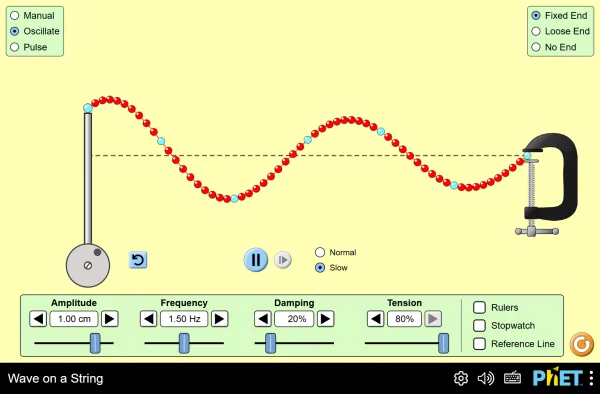
Full screen · PhET Interactive Simulations, University of Colorado Boulder, CC BY 4.0
Recap
- Standing waves: nodes and antinodes λ/2 apart; no energy flows along them.
- Strings and open pipes: L = nλ/2, every harmonic; closed pipes: L = nλ/4 with n odd.
- v = √(T/μ) on a string; f = v/λ always.
- Resonance: driving at a natural frequency builds a large amplitude.
- Beats: f_beat = |f₁ − f₂|, loud when in phase, quiet when 180° out.
| System | Ends | Harmonics |
|---|---|---|
| String | node, node | f = nv/2L, all n |
| Open pipe | antinode, antinode | f = nv/2L, all n |
| Closed pipe | node, antinode | f = nv/4L, odd n |
Challenge
A pipe of unknown type is blown gently and then harder. Two neighbouring resonant frequencies, with no other resonance between them, are 255 Hz and 425 Hz. Take the speed of sound as 343 m s⁻¹ and ignore end corrections. Decide whether the pipe is open at both ends or closed at one end, find its fundamental frequency and its length, and explain your decision.
Hint
Test each kind of pipe in turn. For an open pipe, neighbouring harmonics differ by f₁; for a closed pipe they differ by 2f₁, because only odd harmonics exist. Only one choice makes both given frequencies whole-number harmonics of the right kind.
Answer
Closed at one end; f₁ = 85 Hz (255 Hz is the 3rd harmonic, 425 Hz the 5th); length about 1.01 m.
Step by step
- The gap between neighbouring resonances is 425 − 255 = 170 Hz.
- If the pipe were open, f₁ would be 170 Hz, but 255 Hz is 1.5 × 170, not a whole-number multiple, so the pipe cannot be open.
- For a closed pipe neighbouring harmonics are 2f₁ apart, so f₁ = 85 Hz.
- Check: 255 = 3 × 85 and 425 = 5 × 85, both odd harmonics, as a closed pipe needs.
- Then the length comes from f₁ = v ÷ 4L.
Full working
- Δf = 425 − 255 = 170 Hzneighbouring resonances
- open pipe: f₁ = 170 Hz, 255 ÷ 170 = 1.5not a whole number, so not open
- closed pipe: 2f₁ = 170 Hz, f₁ = 85 Hzonly odd harmonics, so a gap of 2f₁
- 255 = 3 × 85, 425 = 5 × 853rd and 5th harmonics, both odd
- L = v ÷ 4f₁ = 343 ÷ (4 × 85) = 343 ÷ 340 = 1.009 mclosed pipe fundamental
- closed at one end, f₁ = 85 Hz, L = 1.01 m
In a school lab a string runs horizontally from a vibrator, over a pulley 1.50 m away, to a hanging mass, so the tension equals the hanging weight. The vibrator runs at a fixed 120 Hz. With a hanging mass of 0.500 kg, a steady standing wave of 4 loops forms between the vibrator and the pulley (both are nodes). Take g = 9.81 N kg⁻¹. (a) Find the mass per unit length of the string. (b) Find every other hanging mass that gives a standing wave, and the largest one. (c) Explain why a hanging mass of 1.25 kg gives no steady standing wave at all.
Hint
The frequency and length are fixed, so the number of loops n sets the wavelength, which sets the speed v = fλ, which sets the tension through v = √(T ÷ μ). Work out how the hanging mass depends on n.
Answer
(a) μ = 6.06 × 10⁻⁴ kg m⁻¹. (b) 8.00 kg (1 loop), 2.00 kg (2 loops), 0.889 kg (3 loops), 0.320 kg (5 loops) and smaller ones for more loops; the largest is 8.00 kg. (c) It would need 16 × 0.500 ÷ 1.25 = 6.4 = n², and n must be a whole number.
Step by step
- With 4 loops in 1.50 m, each loop is λ2 = 0.375 m, so λ = 0.750 m and v = fλ = 90.0 m s⁻¹.
- The tension is the hanging weight, 0.500 × 9.81 = 4.905 N, so μ = T ÷ v².
- For n loops, λ = 2L ÷ n, so v = 2Lf ÷ n: the speed is proportional to 1 ÷ n.
- Tension is μv², so it is proportional to 1 ÷ n², and so is the hanging mass: M = 0.500 × 16 ÷ n².
- One loop gives the largest mass; 1.25 kg would need n² = 6.4, which no whole number of loops gives.
Full working
- λ = 2L ÷ n = 2 × 1.50 ÷ 4 = 0.750 m4 loops
- v = fλ = 120 × 0.750 = 90.0 m s⁻¹wave equation
- T = Mg = 0.500 × 9.81 = 4.905 Ntension equals the hanging weight
- μ = T ÷ v² = 4.905 ÷ 8100 = 6.06 × 10⁻⁴ kg m⁻¹rearrange v = √(T ÷ μ)
- M ∝ T ∝ v² ∝ 1 ÷ n², so M = 0.500 × 16 ÷ n²f, L and μ fixed
- n = 1, 2, 3, 5: M = 8.00, 2.00, 0.889, 0.320 kgsubstitute
- 1.25 = 8.00 ÷ n² gives n² = 6.4not a perfect square
- μ = 6.06 × 10⁻⁴ kg m⁻¹; largest mass 8.00 kg; 1.25 kg needs 6.4 = n², impossible
Aroha tunes her guitar's D string against its A string, which is correctly tuned to 110.0 Hz. She touches the A string lightly a quarter of the way along and plucks it, then touches the D string lightly a third of the way along and plucks it. The two notes together give 3.0 beats per second, and loosening the D string slightly makes the beats slower. (a) Explain which harmonic each touched string sounds. (b) Find the D string's present fundamental frequency. (c) By what percentage must she change the tension in the D string so the beats stop?
Hint
Touching a string lightly forces a node at that point. Which harmonics have a node a quarter of the way along, and which a third of the way along? The lowest of each sets the note you hear. Then use the beats and the effect of loosening, as in the tuning fork example.
Answer
(a) A sounds its 4th harmonic (440.0 Hz); D sounds its 3rd harmonic. (b) 147.7 Hz (its 3rd harmonic is 443 Hz). (c) Reduce the tension by about 1.35%.
Step by step
- A node at a quarter of the length fits only harmonics with a multiple of 4 loops, so the A string sounds 4 × 110.0 = 440.0 Hz.
- A node at a third of the length fits only multiples of 3 loops, so the D string sounds its 3rd harmonic.
- 3.0 beats means the D note is 437 Hz or 443 Hz; loosening lowers it and slows the beats, so it was above 440 Hz: 443 Hz.
- The D fundamental is a third of that; to stop the beats its 3rd harmonic must be exactly 440 Hz.
- Every frequency is proportional to √T, so the tension ratio is the square of the frequency ratio.
Full working
- A: 4 × 110.0 = 440.0 Hznode at L4 leaves 4f₁, 8f₁, ...
- D: 3f₁ = 440 ± 3.0 Hznode at L3 leaves 3f₁, 6f₁, ...
- loosening lowers f and slows the beats, so 3f₁ = 443 Hzit was above 440 Hz
- f₁ = 443 ÷ 3 = 147.7 HzD's present fundamental
- T_new ÷ T_old = (440 ÷ 443)² = 0.9865f ∝ v = √(T ÷ μ)
- change = 1 − 0.9865 = 0.0135fractional decrease
- A 4th harmonic, D 3rd harmonic; D now 147.7 Hz; reduce tension by about 1.35%