
Physics applied to a context: fibre-optic broadband
What this lesson covers
- What the internal asks for, and how to choose a context with enough Level 8 physics in it.
- Refraction, refractive index and total internal reflection, and why a fibre's core needs a higher index than its cladding.
- Light as an electromagnetic wave and as photons, and why fibre networks use infrared wavelengths.
- Dispersion and attenuation, and why long-distance links use single-mode fibre.
- Finding, judging and citing sources, and linking ideas into one coherent explanation for Excellence.
How this internal works
- You research a context of your choice (technological, biological or astronomical) and present the physics in it, usually as a written report or a poster with notes.
- Achieved relates the key physics ideas to the context: what principle is at work and where.
- Merit explains how or why each idea applies, with cause and effect and the relevant equations used correctly.
- Excellence links the ideas together into one coherent account, so the reader sees how each piece of physics depends on the others to make the whole thing work.
- The physics must be different from what you use for the socio-scientific issue standard (AS 91527), so plan both contexts together.
Choosing a technology or context
- Choose something you are curious about that rests on at least three connected Level 8 ideas, so there is enough to link for Excellence.
- Check that good sources exist at your level: a manufacturer's datasheet, a university page or a textbook beats a single news story.
- Avoid contexts that are mostly engineering or economics with little physics, or ones so broad (all of renewable energy) that you cannot go deep.
| Context | Physics it rests on |
|---|---|
| Fibre-optic broadband | Refraction, total internal reflection, EM waves, photons |
| Ultrasound scanning | Reflection at boundaries, wave speed, Doppler effect |
| Noise-cancelling headphones | Superposition, phase, destructive interference |
| Induction cooktop | Changing magnetic fields, induced currents, resistance heating |
| Solar panel | Photon energy, the photoelectric idea, energy levels |
Inside an optical fibre
- The Ultra-Fast Broadband rollout ran fibre past about 87% of New Zealanders by the end of 2022, with the signal carried as rapid pulses of laser light that stand for the 1s and 0s of digital data.
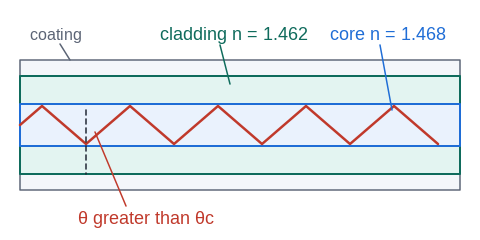
- A single-mode fibre has a glass core about 9 µm across inside a glass cladding 125 µm across, wrapped in a plastic coating.
- The core is doped to have a slightly higher refractive index than the cladding, so light meeting the boundary at a large angle is totally reflected and stays in the core.
- Because the reflection is total, almost no light leaks out, which is why a signal can cross kilometres of fibre while copper phone lines lose a broadband signal within a few kilometres.
Refraction and total internal reflection
- Light slows down in glass: the refractive index is n = c ÷ v, so in a core of n = 1.468 light travels at 3.00 × 10⁸ ÷ 1.468 = 2.04 × 10⁸ m s⁻¹.
- At a boundary, n₁ sin θ₁ = n₂ sin θ₂, with angles measured from the normal; going into a lower index, the ray bends away from the normal.
- At the critical angle θc the refracted ray would travel along the boundary (θ₂ = 90°), so sin θc = n₂ ÷ n₁.
- For any angle bigger than θc no refracted ray is possible and all the light reflects: total internal reflection, which only happens going from a higher index into a lower one.
Light and waves
Example: the critical angle in a fibre
- A fibre's core has n = 1.468 and its cladding n = 1.462.
- Find the critical angle at the core and cladding boundary, the largest angle a ray in the core can make with the fibre's axis and still be trapped, and how long light takes to travel 10.0 km.
- sin θc = n₂ ÷ n₁ = 1.462 ÷ 1.468 = 0.99591
- θc = 84.8°measured from the normal to the boundary
- largest angle to the axis = 90° − 84.8° = 5.2°the boundary runs along the axis, so the normal is at 90° to it
- v = c ÷ n = 3.00 × 10⁸ ÷ 1.468 = 2.044 × 10⁸ m s⁻¹
- t = d ÷ v = 1.00 × 10⁴ ÷ 2.044 × 10⁸ = 4.89 × 10⁻⁵ s
- θc = 84.8°, rays within 5.2° of the axis are trapped, t = 48.9 µs
Why infrared light
- Home fibre (GPON) sends data to the house at 1490 nm and back at 1310 nm, both in the near infrared, just beyond the red end of visible light (about 400 to 700 nm).
- Glass loses light by Rayleigh scattering from tiny variations in its structure, which grows as 1/λ⁴, so longer wavelengths scatter far less: light at 1550 nm scatters about 24 times less than at 700 nm.
- Beyond about 1600 nm the glass itself starts absorbing infrared, so the lowest-loss window sits around 1300 to 1600 nm.
- Each pulse is made of photons of energy E = hf = hc/λ, about 1.3 × 10⁻¹⁹ J at 1490 nm; a laser diode makes them when electrons drop across an energy gap of the same size, and a photodiode detects them when each photon frees an electron.
Try it: where infrared sits
Dispersion: why single-mode fibre
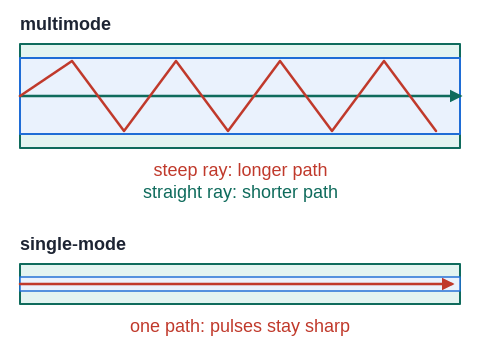
- In a wide multimode core, rays at different angles take different path lengths, so parts of one pulse arrive at different times and the pulse spreads out (modal dispersion).
- If pulses spread into each other, the receiver cannot tell a 1 from a 0, which limits how many pulses per second (bits per second) the link can carry over a given distance.
- A single-mode core is only a few wavelengths wide, so the light can only travel as one mode along the axis and modal dispersion disappears.
- A little spreading remains because the refractive index depends slightly on wavelength (chromatic dispersion), which is one reason lasers with a very narrow range of wavelengths are used.
Try it: keep the light in the fibre
Researching and evaluating sources
- Use at least three sources of different kinds and record each one fully (author or organisation, title, date, URL) as you go, not at the end.
- Judge each source: who wrote it and why, how recent it is, whether its numbers agree with other sources, and whether the physics is explained or just asserted.
- Rewrite everything in your own words and explain it; copying a diagram or a paragraph shows you found the idea, not that you understand it.
| Source | Strength | Check for |
|---|---|---|
| Fibre manufacturer's datasheet | Exact measured values (index, loss per km) | Gives numbers, not explanations |
| Physics textbook or university page | Correct, explained physics | May be general, not about your device |
| Network company website | Local facts about the New Zealand network | Written to sell, so check claims |
| Encyclopaedia or video | Quick overview and leads | Check every number against a primary source |
Try it: what each source is good for
Example: one idea at three depths
- The same idea, why light stays in the core, written at each grade.
- Notice how Excellence links refraction, the index difference, the narrow core and the infrared wavelength, rather than listing them.
| Grade | What the student wrote |
|---|---|
| Achieved | Light stays in the fibre by total internal reflection, because the core has a higher refractive index than the cladding. |
| Merit | Light slows less in the cladding (n = 1.462) than in the core (n = 1.468), so a ray hitting the boundary bends away from the normal. Beyond the critical angle of 84.8° no refracted ray can exist, so all the light reflects back into the core. |
| Excellence | As Merit, linked on: because the index difference is tiny, only rays within 5.2° of the axis are trapped, which suits a laser's narrow beam. Keeping the core only 9 µm wide forces one path, so pulses do not spread, and using 1310 to 1550 nm infrared keeps scattering low, so pulses stay sharp and strong over many kilometres. |
Common mistakes
- Total internal reflection happens when light goes from the cladding into the core.It only happens going from higher index to lower, so from the core into the cladding.
- The critical angle is measured from the surface of the boundary.Angles in Snell's law are measured from the normal, so θc = 84.8° means the ray almost grazes the boundary.
- Light travels through the fibre at 3.00 × 10⁸ m s⁻¹.That is its speed in a vacuum; in the core it is c ÷ n = 2.04 × 10⁸ m s⁻¹.
- My report lists refraction, photons and dispersion, so it is comprehensive.Excellence needs the ideas linked: say how each one depends on or affects the others in the device.
Make a mirror out of a water surface
You need: a clear straight-sided plastic cup or container, water, a coin, a phone torch
- Fill the container about two thirds with water and stand it on a table at eye level.
- Look up at the underside of the water surface through the side of the container: from a low enough angle it shines like silver.
- Put the coin under the container, then slowly lower your eye while looking through the side; at some point the coin vanishes.
- Shine the phone torch up through the side towards the surface at different angles and see when the beam stops leaving through the top.
- Look for: once the angle in the water is steeper than about 49° from the normal (the water and air critical angle), all the light reflects back down, just like in a fibre's core.
Safety: Keep the water well away from the phone and any power points, and wipe up spills so nobody slips.
Your turn
Find the critical angle for light going from glass (n = 1.50) into water (n = 1.33).
Find the speed of light in glass with n = 1.50.
Find the energy of a photon of wavelength 1310 nm. Use h = 6.63 × 10⁻³⁴ J s.
Explain why a fibre's cladding must have a lower refractive index than its core.
How long does light take to travel 25.0 km along a fibre core with n = 1.468?
Show answer
1. sin θc = 1.33 ÷ 1.50 = 0.8867, so θc = 62.5°. 2. v = c ÷ n = 3.00 × 10⁸ ÷ 1.50 = 2.00 × 10⁸ m s⁻¹. 3. E = hc/λ = (6.63 × 10⁻³⁴ × 3.00 × 10⁸) ÷ (1310 × 10⁻⁹) = 1.52 × 10⁻¹⁹ J. 4. Total internal reflection only happens when light meets a boundary into a lower refractive index at more than the critical angle, so a lower-index cladding keeps the light in the core. 5. v = 3.00 × 10⁸ ÷ 1.468 = 2.044 × 10⁸ m s⁻¹, t = 25.0 × 10³ ÷ 2.044 × 10⁸ = 1.22 × 10⁻⁴ s, which is 122 µs.
Recap
- Pick a context with at least three connected Level 8 ideas and good sources you can check.
- Achieved relates the physics to the context, Merit explains how and why, Excellence links the ideas into one picture.
- Fibre: total internal reflection from core to lower-index cladding, sin θc = n₂/n₁.
- Infrared at 1310 to 1550 nm keeps scattering and absorption low; single-mode cores stop pulses spreading.
- Record and judge every source as you go, and explain in your own words.
| Formula | Use it for |
|---|---|
| n = c ÷ v | speed of light in a material |
| n₁ sin θ₁ = n₂ sin θ₂ | refraction at a boundary |
| sin θc = n₂ ÷ n₁ | critical angle |
| E = hf = hc/λ | photon energy |
Challenge
A fibre has a core of refractive index 1.475 and a cladding of 1.460. Light from air (n = 1.00) enters the flat, square-cut end of the fibre at an angle α to the fibre's axis, refracts into the core, and then meets the core and cladding boundary. (a) Show that the largest α for which the light stays trapped is given by sin α = √(n₁² − n₂²), where n₁ is the core index and n₂ the cladding index. (b) Find this largest angle α.
Hint
Work from the inside out. At the side boundary the ray must meet the boundary at the critical angle or more, which sets the largest angle the ray may make with the axis inside the core. The end face is at 90° to the axis, so its normal runs along the axis: use Snell's law there with that angle.
Answer
(a) Inside the core the ray can make at most 90° − θc with the axis; at the end face sin α = n₁ sin(90° − θc) = n₁ cos θc = n₁ √(1 − n₂² ÷ n₁²) = √(n₁² − n₂²). (b) α = 12.1°.
Step by step
- For trapping, the ray must hit the side boundary at an angle from the normal of at least θc, where sin θc = n₂ ÷ n₁.
- The side boundary runs along the axis, so the angle between the ray and the axis is at most 90° − θc.
- The end face is perpendicular to the axis, so its normal is the axis itself: the angle inside the core at the end face is that same 90° − θc.
- Snell's law at the end face gives sin α = n₁ sin(90° − θc) = n₁ cos θc, and cos θc = √(1 − sin² θc).
- Simplifying gives √(n₁² − n₂²), which for these indices is 0.2098, so α = 12.1°.
Full working
- sin θc = n₂ ÷ n₁ = 1.460 ÷ 1.475critical angle at the side boundary
- θc = 81.8°, so the ray makes at most 90° − 81.8° = 8.18° with the axisside boundary is parallel to the axis
- 1.00 × sin α = n₁ sin(90° − θc) = n₁ cos θcSnell's law at the end face, whose normal is the axis
- n₁ cos θc = n₁ √(1 − n₂² ÷ n₁²) = √(n₁² − n₂²)cos² θc = 1 − sin² θc
- √(1.475² − 1.460²) = √(0.015 × 2.935) = √0.044025 = 0.2098difference of two squares
- α = sin⁻¹ 0.2098 = 12.1°inverse sine
- sin α = √(n₁² − n₂²) shown; largest α = 12.1°
A laser diode sends pulses of 1550 nm infrared light into a long-haul fibre. Each pulse lasts 0.40 ns at a power of 1.00 mW. Each kilometre of fibre lets through 95.5% of the power that enters it, and the receiver at the far end needs at least 500 photons in a pulse to register a 1. Find the greatest whole number of kilometres of fibre the link can be, and explain why the same link would be much shorter using 850 nm light. Use h = 6.63 × 10⁻³⁴ J s and c = 3.00 × 10⁸ m s⁻¹.
Hint
Find how many photons are in each pulse as it leaves the laser (energy of the pulse divided by energy of one photon). After n km the fraction left is 0.955ⁿ. Set the photons left equal to 500 and use logarithms, or trial values of n, to find n.
Answer
Each pulse has about 3.12 × 10⁶ photons; 0.955ⁿ must be at least 1.60 × 10⁻⁴, so n = 189 km (518 photons arrive; at 190 km only 495). At 850 nm Rayleigh scattering, which grows as 1 ÷ λ⁴, is about 11 times stronger, so far more power is lost each kilometre.
Step by step
- The pulse energy is power × time.
- One photon at 1550 nm has energy hc ÷ λ, so dividing gives the number of photons per pulse.
- Each kilometre keeps 0.955 of the photons, so after n km the number left is N × 0.955ⁿ.
- Setting that equal to 500 and taking logs gives n just under 190, so the longest whole number of kilometres that works is 189.
- Shorter wavelengths scatter far more (as 1 ÷ λ⁴), so 850 nm light loses a much larger fraction per kilometre and the 500-photon limit is reached far sooner.
Full working
- E = Pt = 1.00 × 10⁻³ × 0.40 × 10⁻⁹ = 4.0 × 10⁻¹³ Jenergy in one pulse
- Eₚ = hc ÷ λ = (6.63 × 10⁻³⁴ × 3.00 × 10⁸) ÷ (1550 × 10⁻⁹) = 1.283 × 10⁻¹⁹ Jenergy of one photon
- N = 4.0 × 10⁻¹³ ÷ 1.283 × 10⁻¹⁹ = 3.12 × 10⁶ photonsphotons per pulse at the laser
- 0.955ⁿ = 500 ÷ 3.12 × 10⁶ = 1.604 × 10⁻⁴fraction that must still arrive
- n = ln(1.604 × 10⁻⁴) ÷ ln 0.955 = 189.8take logs of both sides
- check: 3.12 × 10⁶ × 0.955¹⁸⁹ = 518, 3.12 × 10⁶ × 0.955¹⁹⁰ = 495190 km falls below 500
- (1550 ÷ 850)⁴ = 11.1scattering at 850 nm is about 11 times stronger
- longest link 189 km; at 850 nm the loss per km is much larger, so the link is far shorter
An older multimode fibre 2.00 km long has a wide core of refractive index 1.480 and a cladding of 1.465. Light in one short pulse travels along every allowed path at once, from a ray straight down the axis to a ray that zigzags hitting the side boundary exactly at the critical angle. (a) Find the difference in arrival times between these two rays. (b) If neighbouring pulses must be at least that far apart in time so they do not run into each other, estimate the greatest number of pulses per second the link can carry. (c) Explain, using the physics of the fibre, why a single-mode fibre with the same indices can carry far more pulses per second.
Hint
Both rays travel at c ÷ n₁ in the core, so the difference comes only from path length. A ray hitting the boundary at θc from the normal travels at 90° − θc to the axis: how long is its zigzag path for each 2.00 km along the axis?
Answer
(a) About 101 ns (1.01 × 10⁻⁷ s). (b) About 1 ÷ 1.01 × 10⁻⁷ = 9.9 × 10⁶ pulses per second (about 10 million). (c) A single-mode core is only a few wavelengths wide, so only the axial path exists: there is no spread between paths, pulses stay short, and they can be packed much closer together.
Step by step
- Both rays are in the same core material, so both move at v = c ÷ n₁; only their path lengths differ.
- The zigzag ray travels at angle 90° − θc to the axis, so its path is L ÷ cos(90° − θc) = L ÷ sin θc = L n₁ ÷ n₂.
- Divide each path by the speed and subtract to get the spread in arrival time.
- If pulses must be one spread apart, the most pulses per second is about 1 divided by the spread.
- In a single-mode fibre only one path (along the axis) is possible, so this modal spreading disappears.
Full working
- v = c ÷ n₁ = 3.00 × 10⁸ ÷ 1.480 = 2.027 × 10⁸ m s⁻¹same speed for both rays
- t(axis) = 2000 ÷ 2.027 × 10⁸ = 9.867 × 10⁻⁶ sstraight path
- sin θc = n₂ ÷ n₁ = 1.465 ÷ 1.480 = 0.9899critical angle condition
- zigzag path = L ÷ sin θc = 2000 × 1.480 ÷ 1.465 = 2020.5 mray at 90° − θc to the axis
- t(zigzag) = 2020.5 ÷ 2.027 × 10⁸ = 9.968 × 10⁻⁶ ssame speed, longer path
- Δt = 9.968 × 10⁻⁶ − 9.867 × 10⁻⁶ = 1.01 × 10⁻⁷ sspread in arrival time
- rate ≈ 1 ÷ 1.01 × 10⁻⁷ = 9.9 × 10⁶ pulses per secondone pulse per spread
- Δt = 101 ns; about 9.9 million pulses per second; single mode removes the path difference