
The ocean carbon cycle and ocean acidification
What this lesson covers
- The ocean as a carbon store, and the forms dissolved carbon takes.
- Carbonate chemistry: the equilibria from dissolved CO₂ to carbonic acid, hydrogencarbonate and carbonate ions.
- Ocean acidification: why more CO₂ means lower pH and fewer carbonate ions.
- The physical (solubility) pump: temperature, wind, waves and downwelling.
- The biological pump: photosynthesis, food webs and marine snow, and the carbonate pump.
- Effects of acidification and warming on shell builders and food webs, including in New Zealand waters.
The ocean as a carbon store
- The ocean holds roughly 50 times as much carbon as the atmosphere, almost all as dissolved inorganic carbon; marine life and sediments hold the rest.
- Carbon dioxide crosses the sea surface in both directions; where the air has more CO₂ than the water is in balance with, there is a net flow into the sea.
- Since the Industrial Revolution the air's CO₂ has risen from about 280 ppm to over 420 ppm, so the ocean now takes up more than it releases, around a quarter of the CO₂ humans emit each year.
- Two processes carry that carbon from the surface into the deep ocean, where it can stay for centuries: the physical pump and the biological pump.
Try it: CO₂ in the air
Carbonate chemistry
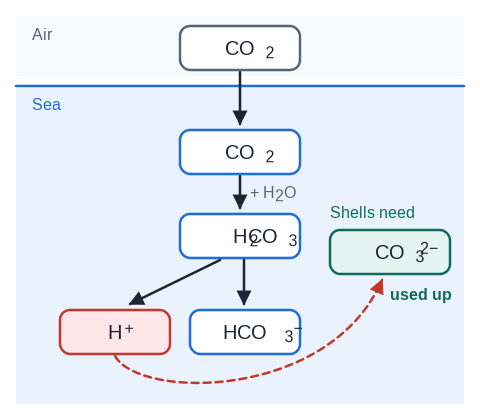
- Dissolved CO₂ reacts with water to make carbonic acid, a weak acid that partly dissociates in two steps, releasing hydrogen ions (H⁺) each time.
- Every step is a reversible reaction at equilibrium, so adding CO₂ pushes all of them to the right, while removing CO₂ (by photosynthesis) pulls them back to the left.
- In seawater at pH about 8.1, roughly 90% of the dissolved inorganic carbon is hydrogencarbonate (HCO₃⁻), about 9% carbonate (CO₃²⁻) and only about 1% dissolved CO₂.
- Shell builders combine calcium ions with carbonate ions to make calcium carbonate: Ca²⁺ + CO₃²⁻ → CaCO₃.
| Step | Equation |
|---|---|
| CO₂ dissolves | CO₂(g) ⇌ CO₂(aq) |
| Carbonic acid forms | CO₂ + H₂O ⇌ H₂CO₃ |
| First dissociation | H₂CO₃ ⇌ H⁺ + HCO₃⁻ |
| Second dissociation | HCO₃⁻ ⇌ H⁺ + CO₃²⁻ |
Ocean acidification
- More CO₂ dissolving makes more carbonic acid, which releases more H⁺, so [H⁺] rises and pH falls. The sea is still slightly basic; acidification means its pH is moving towards acidic.
- Most of the extra H⁺ does not stay free: it combines with carbonate ions, H⁺ + CO₃²⁻ → HCO₃⁻, which buffers the pH but uses up carbonate.
- So adding CO₂ raises hydrogencarbonate and lowers carbonate, the very ion that corals, shellfish and some plankton need to build shells.
- Average surface ocean pH has fallen from about 8.2 before industrialisation to about 8.1 today, and could reach about 7.7 to 7.8 by 2100 if emissions stay high.
Example: what a fall of 0.1 pH means
- PH = −log₁₀[H⁺], so [H⁺] = 10^(−pH) mol L⁻¹.
- Find the percentage increase in [H⁺] when surface ocean pH falls from 8.2 to 8.1.
- pH 8.2: [H⁺] = 10^(−8.2) = 6.31 × 10⁻⁹ mol L⁻¹
- pH 8.1: [H⁺] = 10^(−8.1) = 7.94 × 10⁻⁹ mol L⁻¹
- ratio = 7.94 ÷ 6.31 = 1.26or 10^0.1 = 1.26 directly
- pH is a log scale, so a 0.1 fall is a 26% change, not a tiny one
- [H⁺] has increased by about 26%
Try it: the pH scale
The physical (solubility) pump
- Gases dissolve better in cold water, so cold surface water at high latitudes takes up much more CO₂ than warm tropical water.
- Strong winds and breaking waves stir the surface, mix air into the water as bubbles and keep fresh water at the surface, speeding up gas exchange.
- Where cold, dense water sinks (downwelling, and deep water formation off Antarctica and in the North Atlantic), it carries its dissolved CO₂ down and out of contact with the air for centuries, lowering surface CO₂ so more can dissolve.
- The Southern Ocean combines all three: very cold water, the strongest winds and biggest waves on Earth, and sinking water masses, so it takes up a large share of the ocean's CO₂.
- Where deep water upwells and warms, as in the eastern tropical Pacific, the ocean releases CO₂ back to the air.
| Temperature (°C) | 0 | 10 | 20 | 30 |
|---|---|---|---|---|
| CO₂ dissolved (g per kg) | 3.35 | 2.32 | 1.69 | 1.26 |
Example: cold water against warm water
- Use the table to compare water at 0 °C, like the Southern Ocean near Antarctica, with water at 20 °C, like the sea off Northland in summer.
- 0 °C: 3.35 g per kg; 20 °C: 1.69 g per kg
- 3.35 ÷ 1.69 = 1.98
- from 0 °C to 20 °C the amount roughly halves
- about 2.0 times as much CO₂ dissolves at 0 °C as at 20 °C
The biological pump
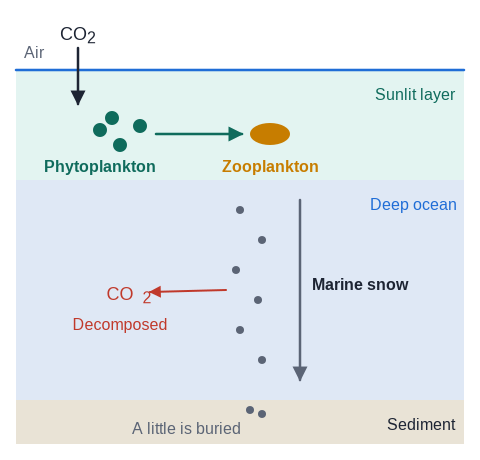
- Phytoplankton in the sunlit surface layer photosynthesise, 6CO₂ + 6H₂O → C₆H₁₂O₆ + 6O₂, turning dissolved CO₂ into organic carbon and lowering surface CO₂ so more can enter from the air.
- Zooplankton eat the phytoplankton and fish eat the zooplankton, passing the carbon along the food web.
- Dead organisms, moults and faecal pellets clump together and sink as marine snow. Bacteria break most of it down on the way, releasing CO₂ by respiration in the deep water, where it stays for centuries; a small fraction is buried in sediments for millions of years.
- Growth is limited by nutrients: in much of the Southern Ocean there is plenty of nitrate but too little iron, so the pump works below its potential, while upwelling zones and the Chatham Rise near New Zealand are highly productive.
- Shell-building plankton add a carbonate pump: their CaCO₃ shells sink and carry carbon down, although making the shells releases some CO₂ at the surface.
Effects on marine life
- With fewer carbonate ions, organisms must spend more energy to build and repair shells of calcium carbonate; aragonite, the form used by pteropods, corals and many larvae, dissolves most easily.
- Cold water already holds fewer carbonate ions, so the Southern Ocean will be among the first places where surface water becomes corrosive to aragonite, threatening pteropods, a key food for fish and whales.
- In New Zealand, the larvae of shellfish such as green-lipped mussels and pāua build their first shells in their first days, and experiments show weaker, smaller shells at lower pH; coralline algae, which young pāua settle on, are affected too.
- Warming adds to the stress: warmer surface water holds less oxygen and forms a stronger pycnocline, which reduces the nutrients mixed up from below, so plankton growth and the whole food web can suffer.
What Achieved, Merit and Excellence look like
- Merit and Excellence answers use equations, link a cause to each effect, and connect the pumps to the chemistry.
| Grade | A model answer |
|---|---|
| Achieved | More CO₂ dissolves in the ocean and makes it more acidic. This makes it harder for shellfish to build shells. |
| Merit | CO₂ reacts with water to form carbonic acid, CO₂ + H₂O ⇌ H₂CO₃, which dissociates, H₂CO₃ ⇌ H⁺ + HCO₃⁻, raising [H⁺] and lowering pH. The extra H⁺ reacts with carbonate, H⁺ + CO₃²⁻ → HCO₃⁻, so there are fewer carbonate ions for organisms to make CaCO₃ shells. |
| Excellence | Rising atmospheric CO₂ increases uptake through the physical pump, especially in cold, windy waters such as the Southern Ocean. The extra CO₂ shifts each carbonate equilibrium to the right, but the H⁺ produced is mostly removed by carbonate ions, so carbonate concentration falls even though the pH changes only slightly. Shell builders must use more energy to gather carbonate, and in cold water, already low in carbonate, aragonite shells can begin to dissolve; losses of pteropods or shellfish larvae then reduce food for fish higher up the food web. |
Common mistakes
- Ocean acidification means the sea is now an acid with a pH below 7.The sea is still basic (about pH 8.1); acidification means its pH is falling towards acidic.
- A fall of 0.1 in pH is too small to matter.pH is logarithmic: a 0.1 fall means about 26% more hydrogen ions.
- Extra CO₂ gives shellfish more carbonate to build shells with.The extra H⁺ reacts with carbonate to form hydrogencarbonate, so carbonate ions decrease.
- Warm tropical water absorbs the most CO₂ because it has the most plankton.Cold water dissolves more CO₂, and cold, windy, sinking regions like the Southern Ocean take up the most.
See CO₂ make water more acidic
You need: 2 red cabbage leaves, hot tap water, a jug, 2 clear glasses, a drinking straw, a sieve
- Tear the cabbage leaves into the jug, cover with hot tap water, leave for 10 minutes, then strain the purple liquid into both glasses.
- Keep one glass as the control.
- Blow gently out through the straw into the other glass for 2 to 3 minutes, so your breath bubbles through it.
- Hold both glasses against white paper and compare their colours.
- Look for: the glass you breathed into turns a pinker purple, because the CO₂ in your breath formed carbonic acid and lowered the pH.
Safety: Only blow out through the straw, never suck in, and do not drink the cabbage water.
Your turn
If ocean pH fell from 8.10 to 7.80, by what factor would [H⁺] increase?
Calculate [H⁺] in seawater at pH 8.1.
Using the solubility table, how many times more CO₂ dissolves at 10 °C than at 30 °C?
Phytoplankton turn CO₂ into sugar, and their remains sink as marine snow. Which pump is this?
Why does adding CO₂ to seawater reduce the concentration of carbonate ions?
Show answer
1. 10^(8.10 − 7.80) = 10^0.30 = 2.0 times. 2. [H⁺] = 10^(−8.1) = 7.9 × 10⁻⁹ mol L⁻¹. 3. 2.32 ÷ 1.26 = 1.84 times. 4. The biological pump. 5. The extra H⁺ from carbonic acid reacts with carbonate, H⁺ + CO₃²⁻ → HCO₃⁻, turning it into hydrogencarbonate.
Exam-style question: carbon and pāua
- The cold waters south and east of New Zealand take up large amounts of CO₂ each year. Pāua farmers worry that falling pH could affect their young pāua.
Describe how the physical pump moves CO₂ from the air into the deep ocean.
Explain how the biological pump removes carbon from surface water.
Using equations, explain how dissolving CO₂ lowers the pH of seawater.
Explain why young pāua may grow weaker shells as the ocean takes up more CO₂.
Show answer
1. CO₂ dissolves at the surface, faster in cold water and where wind and waves mix the surface; sinking (downwelling) cold water carries it down away from the air (Achieved for dissolving and cold water; Merit adds wind, waves and downwelling). 2. Phytoplankton photosynthesise, 6CO₂ + 6H₂O → C₆H₁₂O₆ + 6O₂, making organic carbon that passes through the food web; dead matter and faecal pellets sink as marine snow and are decomposed at depth or buried, so carbon leaves the surface (Merit). 3. CO₂ + H₂O ⇌ H₂CO₃, then H₂CO₃ ⇌ H⁺ + HCO₃⁻ and HCO₃⁻ ⇌ H⁺ + CO₃²⁻. More CO₂ shifts the equilibria right, raising [H⁺], so pH = −log[H⁺] falls (Merit for two equations with charges and an explanation). 4. The extra H⁺ combines with carbonate, H⁺ + CO₃²⁻ → HCO₃⁻, so fewer carbonate ions are available for Ca²⁺ + CO₃²⁻ → CaCO₃. Pāua larvae and juveniles must spend more energy building shell, and in cold water, already low in carbonate, the shell may grow thinner or even dissolve, reducing survival (Excellence links uptake, equilibrium shift, carbonate loss and the effect on the organism).
Recap
- CO₂ dissolves, forms carbonic acid and releases H⁺; more CO₂ means lower pH and fewer carbonate ions.
- The physical pump is strongest in cold, windy regions where water sinks, such as the Southern Ocean.
- The biological pump turns CO₂ into organic carbon that sinks as marine snow.
- Shell builders, especially in cold water, struggle as carbonate falls, with knock-on effects through the food web.
| Equation | What it shows |
|---|---|
| CO₂ + H₂O ⇌ H₂CO₃ | CO₂ forms carbonic acid |
| H₂CO₃ ⇌ H⁺ + HCO₃⁻ | acid releases H⁺ |
| H⁺ + CO₃²⁻ → HCO₃⁻ | carbonate used up |
| Ca²⁺ + CO₃²⁻ → CaCO₃ | shell building |
| [H⁺] = 10^(−pH) | from pH to concentration |
Challenge
Water that sank in the Southern Ocean at 4 °C, in balance with the air, travels through the deep ocean for centuries and then upwells off Peru, where it warms to 24 °C at the surface. Use a simple model: the dissolved CO₂ follows the solubility table on this page (0 °C: 3.35, 10 °C: 2.32, 20 °C: 1.69, 30 °C: 1.26 g per kg), with values between table temperatures found by assuming a straight line. (a) Estimate the solubility at 4 °C and at 24 °C. (b) What fraction of the water's dissolved CO₂ must leave to the air for it to come back into balance at 24 °C? (c) On its journey, marine snow decomposing in the deep water added 10% more dissolved CO₂ than it started with. Find the new fraction, and explain which two pumps make upwelling zones a source of CO₂ to the air.
Hint
4 °C is 40% of the way from 0 to 10 °C; 24 °C is 40% of the way from 20 to 30 °C. The fraction that leaves is 1 minus (what it can hold) ÷ (what it has).
Answer
(a) About 2.94 g per kg at 4 °C and 1.52 g per kg at 24 °C. (b) About 48%. (c) About 53%: the physical pump stored CO₂ in cold sinking water, the biological pump added respired CO₂ at depth, and warming on upwelling releases both.
Step by step
- Interpolate between table values to estimate solubility at 4 °C and 24 °C.
- Warm water can hold only about half as much CO₂, so the rest leaves to the air.
- Respiration of sinking organic matter adds CO₂ in the deep water, so the upwelled water holds even more.
- The fraction released rises because it starts with more but can still hold only 1.52 g per kg.
- Upwelling reverses both pumps: the cold-water store and the deep biological store come back to the surface together.
Full working
- 4 °C: 3.35 − 0.4 × (3.35 − 2.32) = 3.35 − 0.41 = 2.94 g per kgstraight line, 0 to 10 °C
- 24 °C: 1.69 − 0.4 × (1.69 − 1.26) = 1.69 − 0.17 = 1.52 g per kgstraight line, 20 to 30 °C
- fraction kept = 1.518 ÷ 2.938 = 0.517can hold ÷ has
- fraction released = 1 − 0.517 = 0.48about 48%
- with respired CO₂: 2.938 × 1.10 = 3.23 g per kg10% more
- fraction released = 1 − 1.518 ÷ 3.232 = 0.53about 53%
- About 2.94 and 1.52 g per kg; about 48% must leave, rising to about 53% with the biological pump's extra CO₂
Coccolithophores are plankton that both photosynthesise and build calcium carbonate plates. (a) Using the equations H₂CO₃ ⇌ H⁺ + HCO₃⁻, HCO₃⁻ ⇌ H⁺ + CO₃²⁻, Ca²⁺ + CO₃²⁻ → CaCO₃ and CO₂ + H₂O ⇌ H₂CO₃, show that building shell from hydrogencarbonate can be summed up as Ca²⁺ + 2HCO₃⁻ → CaCO₃ + CO₂ + H₂O. (b) Over a spring bloom east of New Zealand, coccolithophores turn 12 g of carbon per square metre into organic matter and 3 g of carbon per square metre into CaCO₃. Using the overall equations, find the net amount of CO₂ removed from the surface water, in moles and in grams per square metre. (c) Find the ratio of CaCO₃ carbon to organic carbon at which the bloom would remove no CO₂ at all. (d) Acidification makes calcification harder. Explain why that would reduce CO₂ release at the surface, yet could still weaken the biological pump, given that CaCO₃ plates make marine snow heavier.
Hint
One HCO₃⁻ gives up its H⁺ to become CO₃²⁻; where does that H⁺ go? In (b), each mole of carbon fixed by photosynthesis removes one mole of CO₂, and each mole of CaCO₃ made releases one.
Answer
(a) HCO₃⁻ → H⁺ + CO₃²⁻; the CO₃²⁻ joins Ca²⁺ to make CaCO₃; the H⁺ joins a second HCO₃⁻ to make H₂CO₃, which breaks down to CO₂ + H₂O. (b) 0.75 mol, 33 g of CO₂ per square metre. (c) 1 : 1. (d) Less calcification releases less CO₂ at the surface, but lighter marine snow sinks more slowly, so more of it is decomposed near the surface and less carbon reaches the deep ocean.
Step by step
- Splitting HCO₃⁻ gives the carbonate for the shell and a spare H⁺.
- That H⁺ turns a second HCO₃⁻ into carbonic acid, which releases CO₂: so calcifying releases CO₂.
- Photosynthesis removes 1 mol of CO₂ per mol of carbon fixed; calcification releases 1 mol per mol of CaCO₃.
- Net removal is the difference; it reaches zero when the two carbon amounts are equal.
- Shells act as ballast. Without them marine snow sinks slowly and is respired in shallow water, so its CO₂ returns to the air sooner.
Full working
- HCO₃⁻ → H⁺ + CO₃²⁻second dissociation
- Ca²⁺ + CO₃²⁻ → CaCO₃shell building
- H⁺ + HCO₃⁻ → H₂CO₃ → CO₂ + H₂Oreverse of the first steps
- sum: Ca²⁺ + 2HCO₃⁻ → CaCO₃ + CO₂ + H₂OH⁺ and CO₃²⁻ cancel
- organic: 12 g ÷ 12 g per mol = 1.00 mol CO₂ removedphotosynthesis
- CaCO₃: 3 g ÷ 12 g per mol = 0.25 mol CO₂ releasedcalcification
- net = 1.00 − 0.25 = 0.75 mol; 0.75 × 44 = 33 g of CO₂ per m²removed
- no net removal when CaCO₃ carbon = organic carbonratio 1 : 1
- Net 0.75 mol (33 g) of CO₂ removed per m²; break-even at a 1 : 1 ratio
For the second dissociation, HCO₃⁻ ⇌ H⁺ + CO₃²⁻, the value of [H⁺] × [CO₃²⁻] ÷ [HCO₃⁻] stays the same at a given temperature. In cold surface water south of New Zealand today, pH = 8.10, [HCO₃⁻] = 1950 µmol per kg and [CO₃²⁻] = 100 µmol per kg. In this water, aragonite (the shell material of pteropods and many larvae) starts to dissolve if [CO₃²⁻] falls below 65 µmol per kg. A projection for 2100 gives pH 7.85 with [HCO₃⁻] risen to 2050 µmol per kg. (a) Find [CO₃²⁻] in 2100 and decide whether the water would be corrosive to aragonite. (b) With [HCO₃⁻] at 2050 µmol per kg, find the pH at which the water first becomes corrosive. (c) Explain, using this calculation, why the carbonate concentration falls by more than the hydrogencarbonate rises, and why cold southern waters reach this threshold before tropical waters.
Hint
Rearrange to [CO₃²⁻] = constant × [HCO₃⁻] ÷ [H⁺]. You do not need the constant's value if you compare 2100 with today as a ratio. Remember [H⁺] = 10^(−pH).
Answer
(a) About 59 µmol per kg, below 65, so corrosive. (b) About pH 7.89. (c) [CO₃²⁻] depends on [HCO₃⁻] ÷ [H⁺]: hydrogencarbonate rises only 5%, but [H⁺] rises by 78%, so carbonate falls by about 41%. Cold water holds more CO₂ and starts with fewer carbonate ions, so it has less to lose before reaching the threshold.
Step by step
- Write [CO₃²⁻] = K × [HCO₃⁻] ÷ [H⁺], so compare 2100 with today as a ratio.
- Hydrogencarbonate rises by a factor 2050 ÷ 1950 = 1.05.
- [H⁺] rises by 10^0.25 = 1.78, so carbonate is divided by 1.78.
- For the threshold, set the carbonate to 65 and solve for the change in pH.
- The H⁺ from extra CO₂ is soaked up by carbonate, so carbonate falls a lot while the pH barely moves; cold water dissolves more CO₂ and starts closer to the limit.
Full working
- [CO₃²⁻] = K × [HCO₃⁻] ÷ [H⁺]rearrange
- new [CO₃²⁻] = 100 × (2050 ÷ 1950) × 10^(7.85 − 8.10)ratio to today
- = 100 × 1.0513 × 0.5623 = 59.1 µmol per kgbelow 65, corrosive
- 65 = 100 × 1.0513 × 10^(pH − 8.10)threshold
- 10^(pH − 8.10) = 65 ÷ 105.13 = 0.6183solve
- pH − 8.10 = log₁₀ 0.6183 = −0.209, so pH = 7.89threshold pH
- (a) About 59 µmol per kg, corrosive to aragonite; (b) corrosive below about pH 7.89