
Surviving extreme environments: hot springs, ice and alpine cold
What this lesson covers
- What the report needs: why the environment is extreme, the adaptations that answer it, and sources recorded so they can be traced.
- The conditions that make an environment extreme and why each one threatens cells.
- Champagne Pool at Waiotapu and the heat-loving bacterium Venenivibrio stagnispumantis.
- Antarctic toothfish and the antifreeze proteins that stop ice growing in their blood.
- Alpine wētā and insects that survive by freezing, and humans who survive with technology.
- Linking each condition to the problem it causes and the adaptation that solves it, for Merit and Excellence.
What the report must include
- AS 91190 is an internal research report: you choose an extreme environment and one or more organisms that live there, which can include humans.
- You must say why the environment counts as extreme: which conditions would kill or harm most living things, with numbers.
- Then you describe the key adaptations, biological for living things or technological for humans, and how each one lets the organism survive.
- Merit explains the links: how each condition causes a problem for cells and how the adaptation solves it.
- Excellence joins these into connected chains and justifies them with evidence, often by showing how several adaptations work together or why one strategy suits that environment better than another.
- Record every source so a marker can find it: author or organisation, title, date, web address and the date you accessed it.
What makes an environment extreme
- An environment is extreme when a condition is far outside the range most organisms can survive: very hot or cold, very acid or alkaline, very salty, high pressure, little oxygen, strong radiation or toxic chemicals.
- Heat breaks the weak bonds that hold proteins in shape, so enzymes denature and stop working, membranes become leaky and DNA strands separate.
- Cold slows enzymes, and if ice forms in the body its sharp crystals tear cells and pull water out of them.
- Acid or alkali changes the charges on proteins, which also changes their shape.
- Low oxygen limits aerobic respiration, so less energy is released from food.
- Hot water holds less dissolved oxygen than cold water, so heat and low oxygen often come together.
Try it: which extreme?
Champagne Pool: hot, acidic and full of toxic elements
- Champagne Pool is a large hot spring at Waiotapu, south of Rotorua, named for the bubbles of carbon dioxide that rise through it.
- GNS Science reports the water stays at about 75 °C, too hot for any plant or animal, and has a pH of 5.5 because the carbon dioxide forms bicarbonate.
- The water also carries arsenic, antimony, mercury and thallium, all poisonous to most life.
- Even so, microbes live in and around it. Under the water most are bacteria and archaea that do not need oxygen and use sulfur compounds instead.
| Champagne Pool condition | Value |
|---|---|
| Water temperature | About 75 °C |
| pH | 5.5 |
| Toxic elements dissolved | Arsenic, antimony, mercury, thallium |
Venenivibrio: a bacterium built for heat
- Venenivibrio stagnispumantis was discovered in a Waiotapu hot spring and described in 2008; its species name means 'of the foaming pool'.
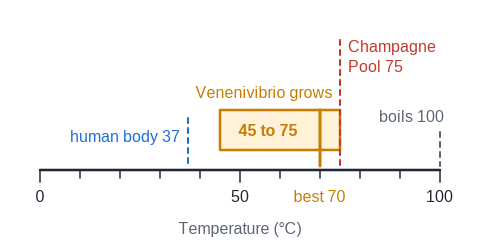
- It grows between 45 and 75 °C, best at 70 °C: the human body, at 37 °C, would be too cold for it.
- Heat-stable enzymes: like other heat-loving microbes, its proteins are held together by extra bonds, so they keep their shape and active sites at temperatures that would denature ours.
- Energy without food or light: it releases energy by reacting hydrogen gas with a little oxygen, and needs sulfur compounds from the spring, so it needs no sunlight and no other organisms to eat.
- Low oxygen suits it: it grows best at 4 to 8% oxygen, far below the 21% in air, which matches hot water that holds little dissolved oxygen.
| Venenivibrio stagnispumantis | Range | Best |
|---|---|---|
| Temperature | 45 to 75 °C | 70 °C |
| pH | 4.8 to 5.8 | 5.4 |
| Oxygen in the gas around it | 1 to 10% | 4 to 8% |
Try it: enzymes and temperature
Antarctic toothfish: blood that should freeze, but does not
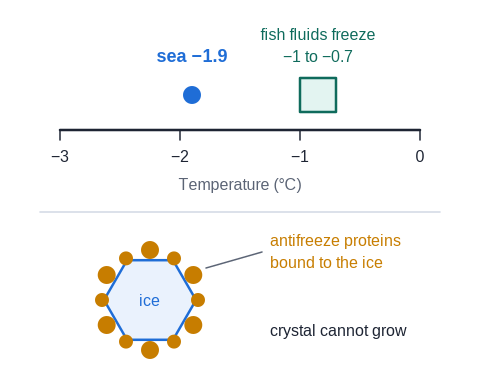
- Coastal Antarctic seawater, such as the Ross Sea where New Zealand works, sits at about −1.9 °C. Salt lets seawater stay liquid below 0 °C.
- A fish's body fluids are less salty, so they freeze at about −0.7 to −1 °C. In −1.9 °C water an unprotected fish would freeze.
- Ice crystals also get in: fish swallow seawater and food that carry tiny crystals, and those would grow and destroy cells.
- The Antarctic toothfish and its relatives, the notothenioids, make antifreeze glycoproteins. These stick to the surface of tiny ice crystals and stop water molecules joining, so the crystals cannot grow.
- The antifreeze is in the blood and in the gut fluid, exactly where ice would enter. These fish make up 90 to 95% of the fish mass in coastal Antarctic water, so the adaptation clearly works.
| Condition or feature | Value |
|---|---|
| Coastal Antarctic seawater | About −1.9 °C |
| Freezing point of fish body fluids without antifreeze | −0.7 to −1 °C |
| Share of coastal Antarctic fish species that are notothenioids | More than 50% |
| Share of coastal Antarctic fish mass that is notothenioids | 90 to 95% |
Example: the toothfish at each grade
- Achieved describes why the environment is extreme and what the adaptation does.
- Merit explains the link: why the condition is a problem for cells, and how the adaptation fixes that problem.
- Excellence joins the links into one justified chain, with evidence that the adaptation is the reason the fish survives.
| Grade | What the student wrote |
|---|---|
| Achieved | The Ross Sea is extreme because the water is about −1.9 °C, below freezing. The toothfish survives because it has antifreeze in its blood that stops it freezing. |
| Merit | Seawater stays liquid at −1.9 °C because of its salt, but the toothfish's body fluids would freeze at about −1 °C. Ice crystals would grow inside the fish and tear its cells. Its antifreeze glycoproteins bind to tiny ice crystals and stop them growing, so its blood stays liquid below its normal freezing point. |
| Excellence | The danger is the 0.9 °C gap between the sea at −1.9 °C and the −1 °C at which fish fluids freeze, plus ice crystals that enter in swallowed seawater and food. Antifreeze glycoproteins solve both, because they bind to any crystal and block its growth, and they are found in the blood and the gut fluid, exactly where ice enters. That notothenioids with this protein make up 90 to 95% of fish mass in these waters supports the claim that the antifreeze is what lets them live there. |
Alpine wētā: survive by freezing
- Alpine wētā, such as the mountain stone wētā of Central Otago's ranges, face winter nights well below freezing with no warm place to hide.
- Instead of stopping ice forming, like the toothfish, they are freeze tolerant: they let their bodies freeze, then thaw hours, days or even weeks later and walk away.
- Massey University researchers report that freezing starts in the gut, at temperatures just below 0 °C. Starting early and slowly keeps the ice under control, rather than letting it form suddenly at a much lower temperature.
- The same strategy turns up in unrelated New Zealand alpine grasshoppers, moths and cockroaches, which suggests it suits these mountains well.
- Comparing the strategies is a good Excellence move: the toothfish lives in water that never drops below −1.9 °C, so avoiding ice is enough, while an alpine wētā can meet much colder air, where freezing in a controlled way is safer than trying to stay liquid.
Humans: surviving with technology
- Humans have no biological adaptations for Antarctica, so people at Scott Base survive with technological modifications, which the standard accepts.
- Layered clothing traps still air, a poor conductor, so less heat flows from the body to the cold air.
- Insulated, heated buildings keep the inside near room temperature, and stored food and fuel supply the energy the body uses to stay warm.
- Write about technology the same way as biology: name the condition, the problem it causes for the body, and how the technology solves it.
Try it: survive the extreme
Common mistakes
- The environment is extreme because it is really hot.Give the numbers and the reason: Champagne Pool is about 75 °C, hot enough to denature the enzymes of almost every plant and animal.
- The toothfish's antifreeze works by adding salt to its blood.Its antifreeze glycoproteins bind to tiny ice crystals and stop them growing; they do not work by making the blood saltier.
- The bacterium adapted to the heat because it wanted to survive.Organisms do not choose adaptations; those with heat-stable proteins survived and reproduced, so the feature became common.
- I listed five adaptations with a sentence on each.Merit and Excellence need links: for each key adaptation, say which condition it answers and how it solves the problem that condition causes.
Does salt water freeze at a lower temperature?
You need: two small plastic cups, tap water, table salt, a tablespoon, a freezer, a phone timer, a pen and labels
- Label the cups 'fresh' and 'salty'. Put 100 mL of tap water in each, and stir 1 tablespoon of salt into the salty cup until it dissolves.
- Stand both cups side by side in the freezer and start the timer.
- Check them every 30 minutes for 3 hours, noting whether each is liquid, slushy or frozen solid.
- Write your observations in a table and compare when each cup started to freeze.
- Look for: the fresh water freezes first and the salty water stays slushy for longer, because dissolved salt lowers the freezing point. That is why the Antarctic sea stays liquid at −1.9 °C, while the toothfish's antifreeze works a different way, by blocking ice crystals from growing.
Safety: Use plastic cups, not glass, because glass full of water can crack as it freezes, and wipe up salt water spills so nobody slips.
Your turn
Venenivibrio grows from 45 to 75 °C. Could it grow in water at 37 °C?
Antarctic seawater is −1.9 °C, and fish body fluids freeze at about −1 °C. By how many degrees is the sea colder than that freezing point?
Why would a human enzyme stop working in 75 °C water?
Which organism avoids freezing and which tolerates it: the toothfish or the alpine wētā?
Why does growing best at 4 to 8% oxygen help Venenivibrio in a hot spring?
Write one condition, problem, adaptation chain for the toothfish, as an Excellence answer would.
Show answer
1. No: 37 °C is below its lowest growth temperature of 45 °C. 2. −1 − (−1.9) = 0.9 °C colder. 3. Heat breaks the weak bonds holding the enzyme's shape, so its active site changes shape (it denatures) and the substrate no longer fits. 4. The toothfish avoids freezing with antifreeze glycoproteins; the alpine wētā tolerates freezing. 5. Hot water holds little dissolved oxygen, so needing only a little oxygen matches what the spring supplies. 6. For example: sea at −1.9 °C is colder than the −1 °C at which fish fluids freeze, so ice crystals entering in seawater and food would grow and tear cells; antifreeze glycoproteins in the blood and gut bind the crystals and stop them growing, so the fish stays unfrozen.
Recap
- Say why the environment is extreme, with numbers, and why each condition harms cells.
- Describe the key adaptations, biological or technological, and how each one lets the organism survive.
- Merit explains the link between each condition and its adaptation; Excellence joins them into justified chains with evidence.
- Record every source in a form a marker can trace.
| Organism | Condition | Adaptation |
|---|---|---|
| Venenivibrio stagnispumantis | About 75 °C, little oxygen | Heat-stable proteins, energy from hydrogen, grows best at low oxygen |
| Antarctic toothfish | Sea at −1.9 °C, ice crystals | Antifreeze glycoproteins in blood and gut |
| Alpine wētā | Freezing winter nights | Controlled freezing that starts in the gut |
| Humans at Scott Base | Extreme cold | Layered clothing, heated insulated buildings |
Challenge
Water leaves Champagne Pool at 75 °C and pH 5.5 and runs down a shallow outflow channel. Along the channel it cools by 2.5 °C every metre, and as carbon dioxide bubbles out its pH rises by 0.1 every metre. Venenivibrio stagnispumantis grows from 45 to 75 °C (best 70 °C) and at pH 4.8 to 5.8 (best 5.4). (a) Over what stretch of channel does the temperature suit it? (b) Over what stretch does the pH suit it? (c) Where along the channel can it actually grow, which condition sets the limit, and where would you expect the most growth? (d) Explain why losing carbon dioxide raises the pH.
Hint
Write the temperature and pH at each metre: 75 − 2.5x and 5.5 + 0.1x. It can only grow where both are inside its ranges at the same time.
Answer
(a) From 0 to 12 m (75 °C down to 45 °C). (b) From 0 to 3 m (pH 5.5 up to 5.8). (c) Only the first 3 m: pH, not temperature, sets the limit. Growth should be best in the first 2 m: the temperature reaches its best 70 °C at 2 m, while the pH is closest to its best 5.4 at the start (5.5) and is already 5.7, near its upper limit, by 2 m. (d) Dissolved carbon dioxide forms carbonic acid, a weak acid that releases hydrogen ions (leaving bicarbonate), so when it escapes there is less acid in the water and the pH goes up.
Step by step
- Use the rate of cooling to find how far the water runs before it drops below 45 °C.
- Use the rate of pH rise to find how far it runs before the pH goes above 5.8.
- The organism needs both conditions at once, so the shorter stretch is the real limit: the factor that runs out first is the limiting factor.
- Its best temperature, 70 °C, is reached at 2 m, but the pH is closest to its best at the source, so the best growth lies somewhere in the first 2 m.
- Carbon dioxide in water makes it acidic, so losing it makes the water less acidic.
Full working
- 75 − 2.5x = 45, so x = 12 mtemperature range ends
- 5.5 + 0.1x = 5.8, so x = 3 mpH range ends
- Both suit it only from 0 to 3 mpH is the limiting factor
- 75 − 2.5x = 70, so x = 2 m; pH there = 5.5 + 0.2 = 5.7best temperature, pH still in range
- CO₂ leaving means less acidpH rises
- Grows from 0 to 3 m, limited by pH, most within the first 2 m
Without antifreeze, a fish's body fluids freeze at about −0.8 °C, because of the salts dissolved in them. Freezing point drops in proportion to the amount of dissolved particles, and seawater freezes at −1.9 °C. An Antarctic toothfish needs its blood to stay liquid down to about −2.2 °C. (a) How many times more dissolved particles would its blood need if it used salt alone? (b) Compare that with seawater. (c) Give two reasons this would harm the fish. (d) Explain why antifreeze glycoproteins avoid these problems.
Hint
If the freezing point drop is proportional to the dissolved particles, compare the drops: 0.8 °C now and 2.2 °C needed. Then compare the blood with seawater's 1.9 °C drop. Think about what salt does to proteins, and which way water moves by osmosis.
Answer
(a) About 2.75 times as much dissolved salt. (b) Its blood would be saltier than seawater, which only lowers the freezing point by 1.9 °C (about 2.4 times the fish's normal level). (c) So much salt would change the charges on proteins and denature its enzymes, and its blood would then be saltier than the sea, so water would move into the fish by osmosis and upset its water balance. (d) Antifreeze glycoproteins do not work by adding particles: they bind to tiny ice crystals and stop them growing, so a small amount protects the fish without making its fluids salty.
Step by step
- Normal fluids freeze 0.8 °C below 0 °C; the fish needs 2.2 °C below.
- Proportional reasoning: 2.2 ÷ 0.8 gives how much more salt that would need.
- Seawater's freezing point is 1.9 °C below 0 °C, so blood that freezes at −2.2 °C would have to be saltier than seawater.
- High salt changes the shape of proteins, and blood saltier than the sea would draw water in by osmosis.
- Antifreeze proteins act on the ice itself rather than lowering the freezing point by dissolved particles, so they avoid both problems.
Full working
- Drop needed ÷ drop now = 2.2 ÷ 0.8 = 2.75proportional to dissolved particles
- Seawater ÷ fish fluids = 1.9 ÷ 0.8 = 2.4seawater's dissolved particles compared
- 2.75 > 2.4blood would be saltier than seawater
- Problems: proteins denature; water enters by osmosissalt changes protein shape and water balance
- Glycoproteins bind ice crystals and block growthno big rise in dissolved particles
- About 2.75 times the salt, saltier than the sea, so antifreeze proteins are the better solution
The Antarctic toothfish avoids freezing, while the alpine wētā tolerates freezing. A student asks: 'Why don't they swap?' The Ross Sea stays at about −1.9 °C all year, while winter air on Otago's ranges can fall to about −10 °C. Antifreeze glycoproteins protect the toothfish only to about −2.2 °C. (a) How much colder than the toothfish's protection would the wētā's nights be, and how many times bigger a freezing point drop below 0 °C would the wētā need than the toothfish's 2.2 °C? (b) Explain why antifreeze would be a poor strategy for the wētā. (c) Explain why freeze tolerance would be a poor strategy for the toothfish. Use the condition, problem, adaptation chain for both.
Hint
Compare −10 °C with −2.2 °C, and compare a drop of 10 °C below 0 °C with the toothfish's 2.2 °C. For the toothfish, think about how often its water ever warms above freezing, and what a frozen fish could not do.
Answer
(a) 7.8 °C colder, and the wētā would need a drop about 4.5 times as big. (b) The antifreeze would be overwhelmed: below its limit the wētā's fluids would freeze suddenly and out of control, with ice forming fast and tearing cells. Starting freezing in the gut just below 0 °C keeps ice slow and controlled, which is safer at −10 °C. (c) The Ross Sea never warms above freezing, so a frozen toothfish would never thaw; it could not swim, feed or escape predators. Its water is only 0.3 °C colder than its antifreeze limit, so a modest antifreeze lets it stay active all year.
Step by step
- Find the gap between −10 °C and the −2.2 °C protection, and compare the drops needed (10 °C) and achieved (2.2 °C).
- Condition for the wētā: air far below any antifreeze limit. Problem: sudden, uncontrolled ice. Adaptation: controlled freezing from the gut.
- Condition for the toothfish: water steadily at −1.9 °C, never above 0 °C. Problem: a frozen fish would stay frozen. Adaptation: antifreeze keeps it liquid and active.
- The best strategy depends on how far below freezing the environment goes and whether it ever warms up again.
Full working
- −2.2 − (−10) = 7.8 °Chow far colder the wētā's nights are
- 10 ÷ 2.2 = 4.5times the freezing point drop the toothfish achieves
- −1.9 − (−2.2) = 0.3 °Ctoothfish's safety margin
- Wētā: antifreeze limit passed, so sudden ice; controlled freezing from the gut is saferfreeze tolerance suits deep, short cold
- Toothfish: water never above 0 °C, so it would never thawavoidance suits steady, mild cold
- Wētā needs 4.5 times the protection antifreeze gives, so it freezes safely; the toothfish lives only 0.3 °C from its limit and must stay unfrozen to stay active