
Electric fields and charges between parallel plates
What this lesson covers
- Charge comes in whole numbers of electron charges (e = 1.6 × 10⁻¹⁹ C), so q = ne.
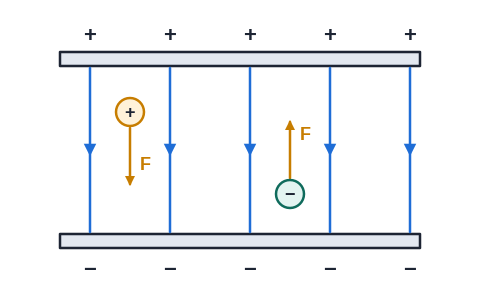
- Between parallel plates the field is uniform: straight, evenly spaced lines from the positive plate to the negative plate.
- Field strength E = V/d, in V m⁻¹ (the same as N C⁻¹), and the force on a charge in the field is F = Eq.
- A positive charge is pushed along the field lines and a negative charge against them, with the same force anywhere between the plates.
- Moving a charge across a gap d changes its electric potential energy by Ep = Eqd, which can become kinetic energy, ½mv².
- A charge entering the field sideways follows a parabola, and a charged drop floats when Eq balances mg.
Charge and the electron
- Charge (q) is measured in coulombs (C); an object becomes charged when it gains electrons (negative) or loses electrons (positive), while its protons stay put.
- Every electron carries a charge of 1.6 × 10⁻¹⁹ C, so any charge is a whole number of these: q = ne, where n is the number of extra or missing electrons.
- Like charges repel and unlike charges attract without touching, because each charge sits in the other's electric field.
- An electric field is a region where a charge feels a force; an uncharged object in a uniform field feels no overall electric force.
| Quantity | Value |
|---|---|
| Charge on an electron (e) | 1.6 × 10⁻¹⁹ C (negative) |
| Mass of an electron | 9.1 × 10⁻³¹ kg |
| Gravitational field strength (g) | 9.8 N kg⁻¹ |
The uniform field between parallel plates
- Connect two flat metal plates to the terminals of a battery and they take opposite charges: the plate joined to the positive terminal becomes positive.
- Field lines show the direction of the force on a small positive charge, so they start on the positive plate and end on the negative plate.
- Between the plates the lines are straight, parallel, evenly spaced and at right angles to the plates: the field is uniform, the same strength at every point.
- Near the edges the lines bow outwards, but questions only ask about the region between the plates.
- A positive charge is pushed along the field lines, towards the negative plate; an electron is pushed the opposite way, towards the positive plate.
Try it: a charge between plates
Field strength: E = V/d and F = Eq
- Electric field strength E is the force on each coulomb of charge, so F = Eq, and E can be given in N C⁻¹.
- Between parallel plates E = V/d, where V is the voltage across the plates and d is the gap in metres, which gives V m⁻¹; the two units are the same thing.
- A bigger voltage or a smaller gap makes a stronger field, and so a bigger force on the same charge.
- Because the field is uniform, a charge feels the same force next to either plate as it does in the middle.
- Convert first: 5.0 mm is 5.0 × 10⁻³ m, 2.0 cm is 0.020 m and 3.0 kV is 3000 V.
Example: the force on an electron
- Two plates 2.0 cm apart are connected to a 600 V supply.
- Find the field strength, then how big the force on an electron between them is and which way it acts.
- d = 2.0 cm = 0.020 mconvert to metres first
- E = V ÷ d = 600 ÷ 0.020 = 3.0 × 10⁴ V m⁻¹uniform field between the plates
- F = Eq = 3.0 × 10⁴ × 1.6 × 10⁻¹⁹ = 4.8 × 10⁻¹⁵ Nuse the size of the charge
- F = 4.8 × 10⁻¹⁵ N, towards the positive plate
- the electron is negative, so it is pushed against the field lines
Work, potential energy and speed
- To move a positive charge towards the positive plate you push it against the field, so you do work on it and its electric potential energy rises.
- Work = force × distance, so the change in potential energy across a distance d is Ep = Fd = Eqd.
- Let the charge go and the field does the work instead: the potential energy becomes kinetic energy, so Eqd = ½mv² for a charge that starts at rest.
- Since E = V/d, Eqd is the same as qV: crossing the whole gap, each coulomb gains energy equal to the voltage, whatever the spacing.
- E is the field strength in V m⁻¹ and Ep is an energy in joules; using the field value as the energy is one of the commonest lost marks.
Example: how fast does the electron arrive?
- An electron starts at rest on the negative plate of a pair of plates 5.0 mm apart, with 250 V across them.
- Find the energy it gains and its speed when it reaches the positive plate (electron mass 9.1 × 10⁻³¹ kg).
- d = 5.0 mm = 5.0 × 10⁻³ mconvert to metres
- E = V ÷ d = 250 ÷ 5.0 × 10⁻³ = 5.0 × 10⁴ V m⁻¹
- Ep = Eqd = 5.0 × 10⁴ × 1.6 × 10⁻¹⁹ × 5.0 × 10⁻³ = 4.0 × 10⁻¹⁷ Jenergy the field gives the electron
- qV = 1.6 × 10⁻¹⁹ × 250 = 4.0 × 10⁻¹⁷ J
- ½mv² = Ep, so v = √(2Ep ÷ m) = √(2 × 4.0 × 10⁻¹⁷ ÷ 9.1 × 10⁻³¹)all the potential energy becomes kinetic energy
- v = √(8.79 × 10¹³) = 9.4 × 10⁶ m s⁻¹
- about 3% of the speed of light, normal for an electron accelerated by a few hundred volts
A charge fired between the plates
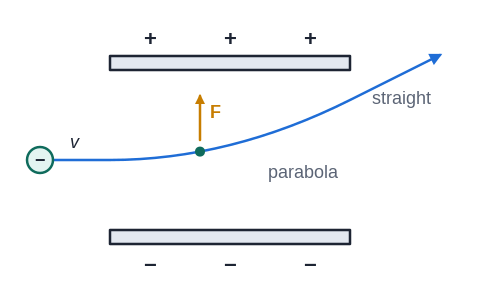
- An electron that enters the field moving parallel to the plates feels a constant force at right angles to its motion, towards the positive plate.
- Along the plates nothing pushes it, so that part of its velocity stays the same; towards the positive plate it speeds up steadily, with a = F ÷ m.
- Steady motion one way plus constant acceleration the other way gives a parabola, the same shape as the path of a ball thrown horizontally.
- Once it leaves the plates there is no field, so it carries on in a straight line.
- A positive charge curves the other way, towards the negative plate, and a heavier particle with the same charge curves less.
Example: holding a drop still
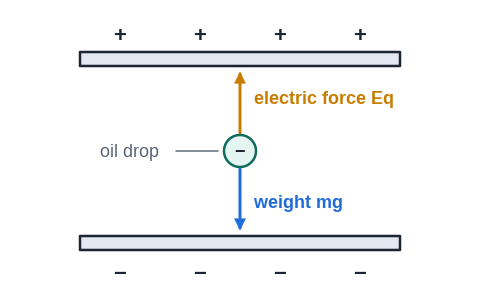
- An oil drop of mass 3.2 × 10⁻¹⁵ kg carries 5 extra electrons and floats, not moving, between horizontal plates 1.5 cm apart.
- Find the voltage across the plates and say which plate is positive (g = 9.8 N kg⁻¹).
- q = ne = 5 × 1.6 × 10⁻¹⁹ = 8.0 × 10⁻¹⁹ C
- weight: mg = 3.2 × 10⁻¹⁵ × 9.8 = 3.14 × 10⁻¹⁴ Nacts downwards
- Eq = mg, so E = mg ÷ q = 3.14 × 10⁻¹⁴ ÷ 8.0 × 10⁻¹⁹ = 3.92 × 10⁴ V m⁻¹the drop is still, so the forces balance
- V = Ed = 3.92 × 10⁴ × 0.015 = 588 V1.5 cm = 0.015 m
- V = 590 V, with the top plate positivea negative drop needs an upward force, so the field points down
- Eq = 3.92 × 10⁴ × 8.0 × 10⁻¹⁹ = 3.14 × 10⁻¹⁴ N, equal to the weight
Try it: predict the push
What Achieved, Merit and Excellence look like
- Achieved gives a correct statement or a one-step calculation; Merit links two ideas with a formula; Excellence connects the formulae to reach a conclusion that is not obvious at the start.
- In a discussion, name the quantity that stays constant before you say what changes.
| Grade | A model answer |
|---|---|
| Achieved | The field gets weaker, so the force on the electron is smaller. |
| Merit | V stays the same and d doubles, so by E = V/d the field halves; with F = Eq and the same charge, the force halves too. |
| Excellence | The field and the force halve (E = V/d, F = Eq), but the electron is pushed over twice the distance. Ep = Eqd = (V/d) × q × d = qV, which does not depend on d, so it gains the same kinetic energy and arrives at the same speed, only later. |
Common mistakes
- E = 5.0 × 10⁴ V m⁻¹, so the electron gains 5.0 × 10⁴ J of energy.That is the field strength, not an energy; the energy is Ep = Eqd, which here is only 4.0 × 10⁻¹⁷ J.
- Field lines go from the negative plate to the positive plate, the way the electrons move.Field lines show the push on a positive charge, so they always run from the positive plate to the negative plate.
- With the plates 5.0 mm apart, E = 250 ÷ 5.0 = 50 V m⁻¹.Convert to metres first: E = 250 ÷ 0.0050 = 5.0 × 10⁴ V m⁻¹, a thousand times bigger.
- A drop with 4 extra electrons has a charge of 4 C.Each electron carries 1.6 × 10⁻¹⁹ C, so q = ne = 4 × 1.6 × 10⁻¹⁹ = 6.4 × 10⁻¹⁹ C.
Bend water with a charged balloon
You need: a balloon, dry hair or a wool jumper, a kitchen tap, a tissue torn into small pieces, a ruler
- Tear a tissue into pieces about the size of your fingernail and spread them on the table.
- Blow up the balloon, tie it, and rub it on dry hair or wool for 20 seconds so it picks up extra electrons.
- Lower the balloon slowly over the tissue and use the ruler to measure the height at which the first pieces jump up.
- Turn the tap on to a thin, smooth stream, rub the balloon again and bring it close to the stream without touching the water.
- Look for: the pieces only jump when the balloon is close and the stream bends towards it; the balloon's field is strongest close up, so the side of each piece nearest the balloon is pulled harder than the far side is pushed.
Safety: Burst balloon pieces can choke small children, so pick them all up, and use a different balloon if anyone in the house is allergic to latex.
Your turn
Plates 4.0 cm apart have 200 V across them. What is the field strength?
What force does a proton feel in that field?
A dust grain carries a charge of 4.8 × 10⁻¹⁸ C. How many extra electrons does it have?
An electron crosses from the negative to the positive plate of a pair 3.0 mm apart with 1500 V across them. How much energy does it gain?
A field of 2.0 × 10⁴ V m⁻¹ pushes a charged drop with a force of 6.4 × 10⁻¹⁴ N. What is the drop's charge?
Show answer
1. E = V ÷ d = 200 ÷ 0.040 = 5.0 × 10³ V m⁻¹ (5000 V m⁻¹). 2. F = Eq = 5.0 × 10³ × 1.6 × 10⁻¹⁹ = 8.0 × 10⁻¹⁶ N, in the direction of the field. 3. n = q ÷ e = 4.8 × 10⁻¹⁸ ÷ 1.6 × 10⁻¹⁹ = 30 electrons. 4. E = 1500 ÷ 0.0030 = 5.0 × 10⁵ V m⁻¹; Ep = Eqd = 5.0 × 10⁵ × 1.6 × 10⁻¹⁹ × 0.0030 = 2.4 × 10⁻¹⁶ J. 5. q = F ÷ E = 6.4 × 10⁻¹⁴ ÷ 2.0 × 10⁴ = 3.2 × 10⁻¹⁸ C.
Exam-style question: a model smoke filter
- Mere's class builds a model chimney filter: smoke rises between two vertical metal plates 4.0 cm apart, connected to a 3000 V supply. One smoke particle picks up 120 extra electrons. Ignore gravity.
Describe the electric field between the plates.
Calculate the electric field strength between the plates.
Calculate the size of the electric force on the smoke particle, and state its direction.
The particle starts next to the negative plate. Calculate the energy the field gives it by the time it reaches the positive plate.
The supply is turned down to 1500 V. Discuss how this changes the force on the particle and the energy it gains crossing the gap.
Show answer
1. Uniform: straight, parallel, evenly spaced lines at right angles to the plates, pointing from the positive plate to the negative plate (Achieved). 2. E = V ÷ d = 3000 ÷ 0.040 = 7.5 × 10⁴ V m⁻¹ (Achieved). 3. q = ne = 120 × 1.6 × 10⁻¹⁹ = 1.92 × 10⁻¹⁷ C; F = Eq = 7.5 × 10⁴ × 1.92 × 10⁻¹⁷ = 1.4 × 10⁻¹² N, towards the positive plate because the particle is negative (Merit: two linked steps and a direction). 4. Ep = Eqd = 7.5 × 10⁴ × 1.92 × 10⁻¹⁷ × 0.040 = 5.8 × 10⁻¹⁴ J; check: qV = 1.92 × 10⁻¹⁷ × 3000 = 5.76 × 10⁻¹⁴ J (Merit). 5. Achieved: a smaller voltage gives a weaker field and a smaller force. Merit: d is fixed, so halving V halves E (E = V/d), and with the same charge F = Eq halves too. Excellence: E and F both halve while the particle still crosses the same 0.040 m, so Ep = Eqd halves to 2.9 × 10⁻¹⁴ J (the same as qV with half the voltage); the particle arrives later and with half the energy.
Charges and Fields
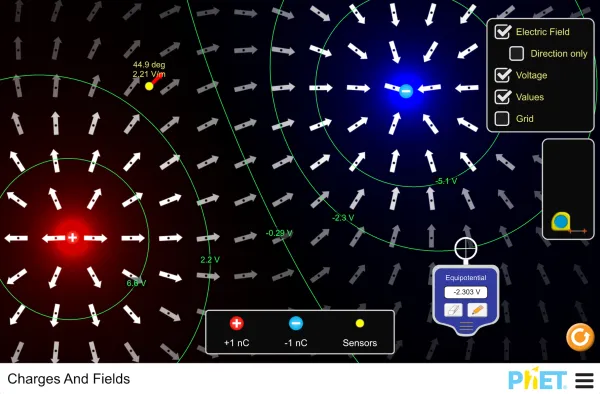
Full screen · PhET Interactive Simulations, University of Colorado Boulder, CC BY 4.0
Recap
- Charge comes in whole electrons: q = ne, with e = 1.6 × 10⁻¹⁹ C.
- Parallel plates make a uniform field from + to −, with E = V/d in V m⁻¹.
- F = Eq: positive charges are pushed along the field, electrons against it.
- Crossing the gap, Ep = Eqd (which equals qV) can become ½mv².
- A charge moving sideways follows a parabola; a floating drop has Eq = mg.
| Formula | Use it to find |
|---|---|
| E = V/d | field strength from the voltage and the gap |
| F = Eq | the force on a charge in the field |
| Ep = Eqd | energy gained, or work done, crossing a distance d |
| Ek = ½mv² | speed from kinetic energy |
| q = ne | charge from a number of electrons |
Challenge
Two parallel plates are 2.0 cm apart with 40 V across them. The positive plate has a small hole in it, and an electron is fired through the hole at 3.0 × 10⁶ m s⁻¹, heading straight towards the negative plate. (a) How far does the electron get before it stops? (b) Does it reach the negative plate, and how fast is it moving when it comes back out through the hole? (c) What is the smallest voltage that would stop the electron before it reaches the negative plate? (electron mass 9.1 × 10⁻³¹ kg, e = 1.6 × 10⁻¹⁹ C)
Hint
An electron is pushed towards the positive plate, so here the field slows it down. Its kinetic energy is used up as work done against the force: ½mv² = Eqx, where x is the distance it travels.
Answer
(a) About 1.3 cm (1.28 cm). (b) No; it stops, turns round and comes back out of the hole at 3.0 × 10⁶ m s⁻¹. (c) Just over 25.6 V (about 26 V).
Step by step
- The force on an electron points towards the positive plate, so an electron heading away from that plate is slowed down.
- Find its kinetic energy, then the field strength and the constant force on it.
- The distance it travels before stopping is its kinetic energy divided by the force, because work = force × distance.
- On the way back the same force does the same work in the other direction, so it regains all its kinetic energy.
- To stop it before the far plate, the energy needed to cross the whole gap, qV, must be at least its kinetic energy.
Full working
- Ek = ½mv² = 0.5 × 9.1 × 10⁻³¹ × (3.0 × 10⁶)² = 4.10 × 10⁻¹⁸ Jkinetic energy at the hole
- E = V ÷ d = 40 ÷ 0.020 = 2.0 × 10³ V m⁻¹uniform field
- F = Eq = 2.0 × 10³ × 1.6 × 10⁻¹⁹ = 3.2 × 10⁻¹⁶ Nforce towards the positive plate
- x = Ek ÷ F = 4.10 × 10⁻¹⁸ ÷ 3.2 × 10⁻¹⁶ = 0.0128 mEqx = ½mv²
- 0.0128 m is less than 0.020 m, so it turns backthe field then returns all the energy
- qV ≥ Ek, so V ≥ 4.10 × 10⁻¹⁸ ÷ 1.6 × 10⁻¹⁹ = 25.6 Venergy to cross the whole gap
- (a) 1.3 cm (b) no, it leaves at 3.0 × 10⁶ m s⁻¹ (c) about 26 V
A tiny oil drop floats still between horizontal plates 1.2 cm apart when the voltage is 490 V. An X-ray knocks one more electron onto the drop, and now it floats still when the voltage is turned down to 392 V. (a) How many extra electrons did the drop carry at first? (b) What is the drop's mass? (c) Which plate is positive? (g = 9.8 N kg⁻¹, e = 1.6 × 10⁻¹⁹ C)
Hint
The weight does not change, so Eq stays the same in both cases. With the same gap, a drop with more charge needs a smaller voltage. Call the first number of electrons n and the second n + 1.
Answer
(a) 4 electrons. (b) About 2.7 × 10⁻¹⁵ kg. (c) The top plate is positive.
Step by step
- While the drop floats, the electric force balances its weight, so Eq = mg both times.
- The weight is the same and E = Vd with the same gap, so V × q is the same both times.
- Write q as n electrons first and n + 1 electrons after, then solve for n.
- Use the first case to find the field and the charge, then the mass from mg = Eq.
- A negative drop needs an upward force, so the field must point down, from a positive top plate.
Full working
- V₁ × ne = V₂ × (n + 1)eEq = mg and d is the same, so Vq is constant
- 490n = 392(n + 1)substitute the two voltages
- 98n = 392, so n = 4first charge: 4 electrons
- E = 490 ÷ 0.012 = 4.08 × 10⁴ V m⁻¹field at 490 V
- q = 4 × 1.6 × 10⁻¹⁹ = 6.4 × 10⁻¹⁹ Cq = ne
- m = Eq ÷ g = 4.08 × 10⁴ × 6.4 × 10⁻¹⁹ ÷ 9.8 = 2.67 × 10⁻¹⁵ kgEq = mg
- Check: 5 electrons at 392 V gives 392 × 5 = 1960 = 490 × 4same Vq
- (a) 4 electrons (b) 2.7 × 10⁻¹⁵ kg (c) top plate positive
An electron enters the gap between two horizontal plates exactly halfway between them, moving parallel to the plates at 2.0 × 10⁷ m s⁻¹. The plates are 5.0 cm long and 1.0 cm apart. (a) Find the largest voltage across the plates for which the electron still gets out of the far end without hitting a plate. (b) At that voltage, show that the energy the field gives the electron is exactly half of e × V, and explain why. (c) At what angle to the plates is it moving as it leaves? (electron mass 9.1 × 10⁻³¹ kg, e = 1.6 × 10⁻¹⁹ C)
Hint
Treat it like a ball thrown horizontally: the time between the plates comes from the steady sideways speed. At the limit the electron just grazes the end of a plate, so in that time it moves 0.50 cm across the gap, starting with no speed in that direction.
Answer
(a) 91 V. (b) The energy gained is 7.28 × 10⁻¹⁸ J, which equals ½ × e × 91, because the electron only crosses half the gap. (c) About 11° to the plates.
Step by step
- Along the plates nothing pushes the electron, so the time inside is the plate length divided by its speed.
- Across the plates it starts from rest and speeds up steadily; to just miss the plate it moves 0.50 cm in that time, which gives its acceleration.
- F = ma gives the force, E = F ÷ q the field and V = Ed the voltage.
- The energy given is Eq times the distance moved along the field, and that distance is only half the gap.
- At the exit, the velocity across the plates is a × t; with the unchanged speed along the plates, tan θ gives the angle.
Full working
- t = 0.050 ÷ 2.0 × 10⁷ = 2.5 × 10⁻⁹ ssteady speed along the plates
- 0.0050 = ½ a (2.5 × 10⁻⁹)², so a = 1.6 × 10¹⁵ m s⁻²half the gap, from rest across the field
- F = ma = 9.1 × 10⁻³¹ × 1.6 × 10¹⁵ = 1.456 × 10⁻¹⁵ NNewton's second law
- E = F ÷ q = 1.456 × 10⁻¹⁵ ÷ 1.6 × 10⁻¹⁹ = 9100 V m⁻¹F = Eq
- V = Ed = 9100 × 0.010 = 91 VE = Vd
- Ep = Eqd = 9100 × 1.6 × 10⁻¹⁹ × 0.0050 = 7.28 × 10⁻¹⁸ Jonly 0.50 cm along the field
- ½ × e × V = 0.5 × 1.6 × 10⁻¹⁹ × 91 = 7.28 × 10⁻¹⁸ Jthe same, because it crosses half the gap
- v across = at = 1.6 × 10¹⁵ × 2.5 × 10⁻⁹ = 4.0 × 10⁶ m s⁻¹gained across the plates
- tan θ = 4.0 × 10⁶ ÷ 2.0 × 10⁷ = 0.20, θ = 11.3°velocity components
- (a) 91 V (b) 7.28 × 10⁻¹⁸ J = ½eV (c) about 11°