
Reactions of organic compounds
What this lesson covers
- Addition to alkenes: H₂ with a Pt catalyst, Cl₂ or Br₂, hydrogen halides, and water with an acid catalyst.
- Markovnikov's rule: on an asymmetric alkene, the H adds to the carbon that already has more H atoms, giving the major product.
- Substitution: alkanes with halogens in UV light, alcohols to haloalkanes, and haloalkanes to alcohols with KOH(aq) or to amines with NH₃.
- Elimination: alcohols with concentrated H₂SO₄ and haloalkanes with KOH(alc) give alkenes, with major and minor products.
- Oxidation of primary alcohols to carboxylic acids with acidified dichromate or permanganate, and of alkenes with permanganate.
- Carboxylic acids as weak acids and amines as weak bases, and addition polymerisation of alkenes.
Six kinds of reaction
- Every Level 2 organic reaction is one of a few types, and the type is set by the functional group and the reagent.
- In answers, give the type, the reagent and the conditions (heat, a catalyst, UV light, concentrated or aqueous), and draw the organic product.
| Type | What happens | Example |
|---|---|---|
| Addition | two molecules join into one; a C=C becomes C–C | ethene + Br₂ → 1,2-dibromoethane |
| Substitution | one atom or group swaps for another | chloroethane + KOH(aq) → ethanol + KCl |
| Elimination | a small molecule (H₂O or HX) leaves, making a C=C | ethanol → ethene + H₂O (conc. H₂SO₄, heat) |
| Oxidation | a primary alcohol becomes a carboxylic acid | ethanol → ethanoic acid (Cr₂O₇²⁻/H⁺, heat) |
| Acid-base | a proton moves to or from the functional group | ethanoic acid + NaOH → sodium ethanoate + water |
| Polymerisation | many alkene molecules add together | ethene → polyethene |
Try it: name the reaction
Addition to alkenes
- Alkenes are unsaturated: one bond of the C=C breaks and each of its carbons gains a new atom or group, leaving a saturated product.
- H₂ with a platinum (Pt) catalyst gives an alkane: ethene becomes ethane.
- Cl₂ or Br₂ add across the double bond: propene and bromine give 1,2-dibromopropane. Orange bromine water loses its colour quickly, which is the test for a C=C; an alkane only does so slowly, in UV light, by substitution.
- Hydrogen halides add an H and a halogen: ethene and HCl give chloroethane.
- Water adds with an acid catalyst (concentrated H₂SO₄, then water) to make an alcohol: ethene gives ethanol.
- Alkynes can add twice, because the triple bond can open twice: ethyne with excess H₂ on Pt gives ethane.
Try it: alkenes and their products
Major and minor products: Markovnikov's rule
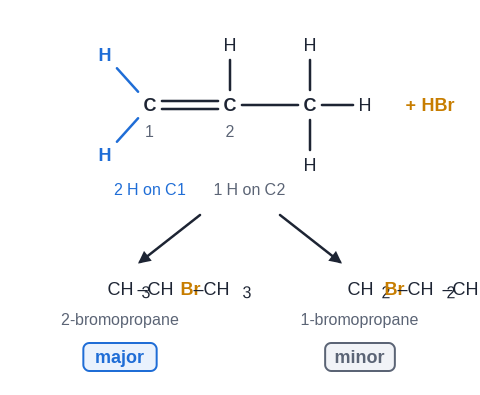
- When HX or H₂O adds to an asymmetric alkene, one whose double-bond carbons carry different numbers of H atoms, two products are possible.
- Markovnikov's rule: the H goes mainly to the carbon of the double bond that already has more H atoms, and the Cl, Br or OH to the other carbon.
- Propene and HBr give mainly 2-bromopropane (major), with some 1-bromopropane (minor).
- Propene and water with an acid catalyst give propan-2-ol (major) and propan-1-ol (minor).
- Symmetric alkenes such as ethene and but-2-ene give one product, and so does H₂, Cl₂ or Br₂ with any alkene, because both added atoms are the same.
Substitution reactions
- Alkanes are unreactive, but with Cl₂ or Br₂ in UV light one H atom is swapped for a halogen: methane and chlorine give chloromethane and HCl.
- Alcohols become haloalkanes when the OH is swapped for a halogen, using HCl or HBr, or PCl₃, PCl₅ or SOCl₂: propan-1-ol and HCl give 1-chloropropane and water.
- Haloalkanes heated with aqueous KOH swap the halogen for OH and become alcohols: 1-bromobutane gives butan-1-ol and KBr.
- Haloalkanes heated with ammonia in alcohol swap the halogen for NH₂ and become amines: chloroethane gives ethanamine.
- Substitution changes the functional group but not the carbon chain, so the new group keeps the old group's position number.
Elimination
- Elimination removes a small molecule from two neighbouring carbons and leaves a C=C double bond.
- Alcohols lose water when heated with concentrated H₂SO₄: ethanol gives ethene.
- Haloalkanes lose HX when heated with KOH dissolved in alcohol, KOH(alc): 2-chloropropane gives propene.
- The solvent decides the reaction: KOH(aq) substitutes to give an alcohol, while KOH(alc) eliminates to give an alkene.
- If the OH or halogen is on an inner carbon with two different neighbours, two alkenes form. The major one comes from removing the H from the neighbouring carbon with fewer H atoms (Saytzeff's rule).
Example: butan-2-ol and concentrated H₂SO₄
- Butan-2-ol, CH₃CH(OH)CH₂CH₃, is heated with concentrated sulfuric acid. Name the products and say which is major.
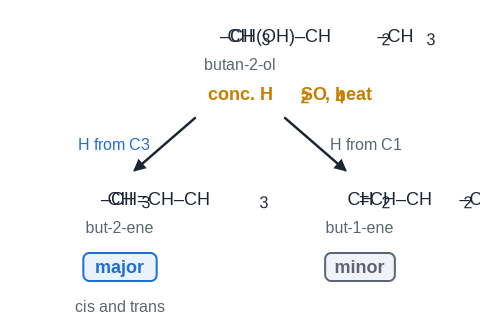
- the OH is on C2; its neighbours are C1 (CH₃, 3 H) and C3 (CH₂, 2 H)the H can leave from either neighbour
- H from C3: CH₃CH=CHCH₃, but-2-eneC3 has fewer H atoms, so this is the major product
- H from C1: CH₂=CHCH₂CH₃, but-1-enethe minor product
- but-2-ene forms as both cis and trans isomers
- major: but-2-ene; minor: but-1-ene
Oxidation of alcohols and alkenes
- Primary alcohols are oxidised to carboxylic acids when heated with acidified dichromate, Cr₂O₇²⁻/H⁺, or acidified permanganate, MnO₄⁻/H⁺: propan-1-ol gives propanoic acid.
- Dichromate turns from orange to green as Cr₂O₇²⁻ becomes Cr³⁺; permanganate turns from purple to colourless as MnO₄⁻ becomes Mn²⁺.
- Tertiary alcohols are not oxidised, so the colour stays. Secondary alcohols are oxidised to ketones, which belong to Level 3.
- Alkenes react with permanganate too: an OH adds to each carbon of the C=C, so ethene gives ethane-1,2-diol and the purple colour fades. Without acid, a brown solid, MnO₂, forms instead.
- Alkanes and haloalkanes react with neither oxidant, so a colour change shows that an alcohol or an alkene is present.
Try it: major, minor or no reaction
Carboxylic acids and amines as acids and bases
- Carboxylic acids are weak acids: in water some molecules give a proton to water, so their solutions turn blue litmus red.
- They fizz with carbonates and hydrogencarbonates as carbon dioxide forms: CH₃COOH + NaHCO₃ → CH₃COONa + H₂O + CO₂. Alcohols do not fizz, which tells the two apart.
- With hydroxides they form a salt and water: CH₃COOH + NaOH → CH₃COONa + H₂O.
- Amines are weak bases: the N accepts a proton from water, so their solutions turn red litmus blue, and small amines smell fishy.
- Amines react with acids to form salts: CH₃CH₂NH₂ + HCl → CH₃CH₂NH₃⁺Cl⁻.
Addition polymerisation
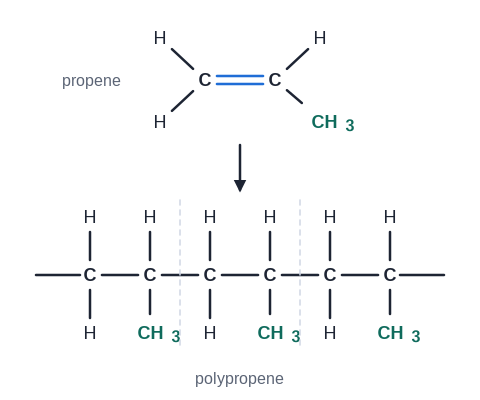
- An alkene monomer can join to many others: one bond of each C=C opens, and each monomer forms single bonds to its neighbours.
- Propene gives polypropene; the CH₃ becomes a side group on every second carbon of the chain.
- To draw the polymer, draw the monomer's two double-bonded carbons as a single-bonded pair carrying the same four groups, repeat the pair, and leave a bond open at each end.
- To find the monomer from a polymer, pick out the repeating two-carbon unit and put the double bond back between them.
- The polymer is saturated, with only C–C single bonds, so it is far less reactive than its monomer; that is why plastics such as polypropene and PTFE (Teflon, from CF₂=CF₂) are stable.
Example: following a reaction scheme
- Start with 1-chloropropane, CH₂ClCH₂CH₃. Give the product, the reaction type and the reagent for each step.
- 1-chloropropane + KOH(aq), heat → propan-1-olsubstitution: OH replaces Cl
- propan-1-ol + Cr₂O₇²⁻/H⁺, heat → propanoic acidoxidation of a primary alcohol; orange to green
- propanoic acid + Na₂CO₃ → sodium propanoate + CO₂ + H₂Oacid-base; it fizzes
- 1-chloropropane + KOH(alc), heat → propeneelimination of HCl
- propene + H₂O/H⁺ → propan-2-ol (major) and propan-1-ol (minor)addition, by Markovnikov's rule
- substitution keeps the OH on C1, but addition to propene puts it mainly on C2
What Achieved, Merit and Excellence look like
- Achieved names the products; Merit says why there are two and uses the rule; Excellence applies the rule to the actual structure, carbon by carbon.
| Grade | A model answer |
|---|---|
| Achieved | Two products form: 2-chloropropane and 1-chloropropane. |
| Merit | Propene is asymmetric, so the H and Cl can add either way round across the C=C. By Markovnikov's rule, 2-chloropropane is the major product. |
| Excellence | Propene is an asymmetric alkene: C1 of the double bond has two H atoms and C2 has one. HCl can add with H on C1 and Cl on C2, giving 2-chloropropane, or the other way round, giving 1-chloropropane. Markovnikov's rule says the H goes mainly to the carbon that already holds more H atoms (C1), so 2-chloropropane is major and 1-chloropropane is minor. |
Common mistakes
- 1-Bromopropane heated with KOH gives propene.It depends on the solvent: KOH(aq) substitutes to give propan-1-ol, and only KOH(alc) eliminates to give propene.
- In the major product, the Br adds to the carbon with more H atoms.It is the H that goes to the carbon with more H atoms; the Br goes to the other carbon.
- 2-Methylpropan-2-ol turns acidified dichromate green.It is a tertiary alcohol, so it is not oxidised and the dichromate stays orange.
- Polypropene is drawn with a double bond in each repeating unit.The double bonds open to form the chain, so the polymer has only single bonds and is saturated.
Acid or alcohol? The fizz test
You need: white vinegar, baking soda, sugar, water, 3 clear glasses, a teaspoon
- Pour a quarter of a cup of white vinegar into the first glass, and a quarter of a cup of water into each of the other two.
- Stir two teaspoons of sugar into the second glass until it dissolves, and leave the third as plain water.
- Add half a teaspoon of baking soda to each glass, one at a time, and look at each for 30 seconds.
- Look for: only the vinegar fizzes. Vinegar holds ethanoic acid, whose COOH group gives a proton to the hydrogencarbonate and makes carbon dioxide; sugar is covered in OH groups like an alcohol's, which do not, so nothing happens.
Safety: The vinegar can foam up quickly, so stand the glasses in a sink or tray and keep your face back so it cannot splash into your eyes.
Your turn
Ethene with H₂ and a Pt catalyst: give the type of reaction and the organic product.
Chloroethane heated with KOH(aq): type and product?
Propan-2-ol heated with concentrated H₂SO₄: type and product?
Butan-1-ol heated with Cr₂O₇²⁻/H⁺: type and product?
Propene with HCl: type and major product?
Show answer
1. Addition; ethane, CH₃CH₃. 2. Substitution; ethanol, CH₃CH₂OH, with KCl. 3. Elimination; propene, CH₂=CHCH₃, the only product, because both neighbours of C2 are CH₃ groups. 4. Oxidation; butanoic acid, CH₃CH₂CH₂COOH, and the orange dichromate turns green. 5. Addition; 2-chloropropane is major and 1-chloropropane minor, by Markovnikov's rule.
Exam-style question: starting from 2-bromobutane
- A chemist starts with 2-bromobutane, CH₃CHBrCH₂CH₃.
Classify 2-bromobutane as primary, secondary or tertiary, and give the reason.
Give the reagent and conditions that turn it into butan-2-ol, and the reaction type.
Heated with KOH(alc), 2-bromobutane gives two alkenes. Name both, say which is major, and justify your choice.
Describe how bromine water could tell the alkene products apart from 2-bromobutane.
Show answer
1. Secondary: the carbon holding the Br (C2) is bonded to two other carbons (Achieved). 2. KOH(aq) and heat; substitution, as OH replaces Br (Achieved). 3. But-2-ene, CH₃CH=CHCH₃, is major and but-1-ene, CH₂=CHCH₂CH₃, is minor. 2-Bromobutane is asymmetric about C2, so the H can be removed from C1 or C3 along with the Br; C3 has fewer H atoms (2) than C1 (3), so removing H from C3 gives the major product, but-2-ene, which forms as cis and trans isomers (Merit for the two products and the rule, Excellence for applying it to C1 and C3). 4. The alkenes turn orange bromine water colourless quickly, because Br₂ adds across the C=C; 2-bromobutane has no C=C, so the colour stays (Achieved for the observation, Merit for the reason).
Recap
- Addition opens a C=C; on an asymmetric alkene the H goes mainly to the carbon with more H atoms.
- KOH(aq) substitutes a haloalkane to an alcohol; KOH(alc) and concentrated H₂SO₄ eliminate to an alkene, mainly the one with the H taken from the carbon with fewer H atoms.
- Acidified dichromate (orange to green) or permanganate (purple to colourless) oxidises a primary alcohol to a carboxylic acid; tertiary alcohols do not react.
- Carboxylic acids turn blue litmus red and fizz with carbonates; amines turn red litmus blue and form salts with acids.
- Alkenes join into saturated addition polymers that are much less reactive than the monomer.
| Starting compound | Reagent and conditions | Product |
|---|---|---|
| alkene | H₂/Pt; Cl₂ or Br₂; HX; H₂O/H⁺ | alkane; dihaloalkane; haloalkane; alcohol |
| alkane | Cl₂ or Br₂, UV light | haloalkane + HX |
| alcohol | HCl, HBr, PCl₃, PCl₅ or SOCl₂ | haloalkane |
| alcohol | conc. H₂SO₄, heat | alkene + H₂O |
| primary alcohol | Cr₂O₇²⁻/H⁺ or MnO₄⁻/H⁺, heat | carboxylic acid |
| haloalkane | KOH(aq), heat | alcohol |
| haloalkane | KOH(alc), heat | alkene |
| haloalkane | NH₃ in alcohol, heat | amine |
Challenge
Compound A is a haloalkane with the formula C₄H₉Br. Heated with KOH(alc), A gives only one alkene, B. When B reacts with HBr, the major product is A again. (a) Identify A and B, and show that the other three bromoalkanes with formula C₄H₉Br fail at least one clue. (b) A is heated with KOH(aq) to give C. Name C and predict what you would see if C were heated with acidified dichromate.
Hint
List the four C₄H₉Br isomers. For each, ask how many different alkenes elimination can give, then add HBr to that alkene using Markovnikov's rule and see where the Br ends up.
Answer
A is 2-bromo-2-methylpropane and B is 2-methylpropene. C is 2-methylpropan-2-ol, a tertiary alcohol, so the dichromate stays orange.
Step by step
- The four isomers are 1-bromobutane, 2-bromobutane, 1-bromo-2-methylpropane and 2-bromo-2-methylpropane.
- 2-Bromobutane gives two alkenes (but-1-ene and but-2-ene), so it fails the first clue.
- 1-Bromobutane gives only but-1-ene, but HBr adds to it mainly as 2-bromobutane, not 1-bromobutane.
- 1-Bromo-2-methylpropane gives only 2-methylpropene, but HBr adds the H to the CH₂ end, putting the Br on the central carbon: 2-bromo-2-methylpropane, not the starting compound.
- 2-Bromo-2-methylpropane has three identical CH₃ neighbours, so it gives only 2-methylpropene, and Markovnikov addition of HBr to that gives it back: it fits both clues.
- KOH(aq) substitutes OH for Br without changing the chain, giving 2-methylpropan-2-ol, which is tertiary and is not oxidised.
Full working
- 2-bromobutane → but-1-ene + but-2-enetwo alkenes, fails clue 1
- 1-bromobutane → but-1-ene; + HBr → 2-bromobutane (major)fails clue 2
- 1-bromo-2-methylpropane → 2-methylpropene; + HBr → 2-bromo-2-methylpropanefails clue 2
- (CH₃)₃CBr → CH₂=C(CH₃)₂ onlyall three neighbours are CH₃
- CH₂=C(CH₃)₂ + HBr → (CH₃)₃CBr (major)H to CH₂, the carbon with more H
- (CH₃)₃CBr + KOH(aq) → (CH₃)₃COH + KBrsubstitution
- A 2-bromo-2-methylpropane, B 2-methylpropene, C 2-methylpropan-2-ol; dichromate stays orange
A technician has plenty of butan-1-ol but needs butan-2-ol. (a) Plan a two-step route, giving the reagents, conditions and reaction type for each step, and explain why the final product is mainly butan-2-ol. (b) A second technician tries the reverse: turning butan-2-ol into butan-1-ol by the same two kinds of step. Explain, step by step, why this route gives almost no butan-1-ol.
Hint
Removing the OH and putting it back can move it, because the elimination and the addition each have a rule about which product is major. Apply both rules to each route and follow where the C=C and then the OH end up.
Answer
(a) Heat butan-1-ol with concentrated H₂SO₄ (elimination) to get but-1-ene only, then add water with an acid catalyst (addition); by Markovnikov's rule the major product is butan-2-ol. (b) Butan-2-ol eliminates mainly to but-2-ene, which can only give butan-2-ol on hydration; the minor but-1-ene also gives mainly butan-2-ol.
Step by step
- Butan-1-ol has its OH on C1, whose only carbon neighbour is C2, so elimination can only form the C=C between C1 and C2: but-1-ene is the only alkene.
- Adding water to but-1-ene: C1 has 2 H atoms and C2 has 1, so the H goes mainly to C1 and the OH to C2, giving mainly butan-2-ol.
- In reverse, butan-2-ol has neighbours C1 (3 H) and C3 (2 H); the H is removed mainly from C3, so the major alkene is but-2-ene.
- But-2-ene is symmetric, so adding water puts the OH on C2 (or C3, which is the same molecule): only butan-2-ol forms.
- Even the minor alkene, but-1-ene, gives mainly butan-2-ol by Markovnikov's rule, so very little butan-1-ol is made.
Full working
- CH₃CH₂CH₂CH₂OH → CH₂=CHCH₂CH₃ + H₂Oconc. H₂SO₄, heat; elimination; only one alkene possible
- CH₂=CHCH₂CH₃ + H₂O → CH₃CH(OH)CH₂CH₃ (major)H₂O with acid catalyst; addition; H to C1
- CH₃CH(OH)CH₂CH₃ → CH₃CH=CHCH₃ (major) + CH₂=CHCH₂CH₃ (minor)H mainly from C3, fewer H
- CH₃CH=CHCH₃ + H₂O → CH₃CH(OH)CH₂CH₃ onlysymmetric alkene
- CH₂=CHCH₂CH₃ + H₂O → mainly CH₃CH(OH)CH₂CH₃the minor route still favours C2
- (a) works: butan-1-ol → but-1-ene → butan-2-ol; (b) fails: both steps steer the OH back to C2
An unknown hydrocarbon, 0.840 g, decolourises bromine water quickly and reacts with exactly 1.60 g of Br₂. (Molar masses: Br₂ 160 g mol⁻¹, C 12.0 g mol⁻¹, H 1.0 g mol⁻¹.) The compound has cis and trans isomers, and when it reacts with water and an acid catalyst it gives one alcohol only. (a) Find its molar mass and molecular formula. (b) Identify the compound, explaining how each clue rules out other possibilities. (c) Name the product with Br₂ and the alcohol formed.
Hint
Fast decolourising means one C=C, so one Br₂ molecule adds to each alkene molecule. That turns the mass of Br₂ into the number of moles of alkene. For the last clue, think about when adding H and OH to the two carbons of the C=C can give only one product.
Answer
(a) 84 g mol⁻¹, C₆H₁₂. (b) Hex-3-ene, CH₃CH₂CH=CHCH₂CH₃. (c) 3,4-dibromohexane and hexan-3-ol.
Step by step
- Moles of Br₂ = 1.60 ÷ 160 = 0.0100 mol, and one Br₂ adds per C=C, so there are 0.0100 mol of alkene.
- Molar mass = 0.840 g ÷ 0.0100 mol = 84 g mol⁻¹. An alkene is CₙH₂ₙ with molar mass 14n, so n = 6: C₆H₁₂.
- One alcohol only means the alkene is symmetric: both C=C carbons carry the same groups, so it makes no difference which way round H and OH add.
- The symmetric C₆H₁₂ alkenes are hex-3-ene and 2,3-dimethylbut-2-ene. Cis and trans need two different groups on each C=C carbon; 2,3-dimethylbut-2-ene has two CH₃ on each, so it is ruled out.
- Hex-3-ene has H and C₂H₅ on each C=C carbon, so it has cis and trans forms and fits every clue.
- Br₂ adds across C3 and C4 to give 3,4-dibromohexane; water gives hexan-3-ol.
Full working
- n(Br₂) = 1.60 ÷ 160 = 0.0100 moln = m ÷ M
- n(alkene) = 0.0100 mol1 Br₂ adds per C=C
- M = 0.840 ÷ 0.0100 = 84 g mol⁻¹M = m ÷ n
- 14n = 84, so n = 6: C₆H₁₂CₙH₂ₙ has mass 12n + 2n
- symmetric C₆H₁₂: hex-3-ene, 2,3-dimethylbut-2-eneone alcohol only
- (CH₃)₂C=C(CH₃)₂: no cis and transtwo CH₃ on each C=C carbon
- CH₃CH₂CH=CHCH₂CH₃ + Br₂ → CH₃CH₂CHBrCHBrCH₂CH₃addition
- C₆H₁₂, hex-3-ene; products 3,4-dibromohexane and hexan-3-ol