
DNA replication, mitosis and the cell cycle
What this lesson covers
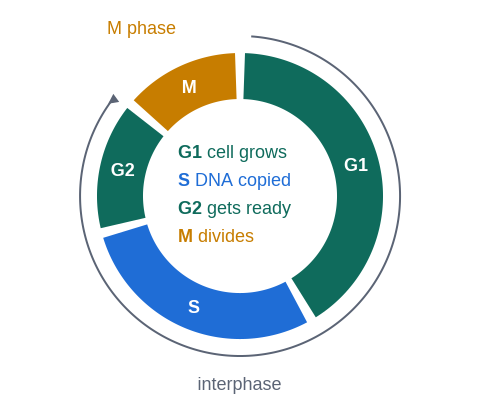
- The cell cycle is interphase (growth, DNA replication, getting ready) followed by mitosis and cytokinesis.
- DNA is copied before division by semi-conservative replication: the strands unzip, each acts as a template, and complementary nucleotides are added in the antiparallel direction.
- In mitosis the chromosomes condense, line up at the equator, have their sister chromatids pulled to opposite poles, and end up in two new nuclei.
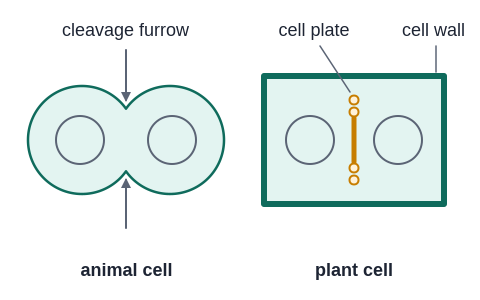
- Animal cells split by a cleavage furrow; plant cells build a cell plate that becomes a new cell wall.
- Mitosis makes two genetically identical cells, which is how organisms grow, repair damage and keep each cell small enough for a high surface area to volume ratio.
The cell cycle
- The cell cycle is the life of a dividing cell, from the moment it is made until it splits into two.
- Most of the time is interphase, which is not a resting stage: in G1 the cell grows and makes new organelles and proteins, in S it copies all of its DNA, and in G2 it keeps growing and makes the proteins it needs for division.
- The short M phase is mitosis (sharing the copied chromosomes between two nuclei) followed by cytokinesis (splitting the cytoplasm to make two cells).
- Cells that no longer divide, such as most nerve cells and mature muscle cells, leave the cycle after G1 and stay in a non-dividing state often called G0.
- Checkpoints between the stages stop the cycle if the DNA is damaged or not fully copied; when those controls fail, cells can keep dividing and form a tumour.
- The exam does not need the stage names, but using them correctly makes a description clear and precise.
DNA replication: copying before dividing
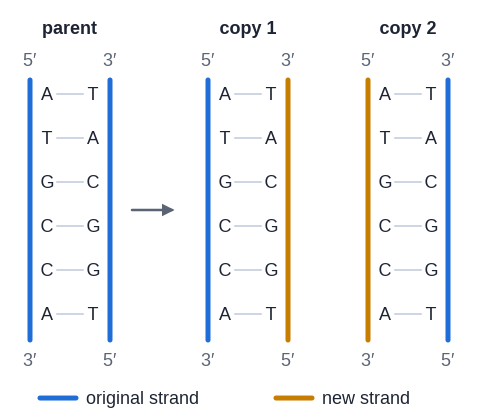
- DNA is two strands of nucleotides held together by hydrogen bonds between complementary bases: adenine pairs with thymine and cytosine pairs with guanine. The strands are antiparallel, running in opposite directions (5′ to 3′ and 3′ to 5′).
- In the S phase, the enzyme helicase unwinds the double helix and breaks the hydrogen bonds, unzipping the two strands.
- Each old strand is a template: free DNA nucleotides in the nucleus pair with the exposed bases (A with T, C with G), and DNA polymerase joins them into a new strand.
- DNA polymerase can only add nucleotides to the 3′ end of a growing strand, so the two new strands are built in opposite directions; one is made in short pieces that the enzyme ligase joins together.
- Each new molecule has one original strand and one new strand, so replication is called semi-conservative.
- Because each base can pair with only one partner, both copies have exactly the same base sequence as the original, which is why the cells mitosis makes carry identical genetic information.
Try it: base pairing
Chromosomes, chromatids and centromeres
- A chromosome is one long DNA molecule wrapped around proteins; human body cells have 46, in 23 pairs, and onion cells have 16.
- During interphase the DNA is spread out as thin threads so its genes can be read; just before mitosis it coils up tightly into short, thick chromosomes that can be moved without tangling or breaking.
- After replication each chromosome is two identical sister chromatids joined at a point called the centromere, so the cell still has 46 chromosomes but 92 DNA molecules.
- In mitosis the sister chromatids are separated, and each daughter cell gets one chromatid of every chromosome: 46 chromosomes, the same as the parent cell.
Example: counting through one cycle
- A human skin cell has 46 chromosomes when it is made.
- Track the number of chromosomes and DNA molecules in the cell from G1 to the end of cytokinesis.
| Stage | Chromosomes | DNA molecules |
|---|---|---|
| G1 | 46 | 46 |
| G2 (after S) | 46 | 92 |
| Metaphase | 46 | 92 |
| Anaphase (whole cell) | 92 | 92 |
| Each daughter cell | 46 | 46 |
- G1: 46 chromosomes, each one DNA moleculenothing has been copied yet
- S: 46 × 2 = 92 DNA moleculesevery chromosome is copied into two sister chromatids
- chromosomes still 46the two chromatids stay joined at one centromere, so they count as one chromosome
- anaphase: 92 ÷ 2 = 46 move to each polesister chromatids separate, and each is now a chromosome in its own right
- each daughter cell: 46 chromosomes, 46 DNA molecules
- same number as the parent cell in G1, so mitosis keeps the chromosome number constant
The stages of mitosis
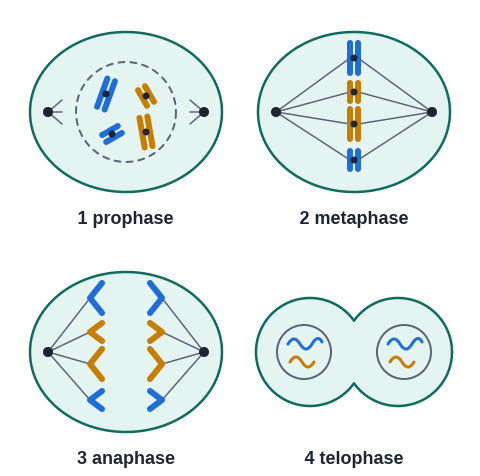
- Prophase: the chromosomes coil up and become visible as two sister chromatids, the nuclear membrane breaks down, and spindle fibres (made of protein) start to form between the two poles of the cell.
- Metaphase: the chromosomes line up in a single row across the middle of the cell, the equator, with a spindle fibre from each pole attached to each centromere.
- Anaphase: each centromere splits and the spindle fibres shorten, pulling the sister chromatids to opposite poles, so each pole gets one copy of every chromosome.
- Telophase: a nuclear membrane forms round each group of chromosomes at the poles, and the chromosomes uncoil again.
- Cytokinesis then divides the cytoplasm and organelles, such as mitochondria, between the two new cells.
Try it: the stages of mitosis
Plant and animal cells divide differently
- Mitosis itself is the same in both, but animal cells organise their spindle from a pair of centrioles at each pole, while plant cells have no centrioles and still form a spindle.
- An animal cell divides its cytoplasm by a ring of protein filaments that tightens round its middle, making a cleavage furrow that pinches the cell in two.
- A plant cell cannot pinch because its cell wall is rigid, so vesicles from the Golgi body, full of cell wall material, line up along the equator and join to form a cell plate, which grows outwards to become a new wall between the two cells.
- In plants, mitosis happens mainly in meristems: the root tips, shoot tips and buds, and the cambium that makes stems thicker. In animals, it happens in most tissues while they grow, and in tissues that are worn away all the time, such as skin, the gut lining and the bone marrow that makes blood cells.
Why mitosis matters: identical cells, growth and repair
- Mitosis makes two daughter cells that are genetically identical to each other and to the parent cell, because the DNA was copied exactly and each cell gets one chromatid of every chromosome.
- Identical DNA means every new cell has the full set of instructions for making the proteins and enzymes its job needs, such as digestive enzymes in a gut cell.
- Organisms grow by making more cells, not by making cells bigger: as a cell grows its volume rises faster than its surface area, so its surface area to volume ratio falls and diffusion can no longer supply its needs or remove its wastes fast enough.
- Dividing gives two smaller cells with a higher ratio, so oxygen, glucose and carbon dioxide can move in and out quickly enough to keep each cell alive.
- Mitosis also repairs damage and replaces worn-out cells, such as a healing cut or new skin cells, with cells identical to the ones lost.
- Rates of mitosis are highest when an organism is growing or repairing: an embryo, a teenager in a growth spurt, plants putting out new shoots and roots in spring, or tissue around a wound.
Try it: count chromosomes and DNA
Example: counting cells in an onion root tip
- A Year 12 class grew onion roots in water, stained a squashed root tip and counted 200 cells under a microscope.
- The mitotic index is the percentage of cells that are in mitosis. Because the cells divide at random times, the share of cells in a stage also shows the share of the cycle that stage takes.
- Calculate the mitotic index, and use the counts to compare how long each stage lasts.
| Stage | Number of cells |
|---|---|
| Interphase | 168 |
| Prophase | 18 |
| Metaphase | 6 |
| Anaphase | 3 |
| Telophase | 5 |
- cells in mitosis = 18 + 6 + 3 + 5 = 32every stage except interphase
- mitotic index = 32 ÷ 200 × 100 = 16%dividing cells as a percentage of all cells counted
- interphase: 168 ÷ 200 × 100 = 84% of the cyclemost of the cycle is spent growing and copying DNA
- prophase: 18 ÷ 200 × 100 = 9%; anaphase: 3 ÷ 200 × 100 = 1.5%anaphase is the shortest stage
- mitotic index 16%; interphase takes 84% of the cycle and prophase is the longest stage of mitosis
- 168 + 18 + 6 + 3 + 5 = 200
What Achieved, Merit and Excellence look like
- Achieved describes: when DNA is copied, what mitosis makes, and what it is for. Merit explains how and why, with template strands, base pairing and enzymes, and with surface area to volume ratio. Excellence links these ideas to keep each cell alive, and then links each cell's survival to the survival of the whole organism.
- Use the context you are given: name the actual tissue, life stage or injury in the question, rather than writing about cells in general.
| Grade | A model answer |
|---|---|
| Achieved | The DNA is copied in interphase before the cell divides. Mitosis makes two identical cells so the root can grow. |
| Merit | Before mitosis, helicase unzips the DNA and each strand acts as a template; DNA polymerase adds complementary nucleotides, A with T and C with G, so each new cell gets an identical full copy. The root grows by making more cells, because a cell that kept growing would have too low a surface area to volume ratio for diffusion to supply it. |
| Excellence | Each root tip cell must have a complete, identical copy of the DNA to make the proteins and enzymes it needs, and must stay small so its high surface area to volume ratio lets water, minerals and oxygen diffuse in and wastes out quickly enough. Copying DNA first and then dividing by mitosis meets both needs at once. Only if the cells survive and keep dividing can the root grow down to reach water and anchor the young tree, so the whole plant depends on this cycle. |
Common mistakes
- DNA replication happens during prophase, when the chromosomes appear.DNA is copied in the S phase of interphase, before mitosis starts; in prophase the already-copied chromosomes only coil up and become visible.
- Interphase is when the cell rests between divisions.Interphase is the busiest part of the cycle: the cell grows, makes organelles and proteins, and copies all its DNA.
- Mitosis makes four cells that are all genetically different.That is meiosis, which makes gametes; mitosis makes two cells identical to the parent, for growth and repair.
- Each daughter cell gets half of the parent cell's DNA.The DNA was doubled first, so each daughter cell gets a complete copy, with the same number of chromosomes as the parent.
Model replication and mitosis with paper chromosomes
You need: a sheet of paper, scissors, a blue pen and a red pen, 4 paperclips, a piece of string or wool about 50 cm long
- Cut four paper strips, two long and two short; colour one long and one short strip blue (from one parent) and the others red (from the other), and write a different short base sequence such as ATTGC along each one. This is a cell in G1 with 4 chromosomes.
- Replicate: for each strip, cut a new strip the same length and colour, write the identical sequence on it, and clip the pair together in the middle with a paperclip as the centromere.
- Lay the string across the table as the equator and line the four clipped chromosomes up along it, one chromatid on each side of the string.
- Unclip each pair and slide one chromatid to each end of the table, then gather each end into its own group as a new nucleus.
- Look for: each new cell has a long blue, a short blue, a long red and a short red strip with the same sequences as the first cell, so the two cells are identical; then try it without the copying step and see that the chromosomes cannot be shared out fairly.
Safety: Take care cutting with scissors, and keep the paperclips away from any small children, who could choke on them.
Your turn
At what point in the cell cycle is DNA copied?
A cell has 8 chromosomes. How many DNA molecules does it contain at metaphase, and how many chromosomes does each daughter cell get?
One DNA strand reads 5′ ATGCCTA 3′. Write the new strand built on it during replication, with its ends labelled.
In a root tip squash, 45 of the 300 cells counted are in mitosis. Calculate the mitotic index.
Explain why a growing root makes more cells rather than making its cells bigger.
Show answer
1. In the S phase of interphase, before mitosis begins. 2. 16 DNA molecules at metaphase (8 chromosomes, each two chromatids); each daughter cell gets 8 chromosomes. 3. 3′ TACGGAT 5′: A pairs with T and C with G, and the new strand runs antiparallel to the template. 4. 45 ÷ 300 × 100 = 15%. 5. A bigger cell has a lower surface area to volume ratio, so substances could not diffuse in and out fast enough; dividing keeps each cell small with a high ratio.
Exam-style question: a copper skink
- Copper skinks are small lizards common in Auckland gardens. Like most New Zealand skinks, they give birth to live young, and a newborn is only a fraction of its adult size. When a bird grabs its tail, the skink can drop the tail and escape, then slowly grow a new one.
Describe when DNA replication happens in the cell cycle, and how the DNA is copied.
Explain why DNA replication must happen before mitosis.
Explain why the young skink grows by making more cells rather than by its cells getting larger.
Discuss why mitosis is needed throughout the skink's life, linking the survival of its cells to the survival of the whole skink.
Show answer
1. DNA is copied in the S phase of interphase, before mitosis (Achieved). Helicase unzips the double helix by breaking the hydrogen bonds between bases; each strand is a template, and DNA polymerase joins free nucleotides to it by complementary pairing, A with T and C with G, building each new strand antiparallel to its template. Each new molecule has one old and one new strand, so replication is semi-conservative (Merit for template, base pairing and enzymes together). 2. Mitosis shares one chromatid of every chromosome between the two daughter cells, so the DNA must be doubled first; otherwise each new cell would get only half the genes and could not make all the proteins and enzymes it needs to work (Merit). 3. As a cell grows, its volume increases faster than its surface area, so its surface area to volume ratio falls. Oxygen and glucose could not diffuse in, or carbon dioxide out, fast enough for a large cell, so the skink makes more small cells, each with a high ratio (Merit). 4. Mitosis is needed at every stage, at different rates (Excellence for linking the ideas). While the young skink grows, mitosis is fast, making many new small cells whose high surface area to volume ratio keeps diffusion fast enough to supply them. When the tail is lost, mitosis at the wound makes new cells to close it and rebuild the tail, and in the adult it keeps replacing worn-out skin and gut cells after growth slows. Because the DNA was copied exactly, every new cell has the full instructions to make the proteins its job needs. Cells that were too large or missing DNA would die, and if enough cells failed, tissues and organs would fail and the skink could not survive.
Recap
- The cell cycle is interphase (G1, S, G2) and then mitosis and cytokinesis.
- DNA is copied in the S phase: helicase unzips it, each strand is a template, and DNA polymerase adds complementary nucleotides in the antiparallel direction, so replication is semi-conservative.
- In mitosis, chromosomes condense, line up at the equator, and have their sister chromatids pulled to opposite poles into two new nuclei.
- Animal cells pinch in two at a cleavage furrow; plant cells build a cell plate.
- Mitosis makes identical cells for growth and repair, and keeps cells small enough to have a high surface area to volume ratio.
| Stage | What happens |
|---|---|
| Interphase | cell grows; DNA copied in S phase |
| Prophase | chromosomes condense; nuclear membrane breaks down; spindle forms |
| Metaphase | chromosomes line up on the equator |
| Anaphase | sister chromatids pulled to opposite poles |
| Telophase | two new nuclei form; chromosomes uncoil |
| Cytokinesis | cleavage furrow (animal) or cell plate (plant) makes two cells |
Challenge
A student squashes and stains an onion root tip and counts 400 cells: 352 in interphase, 28 in prophase, 10 in metaphase, 4 in anaphase and 6 in telophase. Other experiments show that one complete cell cycle in these root tip cells takes 22 hours. (a) Calculate the mitotic index. (b) Estimate how long, in minutes, each stage of mitosis lasts. (c) A second student counts only 40 cells and finds none in anaphase. She concludes that anaphase does not happen in onion cells. Use your answer to (b) to explain why her conclusion is wrong and how to improve her method.
Hint
The cells divide at random times, so the fraction of cells in a stage equals the fraction of the cycle that stage takes. Convert 22 hours into minutes first. For (c), work out how many anaphase cells you would expect in a sample of 40.
Answer
(a) 12%. (b) Prophase about 92 min, metaphase 33 min, anaphase about 13 min, telophase about 20 min. (c) Anaphase takes only about 1% of the cycle, so in 40 cells you would expect only 0.4 anaphase cells; finding none is what you would expect by chance. She should count many more cells (several hundred, from several root tips) before concluding anything.
Step by step
- Cells in mitosis are all those not in interphase; divide by the total and multiply by 100.
- The cycle is 22 × 60 = 1320 minutes long.
- Each stage's share of the cells is its share of the 1320 minutes.
- Anaphase is the shortest stage, about 1% of the cycle.
- A small sample can easily miss a stage that short, so a larger sample is needed for a reliable count.
Full working
- In mitosis = 28 + 10 + 4 + 6 = 48every stage except interphase
- Mitotic index = 48 ÷ 400 × 100 = 12%part (a)
- Cycle = 22 × 60 = 1320 minhours to minutes
- Prophase = 28 ÷ 400 × 1320 = 92.4 min; metaphase = 10 ÷ 400 × 1320 = 33.0 minshare of cells = share of time
- Anaphase = 4 ÷ 400 × 1320 = 13.2 min; telophase = 6 ÷ 400 × 1320 = 19.8 minanaphase is shortest
- Expected anaphase cells in 40 = 40 × 4 ÷ 400 = 0.4so seeing none is not surprising
- 12%; about 92, 33, 13 and 20 min; count far more cells
Colchicine is a chemical that stops spindle fibres forming, but does not stop DNA replication or the splitting of centromeres. Onion root tips (16 chromosomes per cell) are soaked in colchicine. Before treatment, 10 of 400 cells counted were in metaphase; after 4 hours, 58 of 400 were in metaphase-like stages with chromosomes scattered, not lined up. (a) By what factor has the share of cells at this stage risen, and why? (b) Give the number of chromosomes and of DNA molecules in a treated cell stuck at this stage. (c) In some cells the centromeres split, the chromatids stay together in one place, and a single nuclear membrane forms round all of them. Give the chromosome and DNA molecule numbers in that cell, and after it next passes through S phase. (d) Explain why a plant cell treated like this would not form a cell plate and two cells.
Hint
Cells keep entering mitosis from interphase, but without spindle fibres nothing can pull the chromatids to the poles. Count each separated chromatid as a chromosome in its own right.
Answer
(a) From 2.5% to 14.5%, a rise by a factor of 5.8, because cells keep entering mitosis but cannot get past this stage, so they pile up. (b) 16 chromosomes, 32 DNA molecules. (c) 32 chromosomes and 32 DNA molecules; after S phase, 32 chromosomes and 64 DNA molecules. (d) With no spindle the chromatids are never pulled to opposite poles, so no two separate nuclei form and there is no equator between two groups for the Golgi vesicles to build a cell plate across, so the cell stays as one cell with double the chromosomes.
Step by step
- Compare the percentages of cells at the stage before and after treatment.
- Cells enter mitosis at the normal rate but cannot leave, so the stage fills up.
- A stuck cell has replicated its DNA: each of its 16 chromosomes is two sister chromatids.
- Once the centromeres split, each chromatid counts as a chromosome, so the number doubles to 32, with one DNA molecule each.
- Replication then doubles the DNA molecules again but not the chromosome number.
- Cytokinesis depends on mitosis first sharing the chromosomes into two nuclei.
Full working
- Before: 10 ÷ 400 × 100 = 2.5%normal share in metaphase
- After: 58 ÷ 400 × 100 = 14.5%cells stuck without a spindle
- Factor = 14.5 ÷ 2.5 = 5.8part (a)
- Stuck cell: 16 chromosomes, 16 × 2 = 32 DNA moleculeseach chromosome is two chromatids
- Centromeres split, one nucleus: 32 chromosomes, 32 DNA moleculeseach chromatid now a chromosome
- After next S phase: 32 chromosomes, 32 × 2 = 64 DNA moleculesDNA copied, chromosomes still joined in pairs
- (a) 5.8 times (b) 16 and 32 (c) 32 and 32, then 32 and 64 (d) no separate nuclei, so no cell plate
Human chromosome 1 is a single DNA molecule of about 2.5 × 10⁸ base pairs. At each replication fork, DNA polymerase adds about 50 nucleotides per second to each new strand. Replication starts at points called origins, and two forks move away from each origin in opposite directions. (a) If chromosome 1 had only one origin, how long would it take to copy, in days? (b) S phase lasts about 8 hours. Calculate the minimum number of origins chromosome 1 must have. (c) At each fork, one new strand is built smoothly and the other in short pieces joined by ligase. Explain why, using the structure of DNA and how DNA polymerase works. (d) Explain why a mistake in copying a single base, if not repaired, appears in every cell made from that cell by mitosis.
Hint
One origin copies 2 × 50 base pairs each second because it has two forks. For (c), the two template strands are antiparallel, and DNA polymerase can only add nucleotides to the 3′ end of a new strand.
Answer
(a) About 2.5 × 10⁶ seconds, roughly 29 days. (b) At least 87 origins. (c) The two template strands run in opposite directions. DNA polymerase can only build a new strand from 5′ to 3′, so on one template it can follow the fork continuously, but on the other it has to work away from the fork, starting again each time more DNA is unzipped; those short pieces are joined by ligase. (d) The changed base becomes part of the DNA sequence, and in the next replication it acts as a template, so the complementary base is copied exactly; mitosis then gives every daughter cell an identical copy, so all cells descended from it carry the change.
Step by step
- Each origin has two forks, so it copies 100 base pairs per second.
- Divide the length of the chromosome by this rate, then convert seconds to days.
- In 8 hours, one origin copies 100 × 28 800 base pairs; divide the chromosome by this to find how many origins are needed, rounding up.
- Antiparallel strands plus a polymerase that only works in one direction means one strand has to be made backwards in pieces.
- Complementary base pairing copies whatever sequence is there, mistakes included, so mitosis passes it on.
Full working
- Rate per origin = 2 × 50 = 100 base pairs per secondtwo forks
- One origin: 2.5 × 10⁸ ÷ 100 = 2.5 × 10⁶ stime to copy
- 2.5 × 10⁶ ÷ (60 × 60 × 24) = 28.9 daysseconds to days
- S phase = 8 × 3600 = 28 800 s8 hours in seconds
- Per origin in S phase: 100 × 28 800 = 2.88 × 10⁶ base pairscopied by one origin
- Origins = 2.5 × 10⁸ ÷ 2.88 × 10⁶ = 86.8, so at least 87round up, a part origin cannot exist
- (a) about 29 days (b) at least 87 origins (c) antiparallel strands, polymerase adds only at 3′ (d) copied by base pairing, passed on by mitosis