
Moon phases and eclipses, seen from New Zealand
What this lesson covers
- The Moon makes no light of its own; the Sun always lights half of it, and the phase is how much of that lit half faces Earth.
- The Moon orbits Earth in 27.3 days, but new moon to new moon takes 29.5 days because Earth moves along its own orbit meanwhile.
- From the Southern Hemisphere a waxing Moon is lit on the left, the reverse of the northern view.
- A solar eclipse happens at new moon and a lunar eclipse at full moon, when the Sun, Earth and Moon line up exactly.
- The Moon's orbit is tilted about 5°, so most new and full moons miss making an eclipse.
- The Moon's distance changes between perigee and apogee, which explains super full moons.
Why we see the Moon at all
- The Moon does not glow. We see it because sunlight bounces (reflects) off its surface towards us.
- Like Earth, the Moon always has one half lit by the Sun and one half in darkness. Which half is lit depends only on where the Sun is.
- The Moon orbits Earth, so over a month we see different amounts of its lit half. That changing view is what we call the phases.
- The Moon spins once for every orbit, so the same face always points towards Earth. The far side is not always dark: it is fully lit at new moon.
- One orbit relative to the stars takes 27.3 days. But Earth has moved about a twelfth of the way round the Sun in that time, so the Moon must travel about 2 more days to line up with the Sun again: new moon to new moon takes 29.5 days.
| Moon fact | Value |
|---|---|
| Orbit relative to the stars (sidereal month) | 27.32 days |
| New moon to new moon (synodic month) | 29.53 days |
| Closest to Earth (perigee), average | 363 300 km |
| Furthest from Earth (apogee), average | 405 500 km |
| Tilt of the orbit to Earth's orbit | 5.1° |
Phases come from the Moon's position
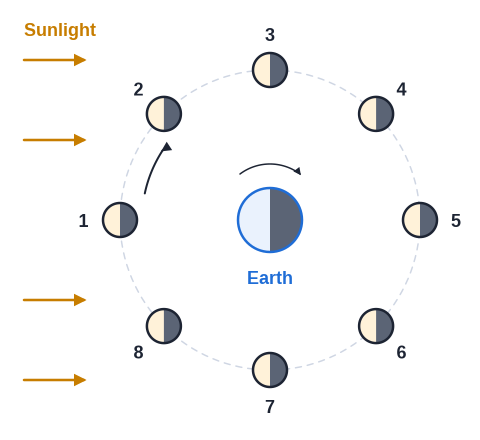
- The diagram looks down from above the South Pole, as NZQA diagrams often do. From here the Moon's orbit and Earth's spin both go clockwise.
- Every Moon in the diagram has the half facing the Sun lit. What changes is how much of that lit half faces Earth.
- Position 1, new moon: the Moon is between Earth and the Sun, its lit half faces away and we see nothing.
- Position 3, first quarter: the Moon is at right angles to the Sun, and we see half of the lit half, so half the disc.
- Position 5, full moon: Earth is between the Sun and the Moon, and we see the whole lit half.
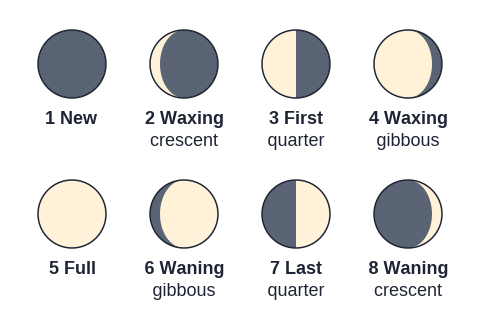
- Position 7, last quarter: right angles again, on the other side. Between these come the crescents (2 and 8) and the gibbous moons (4 and 6).
Try it: phases from New Zealand
How the phases look from New Zealand
- Waxing means the lit part is growing (new to full); waning means it is shrinking (full to new).
- In New Zealand we face north to see the Moon, so the Sun's side is on our left in the evening: a waxing Moon is lit on the left and a waning Moon on the right.
- Someone in the United Kingdom faces south to see the Moon. They are standing the opposite way up compared with us, so they see the same phase rotated, upside down: their waxing Moon is lit on the right.
- Both hemispheres see the same phase on the same night; only the way it looks is flipped. Even the dark patches (the maria) appear upside down.
Sky and seasons
Why the Moon rises later each day
- Each day the Moon moves about 13° further round its orbit (360° ÷ 27.3 days), in the same direction Earth spins.
- So after one full spin, Earth must turn about 13° more to bring the Moon back into view. That takes roughly 50 minutes, so moonrise is about 50 minutes later each day (it varies from about half an hour to over an hour).
- This is why the phase tells you when to look: a full moon is opposite the Sun, so it rises around sunset; a first quarter rises around midday and is high in the sky at sunset; a last quarter rises around midnight and is seen in the morning.
- In the maramataka, the Māori lunar calendar, each night of the Moon's cycle has its own name, with Whiro usually the first night of the new moon and Rākau-nui the full moon in Ngāti Kahungunu's list. The names and their guidance for fishing and planting differ between iwi.
| Phase | Rises about | Best seen |
|---|---|---|
| New | with the Sun | not visible |
| First quarter | midday | evening, sets about midnight |
| Full | sunset | all night |
| Last quarter | midnight | after midnight and in the morning |
Example: predicting November 2026's phases
- New moon is on 9 November 2026 at 8:02 pm NZDT.
- Predict the dates of first quarter, full moon and last quarter, then compare with the published times.
| Phase | Date and time |
|---|---|
| New moon | 9 November, 8:02 pm |
| First quarter | 18 November, 12:48 am |
| Full moon | 25 November, 3:53 am |
| Last quarter | 1 December, 7:08 pm |
- 29.5 ÷ 4 ≈ 7.4 days between main phasesfour quarters in one synodic month
- first quarter ≈ 9 + 7.4 = 16.4, so about 17 Novemberone quarter on
- full ≈ 9 + 14.8 = 23.8, about 24 November; last quarter ≈ 9 + 22.1 = 31.1, about 1 Decembertwo and three quarters on
- predicted: about 17 Nov, 24 Nov, 1 Dec
- published: 18 Nov, 25 Nov, 1 Decwithin a day: the orbit is an ellipse, so the Moon's speed varies
Solar and lunar eclipses
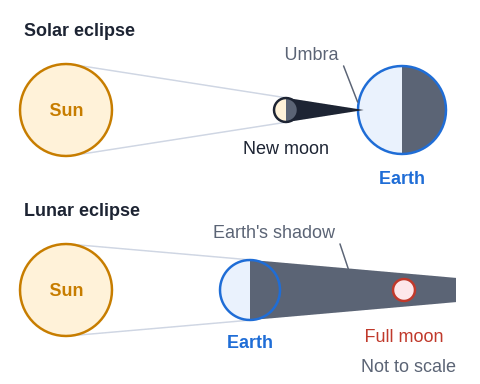
- A solar eclipse happens when the Moon passes exactly between the Sun and Earth, so it can only happen at new moon. The Moon's shadow falls on a small part of Earth.
- Inside the darkest part of the shadow (the umbra) the Sun is completely covered: a total eclipse. Around it, in the paler penumbra, people see a partial eclipse.
- If the Moon is near apogee it looks slightly too small to cover the Sun, and a ring of Sun is left showing: an annular eclipse.
- A lunar eclipse happens when Earth passes exactly between the Sun and the Moon, so it can only happen at full moon. The Moon moves into Earth's shadow.
- The totally eclipsed Moon usually glows dull red, because Earth's atmosphere scatters away blue light and bends red sunlight into the shadow, like the light of every sunrise and sunset at once.
- Never look at the Sun, even when it is partly covered: it can permanently damage your eyes. Use certified eclipse glasses or a pinhole projector. A lunar eclipse is safe to look at.
Why there is not an eclipse every month
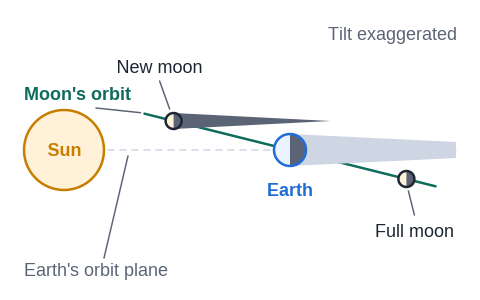
- The Moon's orbit is tilted about 5° to the plane of Earth's orbit round the Sun.
- So at most new moons the Moon passes a little above or below the line from the Sun to Earth, and its shadow misses Earth. At most full moons it passes above or below Earth's shadow.
- An eclipse can only happen when a new or full moon falls close to one of the two points where the tilted orbit crosses Earth's orbit plane. That lines up about every six months, in an eclipse season.
- That is why eclipses come in groups: a solar eclipse and a lunar eclipse about two weeks apart, then another pair about six months later.
| Date | Eclipse | Moon phase |
|---|---|---|
| 17 February | Annular solar | New moon |
| 3 March | Total lunar (seen from New Zealand) | Full moon |
| 12 August | Total solar | New moon |
| 28 August | Partial lunar | Full moon |
Try it: Moon quest
Who sees an eclipse, and for how long
- A lunar eclipse can be seen by everyone on the night side of Earth, because they can all see the Moon going into Earth's shadow.
- Earth's shadow is much wider than the Moon, so the Moon takes hours to cross it and totality can last over an hour.
- The Moon's umbra is only a narrow spot on Earth's surface, and it sweeps across quickly as the Moon orbits and Earth turns. A total solar eclipse is seen only along a narrow path, and totality lasts at most a few minutes at any one place.
- So total solar eclipses are rare at any one place. On 22 July 2028 the path of totality crosses Australia and the South Island, the first total eclipse seen from Dunedin in about 900 years; the rest of the country will see only a partial eclipse.
| Stage | Approximate local time |
|---|---|
| Partial eclipse begins | 3:10 pm |
| Totality begins | 4:15 pm |
| Totality ends | 4:18 pm |
Example: the super full moon of 24 December 2026
- The full moon is at 1:28 am UT on 24 December 2026 (2:28 pm NZDT), and the Moon reaches perigee 7 hours later.
- Use the table to explain why this full moon looks bigger than usual, and why such moons are rare.
| Event | Date and time | Distance | Apparent width |
|---|---|---|---|
| Apogee | 11 Dec, 06:46 | 406 421 km | 29.40 arc minutes |
| Perigee | 24 Dec, 08:30 | 356 650 km | 33.51 arc minutes |
- 33.51 ÷ 29.40 = 1.14compare the Moon's apparent width at perigee and apogee
- at perigee the Moon looks about 14% wider than at apogeeit is about 50 000 km closer
- full moon every 29.5 days, perigee every 27.5 daystwo different cycles
- each month full moon falls about 2 days later in the perigee cycle29.5 − 27.5 = 2
- full moon and perigee line up again only after about 27.5 ÷ 2 ≈ 14 monthsso a few super full moons in a row, then a long gap
- full moon (Earth between Sun and Moon) at the same time as perigee: a super full moon, only 1 to 3 a year
What Achieved, Merit and Excellence look like
- Achieved names phases and describes positions. Merit explains a phase using where the Sun, Earth and Moon are. Excellence links the positions, the timing (29.5 days, 27.5 days, 6 months) and the viewer's place on Earth into one argument.
- Question: Explain why we see a first quarter Moon.
| Grade | A model answer |
|---|---|
| Achieved | The Moon reflects light from the Sun. At first quarter we see half of the Moon lit up. |
| Merit | The Sun always lights half the Moon. At first quarter the Moon is a quarter of the way round its orbit, at right angles to the Sun from Earth, so only half of the lit half faces us and we see half the disc. |
| Excellence | The Sun lights half the Moon at all times. About 7.4 days after new moon the Moon has moved a quarter of its orbit and sits at 90° to the Sun-Earth line, so half of its lit half faces Earth. From New Zealand we look north at it, so the lit half is on our left, the side towards the setting Sun; a viewer in Britain sees the same Moon lit on the right because they face south. |
Common mistakes
- The phases happen because Earth's shadow covers part of the Moon.Earth's shadow only reaches the Moon during a lunar eclipse; phases come from how much of the Moon's sunlit half faces us.
- A solar eclipse happens at full moon.The Moon must be between the Sun and Earth for a solar eclipse, which is new moon; a lunar eclipse is at full moon.
- There should be an eclipse every month because there is a new moon every month.The Moon's orbit is tilted about 5°, so most new and full moons pass above or below the Sun-Earth line.
- The waxing crescent in New Zealand is lit on the right, like the pictures in most books.Most books show the northern view; from New Zealand a waxing Moon is lit on the left.
Make the phases with a ball and a torch
You need: a torch, a pale ball, such as a tennis ball, or an orange, a fork or pencil to hold the ball on, a pile of books, a dark room
- Stand the torch on the pile of books at head height, pointing across a dark room; it is the Sun.
- Push the ball onto the fork, hold it at arm's length and stand facing the torch so the ball is between you and the torch: your head is Earth and the ball is a new moon.
- Turn slowly to your right on the spot, keeping the ball in front of your face, and stop every eighth of a turn to look at the ball.
- Note when you see a crescent, a half, a gibbous and a full ball (hold the ball just above your head's shadow for full).
- Look for: the torch always lights the half of the ball facing it, and only how much of that lit half you can see changes; turning to the right copies the orbit seen from above the South Pole, so the growing ball is lit on the left, as in New Zealand's sky.
Safety: Moving around in a dark room is a trip risk, so clear the floor first, and keep the fork's points away from your face.
Your turn
In the orbit diagram, which phase is seen from Earth at position 7?
Why does it take 29.5 days, not 27.3, to go from one new moon to the next?
On 3 March 2026 (Universal Time) there was a total lunar eclipse. What phase was the Moon in?
A full moon happens about every 29.5 days. Explain why there is not a lunar eclipse every month.
In New Zealand, a crescent Moon is seen in the western sky just after sunset. Which side of it is lit, and is it waxing or waning?
Show answer
1. Last quarter: the half of the disc on the right is lit, as seen from New Zealand. 2. While the Moon orbits Earth, Earth also moves along its orbit round the Sun, so the Moon must go about 2 extra days of orbit to line up with the Sun again. 3. Full moon: Earth was between the Sun and the Moon. 4. The Moon's orbit is tilted about 5° to Earth's orbit, so at most full moons the Moon passes above or below Earth's shadow; an eclipse needs a full moon near where the two orbits cross. 5. Lit on the left (the side towards the set Sun), and it is waxing.
Exam-style question: the Christmas Eve super full moon
- On 24 December 2026 a full moon happens 7 hours before the Moon reaches perigee, its closest point to Earth, 356 650 km away. Two weeks earlier, at apogee, it was 406 421 km away. Use the orbit diagram and the tables in this lesson.
Describe where the Sun, Earth and Moon are at full moon, and how often a full moon comes round.
Explain why viewers in New Zealand see the Moon go through phases over a month, and how a waxing Moon looks different here from in the Northern Hemisphere.
Discuss why a super full moon is seen only one to three times a year, rather than every month.
Show answer
1. A full moon happens when Earth is between the Sun and the Moon, so the whole sunlit half of the Moon faces Earth. It happens about every 29.5 days (Achieved). 2. The Moon reflects sunlight and the Sun always lights half of it. As the Moon orbits Earth, its position compared with the Sun changes, so we see a different fraction of the lit half: none at new moon, half the disc at the quarters, all of it at full moon. From New Zealand we look north at the Moon, so a waxing Moon is lit on the left; northern viewers face south and see it lit on the right, the image flipped (Merit). 3. Excellence links the two cycles: the Moon's orbit is an ellipse, so its distance varies, and at perigee it looks about 14% wider than at apogee (33.51 against 29.40 arc minutes). Perigee comes round every 27.5 days but full moon every 29.5 days, because Earth's orbit round the Sun means the Moon must travel further to line up opposite the Sun. Each month the full moon slips about 2 days later in the perigee cycle, so the two coincide only for a run of one to three months about every 14 months, as on 24 December 2026, when the full moon and perigee were just 7 hours apart.
Gravity and Orbits
Full screen · PhET Interactive Simulations, University of Colorado Boulder, CC BY 4.0
Recap
- The Sun always lights half the Moon; the phase is how much of that half faces Earth.
- New moon: Moon between Sun and Earth. Full moon: Earth between Sun and Moon. Quarters: at right angles.
- New moon to new moon is 29.5 days, longer than the 27.3-day orbit, because Earth moves round the Sun.
- From New Zealand a waxing Moon is lit on the left, the reverse of the northern view.
- Solar eclipses happen at new moon, lunar eclipses at full moon, and only when the 5° tilted orbit lines up, about every six months.
- A super full moon is a full moon near perigee; the 29.5 and 27.5 day cycles line up only every 14 months or so.
| Event | Line-up | Phase |
|---|---|---|
| Solar eclipse | Sun, Moon, Earth | New moon |
| Lunar eclipse | Sun, Earth, Moon | Full moon |
| First and last quarter | Moon at 90° to the Sun | Half disc lit |
| Super full moon | Full moon near perigee | Full moon |
Challenge
The 2026 eclipses were an annular solar eclipse on 17 February, a total lunar eclipse on 3 March, a total solar eclipse on 12 August and a partial lunar eclipse on 28 August. (a) A student expects another total lunar eclipse about 29.5 days after 3 March. Explain why that does not happen. (b) Show that the gap between the two solar eclipses, and the gap between the two lunar eclipses, are each very close to a whole number of synodic months. (c) Explain why each solar eclipse is followed by a lunar eclipse about two weeks later, but then there are no eclipses for about five months.
Hint
Count the days between the dates and divide by 29.53. Then think about where the Moon is in its tilted orbit: an eclipse needs a new or full moon close to a crossing point of the two orbit planes.
Answer
(a) A month later the Moon is full again but no longer near a crossing point, so it passes above or below Earth's shadow. (b) 176 days ≈ 5.96 synodic months; 178 days ≈ 6.03 synodic months: both about 6. (c) Half a synodic month (about 14.8 days) after a new moon at a crossing point, the full moon is still near the crossing point, giving a pair; the next lining-up comes about six months later.
Step by step
- An eclipse needs Sun, Earth and Moon in an exact line, which only happens when a new or full moon falls near one of the two points where the Moon's tilted orbit crosses Earth's orbit plane.
- A month later the Sun has moved about 30° round the sky, so the next full moon is no longer near a crossing point and passes a few degrees above or below Earth's shadow, which is less than 1.5° wide.
- 17 February to 12 August is 176 days and 3 March to 28 August is 178 days; dividing by 29.53 gives about 6 in both cases.
- Each solar and lunar pair is 14 or 16 days apart, about half a synodic month, so the new and the next full moon both fall in the same eclipse season.
- The Sun lines up with the crossing points only about every six months, which is why the next pair waits until the second eclipse season.
Full working
- 17 Feb to 12 Aug = 176 dayscount the days
- 176 ÷ 29.53 = 5.96 ≈ 6 synodic monthssolar to solar
- 3 Mar to 28 Aug = 178 days, 178 ÷ 29.53 = 6.03 ≈ 6lunar to lunar
- 17 Feb to 3 Mar = 14 days; 12 Aug to 28 Aug = 16 dayseach pair
- 29.53 ÷ 2 = 14.8 daysnew moon to full moon
- one month on, the full moon is a few degrees off the lineno eclipse in April
- eclipse seasons about 6 months apart, each with a new and a full moon about 14.8 days apart
On 11 December 2026 the Moon was at apogee, 406 421 km away, and looked 29.40 arc minutes wide. On 24 December it was at perigee, 356 650 km away, and looked 33.51 arc minutes wide. (a) Show that the Moon's apparent width is inversely proportional to its distance. (b) The Sun looks about 32.0 arc minutes wide from Earth. At what distance does the Moon look exactly as wide as the Sun? (c) A solar eclipse happens when the Moon is 390 000 km away. Predict whether people in the centre of the shadow path see a total or an annular eclipse, and explain. (d) Use your answers to explain why the 17 February 2026 eclipse was annular even though the Sun, Moon and Earth were exactly lined up.
Hint
For an inverse relationship, distance × width stays the same. Use that constant to work out a width from a distance, or a distance from a width.
Answer
(a) Distance × width ≈ 11 950 000 for both, so they are inversely proportional. (b) About 373 000 km. (c) The Moon looks about 30.6 arc minutes wide, smaller than the Sun, so annular. (d) The Moon was further than about 373 000 km, so it looked too small to cover the Sun and left a ring.
Step by step
- Multiplying distance by apparent width gives about 11.95 million both times, so doubling the distance would halve the width: inverse.
- Setting width = 32.0 gives distance = 11.95 million ÷ 32.0 ≈ 373 000 km.
- At 390 000 km the Moon is further than this, so it looks narrower than the Sun: about 30.6 arc minutes.
- A Moon narrower than the Sun cannot cover it completely, so even on the centre line a ring of Sun is left showing: an annular eclipse.
- So annular eclipses happen when the Moon is in the far part of its orbit, beyond about 373 000 km, and total ones when it is closer.
Full working
- 406 421 × 29.40 = 11 948 777distance × width at apogee
- 356 650 × 33.51 = 11 951 342same within 0.03%, so inverse
- d = 356 650 × 33.51 ÷ 32.0 = 373 479 km ≈ 373 000 kmwidth equals the Sun's
- width = 356 650 × 33.51 ÷ 390 000 = 30.6 arc minutesat 390 000 km
- 30.6 < 32.0, Moon too small to cover the Suncompare widths
- inverse; about 373 000 km; 30.6 arc minutes, annular; February Moon further than 373 000 km
The Moon takes 27.32 days to go once round Earth relative to the stars, and Earth takes 365.25 days to go round the Sun. (a) How many degrees a day does each move round its orbit? Use this to show that new moon to new moon takes about 29.5 days. (b) By how many minutes does moonrise get later each day on average, measured against the Sun? (c) From Nelson one evening at sunset, the Moon is 73° east of the Sun along the sky. How many days old is it, what does it look like, which side is lit, and about how long after sunset will it set?
Hint
The Moon and the Sun both move eastwards against the stars, so the Moon gains on the Sun by the difference of their daily angles. Earth turns 360° in 24 hours, which is 15° an hour.
Answer
(a) Moon 13.18° a day, Sun (because of Earth's orbit) 0.99° a day; the Moon gains 12.19° a day, so it laps the Sun every 360 ÷ 12.19 = 29.53 days. (b) About 49 minutes (nearer 50 once you allow for the Moon moving on while Earth catches up). (c) About 6 days old: a fat waxing crescent, nearly first quarter, lit on the left (the side towards the set Sun), setting about 4 h 50 min after sunset.
Step by step
- The Moon goes 360° in 27.32 days, about 13.18° a day; Earth's orbit makes the Sun appear to move 360° in 365.25 days, about 0.99° a day, the same way.
- So the Moon gains 12.19° a day on the Sun and needs 360 ÷ 12.19 ≈ 29.53 days to come back to new moon: the synodic month.
- Earth turns 15° an hour, so making up 12.19° takes 12.19 ÷ 15 h ≈ 49 minutes: moonrise is about 49 minutes later each day on average; the Moon creeps on a little during those minutes, so the true average is nearer 50 minutes.
- A Moon 73° from the Sun is 73 ÷ 12.19 ≈ 6 days past new moon, less than 90°, so it is a crescent just short of first quarter and waxing.
- From New Zealand a waxing Moon is lit on the left, towards the Sun, and the sky must turn about 73° before the Moon reaches the western horizon: 73 ÷ 15 ≈ 4.9 h after the Sun.
Full working
- Moon: 360 ÷ 27.32 = 13.18° a dayrelative to the stars
- Sun: 360 ÷ 365.25 = 0.99° a dayEarth's yearly orbit
- 13.18 − 0.99 = 12.19° a dayMoon gaining on the Sun
- 360 ÷ 12.19 = 29.53 dayssynodic month
- 12.19 ÷ 15 = 0.813 h = 48.8 min ≈ 49 minEarth turns 15° an hour
- age = 73 ÷ 12.19 = 5.99 ≈ 6 days73° east of the Sun
- setting delay = 73 ÷ 15 = 4.87 h ≈ 4 h 50 minsky turns 15° an hour
- 29.53 days; about 49 min later a day; 6 days old, waxing crescent lit on the left, sets about 4 h 50 min after the Sun