
The Earth system, the carbon cycle and rising CO₂
What this lesson covers
- The atmosphere, hydrosphere, biosphere and geosphere are linked, so a change in one sphere spreads to the others.
- Carbon moves between stores by photosynthesis, respiration, dissolving, burial, eruptions and combustion.
- Burning fossil fuels moves carbon locked in rock for millions of years into the air within decades.
- Extra greenhouse gases absorb and re-emit more infrared, giving the enhanced greenhouse effect.
- Dissolved CO₂ forms carbonic acid, lowering ocean pH and leaving less carbonate for shells.
- Real measurements from Mauna Loa, Baring Head, the Munida transect and New Zealand's emissions inventory show these changes.
Four spheres, one system
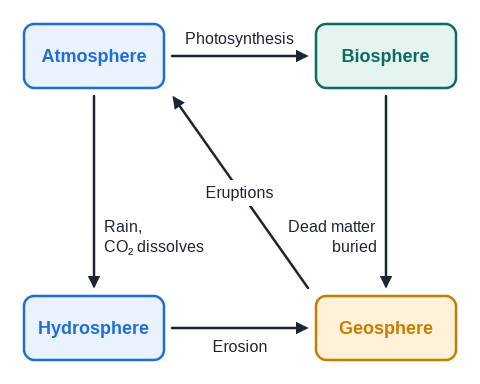
- Scientists treat the Earth as one system made of four spheres: the atmosphere (air), the hydrosphere (all water, including ice and groundwater), the biosphere (every living thing) and the geosphere (rock, soil and the Earth's interior).
- Matter and energy cross between the spheres all the time, so a change in one sphere sets off changes in the others.
- Carbon, water and heat are the three things you will follow most often: where each is stored and what moves it.
- A change is human-induced when people caused it, either directly (clearing a forest) or indirectly (warming that shrinks a glacier).
- Every AS 92044 answer names three things: the human activity, the change it makes, and the effect in at least one other sphere.
| Sphere | What it includes | One link to another sphere |
|---|---|---|
| Atmosphere | Air, clouds, greenhouse gases | CO₂ dissolves into the sea (hydrosphere) |
| Hydrosphere | Oceans, rivers, lakes, groundwater, ice | Rain and rivers wear away rock (geosphere) |
| Biosphere | Plants, animals, microbes, people | Plants take CO₂ out of the air (atmosphere) |
| Geosphere | Rock, soil, fossil fuels, volcanoes | Eruptions release CO₂ into the air (atmosphere) |
The carbon cycle: stores and flows
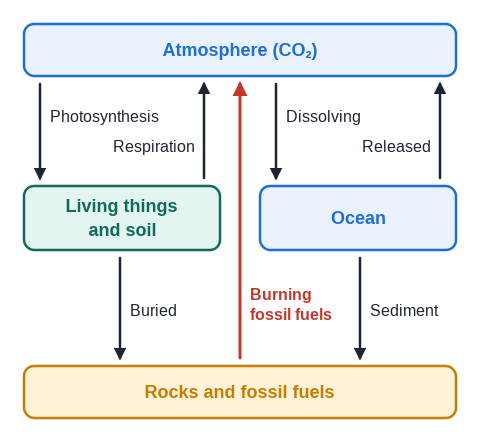
- Carbon is held in stores in every sphere: CO₂ in the air, dissolved carbon in the ocean, living things and soil, and rocks such as limestone, coal, oil and natural gas.
- Photosynthesis moves carbon from the atmosphere into the biosphere: 6CO₂ + 6H₂O → C₆H₁₂O₆ + 6O₂, powered by light.
- Respiration and decomposition move it back, breaking glucose down and releasing CO₂ to the air.
- The ocean swaps CO₂ with the air at its surface. Cold water holds more, and sea creatures lock some into calcium carbonate shells that can end up as limestone.
- Fast flows such as photosynthesis turn carbon over in years; slow flows such as burial and rock formation take millions of years, which is how fossil fuels formed.
- Before industry the flows in and out of the air were close to balanced, so CO₂ stayed near 280 ppm (parts per million).
| Process | Carbon moves from | Carbon moves to |
|---|---|---|
| Photosynthesis | Atmosphere | Biosphere |
| Respiration and decomposition | Biosphere | Atmosphere |
| Dissolving at the sea surface | Atmosphere | Hydrosphere |
| Shells and sediment buried | Hydrosphere | Geosphere |
| Volcanic eruptions | Geosphere | Atmosphere |
| Burning fossil fuels | Geosphere | Atmosphere |
Burning fossil fuels short-circuits the slow cycle
- Coal, oil and natural gas are the remains of plants and plankton buried and squeezed over millions of years, so their carbon was taken out of the fast cycle.
- Burning them returns that carbon to the air within decades, far faster than slow processes such as rock formation can remove it.
- For natural gas (methane): CH₄ + 2O₂ → CO₂ + 2H₂O. Every carbon atom in the fuel ends up in a CO₂ molecule; no carbon is created or destroyed, it only changes store.
- Clearing or burning forest adds to this: the carbon in wood and soil is released, and the trees are no longer there to take CO₂ in.
- Not all the extra CO₂ stays in the air. The ocean and land plants absorb a large part of it, which slows the rise in the air but changes the ocean's chemistry.
Try it: carbon on the move
Example: how fast is CO₂ rising?
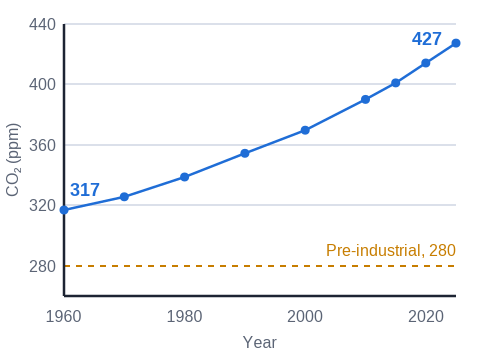
- NOAA has measured CO₂ at Mauna Loa Observatory in Hawaiʻi since 1958, far from cities and forests, so the air is well mixed. The table gives yearly averages.
- Work out how fast CO₂ rose in the 1960s and in the last ten years, and say what the comparison shows.
| Year | CO₂ (ppm) |
|---|---|
| 1960 | 316.91 |
| 1970 | 325.68 |
| 1980 | 338.76 |
| 1990 | 354.45 |
| 2000 | 369.71 |
| 2010 | 390.10 |
| 2015 | 401.01 |
| 2020 | 414.21 |
| 2025 | 427.35 |
- 1960 to 1970: 325.68 − 316.91 = 8.77 ppm in 10 yearsabout 0.9 ppm a year
- 2015 to 2025: 427.35 − 401.01 = 26.34 ppm in 10 yearsabout 2.6 ppm a year
- 26.34 ÷ 8.77 ≈ 3compare the two rates
- CO₂ is rising about three times as fast as in the 1960s: the increase is speeding up, not just continuing
- 1960 to 2025: (427.35 − 316.91) ÷ 316.91 × 100 ≈ 35% increasethe total change
Try it: CO₂ at Baring Head
Try it: CO₂ at Baring Head
- Baring Head, on the coast just east of the entrance to Wellington Harbour, has measured CO₂ in clean Southern Ocean air for more than 50 years. Its readings are below.
- 1. By how much did CO₂ at Baring Head rise over the ten years, and what is that per year?
- 2. By what percentage is the latest reading above the pre-industrial level?
- 3. Mauna Loa's yearly mean for 2025 was 427.35 ppm. Give one reason Baring Head reads a little lower.
| Baring Head reading | CO₂ (ppm) |
|---|---|
| Latest (published July 2026) | 424.7 |
| One year earlier | 423.3 |
| Ten years earlier | 401.1 |
| Pre-industrial level | 280 |
Show answer
1. 424.7 − 401.1 = 23.6 ppm in ten years, about 2.4 ppm a year. 2. (424.7 − 280) ÷ 280 × 100 = 144.7 ÷ 280 × 100 ≈ 52% higher. 3. Most fossil fuel is burned in the Northern Hemisphere, and air takes about a year to mix across the equator, so the Southern Hemisphere lags slightly behind.
The natural and the enhanced greenhouse effect
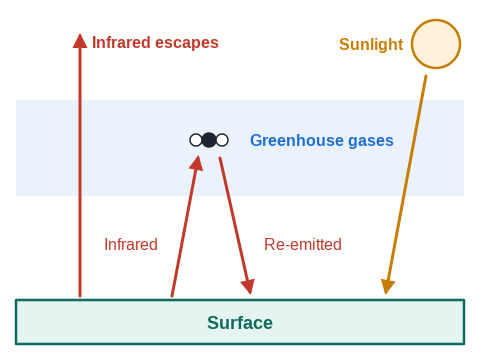
- Sunlight arrives mostly as visible light, which passes through the air and warms the land and sea.
- The warm surface gives off infrared radiation. Greenhouse gases (water vapour, CO₂, methane and nitrous oxide) absorb some of it and re-emit it in every direction, including back down.
- This natural greenhouse effect keeps the Earth's average surface temperature about 33 °C warmer than it would be without it, warm enough for liquid water and life.
- Adding greenhouse gases means more infrared is absorbed and sent back down, so the Earth takes in more energy than it loses until the surface and oceans warm up. This extra warming is the enhanced greenhouse effect.
- The extra energy goes mostly into the ocean, which warms and expands, while glaciers and ice sheets melt: both raise sea level.
Ocean acidification
- When CO₂ dissolves in seawater it reacts to form carbonic acid, which releases hydrogen ions: CO₂ + H₂O → H₂CO₃ → H⁺ + HCO₃⁻.
- More hydrogen ions means a lower pH. Seawater is still alkaline (about pH 8), so it is acidifying, not acidic.
- The extra hydrogen ions also react with carbonate ions, H⁺ + CO₃²⁻ → HCO₃⁻, leaving less carbonate for shell builders such as pāua, mussels, oysters and many plankton to make calcium carbonate.
- PH is a logarithmic scale, so a small fall in pH is a big rise in hydrogen ions. The Munida record off Otago, the longest pH record in the Southern Hemisphere, shows this happening in our own waters.
| Measure | 1998 | 2020 | Change |
|---|---|---|---|
| pH of surface seawater | 8.092 | 8.057 | Down 0.035 |
| Dissolved CO₂ (pCO₂, µatm) | 349.9 | 384.9 | Up 10.0% |
| Acidity (hydrogen ions) | Starting level | Higher | Up 8.4% |
Example: New Zealand's emissions by sector
- The Ministry for the Environment's inventory, published in 2026, gives New Zealand's 2024 emissions in megatonnes of CO₂-equivalent (Mt CO₂-e): each gas counted as the mass of CO₂ that would cause the same warming.
- Gross emissions count everything released; net emissions subtract what forests and land took back up.
- Find agriculture's and energy's share of gross emissions, and the change in gross emissions since 1990 (67.6 Mt).
| Sector | 2024 emissions (Mt CO₂-e) |
|---|---|
| Agriculture | 40.1 |
| Energy, including transport | 28.8 |
| Industrial processes and products | 3.9 |
| Waste | 3.0 |
| Gross emissions | 75.8 |
| Land use and forestry (taken up) | −21.0 |
| Net emissions | 54.8 |
- agriculture: 40.1 ÷ 75.8 × 100 ≈ 53%share of gross
- energy: 28.8 ÷ 75.8 × 100 ≈ 38%share of gross
- since 1990: (75.8 − 67.6) ÷ 67.6 × 100 ≈ 12% increasepercentage change = change ÷ start × 100
- 75.8 − 21.0 = 54.8 Mt netforests take up carbon
- agriculture makes over half of gross emissions; in most developed countries energy is the biggest sector
Why New Zealand's emissions are mostly methane
- Cattle and sheep digest grass with microbes in their rumen that release methane, which the animals burp out.
- Urine patches and nitrogen fertiliser on soil release nitrous oxide, a powerful and long-lived greenhouse gas.
- Methane traps far more heat per tonne than CO₂ but breaks down in the air in about a decade, while much of the CO₂ added stays for centuries.
- That is why New Zealand's emissions are mostly methane, while energy and transport supply most of the CO₂.
| Gas | 2024 (Mt CO₂-e) | Share of gross |
|---|---|---|
| Methane (CH₄) | 36.5 | 48% |
| Carbon dioxide (CO₂) | 31.4 | 41% |
| Nitrous oxide (N₂O) | 6.7 | 9% |
| Fluorinated gases | 1.1 | 1.5% |
Following extra CO₂ through every sphere
- A strong answer traces one change through several spheres and gives the science idea behind each step.
- Some effects loop back and make the change bigger, which is a positive feedback. Warmer seawater dissolves less CO₂, so more stays in the air.
- Melting snow and sea ice exposes darker land and water, which absorb more sunlight and warm further.
- Some effects are slow to reverse: the deep ocean takes centuries to catch up, so warming and sea-level rise continue even after emissions fall.
| Sphere | Effect of extra CO₂ | Science idea |
|---|---|---|
| Atmosphere | Warmer air, more water vapour, heavier downpours | Greenhouse gases absorb and re-emit infrared |
| Hydrosphere | Warmer, more acidic sea; rising sea level | Carbonic acid; water expands when heated; land ice melts |
| Biosphere | Shell builders stressed; species shift to cooler water or higher ground | Less carbonate; each species has a temperature range |
| Geosphere | Glaciers retreat; more landslides and erosion in heavy rain | Melting exposes loose rock; more runoff moves sediment |
Example: one answer at Achieved, Merit and Excellence
- Task: burning fossil fuels has changed the Earth system. Show your understanding, using the ocean around Aotearoa.
- Each grade keeps everything from the one below and adds to it.
- Achieved (describe): burning fossil fuels adds CO₂ to the atmosphere. Some dissolves in the sea, making it more acidic, so shellfish such as mussels find it harder to build shells.names the activity, the change, and an effect in another sphere
- Merit (explain): CO₂ reacts with water to make carbonic acid, which releases H⁺ ions and lowers pH. H⁺ reacts with carbonate ions, so less carbonate is left to make calcium carbonate shells.says how and why, with the chemistry
- Excellence (discuss implications): plankton and shellfish are near the base of food webs, so fish, seabirds, mahinga kai and mussel farming are affected. Warmer water also holds less CO₂, and the change is slow to reverse because added CO₂ stays in the air for centuries; cutting emissions slows it, while local fixes protect only small areas.links several spheres, consequences, timescales and responses
Common mistakes
- Global warming is caused by the hole in the ozone layer letting in more heat.The ozone hole lets through more ultraviolet; warming comes from greenhouse gases absorbing and re-emitting infrared given off by the surface.
- Ocean acidification means the sea has turned into an acid.Seawater is still alkaline at about pH 8; acidification means its pH is falling as dissolved CO₂ adds hydrogen ions.
- The greenhouse effect is harmful and should be stopped.The natural greenhouse effect keeps the Earth warm enough for life; the problem is the enhanced effect from the extra gases people add.
- Burning fossil fuels creates new carbon.Burning moves carbon that was locked in the geosphere for millions of years into the atmosphere; carbon atoms are never created or destroyed.
Acidify a model ocean with your breath
You need: 2 red cabbage leaves, hot tap water, a jug, 2 clear glasses, a drinking straw, baking soda, a sheet of white paper
- Tear the cabbage leaves into the jug, cover them with hot tap water and leave for 10 minutes, then pour the purple liquid into the two glasses, leaving the leaves behind.
- Stir a very small pinch of baking soda into each glass so both turn the same blue-green colour: two model seas that are slightly alkaline, like real seawater.
- Put the straw in one glass and blow out through it gently for 2 to 3 minutes. Leave the other glass alone as your control.
- Stand both glasses on the white paper and compare their colours every minute.
- Look for: the glass you blew into shifts from blue-green back towards purple while the control stays the same, because CO₂ from your breath dissolved, formed carbonic acid and lowered the pH, as extra CO₂ does to the ocean.
Safety: Only ever blow out through the straw, never suck in, and do not drink the cabbage water; it also stains clothes and benches, so wipe up spills.
Your turn
Name the sphere each of these belongs to: a glacier, a kauri tree, a coal seam.
Write the balanced equation for burning methane. How many CO₂ molecules does one methane molecule make?
CO₂ at Mauna Loa rises and falls a little every year, peaking around May. Explain why.
Explain how burning fossil fuels can harm pāua.
Discuss one way warming can feed back to make itself worse.
Show answer
1. Glacier: hydrosphere (water as ice); kauri: biosphere; coal seam: geosphere. 2. CH₄ + 2O₂ → CO₂ + 2H₂O; one CO₂ molecule for each methane molecule, because there is one carbon atom in each. 3. Most land plants are in the Northern Hemisphere: in its spring and summer photosynthesis takes in more CO₂ than respiration and decay release, so CO₂ falls; in autumn and winter decay and respiration win, so it builds up again until May. 4. Burning adds CO₂ to the air; some dissolves in seawater to form carbonic acid, releasing H⁺ ions that lower the pH and react with carbonate ions, so pāua have less carbonate to build their calcium carbonate shells. 5. For example: warmer seawater dissolves less CO₂, so more stays in the air and adds to warming; or melting snow and ice exposes darker ground and sea that absorb more sunlight and warm further. Either keeps going after it starts, so it makes cutting emissions early more important.
Greenhouse Effect
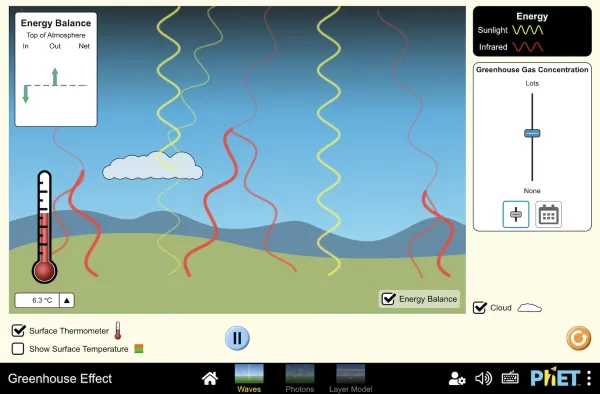
Full screen · PhET Interactive Simulations, University of Colorado Boulder, CC BY 4.0
Recap
- The atmosphere, hydrosphere, biosphere and geosphere are linked by flows of matter and energy.
- Carbon moves between stores by photosynthesis, respiration, dissolving, burial, eruptions and combustion.
- Burning fossil fuels moves ancient carbon from the geosphere to the atmosphere: CO₂ at Mauna Loa rose from 316.91 ppm in 1960 to 427.35 ppm in 2025.
- More greenhouse gas enhances the greenhouse effect; more dissolved CO₂ acidifies the ocean.
- Agriculture makes 53% of New Zealand's gross emissions, so most of our emissions are methane.
- Achieved describes, Merit explains with science ideas, Excellence discusses implications across the spheres.
| Grade | What the answer does |
|---|---|
| Achieved | Describes the change and its effects using science words |
| Merit | Explains how and why, step by step, with the science |
| Excellence | Discusses implications: links between spheres, consequences, timescales, responses |
Challenge
A restaurant's gas cooktops burn 2.0 kg of natural gas (methane, CH₄) in an evening. Using C = 12, H = 1 and O = 16 for the relative masses of the atoms, show that more than 5 kg of CO₂ is released. Then explain how the CO₂ can have more mass than the fuel when no carbon is created or destroyed, and name the store the carbon came from and the store it goes to.
Hint
From CH₄ + 2O₂ → CO₂ + 2H₂O, one CH₄ molecule makes one CO₂ molecule. Work out the mass of each molecule, then scale up. Where do the two oxygen atoms in each CO₂ come from?
Answer
5.5 kg of CO₂. Each CH₄ (mass 16) becomes one CO₂ (mass 44), so the mass is multiplied by 44 ÷ 16 = 2.75. The extra mass is oxygen taken from the air; the carbon atoms are the same ones. The carbon moves from the geosphere (fossil gas) to the atmosphere.
Step by step
- Mass of one CH₄ = 12 + 4 × 1 = 16; mass of one CO₂ = 12 + 2 × 16 = 44.
- Each CH₄ gives exactly one CO₂, because each has one carbon atom, so the CO₂ mass is 44 ÷ 16 = 2.75 times the methane mass.
- 2.0 kg × 2.75 = 5.5 kg of CO₂, which is more than 5 kg.
- The carbon atoms are unchanged in number; each just gains two oxygen atoms from the air, and that oxygen supplies the extra mass.
- The carbon was locked in the geosphere for millions of years and is now added to the atmosphere within minutes.
Full working
- CH₄: 12 + 4 × 1 = 16mass of one molecule
- CO₂: 12 + 2 × 16 = 44mass of one molecule
- 1 CH₄ → 1 CO₂, so mass × 44 ÷ 16 = × 2.75one carbon each
- 2.0 × 2.75 = 5.5 kgmore than 5 kg
- extra mass = O from the air; carbon only changes storeconservation
- 5.5 kg of CO₂; the extra mass is oxygen from the air; carbon moves from geosphere to atmosphere
At Mauna Loa, CO₂ rose from 401.01 ppm in 2015 to 427.35 ppm in 2025. Each 1 ppm of CO₂ in the whole atmosphere is about 7.8 billion tonnes (Gt) of CO₂. Suppose people released about 41 Gt of CO₂ a year over that decade, from fossil fuels and clearing land. (a) How many Gt of CO₂ were added to the air over the ten years? (b) What fraction of the CO₂ people released stayed in the air? (c) Where did the rest go, and what is one consequence of that in another sphere?
Hint
Turn the ppm rise into tonnes using 7.8 Gt per ppm, then compare with ten years of emissions. Carbon is never destroyed, so any carbon not in the air has moved to another store. Which stores take up CO₂ quickly?
Answer
(a) about 205 Gt (b) about 50%, so roughly half stayed in the air (c) the rest was taken up by the ocean (dissolving at the surface) and by land plants (photosynthesis). The ocean uptake forms carbonic acid, lowering pH and leaving less carbonate for shell builders such as pāua and mussels.
Step by step
- Rise in CO₂: 427.35 − 401.01 = 26.34 ppm.
- In tonnes: 26.34 × 7.8 ≈ 205 Gt added to the air.
- Released by people: 41 × 10 = 410 Gt, so 205 ÷ 410 ≈ 0.50: about half stayed in the air.
- Carbon is not destroyed, so the other half moved into other stores: dissolved in the ocean (hydrosphere) and taken up by plants (biosphere).
- The dissolved CO₂ reacts to form carbonic acid, releasing H⁺ ions that lower pH and use up carbonate ions, so shell builders struggle. The sinks slow warming but change the ocean.
Full working
- 427.35 − 401.01 = 26.34 ppmrise over the decade
- 26.34 × 7.8 ≈ 205 Gt(a) added to the air
- 41 × 10 = 410 Gtreleased by people
- 205 ÷ 410 ≈ 0.50(b) fraction that stayed
- other half → ocean and land plants; ocean → carbonic acid, lower pH, less carbonate(c)
- (a) about 205 Gt (b) about half (c) ocean and plants; the ocean acidifies, harming shell builders
Off Otago, surface seawater pH fell from 8.092 in 1998 to 8.057 in 2020, which the lesson says is an 8.4% rise in hydrogen ions. On the pH scale, a fall of x pH units multiplies the hydrogen ion concentration by 10ˣ. (a) Check the 8.4% figure. (b) If pH fell by a further 0.30 by 2100, by how many times would hydrogen ions increase from the 2020 level, and what would the pH be? (c) Would the sea then be acidic? Discuss what this would mean for shell builders in the cold Southern Ocean, and why this water is affected early.
Hint
Use the 10ˣ key on your calculator: a fall of 0.035 gives 10 to the power 0.035. For (c), compare the new pH with 7. Remember from the lesson which water holds more CO₂, warm or cold.
Answer
(a) 10 to the power 0.035 ≈ 1.084, an 8.4% rise (b) 10 to the power 0.30 ≈ 2.0, so hydrogen ions about double; pH ≈ 7.76 (c) No: still above 7, so still alkaline, but the doubled H⁺ would react with much more carbonate, leaving far less for calcium carbonate shells. Cold water holds more CO₂, so the Southern Ocean takes up CO₂ fastest and its shell builders feel it early.
Step by step
- pH fell by 8.092 − 8.057 = 0.035, so H⁺ is multiplied by 10 to the power 0.035 ≈ 1.084, an 8.4% rise, matching the lesson.
- A further fall of 0.30 multiplies H⁺ by 10 to the power 0.30 ≈ 2.0, roughly doubling it, though the pH number changes only a little.
- New pH = 8.057 − 0.30 = 7.757, about 7.76, still above 7, so the sea would be acidified but not acidic.
- More H⁺ reacts with carbonate ions (H⁺ + CO₃²⁻ → HCO₃⁻), so less carbonate is left for pāua, mussels and plankton to build calcium carbonate shells, which affects the food webs that depend on them.
- Cold water dissolves more CO₂, so cold Southern Ocean water near Aotearoa takes up CO₂ quickly and shows the effects sooner.
Full working
- 8.092 − 8.057 = 0.035; 10 to the power 0.035 ≈ 1.084(a) 8.4% rise checks
- 10 to the power 0.30 ≈ 2.0(b) H⁺ about doubles
- 8.057 − 0.30 = 7.757 ≈ 7.76(b) new pH
- 7.76 > 7, still alkaline(c) acidified, not acidic
- more H⁺ + CO₃²⁻ → HCO₃⁻, less carbonate; cold water holds more CO₂shells and why the south is early
- (a) 8.4% confirmed (b) H⁺ about 2 times, pH about 7.76 (c) still alkaline, but much less carbonate for shells, felt first in cold southern water