
Particles and forces in the five types of material
What this lesson covers
- Sort a material into one of five types: molecular, metallic, ionic, covalent network or polymer.
- Name the particles in each type: atoms, ions, molecules and electrons.
- Tell strong forces (covalent, ionic and metallic bonds) apart from weak forces between molecules or chains.
- Draw and read a particle diagram for each type of material.
- Write a structure and bonding description that names the type, the particles, their arrangement and the force holding them.
Five types of material
- A material is a group of substances built the same way inside, so substances of one type share many physical properties.
- Chemists sort solids into five types by asking two questions: what are the particles, and what holds them together?
- The particles can be atoms, ions (charged atoms), molecules (atoms joined into a small group) or electrons.
- Every exam answer on this standard starts by naming the type correctly, because everything after it depends on that choice.
| Type | Particles | What holds them together | Examples |
|---|---|---|---|
| Molecular | Small molecules | Strong covalent bonds inside each molecule; weak forces between molecules | Water, iodine, carbon dioxide |
| Metallic | Positive metal ions (cations) and delocalised electrons | Strong metallic bonding in every direction | Copper wire, lead pipe, magnesium alloy wheels |
| Ionic | Positive and negative ions | Strong ionic bonds in every direction | Salt (NaCl), nitrate fertilisers |
| Covalent network | Atoms | Strong covalent bonds joining every atom into one giant structure | Diamond, graphite |
| Polymer | Very long chain molecules | Strong covalent bonds along each chain; weak forces between chains | DNA, proteins, polythene, non-stick coatings |
Strong bonds and weak forces
- Covalent bonds (shared pairs of electrons), ionic bonds (attraction between opposite charges) and metallic bonds (attraction between cations and delocalised electrons) are all strong.
- Intermolecular forces, the attractions between separate molecules or separate polymer chains, are weak by comparison.
- A property like melting point depends on which forces have to be overcome: if only weak forces break, little energy is needed; if strong bonds break, a lot is needed.
- When water boils, the molecules move apart but each H₂O molecule stays whole, so only the weak forces between molecules were overcome.
- The 2025 assessment report noted that answers naming the exact force did better than answers that just said 'strong bonds' or 'intermolecular forces' with no detail.
Molecular substances
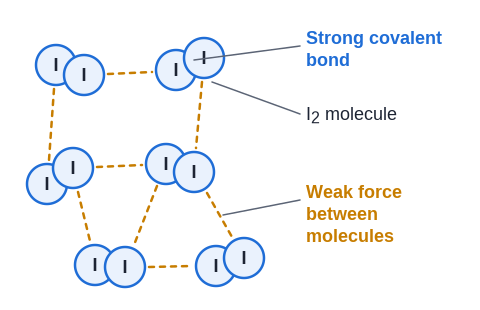
- A molecular substance is made of separate, small molecules, such as H₂O in water or I₂ in iodine.
- Inside each molecule the atoms share electrons in strong covalent bonds.
- Between one molecule and the next there are only weak intermolecular forces.
- Because only the weak forces need to break, molecular substances have low melting and boiling points: many are liquids or gases at room temperature, and solid iodine turns to a purple vapour with gentle warming.
- The molecules carry no overall charge and have no free electrons, so molecular substances do not conduct electricity.
Metallic solids
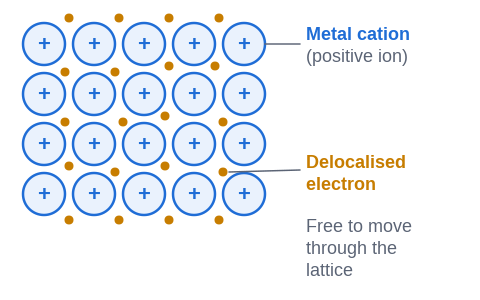
- A metal is a 3D lattice of positive ions (cations) packed tightly in regular layers.
- Each atom has given up its outer electrons, which are delocalised: they are free to move through the whole lattice.
- The metallic bond is the strong attraction between the cations and the sea of delocalised electrons around them.
- The bond pulls equally in every direction (it is non-directional), so layers of cations can slide over each other without the attraction breaking.
- The delocalised electrons are charged and mobile, which is why metals conduct electricity and heat.
Ionic materials
- An ionic material is built from positive and negative ions, most often made when a metal gives electrons to a non-metal.
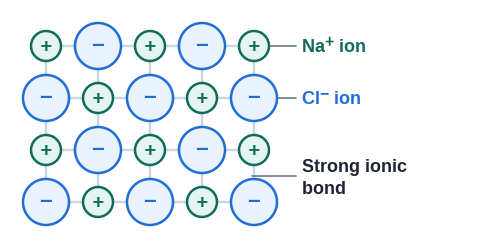
- In salt, sodium ions (Na⁺) and chloride ions (Cl⁻) alternate in a regular 3D lattice, so every ion is surrounded by ions of the opposite charge.
- The ionic bond is the strong electrostatic attraction between these oppositely charged ions, acting in every direction.
- The ions are locked in fixed places in the solid, so solid salt does not conduct; melted or dissolved, the ions can move and it does.
- Nitrate fertilisers such as ammonium nitrate are ionic too, built from ions like NH₄⁺ and NO₃⁻.
Covalent networks: diamond and graphite
- A covalent network is one giant structure of atoms, all joined by strong covalent bonds, with no separate molecules.
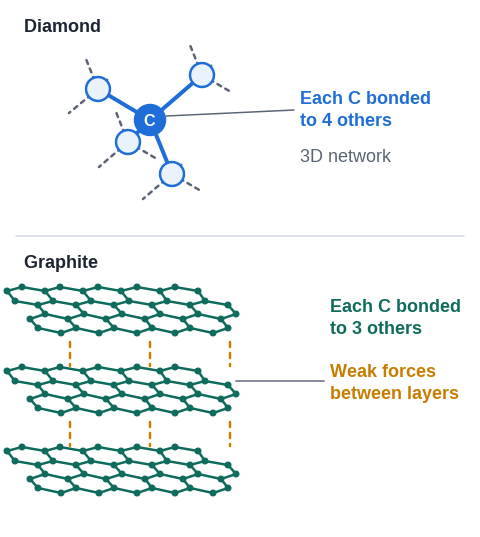
- In diamond, every carbon atom shares a covalent bond with each of four neighbours, building one rigid 3D network.
- In graphite, each carbon atom is bonded to only three others, forming flat layers of hexagons (a 2D network).
- Each carbon in graphite has one outer electron left over, which is delocalised and free to move along the layer.
- The layers are held to each other only by weak forces, so they can slide apart, while the bonds within a layer stay strong.
Polymers: natural and synthetic
- A polymer is a very long chain molecule made from many small repeating units called monomers joined end to end.
- Atoms along each chain are held by strong covalent bonds; separate chains are held to each other by weak intermolecular forces.
- Because the chains are so long, they touch at many points, so the weak forces add up and polymers are usually solids.
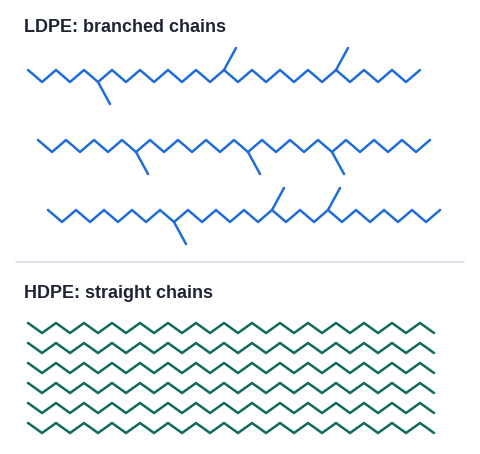
- Branches matter: in low-density polyethylene (LDPE) side branches stop the chains packing closely, while in high-density polyethylene (HDPE) straight chains lie close together.
- Natural polymers include DNA, proteins such as wool, and the cellulose in muka, the fibre Māori prepare from harakeke; synthetic ones include polythene and the PTFE coating on non-stick pans.
Try it: what breaks, what conducts
Example: name the type from the clues
- Exams often describe a substance and ask you to name its type before explaining anything.
- Use the clues in this order: is it a metal, made of a metal and a non-metal, one element of carbon, small molecules, or long chains?
- Then check the properties fit the type you chose.
| Clue in the question | Type | Why |
|---|---|---|
| Shiny solid that bends and conducts as a solid | Metallic | Delocalised electrons carry charge; layers slide |
| Crumbly crystals, conduct only when melted or dissolved | Ionic | Ions are fixed in the solid, free in a liquid |
| Only carbon atoms, extremely high melting point, very hard | Covalent network (diamond) | Every atom held by strong covalent bonds |
| Low melting point, does not conduct, small formula like CO₂ | Molecular | Only weak forces between molecules break |
| Long chain of repeating units, bends, softens when warmed | Polymer | Weak forces between chains let them move |
Try it: which type of material?
Example: describing graphite at each grade
- Question: describe the structure and bonding in graphite.
- Achieved answers name the type and describe the particles and forces; Merit answers also explain what those forces mean; Excellence answers connect all of it to a property and a use.
- Notice how each grade keeps everything from the one before and adds a link.
- Achieved: graphite is a covalent network of carbon atoms in layers, with weak forces between the layers.type, particles, arrangement, forces
- Merit: each carbon is covalently bonded to three others in a layer; the fourth electron is delocalised; the forces between layers are weak, so little force slides them apart.explains what the forces do
- Excellence: the strong covalent bonds within each layer give a very high melting point, while the weak forces between layers let them slide off onto paper, so graphite works as pencil lead and its free electrons let it conduct.links structure and forces to properties and uses
A recipe for a structure and bonding answer
- Name the type of material.
- Name the particles (atoms, ions, molecules, electrons).
- Describe how they are arranged (lattice, layers, separate molecules, long chains).
- Name the force or bond and say whether it is strong or weak, and between which particles.
- For Merit and Excellence, finish by saying what that force means for the property the question is about.
Common mistakes
- When water boils, the covalent bonds in the water molecules break.Boiling only overcomes the weak forces between molecules; each H₂O molecule stays whole in the steam.
- Salt is made of sodium and chlorine molecules.Salt is an ionic lattice of Na⁺ and Cl⁻ ions; there are no molecules in an ionic material.
- Graphite conducts because its layers slide.Graphite conducts because each carbon has one delocalised electron free to move; sliding layers explain softness, not conduction.
- Polymers are held together by weak forces, so they are weak.Bonds along each chain are strong covalent bonds; only the forces between chains are weak, and long chains have many of them.
Test one material of each type
You need: a few grains of table salt, a few grains of sugar, a square of aluminium foil, a pencil and paper, a piece of plastic shopping bag, a metal spoon, two glasses of water
- Lay out salt (ionic), sugar (molecular), foil (metallic), the pencil (graphite, a covalent network) and the plastic bag (polymer).
- Press a few salt grains and a few sugar grains under the back of the spoon on a plate, then fold the foil over and over.
- Rub the pencil hard on the paper, then stretch a strip of the plastic bag slowly until it thins.
- Stir the salt into one glass of water and the sugar into the other, and drop a scrap of plastic bag and a scrap of foil into the salty glass.
- Look for: salt crystals crumble but foil bends without breaking, graphite layers rub off onto the paper, the plastic stretches as chains slide, and salt and sugar dissolve while the foil and plastic do not.
Safety: Torn foil edges can cut skin, so fold the foil with flat fingers and keep the salt grains away from your eyes when you crush them.
Exam-style question: iodine and salt
- Iodine crystals are used to make an antiseptic. A student warms iodine and salt crystals side by side in a warm water bath.
- The iodine slowly gives off a purple vapour, but the salt crystals do not change.
- (a) Name the type of material iodine is and the type salt is.
- (b) Describe the particles and the forces between them in each substance.
- (c) Explain why the iodine turns to vapour at this temperature but the salt does not change.
Show answer
1. (a) Iodine is a molecular substance; salt is an ionic material. (b) Iodine is made of I₂ molecules, each two atoms held by a strong covalent bond, with weak intermolecular forces between molecules. Salt is a 3D lattice of alternating Na⁺ and Cl⁻ ions held by strong ionic bonds in every direction. Getting (a) right and describing one structure earns Achieved. (c) To become a vapour, the iodine molecules only need to separate from each other, which means overcoming the weak forces between molecules; the covalent bonds inside each I₂ do not break. Little heat energy does this, so a warm water bath is enough. To melt salt, the strong ionic bonds between ions all through the lattice must be overcome, which needs far more energy, so the salt stays solid. Explaining one substance this way is Merit; comparing both, naming which forces break in each and linking the difference in force strength to what the student saw, is Excellence.
Your turn
Name the particles in copper wire and the force that holds them together.
A white solid does not conduct electricity, but it conducts once dissolved in water. What type of material is it, and why does dissolving change things?
Diamond and graphite are both pure carbon. Why does graphite conduct electricity when diamond does not?
Why is low-density polyethylene less dense than high-density polyethylene?
Carbon dioxide is a gas at room temperature. Which forces are weak in carbon dioxide, and which are strong?
Show answer
1. Positive copper ions (cations) and delocalised electrons, held by metallic bonding: the strong attraction between the cations and the sea of electrons. 2. Ionic; in the solid the ions are fixed in the lattice, but in solution they are free to move and carry charge. 3. In graphite each carbon bonds to only three others, leaving one delocalised electron free to move; in diamond all four outer electrons are used in covalent bonds, so none are free. 4. LDPE chains have side branches that stop them packing closely, so there is less mass in each cubic centimetre; HDPE's straight chains pack tightly. 5. The forces between CO₂ molecules are weak; the covalent bonds between the carbon and oxygen atoms inside each molecule are strong.
States of Matter: Basics
Full screen · PhET Interactive Simulations, University of Colorado Boulder, CC BY 4.0
Recap
- Five types: molecular, metallic, ionic, covalent network and polymer.
- Covalent, ionic and metallic bonds are strong; forces between molecules and between polymer chains are weak.
- Metals and graphite have delocalised electrons; ionic solids have fixed ions that move only when melted or dissolved.
- Every answer names the type, the particles, their arrangement and the force, then links it to the property asked about.
| Type | Particles | Force that must break to melt it |
|---|---|---|
| Molecular | Molecules | Weak forces between molecules |
| Metallic | Cations and delocalised electrons | Strong metallic bonds |
| Ionic | Positive and negative ions | Strong ionic bonds |
| Covalent network | Atoms | Strong covalent bonds |
| Polymer | Long chain molecules | Weak forces between chains (softens) |
Challenge
Dry ice (solid CO₂) turns straight to a gas at −78 °C. Quartz (SiO₂) melts at about 1700 °C. Both are made of a group 14 element joined to oxygen by strong covalent bonds. A student says: "Both have strong covalent bonds, so quartz must melt higher because silicon atoms are heavier than carbon atoms." Explain what is wrong with this, and give the real reason for the huge difference.
Hint
Ask the first question of the lesson for each one: what are the particles? Are there separate small molecules in quartz, or one giant structure? Then ask which force must actually be overcome to turn each solid into a liquid or gas.
Answer
Dry ice is molecular: only the weak forces between separate CO₂ molecules are overcome, and the C=O covalent bonds stay whole. Quartz is a covalent network: there are no separate molecules, so melting it means breaking strong Si–O covalent bonds all through the structure. The type of material, not the mass of the atoms, causes the difference.
Step by step
- Both substances do contain strong covalent bonds, so that cannot be what separates them.
- Dry ice is molecular: separate CO₂ molecules with only weak intermolecular forces between them.
- When dry ice turns to gas the molecules move apart but each CO₂ stays whole, so only the weak forces are overcome and little energy is needed.
- Quartz is a covalent network: every Si atom is covalently bonded to O atoms, which bond to more Si atoms, in one giant structure with no separate molecules.
- To melt quartz, strong covalent bonds themselves must break all through the network, which needs a lot of energy, so its melting point is very high.
- The student has named the right bonds but the wrong forces: what matters is which force has to be overcome, which depends on the type of material.
Full working
- CO₂: molecular, separate small moleculestype of material
- change of state breaks only weak forces between CO₂ moleculesC=O bonds stay whole
- SiO₂: covalent network, no separate moleculestype of material
- melting breaks strong Si–O covalent bonds throughoutno weak forces to overcome instead
- atom mass is not the cause; the force overcome iscorrect the claim
- Dry ice: weak forces between molecules overcome; quartz: strong covalent bonds broken, so quartz melts far higher
A thin flake of graphite is tested two ways. Along its layers it conducts electricity very well. Straight through the flake, across the layers, it conducts thousands of times worse. Diamond does not conduct in any direction. Use the particles and forces in each structure to explain all three results.
Hint
Where are graphite's delocalised electrons, and where are they free to move? What lies between one layer and the next: bonds, or weak forces? Then count how many of diamond's outer electrons are used in bonds.
Answer
Graphite's delocalised electrons (one per carbon) move freely within each layer, so it conducts well along the layers. Between layers there are only weak forces and no shared delocalised electrons, so electrons cannot easily cross from one layer to the next, and it conducts poorly across them. In diamond all four outer electrons of each carbon are used in covalent bonds, so there are no free charged particles at all.
Step by step
- To conduct, a material needs charged particles that are free to move in the direction of the current.
- In graphite each carbon bonds to three others in a flat layer, and its fourth outer electron is delocalised over that layer.
- So electrons can move a long way within a layer: conduction along the layers is good.
- Between layers there are only weak forces, not covalent bonds, and the delocalised electrons belong to their own layer, so it is hard for them to cross the gap: conduction across the layers is poor.
- In diamond every carbon uses all four outer electrons in covalent bonds to four neighbours, leaving no delocalised electrons, so diamond does not conduct in any direction.
Full working
- conducting needs free charged particles moving that waythe rule
- graphite: 3 bonds per C, 1 delocalised electron per C, spread over the layerparticles
- along a layer: delocalised electrons free to movegood conduction
- between layers: weak forces only, electrons tied to their own layerpoor conduction across
- diamond: 4 bonds per C, no delocalised electronsno conduction
- Graphite conducts along layers (mobile delocalised electrons in each layer), poorly across them (only weak forces between layers); diamond has no free electrons
A polythene bag softens when warmed and can be melted and moulded into a new shape. The melamine plastic in a picnic plate is also a polymer, but in it the long chains are joined to each other at many points by covalent bonds (cross-links). When heated strongly, a melamine plate does not soften at all; it chars and burns. Explain both behaviours using particles and forces, and say why a melamine plate cannot be recycled by melting it down.
Hint
In polythene, what holds one chain to the next, and how much energy is needed to overcome it? In melamine, what holds one chain to the next now? Compare that with the bonds inside each chain: which strong bonds would break first?
Answer
Polythene's chains are held to each other only by weak intermolecular forces, so gentle heat overcomes them and the chains slide past each other: it softens and melts. In melamine the chains are cross-linked by strong covalent bonds, so the chains cannot slide unless covalent bonds break; the energy needed is so high that the bonds in the chains break and the material decomposes (chars) instead. Melting it down is impossible, because it never melts.
Step by step
- In polythene, the atoms along each chain are held by strong covalent bonds, but separate chains are held to each other only by weak forces.
- Warming gives enough energy to overcome those weak forces, so chains slide past each other: the plastic softens, melts and can be remoulded.
- In melamine the chains are joined to each other by covalent cross-links, making something closer to one giant network.
- For chains to slide, strong covalent bonds would have to break; the cross-links are no weaker than the bonds along the chains, so heating breaks bonds all through the material and it decomposes, charring instead of melting.
- Since it cannot be melted, it cannot be reshaped into a new product, so it cannot be recycled by melting.
Full working
- polythene: strong covalent bonds along chains, weak forces between chainsstructure
- heat overcomes weak forces → chains slide → softens, meltswhy it can be remoulded
- melamine: chains joined by covalent cross-linksstructure
- sliding would need strong covalent bonds to break → bonds break, material decomposeswhy it chars
- no melting → no remouldingwhy melt recycling fails
- Polythene softens because only weak forces between chains break; cross-linked melamine would need covalent bonds broken, so it chars and cannot be melted down