
Science claims: who is saying it and why
What this lesson covers
- A science-related claim is a conclusion that someone backs up with scientific evidence.
- The source is the person or organisation who made, or paid for, the information; the purpose is why they made it.
- Adverts, news, research papers, social media and government sites are checked in different ways before you see them.
- Peer review is checking by other experts before publication, and it makes a claim more trustworthy but not certain.
- Bias and conflicts of interest can make a source leave out evidence that goes against its claim.
- In the exam you answer five parts for each resource: who, why, the claim, the language or conventions, and how well they support it.
What a science-related claim is
- A science-related claim is a conclusion that uses scientific evidence to justify it: "This sunscreen blocks 97% of UVB rays" or "Kauri dieback spreads in soil carried on boots".
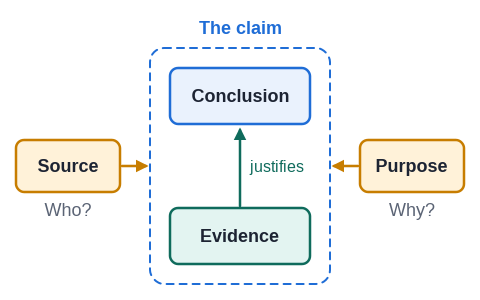
- Every claim has two halves: the conclusion (what they want you to believe) and the evidence (why you should believe it).
- Not every sentence is a claim. "Our cream smells like rose petals" is a description; "our cream reduces wrinkles in four weeks" is a claim, because it says something testable happens.
- A good way to find the claim is to ask: what does the writer want me to believe or do after reading this?
- In the exam, write the claim in one clear sentence in your own words, and make sure it is something the resource actually says.
Source and purpose: who made it, and why
- The source is the person, people or organisation who created the information, or who paid for it to be made.
- Look past the website name: an article on a news site may be a press release from a company, and a study may be funded by the firm whose product it tests.
- The purpose is the reason it was made: to inform, to persuade, to sell, to warn, to report new research, to entertain or to get clicks.
- Most information has more than one purpose. A company blog can inform you about plastics and also sell its own packaging.
- Achieved answers name the source and purpose; better answers say how that source and purpose could shape which evidence is shown.
| Ask | Where to look |
|---|---|
| Who wrote it? | By-line, author box, "About us" page |
| Who published or paid for it? | Website owner, sponsor, funding statement |
| When? | Date at the top or bottom |
| Why? | Is there something to buy, sign up to or share? |
Example: a news story about a sports drink
- A news website runs a story headed "Electrolyte drink helps teens train longer". At the bottom it says the article was supplied by FizzFuel Ltd, the company that makes the drink.
- The story says 30 club rugby players ran 8% longer on a treadmill after drinking FizzFuel than after drinking water.
- Name the source, the purpose and the claim.
- source: FizzFuel Ltd, which wrote the article; the news site only published itwho created it
- purpose: to persuade people to buy FizzFuel, presented as newsthe maker gains from sales
- claim: drinking FizzFuel lets teenagers exercise for longerthe conclusion they want you to believe
- evidence offered: a treadmill test on 30 rugby playerswhat they use to justify it
- a source with something to sell, using a small test it ran itself
Adverts, news, research and social media compared
- Where information comes from changes how much checking it had before it reached you.
- Adverts in Aotearoa must follow the Advertising Standards Code, which says advertisers must hold evidence for their claims and that testimonials do not count as that evidence.
- A news reporter checks facts but is not usually a scientist, and a headline is written to be read, so it often sounds more certain than the study.
- Social media posts usually have no checking at all; likes and shares show popularity, not accuracy.
- Mātauranga Māori is knowledge built and tested over generations by iwi and hapū; a claim drawing on it is stronger when it names the knowledge holders and the iwi it comes from.
| Channel | Checked by | Usual purpose |
|---|---|---|
| Advert | Advertising rules, complaints after | Sell |
| News article | Editor and reporter | Inform, get readers |
| Research paper | Other experts (peer review) | Report new findings |
| Government or agency site | Experts in that agency | Inform, advise |
| Social media post | Usually nobody | Share, persuade, get followers |
Try it: where did the claim come from?
Peer review: experts check it first
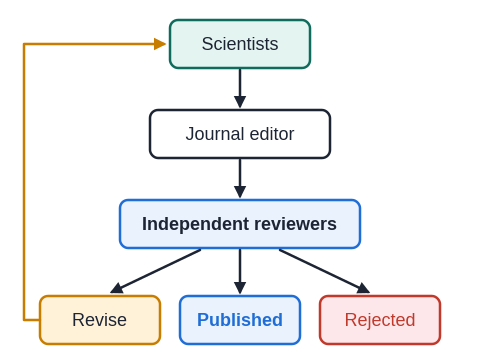
- Peer review means other scientists in the same field read a study before a journal publishes it, checking the method, the data and whether the conclusion follows.
- It makes a claim more believable because people with no stake in the result have looked for mistakes.
- It does not make a claim certain: reviewers only see what the authors report, and science stays open to new evidence.
- A famous case: a 1998 paper in The Lancet linked the MMR vaccine to autism using only 12 children. Larger studies found no link, and the journal retracted (withdrew) the paper in 2010.
- So a single peer-reviewed study is good evidence, and several studies by different teams that agree is much better.
| Wakefield and others, The Lancet | Detail |
|---|---|
| Published | February 1998 |
| Children studied | 12 |
| Retracted by the journal | February 2010 |
Bias and conflicts of interest
- Bias is a leaning that makes someone more likely to show one side, for example only quoting the studies that agree with them.
- A conflict of interest is when the source gains (money, reputation, followers) if you believe the claim, such as a company selling the product it is praising.
- A conflict of interest does not make a claim false; it means you should ask what evidence might have been left out.
- Look for funding statements in research ("This study was funded by...") and for links to buy something on websites.
- A strong answer weighs both sides: the company gains from sales, but it could also lose trust, or face a complaint to the Advertising Standards Authority, if its claim is false.
Try it: how big is the effect?
Try it: who says it, and why?
Example: Achieved, Merit and Excellence on the same point
- Resource: a honey company's website says its mānuka honey "soothes sore throats", quoting a study it paid for.
- Here is the same idea, conflict of interest, written at each grade.
| Grade | What the answer does | Sample sentence |
|---|---|---|
| Achieved | Names the convention | There is a conflict of interest because the company sells the honey. |
| Merit | Explains its effect on the claim | The company profits if people believe the honey works, so it may only show results that help it. This makes the claim less believable. |
| Excellence | Weighs it, links it to another convention, suggests a fix | The paid study may favour the honey, and we are not told if it was peer reviewed, so nobody independent has checked it. The claim would be stronger if the study were peer reviewed or repeated by a university with no link to the company. |
Common mistakes
- The source is Google, because that is where I found it.The source is whoever created or paid for the information, such as the company or researchers, not the search engine or app.
- The company sells the product, so the claim is false.A conflict of interest makes a claim less trustworthy, not automatically false; say what evidence might be missing.
- It was peer reviewed, so it is proven.Peer review makes a claim more reliable, but science is never proven for good; new evidence can still change it.
- I know from experience that honey does not work, so the claim is wrong.Judge the claim on the evidence in the resource, not your own opinion or extra research; markers do not credit that.
Test a paper towel claim
You need: two brands of paper towel, a measuring jug, two bowls, water, a tray or the sink
- Find a claim on a paper towel packet, such as "super absorbent" or "twice as strong", and write down who made the claim and why.
- Pour 100 mL of water into each bowl.
- Fold one sheet of each brand the same way, dip it fully into its bowl for 10 seconds, then lift it out and let it drip for 10 seconds.
- Pour what is left in each bowl back into the jug to see how much each sheet soaked up, and repeat three times with fresh sheets.
- Look for: whether your results back the packet's claim, and how keeping the sheet size, timing and water the same made the test fair.
Safety: Spilt water makes kitchen floors slippery, so work over a tray or the sink and wipe up drips straight away.
Your turn: name the source and purpose
A Facebook post from a fitness influencer says a protein powder "burns fat while you sleep" and gives a discount code. What is the main purpose?
A university research team publishes a study on kauri dieback in a peer-reviewed journal. Who is the source?
A news site runs a story that, at the bottom, says it was supplied by the company that makes the product. Who is the source?
A company paid for a study showing its toothpaste whitens teeth. Name the convention this raises, and its effect on the claim.
Show answer
1. To sell the protein powder (and earn from the discount code); persuading, not informing. 2. The university research team that did the study. 3. The company, because it created the article; the news site only published it. 4. A conflict of interest: the company gains if you believe it, so it might leave out unhelpful results, making the claim less believable.
Exam-style question: a sunscreen advert
- Resource: SunShield Ltd's website says "Our new SPF 50 lotion is scientifically proven to block 98% of UVB rays. Dermatologist tested. Trusted by 10,000 Kiwi families." A footnote says the lab test was done on 20 volunteers by a lab SunShield hired, and was not published in a journal. There is a "Buy now" button.
(a) Who published this information?
(b) Why was it published?
(c) State one science-related claim the resource makes.
(d) Identify the science language or conventions used to support the claim.
(e) How well do they support the claim? Use evidence from the resource.
Show answer
1. SunShield Ltd, the company that makes and sells the sunscreen (Achieved). 2. To persuade people to buy the lotion, while informing them about UV protection (Achieved). 3. The lotion blocks 98% of UVB rays (Achieved). 4. Language: SPF 50, UVB, dermatologist tested, scientifically proven. Conventions: a percentage result, a lab test, a sample of 20 people, no peer review, a conflict of interest (Achieved for naming these). 5. Merit: SunShield sells the lotion, so it gains if people believe it and may only report good results, which weakens the claim; words like "dermatologist tested" make it sound expert, but we are not told what the test found. Excellence: the 98% figure and the hired lab make the claim look scientific, but 20 people is a small sample, so the result could be a fluke, and because the test was not peer reviewed nobody independent has checked the method. "Trusted by 10,000 families" is a testimonial, which is popularity, not evidence. Overall the claim is only weakly supported; it would be stronger with a larger test by an independent lab, published and peer reviewed.
Recap
- A science-related claim is a conclusion backed by scientific evidence; find it by asking what you are meant to believe.
- The source is who created or paid for it; the purpose is why, and there is often more than one.
- Adverts, news, research, agency sites and social media get very different checking before you see them.
- Peer review raises trust but never proves a claim for good.
- A conflict of interest is a reason to look for missing evidence, not proof the claim is false.
- For Merit say how each point changes the claim's believability; for Excellence weigh several points together and suggest what would make it stronger.
| Exam part | What to write |
|---|---|
| (a) Who | The person or organisation who made or paid for it |
| (b) Why | Inform, persuade, sell, warn, report research |
| (c) Claim | One sentence, your own words |
| (d) Language or conventions | Name specific words and conventions from the resource |
| (e) How well | Explain each one's effect, weigh them, suggest improvements |
Challenge
A toothpaste advert says "9 out of 10 dentists recommend Brightsmile". The footnote explains that 10 dentists were each shown a list of 6 toothpaste brands and asked to tick every brand they would be happy to recommend. On average each dentist ticked 5 brands. (a) If ticks were spread evenly, how many of the 10 dentists would you expect to tick any one brand? (b) Explain why the advert's claim is weaker than it sounds, naming two conventions. (c) Write a fairer sentence the company could use.
Hint
If a dentist ticks 5 of 6 brands, what fraction of the brands gets a tick from that dentist? Then think about what the reader assumes the question was.
Answer
(a) about 8 or 9 dentists (8.3 on average) (b) the question let dentists recommend several brands, so 9 out of 10 is barely above what any brand would get, and a sample of 10 is tiny (c) for example: "9 of the 10 dentists we asked were happy to recommend Brightsmile, along with other brands"
Step by step
- Each dentist ticked 5 of the 6 brands, so each brand had a 56 chance of a tick from each dentist.
- Out of 10 dentists that is 10 × 56 ≈ 8.3, so most brands would score about 8 or 9 out of 10.
- The advert reads as if dentists chose Brightsmile over others, but the survey never asked them to choose one, so the claim hides how the question was asked.
- The sample is also only 10 dentists, and the company, which profits from sales, ran and reported the survey with no independent check.
- A fair sentence states what was actually measured, so readers can see that Brightsmile was one of several brands recommended.
Full working
- chance of a tick per dentist = 565 brands ticked out of 6
- expected ticks = 10 × 56 ≈ 8.3per brand, out of 10 dentists
- 9 out of 10 compared with about 8.3barely above an average brand
- sample of 10, survey run by the sellersmall sample, conflict of interest
- (a) about 8.3 of 10 (b) the question allowed many brands, so the claim is weak (c) say it was one of several brands recommended
A supplement website claims "Kiwi-Calm reduces anxiety" and links to 3 studies that support it, all paid for by the company. A student searching a research database finds 8 studies of the same supplement in total. The other 5 were run by universities with no link to the company, were peer reviewed, and found no effect. (a) What fraction of all the studies support the claim, and what fraction of the independent ones? (b) Name the kind of bias the website shows and explain its effect on the claim. (c) Judge the claim, and explain why the conflict of interest alone would not have been enough to reject it.
Hint
Count studies in two ways: all of them, and only those with no money link to the company. What did the website choose to show you?
Answer
(a) 38 of all studies (37.5%), and 0 of the 5 independent studies (b) cherry-picking: showing only the studies that agree, so readers think the evidence is one-sided when most of it goes against the claim (c) weakly supported; a conflict of interest only makes evidence less certain, but here the independent, peer-reviewed studies all found no effect, which is what weighs against it
Step by step
- 3 of the 8 studies support the claim, which is 38 or 37.5%. None of the 5 independent studies do.
- The website showed only the 3 supporting studies, so its bias is cherry-picking evidence: leaving out the results that go against it.
- The 3 supporting studies were all funded by the company, a conflict of interest, so the company gained from their results.
- A conflict of interest does not make a study wrong on its own; the company's studies might be well done.
- What tips the judgement is the missing evidence: 5 independent, peer-reviewed studies found no effect. Together, the funding pattern and the hidden studies mean the claim is weakly supported.
Full working
- supporting ÷ all = 38 = 37.5%all studies
- independent supporting = 0 of 5no link to the company
- website shows 3 of 8cherry-picking
- all 3 supporting studies company-fundedconflict of interest
- 5 peer-reviewed independent studies, no effectthe evidence that was left out
- (a) 38 overall, 0 of 5 independent (b) cherry-picking (c) weakly supported, mainly because independent evidence goes against it
In this invented example, a friend shares a social media post with 4000 likes: "Science says chocolate milk beats sports drinks for recovery!" It links a news article headed "Chocolate milk better than sports drinks, study finds". The article is based on a press release from a university. The press release describes a peer-reviewed study of 18 rugby players, funded by a dairy industry group, whose authors wrote that chocolate milk "may aid recovery as well as" a sports drink. (a) Who is the source of the evidence, and who has a conflict of interest? (b) Trace how the claim changed at each step, and why. (c) Judge how well the post's claim is supported, and say what would make it stronger.
Hint
Work back from the post to the study. At each step ask: who wrote this, what was their purpose, and what checking did it get?
Answer
(a) the source of the evidence is the university research team; the dairy industry group that paid for the study has a conflict of interest (b) "may aid recovery as well as" became "better than" in the headline and "science says" in the post, because each step was written to attract readers, not to report carefully (c) weakly supported as stated: only the original, cautious claim had peer review, from a small sample of 18 with industry funding; larger independent studies would make it stronger
Step by step
- The evidence comes from the university team that ran the study; the news site and the post only passed it on. The dairy group paid for it and gains if people buy more milk.
- The study's careful words were "may aid recovery as well as": cautious, and only claiming equal, not better.
- The news headline turned that into "better than", because headlines are written to be read and often sound more certain than the study.
- The post went further with "science says", and 4000 likes show popularity, not accuracy; social media posts get almost no checking.
- Only the original paper was peer reviewed, and it had just 18 players and industry funding, so even the cautious claim is limited. The post's stronger claim is weakly supported.
- Stronger evidence would be larger studies by teams with no industry funding, with a control group, that actually found chocolate milk better.
Full working
- study: "may aid recovery as well as"peer reviewed, 18 players, dairy-funded
- press release: written by the university to publicise the studypurpose: inform and promote
- headline: "better than"written to attract readers, more certain than the study
- post: "science says", 4000 likesno checking, popularity is not evidence
- equal became better, may became saysthe claim grew at each step
- Source: the university team; conflict of interest: the dairy group; the post's claim is weakly supported