
Sensory neurons, motor neurons and the reflex arc
What this lesson covers
- Sensory neurons and the direction they carry signals
- How the central nervous system weighs up signals and picks a response
- Motor neurons and the effectors they control
- Muscles and glands as effectors
- The reflex arc, and why reflexes are faster than chosen actions
- What makes data from human subjects more or less reliable
Connecting the parts
- Part 1 named the parts: receptors detect stimuli, the brain and spinal cord form the central nervous system, and nerves run everywhere else.
- This part connects them into one pathway that every response follows.
- The signal always travels in one direction: in from a receptor, through the central nervous system, then out to something that acts.
| Step | Part | What happens |
|---|---|---|
| 1 | Stimulus | A change happens, such as a wasp landing on your arm |
| 2 | Receptor | Touch receptors in the skin detect it and start a signal |
| 3 | Sensory neuron | Carries the signal to the spinal cord and brain |
| 4 | Central nervous system | Processes the signal and decides what to do |
| 5 | Motor neuron | Carries the instruction out to an effector |
| 6 | Effector | Arm muscles contract and you flick the wasp off |
Sensory and motor neurons
- A neuron is a nerve cell stretched into a long thin fibre so it can carry an electrical signal a long way; some run from your spine to your toes, about a metre.
- Sensory neurons carry signals inward, from receptors to the spinal cord and brain.
- Motor neurons carry signals outward, from the spinal cord and brain to effectors.
- Inside the central nervous system, relay neurons (also called interneurons) link sensory neurons to motor neurons and to each other.
- Where two neurons meet there is a tiny gap called a synapse, and the signal crosses it as a chemical before carrying on electrically.
| Neuron | Carries signals from | Carries signals to |
|---|---|---|
| Sensory | Receptors | Brain and spinal cord |
| Relay | Sensory neurons | Motor neurons, inside the CNS |
| Motor | Brain and spinal cord | Effectors (muscles or glands) |
The brain and spinal cord decide
- The central nervous system is the coordinator: it receives signals from many receptors at once and combines them.
- It compares what is happening with past experience, then sends instructions to the right effectors in the right order.
- Catching a ball needs the eyes to track it, the cerebrum to decide to catch, and the cerebellum to time the arm and hand muscles together.
- The spinal cord also carries messages up to the brain and down from it, like a main highway for signals.
Effectors: muscles and glands
- An effector is the part of the body that carries out the response.
- Muscles respond by contracting, which moves a body part or squeezes an organ.
- Glands respond by releasing a substance, such as saliva, sweat or a hormone.
- The same stimulus can reach several effectors at once: the smell of fish and chips can make you turn your head (muscles) and make your mouth water (salivary glands).
| Effector | Type | Response |
|---|---|---|
| Biceps | Muscle | Contracts to bend the arm |
| Iris muscles in the eye | Muscle | Change the size of the pupil |
| Salivary glands | Gland | Release saliva |
| Sweat glands | Gland | Release sweat onto the skin |
| Adrenal glands | Gland | Release adrenaline in a fright |
The reflex arc: a shortcut
- A reflex arc is the nerve pathway for a reflex, and it takes a shortcut through the spinal cord instead of waiting for the brain to decide.
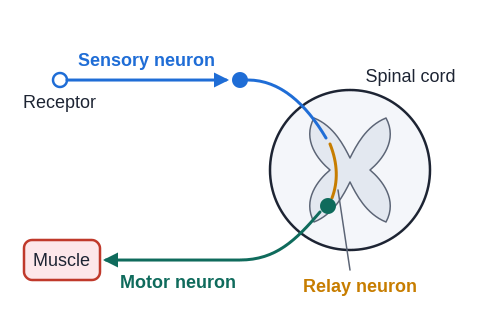
- In the hand-on-a-hot-pan reflex, the sensory neuron passes the signal to a relay neuron in the spinal cord, which passes it straight to a motor neuron.
- Because there are only a few neurons and no conscious decision, the arm muscle pulls your hand away in a fraction of a second.
- A separate signal still travels up to the brain, which is why you feel the pain just after you have already moved.
Try it: the reflex arc
Body explorer
Tracing the hot pan reflex
- You grab the handle of a pan that has been sitting in the oven.
- Trace the signal through each part of the reflex arc.
- Stimulus: high temperature of the handlethe change detected
- Receptor: heat and pain receptors in the skin of the palmthey start the signal
- Sensory neuron: carries the signal up the arm to the spinal cordinward direction
- Relay neuron in the spinal cord: passes it straight onthe brain is bypassed, so no delay
- Motor neuron: carries the signal back down the armoutward direction
- Effector: biceps contracts and the hand lifts away; pain is felt a moment later
Why catching a ruler is slower than a reflex
- A typical ruler-drop catch takes about 0.15 to 0.25 seconds, while a knee-jerk reflex takes only a few hundredths of a second.
- Compare the two pathways to explain the difference.
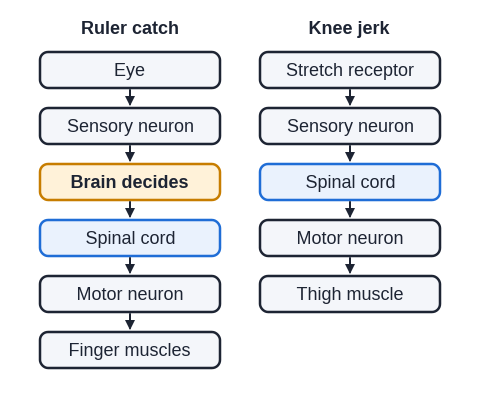
- Ruler: eye, sensory neurons, brain (cerebrum decides), spinal cord, motor neurons, finger muscleslong route with a decision
- Knee jerk: stretch receptor, sensory neuron, spinal cord, motor neuron, thigh muscleshort route, no decision
- More neurons and synapses plus processing in the brain means more timeeach synapse adds a small delay
- The reflex is faster because it is shorter and skips conscious thought
How reliable is data from people?
- Data is reliable if repeating the test gives similar results, and people are much harder to keep consistent than a ruler or a thermometer.
- One person's reaction time changes with tiredness, practice, distraction, caffeine and even mood, so a single catch tells you very little.
- Different people also vary a lot, so testing only two or three people can give a misleading answer.
- You can improve reliability by repeating trials, testing more people, giving everyone the same warm-up and instructions, and spotting results that are far off and asking why.
| Problem | Effect on data | Fix |
|---|---|---|
| Practice | Later trials get faster | Give practice catches first, or alternate conditions |
| Tiredness or distraction | Random slow results | Quiet room, same time of day |
| Dropper gives a hint | Unrealistically fast results | Drop at random times, no countdown |
| Too few people | Results may not represent the group | Test more people and average |
| Reading the ruler | Small measuring errors | Read at the top of the thumb every time |
Dealing with an odd result
- Sam's five drop distances were 16, 14, 33, 15 and 15 cm. During the third catch someone called his name.
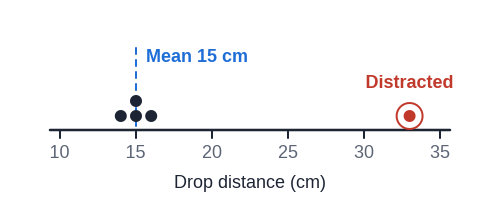
- 33 cm is about twice the othersan outlier
- A known distraction explains it, so leave it out and note whyit did not measure his normal reaction
- 16 + 14 + 15 + 15 = 60the four valid results
- 60 ÷ 4 = 15 cmmean of the valid results
- Mean drop 15 cm, about 0.17 s
Try it: reaction time data
Common mistakes
- Sensory neurons carry the signal to the muscle.Sensory neurons carry signals in from receptors; motor neurons carry them out to effectors such as muscles.
- In a reflex the brain decides very quickly what to do.A reflex arc passes through a relay neuron in the spinal cord with no conscious decision; the brain only finds out a moment later.
- Effectors are always muscles.Effectors are muscles, which contract, and glands, which release substances such as sweat, saliva or adrenaline.
- Testing one friend ten times makes the result true for everyone.Repeats make the result more reliable for that person, but people vary a lot, so you need to test many people before you can generalise.
Test your knee-jerk reflex
You need: a sturdy table or high bench, a partner
- Sit on the edge of the table with your lower legs hanging freely, feet off the floor, and let your legs go loose.
- Your partner finds the soft spot just below your kneecap, where the tendon is, and taps it sharply but gently with the side of their hand while you look away.
- If nothing happens, hook the fingers of your two hands together and pull hard as if to pull them apart while they tap again.
- For comparison, now try to kick on purpose the moment you feel a tap, and notice how different that feels.
- Look for: on a good tap the lower leg kicks forward by itself before you decide anything, because the signal goes from stretch receptor to sensory neuron to spinal cord to motor neuron to thigh muscle without waiting for the brain.
Safety: The foot kicks out without warning, so the tapper stands to the side, taps only with the side of the hand and never on the kneecap itself, and the table must be sturdy enough not to tip.
Your turn
Which type of neuron carries signals from the spinal cord to a muscle?
Name one effector that is a gland and the substance it releases.
You step on a sharp shell at the beach and lift your foot. Put these in order: motor neuron, receptor, effector, sensory neuron, spinal cord.
Why do you lift your foot before you feel the pain?
A student tests reaction time on one friend, once each, before and after an energy drink. Give two reasons the data is not reliable.
In the reflex arc for touching a hot pan, which neuron in the spinal cord passes the signal from the sensory neuron to the motor neuron?
A ruler catch takes about 0.2 s but a knee-jerk reflex takes a few hundredths of a second. Which statement explains the difference?
Kiri's ruler drops were 12, 13, 28, 11 and 14 cm, and a door slammed during the third catch. What is her mean drop from the valid results?
Show answer
1. A motor neuron. 2. For example sweat glands release sweat, salivary glands release saliva, or adrenal glands release adrenaline. 3. Receptor, sensory neuron, spinal cord, motor neuron, effector. 4. It is a reflex: the signal goes through the spinal cord straight to the motor neuron, while the signal to the brain that produces the feeling of pain arrives slightly later. 5. Any two: only one person was tested, only one trial was done in each condition, practice from the first test could make the second faster, and the friend knew about the drink and might try harder. 6. A relay neuron (interneuron) in the spinal cord passes the signal straight from the sensory neuron to the motor neuron. 7. The knee jerk goes through the spinal cord with fewer neurons and synapses and no decision by the brain, so it is faster than the ruler catch. 8. Leave out the 28 cm outlier caused by the distraction: 12 + 13 + 11 + 14 = 50, and 50 ÷ 4 = 12.5 cm.
Neuron
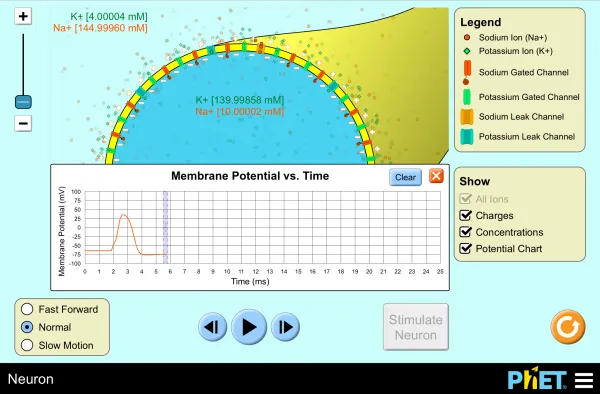
Full screen · PhET Interactive Simulations, University of Colorado Boulder, CC BY 4.0
What to take away
- Signals travel receptor, sensory neuron, central nervous system, motor neuron, effector.
- Sensory neurons carry signals in; motor neurons carry them out to effectors.
- The brain and spinal cord combine information and coordinate the response.
- Effectors are muscles, which contract, and glands, which release substances.
- A reflex arc runs through the spinal cord without a conscious decision, so it is faster than a chosen action.
- Human data becomes more reliable with repeated trials, more people and the same conditions for everyone.
Challenge
In a knee-jerk reflex, the sensory neuron from the stretch receptor to the spinal cord is 0.8 m long, and the motor neuron back to the thigh muscle is another 0.8 m. Both carry signals at 80 m s⁻¹. The whole reflex, from tap to kick, takes 0.030 s. (a) How long does the signal spend travelling along the neurons, and how much of the 0.030 s is left for everything else? Name two things that use that remaining time. (b) If the person kicks on purpose the moment they feel the tap, the response takes 0.25 s. The extra route up the spinal cord to the brain and back down is 1.0 m in total, also at 80 m s⁻¹. Show that the extra travel explains only a small part of the extra time, and explain where the rest goes.
Hint
Time = distance ÷ speed. Compare the extra travel time with the extra total time.
Answer
(a) 0.020 s travelling, leaving 0.010 s for crossing synapses (the signal crosses as a chemical) and for the muscle to contract. (b) The extra time is 0.22 s, but the extra travel is only 0.0125 s, about 6% of it; the rest is spent in the brain, where the signal crosses many synapses through many relay neurons as the cerebrum processes it and decides to kick.
Step by step
- Add the two neuron lengths and divide by the speed to get the travel time.
- The rest of the reflex time is used at the synapses and by the muscle itself.
- The voluntary kick takes 0.25 − 0.030 = 0.22 s longer than the reflex.
- The extra 1.0 m at 80 m s⁻¹ only accounts for a tiny part of that.
- So most of the delay is the processing and decision in the brain, which a reflex skips.
Full working
- Reflex travel: (0.8 + 0.8) ÷ 80 = 1.6 ÷ 80 = 0.020 stime = distance ÷ speed
- Left over: 0.030 − 0.020 = 0.010 ssynapses and muscle contraction
- Extra total time: 0.25 − 0.030 = 0.22 svoluntary minus reflex
- Extra travel: 1.0 ÷ 80 = 0.0125 stime = distance ÷ speed
- 0.0125 ÷ 0.22 ≈ 0.06about 6% of the extra time
- Travel 0.020 s, extra travel 0.0125 s: about 0.21 s of the extra time is the brain deciding
A doctor tests three patients who each have a problem with one foot. She pricks the sole with a pin, watches for the withdrawal reflex, and asks the patient to wiggle their toes. Patient A feels nothing, shows no reflex, but can wiggle the toes when asked. Patient B feels the pin clearly, shows no reflex, and cannot move the foot at all. Patient C feels nothing and cannot wiggle the toes when asked, but the foot jerks away strongly in a reflex. For each patient, say which part of the pathway (receptor, sensory neuron, spinal cord, motor neuron or effector) is most likely damaged, and explain how the evidence shows it.
Hint
List which pathways need which neurons. Feeling needs signals in; wiggling on request needs signals out; the reflex needs both, but not the brain.
Answer
A: the sensory neuron (or the receptors) from the foot, because nothing gets in, but the motor neuron and muscles work. B: the motor neuron to the foot (or the muscles), because signals get in and reach the brain, but nothing gets out, by reflex or by choice. C: the spinal cord above the reflex level, cutting the link to the brain, because the full reflex arc works, but signals cannot reach the brain or come down from it.
Step by step
- Feeling the pin needs receptor, sensory neuron and spinal cord up to the brain.
- Moving on request needs the brain, spinal cord, motor neuron and muscle.
- The reflex needs receptor, sensory neuron, relay neuron in the spinal cord, motor neuron and muscle, but no brain.
- A loses feeling and reflex but keeps chosen movement, so only the incoming side is broken.
- B loses both kinds of movement but keeps feeling, so the outgoing side is broken; C keeps the whole reflex arc, so the break is between it and the brain.
Full working
- Feel: receptor → sensory → spinal cord → brainneeds the inward side
- Wiggle: brain → spinal cord → motor → muscleneeds the outward side
- Reflex: receptor → sensory → relay → motor → muscleno brain
- A: no feel, no reflex, can wigglesensory neuron or receptor damaged
- B: feels, no reflex, cannot wigglemotor neuron or muscle damaged
- C: no feel, cannot wiggle, reflex worksspinal cord damaged above the reflex arc
- A sensory, B motor, C spinal cord above the reflex
Six students test whether an energy drink speeds up reactions. Each does five ruler drops after drinking water, then five more an hour later after an energy drink, and records their mean drop in cm. Water then drink: Ana 16 then 15, Ben 18 then 18, Cai 14 then 16, Dev 20 then 17, Eli 15 then 14, Fia 17 then 30. During Fia's energy drink catches, her phone kept ringing. (a) Find the class mean before and after with all six students. What would someone conclude? (b) Decide what to do with Fia's result and recalculate both means. (c) Look at each student's change. Is the new difference good evidence that the drink works? Use the table from the lesson, where 15 cm is 0.17 s and 20 cm is 0.20 s, to estimate the difference in seconds. (d) Give two problems with the design (other than Fia) and how to fix each.
Hint
Compare the size of the mean change with how much individual students changed. Think about what else was different the second time, apart from the drink.
Answer
(a) About 16.7 cm before and 18.3 cm after, which suggests the drink made reactions slower. (b) Leave Fia out (a known distraction explains her 30 cm) and note why: 16.6 cm before, 16.0 cm after. (c) No: the mean fell by only 0.6 cm, about 0.004 s, while individual changes ranged from 3 cm faster to 2 cm slower, so the difference is smaller than the normal variation. (d) Everyone had the drink second, so practice could explain faster catches: have half the students take the drink first. Students knew which drink they had and could try harder: give a drink that looks and tastes the same but has no caffeine, without telling them which is which. Also, six students is too few: test more people.
Step by step
- Add each column and divide by 6 for the first means.
- Fia's 30 cm is an outlier with a known cause, so it does not measure her real reaction and is left out, with a note.
- With five students the drink column is only 0.6 cm lower.
- Each student changed by between −3 and +2 cm, so a 0.6 cm average change could easily be chance.
- Using the table, 5 cm is about 0.03 s, so 1 cm is about 0.006 s and 0.6 cm is about 0.004 s.
- Order, expectation and a small sample all weaken the test.
Full working
- Before: (16 + 18 + 14 + 20 + 15 + 17) ÷ 6 = 100 ÷ 6 ≈ 16.7 cmall six
- After: (15 + 18 + 16 + 17 + 14 + 30) ÷ 6 = 110 ÷ 6 ≈ 18.3 cmall six
- Without Fia: 83 ÷ 5 = 16.6 cm, 80 ÷ 5 = 16.0 cmknown distraction removed
- Changes: −1, 0, +2, −3, −1spread from −3 to +2 cm
- (0.20 − 0.17) ÷ 5 = 0.006 s per cmfrom the table
- 0.6 × 0.006 ≈ 0.004 stiny compared with the spread
- Means 16.6 and 16.0 cm: a 0.004 s difference is not good evidence the drink works